The direct answer
How to study after losing your job: give the day a simple shape before anything else. One morning study block, one afternoon block for the job search, and one evening free. Study three to four focused hours a day, in two blocks, and let the rest of the day handle the practical things losing a job creates.
Losing a job while you study does two things at once. It gives you time, and it takes away structure, money, and confidence. The time looks like a gift, and it is not. A day with no shape becomes a day of scrolling, worrying, and studying in bursts that never add up. The system below rebuilds the shape first, then puts the study inside it.
The system in short
- Give the day a fixed shape on the first morning: study in the morning, job search in the afternoon, evening free.
- Study in two blocks a day, 90 minutes each, and no more, so the study stays focused and does not burn you out.
- Start with retrieval, not new material, because testing yourself from memory needs less concentration when you are stressed.
- Use the job search as a second study block: applications, CV work, and interview preparation are real work, and they get their own hours.
- Sort the money question in the first week: talk to your university, check what help exists, and know what you can afford before you decide anything.
- Review for 15 minutes each Sunday: what the week produced, what slipped, and what next week must protect.
Step 1: Give the day a fixed shape on the first morning
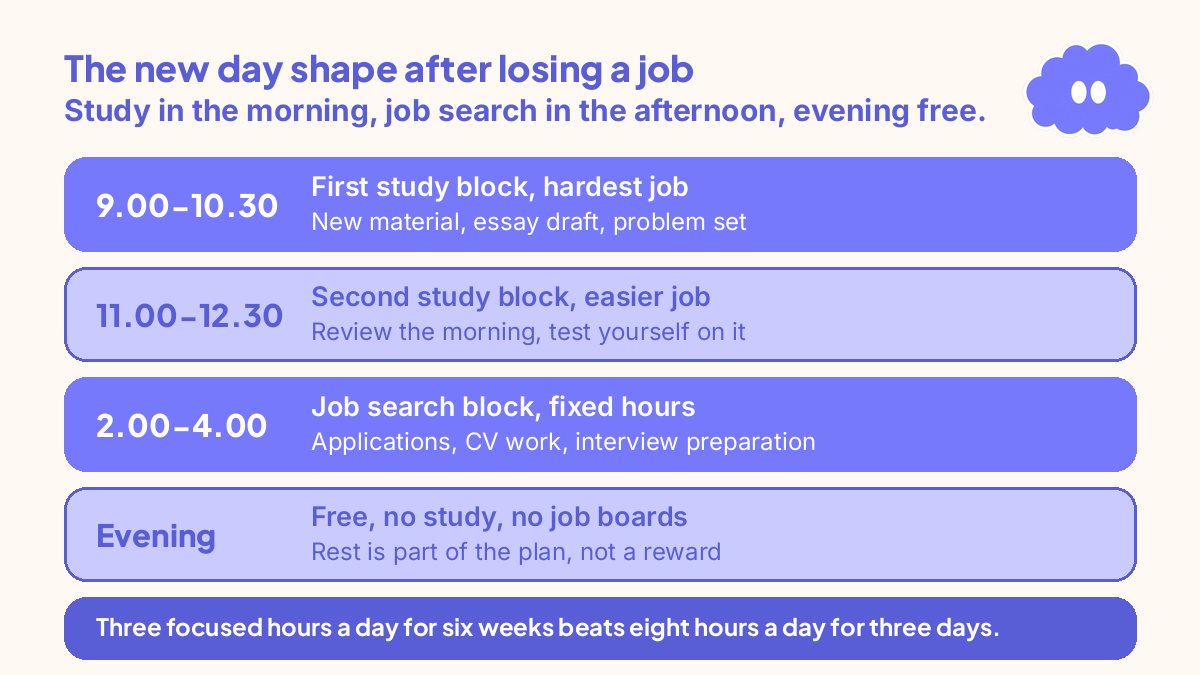
Do this on the first morning after the job ends, before the day has a chance to drift. The shape is simple: a morning study block from 9.00 to 10.30, a break, a second study block from 11.00 to 12.30, lunch, a job search block from 2.00 to 4.00, and the evening free. Write it down, put it where you can see it, and follow it the same way every weekday.
The shape matters more than the hours. A day with a shape is a day you can live in. A day without one becomes a long stretch of worry with study fitted in wherever it can, which is usually nowhere. The morning study block is first because your mind is freshest then.
Keep the weekends different. Study on Saturday morning only, one block, and keep Sunday free, or use Sunday for the weekly review. A week with no rest day is a week that ends in exhaustion, and exhaustion is what makes students quit a course they could have finished.
Step 2: Study in two blocks a day, 90 minutes each, and no more
Two 90-minute blocks is three hours of focused study a day, and that is enough. It is more than most working students manage, and it is a pace you can hold for weeks. Do not try to study eight hours a day to make up for lost time. You will manage it for two or three days, then crash, then study nothing for a week. Three focused hours a day for six weeks beats eight hours a day for three days and nothing after.
Each block has one job, written down the night before. The morning block takes the harder job: new material, an essay draft, a problem set. The second block takes the easier job: reviewing what the morning covered, testing yourself on it, or working through practice questions. Finish each block by testing yourself on what you just did, because a block without a test at the end is a block you will have to repeat.
If a block fails, because the morning was taken up by a phone call about benefits or a job interview, do not try to rescue it in the evening. Move the job to the next morning’s block, and let the evening stay free. The system survives because it has room for a bad day. For the days when a bad day turns into a bad week, the system in How to get back on track after a bad study day covers the restart in detail.
Step 3: Start with retrieval, not new material
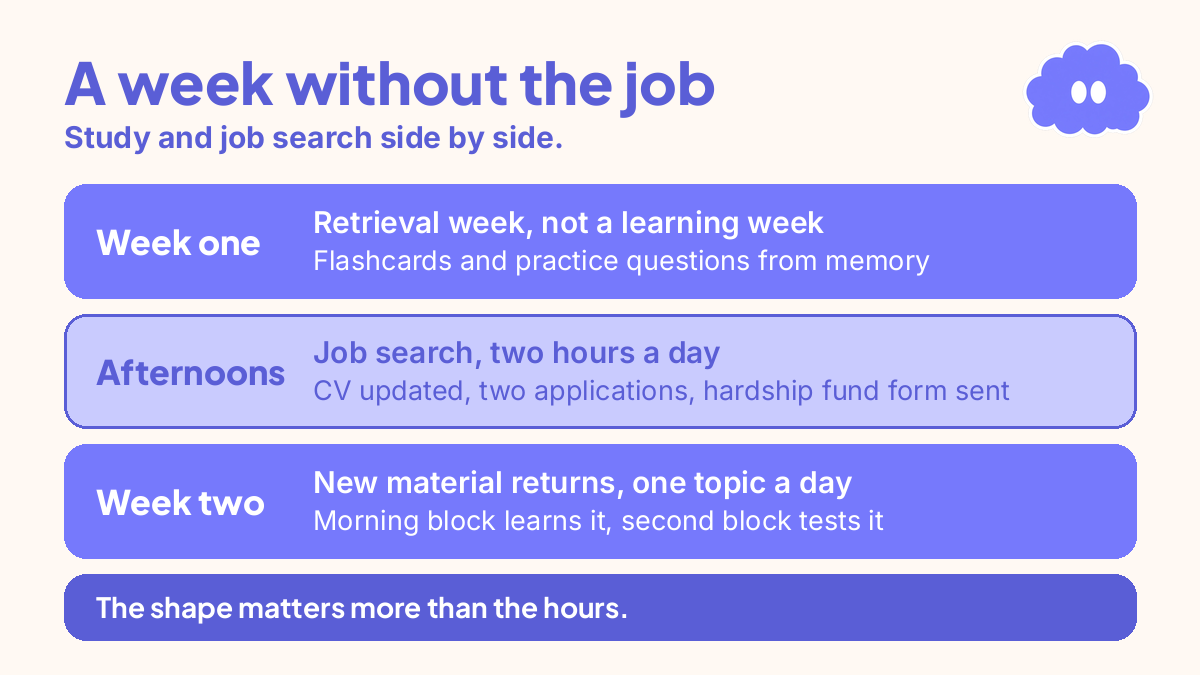
When you are stressed, concentration is the first thing to go, and new material needs the most concentration. So the first week after losing a job is a retrieval week, not a learning week. Test yourself from memory on what you already know: flashcards, practice questions, explaining a topic out loud without your notes. Retrieval needs less concentration than learning, and it tells you what you actually know, which is useful information when everything else feels uncertain.
Keep the retrieval sessions short and ready. A deck of flashcards on your phone, a list of practice questions in a notebook, or a topic you can explain from memory while you walk. The session must start in under a minute, because a session that needs ten minutes of setup does not happen on a stressed day. For short sessions built on testing yourself, the method in Flashcard system that works gives you decks that fit a 25-minute block exactly.
After a week of retrieval, the concentration comes back, and new material becomes possible again. Add it gradually: one new topic a day, in the morning block, with the second block used to test yourself on it. If the stress spikes again, drop back to retrieval for a day. The system bends; it does not break.
Step 4: Use the job search as a second study block
The job search is real work, and it needs its own hours, or it will eat the study hours. Give it a fixed block, 2.00 to 4.00 in the afternoon, and treat it like a shift: it starts on time, it ends on time, and it has a job list. Applications, CV work, interview preparation, and checking job boards. Two hours a day is enough to make real progress, and it is short enough that you do not spend the whole day refreshing the same three job sites.
Keep the job search and the study separate. Do not check job boards during a study block, and do not study during a job search block. The separation protects both: the study stays focused, and the job search stays bounded.
If the job search produces an interview, the interview preparation goes in the job search block, not the study block. If it produces a new job, the study plan changes, and the system in How to study with a full-time job is the one to switch to. A new job is a good problem, and it has its own system.
Step 5: Sort the money question in the first week
Losing a job creates a money problem, and the money problem creates a study problem, because worry is the enemy of concentration. Sort it in the first week, before it has time to grow. Talk to your university or college first: ask about hardship funds, payment plans, and whether your course can pause for a term. Many students assume they must quit the course, when the real problem is one fee or one term, and there is help for exactly that.
Then work out what you can afford, in numbers, not in feelings: how many weeks you can cover, what is coming in, and what is going out. Write it down. A number you can see is a problem you can plan around.
If the course can pause, that is a real option, and it is better than quitting. A pause keeps your place, keeps your credits, and lets you come back when the money is sorted. Talk to your tutor or your student support office about it, and ask what the deadline is for deciding. Do not decide in the first week, when the shock is freshest. Decide in the second week, when you have the numbers and the options in front of you.
Step 6: Review for 15 minutes each Sunday
On Sunday, or on your first free evening after the week ends, spend 15 minutes on three questions. First, did the two study blocks happen each day, and did they carry the right jobs? Second, did the job search block happen, and did it produce anything: applications sent, interviews booked, a CV updated? Third, what is the money situation now, and has anything changed?
Write the answers in two or three lines. If the study blocks keep failing, fix the shape: the morning block starts too late, or the second block has no job written down. If the job search keeps eating the study, move the job search block later and protect the morning harder.
A worked example: a second-year student loses a retail job
Your situation: Second-year student, part-time job in a shop, 20 hours a week. The shop closes and the job ends on a Friday. Exams in eight weeks. Rent is covered for six weeks from savings. The course cannot pause without losing the term, but a hardship fund exists.
- Saturday morning, first day without the job: Write the day shape on paper and put it on the desk. Study 9.00 to 10.30 and 11.00 to 12.30. Job search 2.00 to 4.00. Evening free.
- Monday, week one, retrieval week: Morning block, 25 minutes of flashcards on the weakest topic, then 25 minutes of practice questions. Second block, test yourself on the same topic again from memory, then write down what you got wrong.
- Monday afternoon, job search block: Update the CV, apply for two jobs, and check the university hardship fund page. Write down what the fund needs: a form, a bank statement, and a letter from the tutor.
- Tuesday: Same shape. Morning blocks are retrieval again. Afternoon block: fill in the hardship fund form and email the tutor for the letter.
- Monday, week two: New material returns, one topic a day, in the morning block. The second block tests it. The job search block continues, two hours a day, and one interview is booked for Thursday.
- Sunday review, 15 minutes: Study blocks happened every weekday. Job search produced two applications and one interview. Money: the hardship fund will cover the next fee, and the savings cover six weeks. Next week: keep the shape, add one new topic a day, and prepare for the interview.
When it goes wrong
You cannot concentrate at all, and the study blocks feel impossible. Shorten them. A 25-minute session with one small job, such as five practice questions, is enough for a bad day. Start with retrieval, not new material, and stop when the 25 minutes are done. The system survives on 25 minutes a day. It does not survive on zero.
The money runs out faster than you planned. Talk to the university again, and talk to them early, before the money is gone. A hardship fund, a payment plan, or a pause are all easier to arrange when you ask with weeks to spare than when you ask with days. Do not wait until the last week to ask.
You get a new job and the study plan collapses. That is a good problem, and it has a system of its own. Switch to the working-student system in How to study with a full-time job, and rebuild the week around the new shifts. The retrieval habit you built while unemployed comes with you, and it is worth keeping.
Weekly review checklist
- Did the two study blocks happen each weekday, and did they carry the right jobs?
- Did the job search block happen, and did it produce applications, interviews, or a better CV?
- Is the money situation clear, in numbers, and is there anything I need to ask the university?
- Did I study with retrieval this week, or did I slip back into re-reading?
- Did the evening stay free, and did the weekend have a rest day?
- What must next week protect: a study block, a job search block, or a conversation about money?
Downloadable infographic spec: one vertical image, title “How to study after losing your job”, with the six steps from “The system in short” and the six review questions above, in Thynq cream, Cloud Purple, Dark Purple and pink, with the Cloud mascot. Text taken word-for-word from this article.
What this system is not
It is not a promise that losing a job stops hurting. It hurts, and it will keep hurting while the money is uncertain and the job search is going slowly. It is not a way to study eight hours a day and pretend the job loss did not happen. What it does is smaller: it gives the day a shape, so the course keeps moving and the job search keeps moving, one block at a time.
Sources
- Dunlosky, J., et al. (2013). Improving students’ learning with effective learning techniques. Psychological Science in the Public Interest, 14(1), 4-58. Practice testing and distributed practice rated high; rereading rated low, which is why the first week uses retrieval instead of re-reading.
- Roediger, H. L., & Karpicke, J. D. (2006). Test-enhanced learning. Psychological Science, 17(3), 249-255. Recallers remembered more a week later than restudiers, which supports testing yourself from memory in the study blocks.
- Cepeda, N. J., et al. (2006). Distributed practice in verbal recall tasks. Psychological Bulletin, 132(3), 354-380. Spaced practice beat massed practice, which supports two shorter blocks a day instead of one long session.
For the wider working-student system behind this one, start with How to build a study system that fits your life.
Questions
How do I keep studying after losing my job?
Give the day a simple shape before anything else: one morning study block, one afternoon block for the job search, and one evening free. Study in the morning, when your mind is freshest, and keep the sessions short and fixed, so the day has structure even when everything else feels uncertain.
Should I study more now that I have more time?
Not at first. Studying eight hours a day after losing a job sounds like making up for lost time, but it usually leads to burnout within a week. Study three to four focused hours a day, in two blocks, and use the rest of the day for the job search, rest, and the practical things losing a job creates.
What if I cannot afford to keep studying after losing my job?
Talk to your university or college before you stop anything. Ask about hardship funds, payment plans, and whether your course can pause for a term. Many students assume they must quit the course, when the real problem is one fee or one term, and there is help for exactly that.
How do I study when I feel too stressed to concentrate?
Shorten the sessions and make them easier to start. A 25-minute session with one small job, such as five practice questions or one page of notes, is enough. Start with retrieval, not new material, because testing yourself from memory needs less concentration than learning something new.