The direct answer
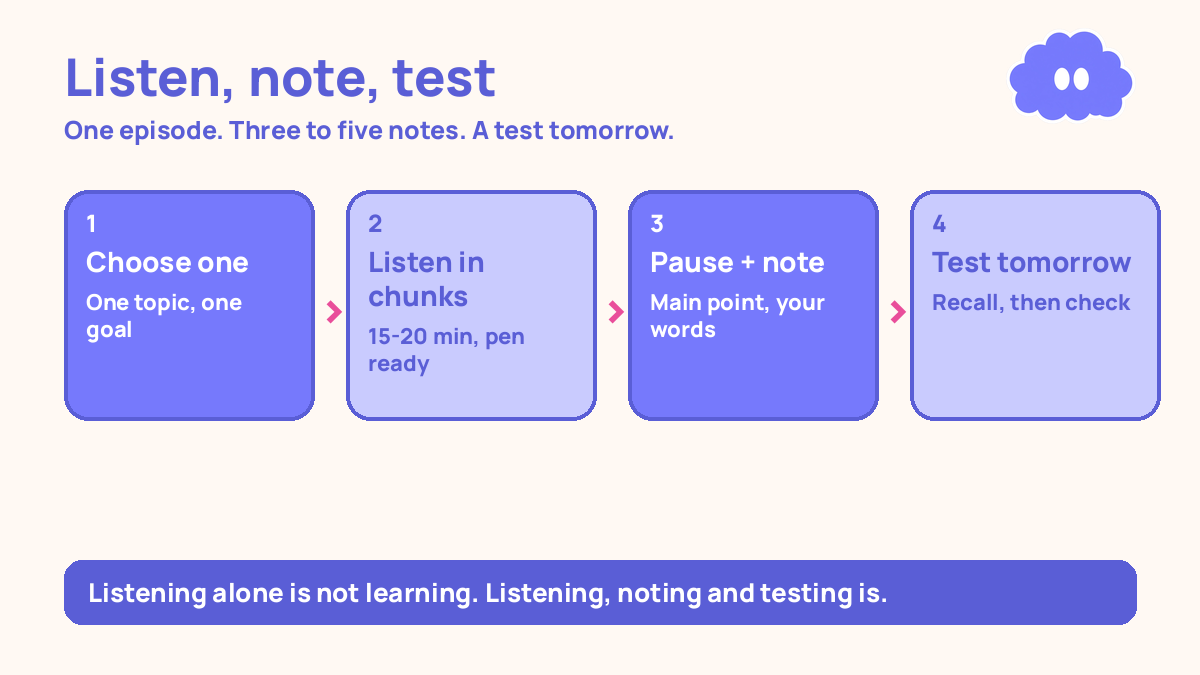
Pick one episode on one clear topic, listen to it in chunks of 15 to 20 minutes, and after each chunk, pause and write the main point in your own words. Then test yourself on those notes the next day, from memory. That is the whole system: choose, listen in chunks, pause and note, test the next day.
Podcasts are the easiest study to start and the easiest to waste. You press play, you walk to class or wash the dishes, and an hour later you have heard a whole episode and remember almost none of it. It felt like study. It was background noise.
Why podcasts slip through your head
Listening is passive. Someone else is doing the talking, and your job is only to hear it. That is why a podcast can run for an hour while your mind wanders to dinner, to tomorrow, to anything except the episode.
In a 2013 review, Dunlosky and colleagues rated ten common study techniques, and only two received a high utility rating: practice testing and distributed practice. Re-reading and highlighting were rated low. Listening to an episode twice is re-reading. Listening once, writing the main points from memory, and testing yourself on them the next day is practice testing.
There is a second problem. Podcasts have no pictures, no headings, and no way to skim. If you miss a point, you cannot glance back at the page. You have to rewind, find the spot, and listen again — and most people do not. That is why the system makes you pause and note as you go. Your notes become the headings the podcast never had.
The system in short
- Choose one episode on one clear topic, and write down what you want to learn from it.
- Listen in chunks of 15 to 20 minutes, with a pen and paper ready.
- After each chunk, pause and write the main point in your own words, in one or two lines.
- Test yourself on your notes the next day, from memory, before you listen to anything new.
- Use podcasts for the right topics — ideas, stories, explanations, language — and pair them with reading when you need detail.
Podcasts fit the same slot: Study system for studying on your commute shows how to test yourself after listening on the move.
Video works the same way as audio here: How to study from YouTube properly stops a lesson from becoming background watching.
Step 1: Choose one episode, on one topic
Pick one episode, and know what it is about before you press play. Read the episode description, and write down one sentence: what you want to learn from it. “How the French Revolution started”, “Why sleep matters for memory”, “Three common mistakes in English grammar”. If you cannot write the sentence, the episode is too vague, and you will remember nothing from it.
Choose episodes that match your level. An episode for experts will go over your head, and an episode for beginners will bore you. The right episode is one where you understand most of it but learn something new in every chunk. If the first five minutes are already confusing, pick a different episode.
Step 2: Listen in chunks, with a pen ready
Listen in chunks of 15 to 20 minutes. Set a timer if it helps, or pause at a natural break — the end of a story, a change of topic, a question from the host. Do not listen to a whole hour in one go. Your attention will drift, and you will not notice when it does.
Keep a pen and paper with you, even if you are walking. A small notebook in your pocket, or the notes app on your phone — but the phone is for notes only, not for scrolling. If you are walking, stop for 30 seconds to write the note. The note is the point of the chunk. Without it, the chunk was only listening.
Step 3: Pause and note the main point, in your own words
After each chunk, pause the episode and write the main point in your own words, in one or two lines. Not a transcript. Not the host’s words copied down. Your words, saying what the chunk was about. “The revolution started because bread prices rose and the king would not listen.” “Sleep moves memories from short-term to long-term storage.” One or two lines per chunk, three to five notes per episode.
If you cannot write the point, you did not understand the chunk. Rewind and listen to it again, and try once more. If you still cannot write it, write down the question instead: “What did he mean by the third cause?” That question is also a note, and it tells you what to look up or ask about later.
Do not try to write everything. An episode with twenty notes is an episode you spent more time writing than listening, and you will never review twenty notes. Three to five notes is enough to remember the episode, and few enough that you will actually test yourself on them.
Step 4: Test yourself the next day, from memory
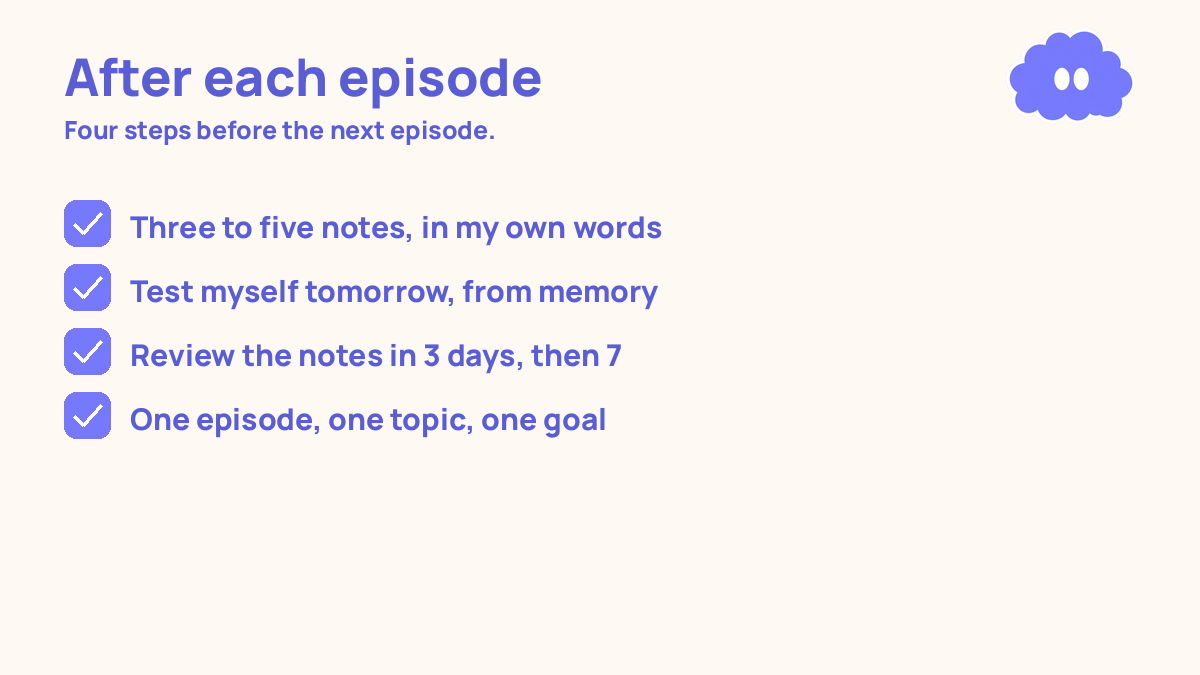
The next day, before you listen to anything new, open your notes — or better, close them — and ask yourself: what were the main points of yesterday’s episode? Write them down from memory. Then open your notes and check. What did you remember? What did you miss? The points you missed go back into your review pile.
This is the step most people skip, and it is the step that makes the system work. Testing yourself from memory is the strongest method in the research base, and it works for audio just as it does for text. In a 2014 meta-analysis, Rowland found that testing beat restudying by a medium amount (g = 0.50), and that the benefit was larger with feedback (g = 0.73) than without it (g = 0.39). Checking your notes after you try to recall is the feedback. Feeling fluent right after hearing something is not the same as remembering it a week later — Roediger and Karpicke (2006) found that students who restudied felt more confident immediately after, but remembered less a week later than students who tested themselves.
Review the notes again after three days, then after seven days. That is a practical starting schedule, not a rule from research.
Step 5: Use podcasts for the right topics
Podcasts are best for ideas, stories, explanations, and language listening — things you can understand by hearing. They are worst for detail you need to see: formulas, diagrams, tables, step-by-step procedures. If the topic needs a diagram, pair the podcast with reading. Listen to the episode for the idea, then read the textbook for the detail.
Use podcasts for the times when you cannot read: walking, commuting, cooking, cleaning. Those are hours that would otherwise be empty, and a podcast turns them into study. But do not use a podcast as a replacement for reading when you could be reading.
A worked example: a week of podcast study, 150 minutes
You are studying history, and you want to learn from podcasts while you walk to class. You pick five episodes, one per weekday, each about 30 minutes. Your listening minutes across the week are: Monday 30, Tuesday 30, Wednesday 20, Thursday 40, Friday 30 — a total of 150 minutes. Wednesday is shorter because your walk is shorter; Thursday is longer because you have a longer commute.
| Day | Minutes | Episode topic | Notes you write |
|---|---|---|---|
| Monday | 30 | How the French Revolution started | 4 notes: bread prices, the king, the assembly, the storming |
| Tuesday | 30 | Why the revolution spread | 3 notes: ideas, armies, other countries |
| Wednesday | 20 | The revolution’s leaders | 3 notes: who led, who opposed, what changed |
| Thursday | 40 | What the revolution changed | 5 notes: laws, land, church, calendar, legacy |
| Friday | 30 | Test yourself on the week’s notes | No new episode — recall all 15 notes from memory |
Total: 150 minutes of listening, 15 notes, and one Friday test. By Friday you have not just heard five episodes — you have notes in your own words, and you have tested yourself on them. Friday is the most important day of the week, because it is the day you find out what you actually remember.
When it goes wrong
You listen to whole episodes and remember nothing. You listened without pausing and without notes. Fix it now: listen in 15-minute chunks, and write one note per chunk. If you finish an episode with no notes, you did not study.
You queue five episodes and they blur together. One episode, one topic, one set of notes. If the episodes blur, it is because you never stopped between them. Pause between episodes, write the notes, and test yourself the next day before you start the next one.
You listen at double speed and understand nothing. Slow down. Speed is only useful when you already know the topic. On new material, normal speed is the right speed.
You listen while studying something else and retain neither.
Weekly review checklist
Copy this list and use it each week:
- How many episodes did I finish this week, and how many minutes did I listen?
- How many notes did I write, and are they in my own words?
- Did I test myself on last week’s notes — and what did I miss?
- Did I listen while doing other study, or only while walking, cooking, or commuting?
- What one episode will I listen to next week, and what do I want to learn from it?
Downloadable infographic spec: one vertical image, title “Listen, note, test”, with the five steps and the weekly review checklist, in Thynq cream, Cloud Purple, Dark Purple and pink, with the cloud mascot. Text taken word-for-word from this article.
What this system is not
It is not a promise that podcasts can replace reading, and it is not a claim that listening is as good as studying from a book. Some topics need diagrams, formulas, and detail you can see, and a podcast cannot give you those. What it promises is simpler: a way to turn the hours you already spend walking, cooking, and commuting into real learning, one episode, one note, and one test at a time.
Sources
- Dunlosky, J., et al. (2013). Psychological Science in the Public Interest, 14 (1), 4-58. Only practice testing and distributed practice received a high utility rating; rereading and highlighting were rated low.
- Roediger, H. L. & Karpicke, J. D. (2006). Science, 311(5767), 966-968. Students who recalled a passage remembered more a week later than students who restudied it, though restudiers felt more confident immediately after.
- Rowland, C. A. (2014). Psychological Bulletin, 140(6), 1432-1463. Testing beat restudying (g = 0.50); with feedback the effect was larger (g = 0.73) than without it (g = 0.39).
- Cepeda, N. J., et al. (2006). Psychological Bulletin, 132(3), 354-380. Spaced practice beat massed practice.
- Rubinstein, J. S., Meyer, D. E. & Evans, J. E. (2001). Journal of Experimental Psychology: Human Perception and Performance, 27(4), 763-797. Mean switch costs were 614 to 1,096 milliseconds per switch, and the cost grows with complexity.
For the general system this one sits inside, read self-study system for online learners.
Questions
Can you really learn from a podcast?
Yes, for the right things: ideas, stories, explanations, and language listening. But only if you listen properly — in chunks, with notes, and with a test the next day. An episode you half-hear while scrolling is background noise, not study.
Should I listen at normal speed or faster?
Normal speed, until you know the topic. Faster speeds save time but cost understanding, especially on a new topic. If the speaker is slow and you already know the basics, try a slightly faster speed — and slow down again when it gets hard.
How do I take notes from a podcast?
Pause after each main point and write it in your own words, in one or two lines. Do not try to write everything. Three to five notes per episode is enough. Then test yourself on those notes the next day, from memory.
Can I listen to a podcast while doing other study?
No. Listening to a podcast while reading or writing means you are switching between two tasks, and every switch costs time — Rubinstein and colleagues (2001) measured switch costs of 614 to 1,096 milliseconds, growing with complexity. Listen while you walk, cook, or commute, not while you study something else.