The direct answer
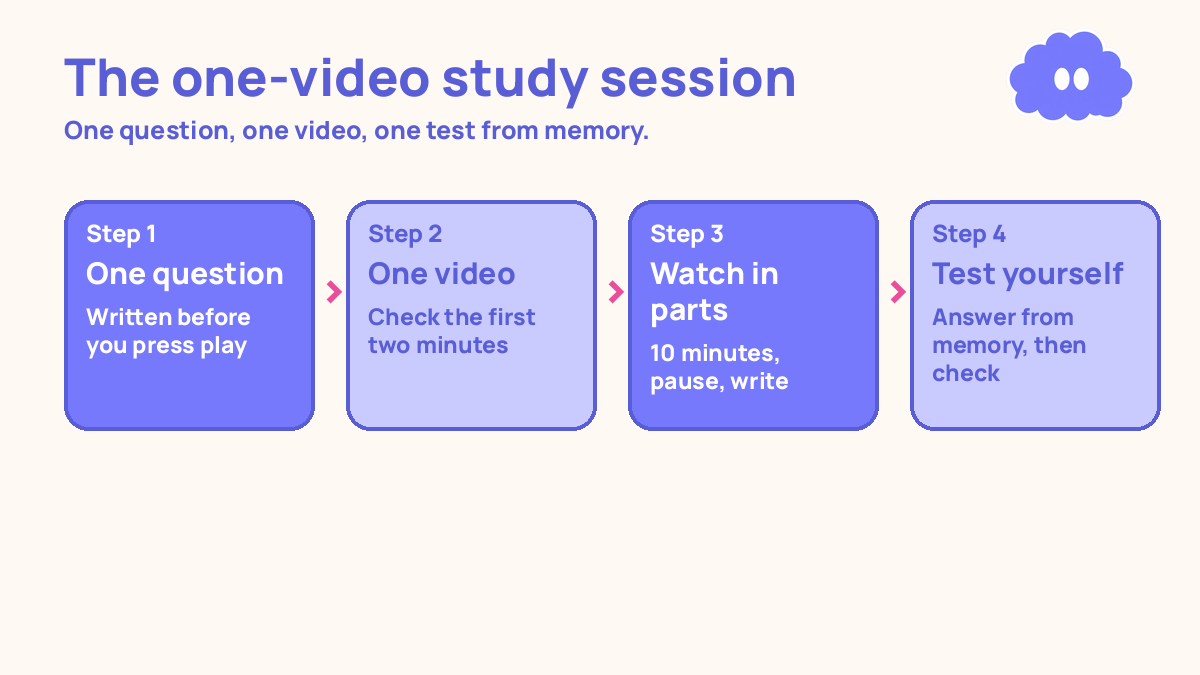
Pick one video that answers one question, write that question down before you press play, watch the video in short parts with a notebook open, and test yourself from memory when it ends. That is the whole system. YouTube is a library and a trap in the same place.
You open YouTube to learn one thing. An hour later you have watched five videos, and you cannot say what any of them taught you. None of them asked you to do anything, and you did nothing.
The problem is that YouTube is built to keep you watching, not to help you remember. Watching feels like learning, and it is mostly recognition. In a 2013 review, Dunlosky and colleagues rated ten common study techniques, and only two received a high utility rating: practice testing and distributed practice. Re-reading was rated low. Watching a video straight through, without stopping, is the video version of re-reading.
This system is for a student who learns from YouTube, alone, with no teacher. It needs one notebook, one video at a time, and a fixed end. For course lectures, the video lectures guide covers lectures specifically. For a full self-study system, read the self-study system for online learners. And if the video is teaching you a language, the language learning guide shows how to turn listening into speaking.
The system in short
- Write one question the video must answer, before you press play.
- Pick one video that answers it. Check the first two minutes before you commit.
- Watch in parts: watch 10 minutes, pause, write what it taught you in your own words.
- Do the example yourself, on paper or on screen, before the video shows the answer.
- When the video ends, close it and test yourself: answer your question from memory, out loud or on paper.
- The next day, test yourself again on the same question before you watch anything new.
Step 1: One question before you press play
Write one question in your notebook before you open YouTube. “How do I solve a quadratic equation?” “What is the difference between a stock and a bond?” One question, in plain words. The question is the filter: a video that answers it is a study video. A video that does not is entertainment, and entertainment can wait.
Decide the cue and the action in advance: “When I sit down after lunch, I will watch one video and answer one question.” That is an if-then plan, and across 94 studies, if-then plans raised goal attainment by a medium-to-large amount (d = 0.65) over holding the goal alone (Gollwitzer and Sheeran, 2006). A plan decided before you open the app is a session that starts without a debate with the recommendations.
Do not open YouTube and then decide what to study. The home page will decide for you, and it will not pick your question.
Step 2: Pick one video, and check the first two minutes
Search for your question and open the video that looks most direct. Watch the first two minutes. If it starts with the answer, or with a clear example, keep watching. If it starts with a long introduction, a sponsor message, and a promise to answer “later in the video”, close it and pick another one. Two minutes is enough to judge. You do not owe a video your evening.
Check three things before you commit: does the video show its working, does it use an example, and is it at your level? A video that only talks, with no example, will leave you with words and no skill. A video far above your level will leave you with nothing. Pick the one you can follow and use today.
Do not open three videos to compare them. Open one, judge it in two minutes, and either watch it or replace it.
Step 3: Watch in short parts, and write as you go
Watch 10 minutes, then pause. Write what those 10 minutes taught you, in your own words, in two or three lines. Then watch the next 10 minutes. A 30-minute video becomes three short lessons, each with notes you wrote yourself. A 30-minute video watched straight through becomes 30 minutes of nodding.
Write notes in your own words, not copied sentences. Explaining why each step works, in your own words, is a moderate-utility technique (Dunlosky, 2013), and a 2018 meta-analysis found prompting self-explanation produced a moderate average benefit (Bisra and colleagues, 2018). The original study was only 8 students, so say so.
When the video shows an example, pause before the answer. Do the example yourself first, on paper or on screen. Then play the answer and compare. Doing it first is the test. Watching the answer first is the re-read.
Step 4: Test yourself when the video ends
When the video ends, close YouTube. Do not let the next video start. Answer your question from memory, out loud or on paper, without looking at your notes. Write the answer in your own words. Then check it against your notes. The parts you miss are the parts to re-watch, not the whole video.
Testing yourself beats restudying: Roediger and Karpicke (2006) found students who recalled a passage remembered more a week later than students who restudied it, even though the restudiers felt more confident straight after studying. Feeling fluent right after watching is not the same as remembering a week later.
Come back to the same question tomorrow, and again in three days, and again in seven days. That 1–3–7 schedule is a practical starting point, not a rule from the research. The research says the best gap grows with how long you need to remember the material (Cepeda and colleagues, 2006). Feedback matters too: Rowland (2014) found testing beat restudying, and the benefit was larger with feedback (g = 0.73) than without it (g = 0.39). Always check your answer against your notes.
If you cannot answer the question at all after watching, the video was too fast, too hard, or too vague. Watch a slower or simpler video on the same question tomorrow. Do not re-watch the same video straight away. A second watch of a video you did not understand is the same confusion, twice.
A worked example: a Thursday evening, one video
You want to learn how to solve quadratic equations. Study time is 7:00 to 8:00pm.
7:00–7:05pm — Question. Write in your notebook: “How do I solve x squared plus 5x plus 6 equals 0?” Open YouTube, search, and open one video. Watch the first two minutes. It starts with an example. Keep it.
7:05–7:15pm — Part 1. Watch 10 minutes. Pause. Write two lines in your own words: “Factor the equation into two brackets. Find two numbers that multiply to 6 and add to 5.”
7:15–7:25pm — Part 2. The video shows a new example. Pause before the answer. Solve it yourself on paper. Play the answer and compare. You got the numbers right and the signs wrong. Write that down.
7:25–7:35pm — Part 3. Watch the last 10 minutes. Pause. Write two more lines: “Each bracket gives one answer. Check by putting the answer back in.”
7:35–7:50pm — Test. Close YouTube. Answer the question from memory on paper: solve x squared plus 5x plus 6 equals 0, and write why each step works. Check against your notes. You missed the sign step again. Write it in your own words.
7:50–8:00pm — Plan tomorrow. Write tomorrow’s first task: “Solve three quadratic equations from memory, and check the signs.” Close the notebook.
One video, one question, one answer you can now write yourself. That is a study session.
When it goes wrong
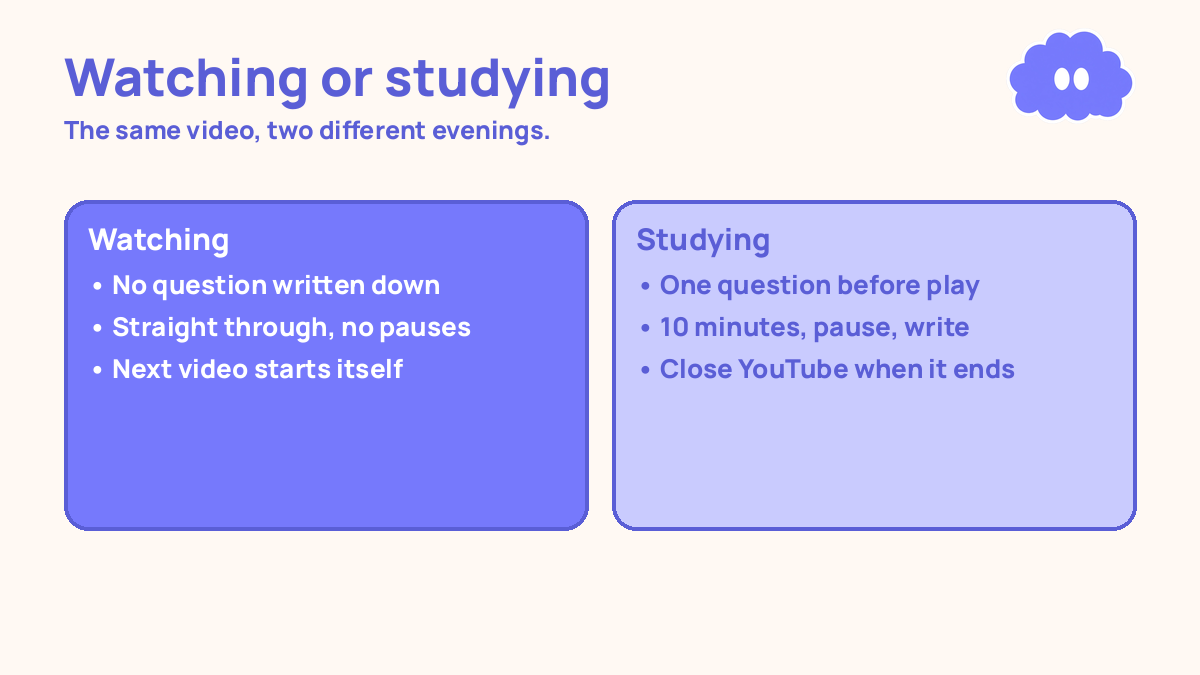
You watch five videos and remember none of them. You watched without a question and without a test. Go back to step 1: one question, one video, one test. A video without a question is entertainment, and entertainment is fine, but it is not study. Do not count it as study.
The recommendations pull you away after every video. Close YouTube the moment the video ends, before the next one starts. Watch in full screen, and do not scroll the comments or the sidebar during the video. Every switch costs time: in four experiments, Rubinstein, Meyer and Evans (2001) found people lost 614 to 1,096 milliseconds on every switch, and lost more as the tasks got more complex. A sidebar is a machine for switches. Keep it closed.
You take notes but they are just copied sentences. Copying is not writing in your own words. After each 10-minute part, close the video and write what you remember, then check. If your notes are word-for-word from the video, they are a transcript, not notes. A transcript you never read again is a transcript wasted.
The video is too fast and you cannot keep up. Slow it to three-quarter speed, and pause more often. A video you follow slowly beats a video you half-hear at full speed. If you still cannot follow it after slowing it down, the video is too hard. Pick a simpler one on the same question. The question stays the same. The video changes.
Weekly review checklist
Copy this list and use it each Sunday:
- How many videos did I study this week, and how many did I just watch?
- How many of the week’s questions can I still answer from memory?
- Which videos wasted my time — too long, too vague, or too hard — and what will I pick instead?
- What one change will I make next week: a written question first, shorter parts, or closing YouTube at the end?
Downloadable infographic spec: one vertical image, title “The one-video study session”, with the four parts — one question, one video, watch in parts, test from memory — and the rule “close YouTube when the video ends”, in Thynq cream, Cloud Purple, Dark Purple and pink, with the cloud mascot.
What this system is not
It is not a claim that YouTube is the best way to learn everything, and it is not a promise that one video a day makes you an expert. It is a practical system for a student who learns from YouTube and wants the hour to count. If a topic needs a book or a teacher, use a book or a teacher. YouTube is one source, not the only source.
Sources
- Dunlosky, J., et al. (2013). Improving students’ learning with effective learning techniques. Psychological Science in the Public Interest, 14(1), 4-58. Only practice testing and distributed practice received a high utility rating; rereading was rated low.
- Roediger, H. L. & Karpicke, J. D. (2006). Test-enhanced learning. Science, 311, 1535-1539. Students who recalled a passage remembered more a week later than students who restudied it.
- Cepeda, N. J., et al. (2006). Distributed practice in verbal recall tasks. Psychological Bulletin, 132(3), 354-380. Spaced practice beat massed practice, and the best gap grows with how long you need to remember the material.
- Rowland, C. A. (2014). The effect of testing versus restudy on retention. Psychological Bulletin, 140(6), 1432-1463. Testing beat restudying, and the benefit was larger with feedback (g = 0.73) than without it (g = 0.39).
- Gollwitzer, P. M. & Sheeran, P. (2006). Implementation intentions and goal achievement: a meta-analysis. Advances in Experimental Social Psychology, 38, 69-119. Across 94 studies, if-then plans raised goal attainment by a medium-to-large amount (d = 0.65).
- Rubinstein, J. S., Meyer, D. E. & Evans, J. E. (2001). Executive control of cognitive processes in task switching. Journal of Experimental Psychology: Human Perception and Performance, 27(4), 763-797. Mean switch costs were 614 to 1,096 milliseconds per switch.
- Bisra, K., et al. (2018). Inducing self-explanation: a meta-analysis. Educational Psychology Review, 30(3), 703-725. Prompting self-explanation produced a moderate average benefit (g = 0.55).
For course lectures, read the video lectures guide, and for the full self-study system, the self-study system for online learners.
Questions
Can you really study from YouTube?
Yes, if you treat a video like a lesson, not like entertainment. Pick one video, write a question before you press play, watch it in short parts, and test yourself from memory after it ends. Watching without a task is not studying.
How do I pick a good study video on YouTube?
Pick a video that matches one question you want answered, from a channel that shows its working and uses examples. Watch the first two minutes: if it starts with the answer instead of a long introduction, it is usually worth your time.
Should I watch a study video at normal speed?
Start at normal speed. Speed it up only when the video is slow and you already know the basics. Slow it down when the video moves too fast. The right speed is the one where you can still write notes in your own words.
How do I stop YouTube from distracting me?
Open only the one video you picked, in full screen, with the recommendations hidden if you can. Put your phone in another room. When the video ends, close YouTube before the next video starts playing.