The direct answer
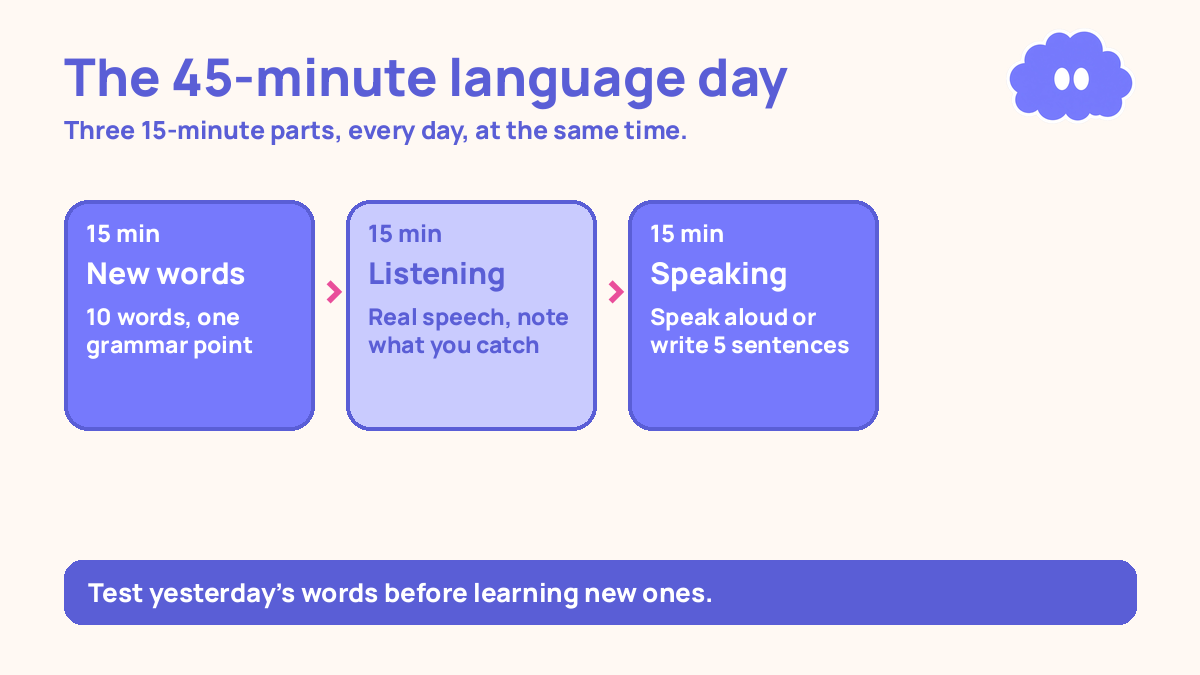
Study a language online for 45 minutes a day: 15 minutes learning new words and one grammar point, 15 minutes listening to real speech, and 15 minutes speaking aloud or writing. Then test yourself from memory the next day, and again after a gap. That is the whole system. No classroom, no paid app, and no long weekend session will do the job that 45 honest minutes a day does.
You open an app, do ten minutes of matching games, and close it feeling as if you studied. A month later you still cannot say a full sentence. The app kept you busy, but it never asked you to speak, to listen to real speech, or to remember anything a week later.
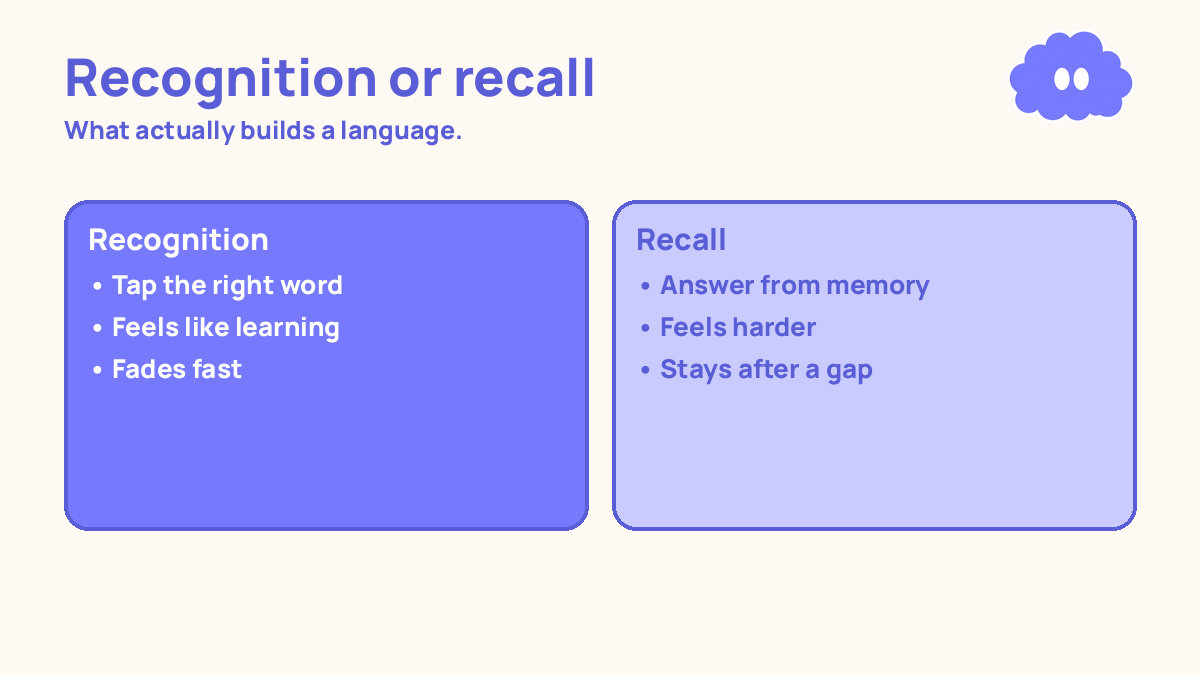
The problem is not you. The problem is that most online language study is recognition: tap the right word, pick the right picture. Recognition feels like learning, and it is not. In a 2013 review, Dunlosky and colleagues rated ten common study techniques, and only two received a high utility rating: practice testing and distributed practice. Re-reading and highlighting were rated low. Tapping the right answer is closer to re-reading than to testing yourself.
This system is built for a student learning a language online, alone, with no teacher and no classroom. It uses free material and one notebook. For the wider self-study system, start with the self-study system for online learners. For video lessons, the video lectures guide shows how to watch them properly.
The system in short
- Pick one language, one level, and one main source of lessons. Stick to it for a month.
- Study 45 minutes a day, at the same time, in three 15-minute parts.
- Part 1: learn 10 new words and one grammar point. Write each word in a sentence.
- Part 2: listen to 15 minutes of real speech at your level, and write down what you catch.
- Part 3: speak aloud for 15 minutes, or write five sentences using today’s words.
- The next day, test yourself on yesterday’s 10 words from memory before learning new ones.
- Once a week, review the whole week’s words, and record yourself speaking for two minutes.
For the subject itself, not just the platform, use Study system for language learning students to plan what to learn each week.
Step 1: Pick one language, one level, one source
Pick one language. Pick your level honestly: beginner means you start at the beginning, not at the interesting middle. Pick one main source of lessons — one course, one channel, one set of audio lessons — and use it for a month before you judge it.
Do not collect five apps, three channels, and two textbooks. Collecting sources is not studying. It is shopping. One source, used every day, beats five sources used once each.
Write your goal in one line, in plain words: “In three months, I want to hold a five-minute conversation about my day.” That goal decides what you study. If the goal is conversation, you need speaking practice, not more grammar tables.
Decide the cue and the action in advance: “When I finish breakfast, I will open the lesson and study for 45 minutes.” That is an if-then plan, and across 94 studies, if-then plans raised goal attainment by a medium-to-large amount (d = 0.65) over holding the goal alone (Gollwitzer and Sheeran, 2006). A plan decided tonight is a session that starts tomorrow without a debate.
Step 2: Part 1 — 10 words and one grammar point
Fifteen minutes. Learn 10 new words, no more. Write each one in a sentence of your own, in the new language, even if the sentence is simple. “I drink water in the morning” is a real sentence. A word without a sentence is a word you will forget by tomorrow.
Learn one grammar point, and only one. One tense, one word order rule, one set of endings. Read the rule, write three examples, and move on. Grammar learned in a big block is grammar you cannot use. Grammar learned one point at a time, then used in sentences the same day, is grammar that stays.
Do not copy long word lists. A list of 50 words is a list you will re-read and forget. Ten words, each in a sentence, tested tomorrow from memory, is a list that becomes yours.
Step 3: Part 2 — listen to real speech
Fifteen minutes. Listen to real speech at your level: a slow news clip, a short dialogue, a song with words you can follow. Listen once without stopping. Then listen again, and write down the words you catch.
Do not listen with subtitles in your own language. Subtitles in your own language turn listening into reading. If you need help, use subtitles in the language you are learning, and only for the second listen.
Write down five things you heard, even if you only caught single words. Then check them against the transcript or the subtitles. The gap between what you heard and what was said is the lesson.
Step 4: Part 3 — speak aloud or write
Fifteen minutes. Speak aloud. Repeat sentences after the video. Answer the lesson’s questions out loud. Describe your day in the new language, even if you only manage five sentences. Speaking alone feels strange. Do it anyway. Speaking is a skill, and skills only grow by doing them, not by reading about them.
What decides the best way to learn something is the content, not your “type”. Pashler and colleagues (2008) found no adequate evidence that matching teaching to a learning style improves learning. A language is sound and speech, so you learn it by listening and speaking.
Record yourself once a week, for two minutes, talking about your week. Keep the recordings. In a month you will hear the difference, and that is the only honest measure you need.
Step 5: Test yourself the next day, and again after a gap
Before you learn new words, test yesterday’s 10 from memory. Cover the list, write the meanings, and check. The ones you miss go on today’s list again. Testing yourself beats restudying: Roediger and Karpicke (2006) found students who recalled a passage remembered more a week later than students who restudied it, even though the restudiers felt more confident straight after studying. Feeling fluent right after re-reading is not the same as remembering a week later.
Come back to each word after a gap: tomorrow, in three days, in seven days. That 1–3–7 schedule is a practical starting point, not a rule from the research. The research says the best gap grows with how long you need to remember the material (Cepeda and colleagues, 2006).
Feedback matters. So use 1–3–7 for your first weeks, and stretch the gaps as the words settle.
A worked example: a Monday with 45 minutes
You study after breakfast, 8:00 to 8:45am.
8:00–8:15am — Words and grammar. Learn 10 new food words. Write each in a sentence. Learn one grammar point: how to say “I want” with a verb. Write three examples.
8:15–8:30am — Listening. Listen to a three-minute dialogue about ordering food, twice. First listen: no subtitles. Second listen: subtitles in the new language. Write down the five words you caught.
8:30–8:45am — Speaking. Repeat five sentences from the dialogue aloud. Then describe what you ate yesterday, in the new language, for five sentences. Record the last minute.
Tuesday 8:00am — Test first. Before new words, test Monday’s 10 food words from memory. You get seven right. The three you miss go on today’s list again.
By Friday you have 50 new words, five grammar points, five listening sessions, and five speaking sessions. On Sunday you test all 50 words from memory.
When it goes wrong
You do the app every day but cannot speak. The app is training recognition, not speaking. Add the speaking part, even if it is only five minutes of talking aloud. If the app has no speaking practice, the app is not your system. It is a warm-up. The system is the 45 minutes, and speaking is one third of it.
You learn words and forget them by next week. You are re-reading the list instead of testing it. Close the list and write the words from memory. Then check. And come back after a gap: tomorrow, in three days, in seven days. A word tested three times after gaps is a word that stays. A word read ten times in one sitting is a word that leaves.
The listening is too fast and you catch nothing. Slow it down to three-quarter speed, and pick easier material. Listening you can half-follow beats listening you cannot follow at all. Raise the speed only when you catch most of it at the slower speed. If you catch nothing after two listens, the material is too hard, not you.
You miss three days and feel as if you have failed. You have not. A daily habit takes weeks to feel automatic — a median of 66 days in one study, with a range of 18 to 254 — and one missed day does not reset it (Lally and colleagues, 2010). Start again tomorrow with the test, not with guilt. Test the last words you learned, then carry on. Three missed days cost you three days, not the whole language.
Weekly review checklist
Copy this list and use it each Sunday:
- How many of this week’s 50 words can I produce from memory right now?
- How many days did I do all three parts, and which part did I skip most?
- What did I hear in listening this week that I could not hear last week?
- What one change will I make next week: easier listening, fewer new words, or more speaking?
Downloadable infographic spec: one vertical image, title “The 45-minute language day”, with the three 15-minute parts — words and grammar, listening, speaking — and the rule “test yesterday’s words before learning new ones”, in Thynq cream, Cloud Purple, Dark Purple and pink, with the cloud mascot.
What this system is not
It is not a promise that you will be fluent in three months, and it is not a claim that 45 minutes is the scientifically correct length for every learner. It is a practical daily system for a student learning alone, online, with free material and one notebook.
Sources
- Dunlosky, J., et al. (2013). Improving students’ learning with effective learning techniques. Psychological Science in the Public Interest, 14 (1), 4-58. Only practice testing and distributed practice received a high utility rating; rereading was rated low.
- Roediger, H. L. & Karpicke, J. D. (2006). Test-enhanced learning. Science, 311, 1535-1539. Students who recalled a passage remembered more a week later than students who restudied it.
- Cepeda, N. J., et al. (2006). Distributed practice in verbal recall tasks. Psychological Bulletin, 132(3), 354-380.
- Rowland, C. A. (2014). The effect of testing versus restudy on retention. Psychological Bulletin, 140(6), 1432-1463. Testing beat restudying, and the benefit was larger with feedback (g = 0.73) than without it (g = 0.39).
- Gollwitzer, P. M. & Sheeran, P. (2006). Implementation intentions and goal achievement: a meta-analysis. Advances in Experimental Social Psychology, 38 , 69-119. Across 94 studies, if-then plans raised goal attainment by a medium-to-large amount (d = 0.65).
- Pashler, H., et al. (2008). Learning styles: concepts and evidence. Psychological Science in the Public Interest, 9(3), 105-119.
- Lally, P., et al. (2010). How are habits formed. European Journal of Social Psychology, 40(6), 998-1009. Median time for a behaviour to feel automatic was 66 days, range 18 to 254 days.
For the wider self-study system behind this path, read the self-study system for online learners, and for video lessons, the video lectures guide.
Questions
How much time do I need each day to learn a language online?
45 minutes is enough to make steady progress: 15 minutes of new words and grammar, 15 minutes of listening, and 15 minutes of speaking aloud or writing. Short daily sessions beat one long session at the weekend.
Do I need to pay for an app to learn a language?
No. Free videos, free audio, and a notebook are enough for this system. Pay only when you know exactly what the paid version adds, such as a real teacher or a speaking partner, and you have used the free version for a month.
How do I practise speaking when I study alone?
Speak aloud to yourself. Repeat sentences after a video, answer questions out loud, and record yourself once a week. Speaking alone feels strange at first, and it is still the only way to practise speaking without a partner.
How do I remember new words?
Test yourself on them from memory, and come back to them after a gap: tomorrow, in three days, in seven days. That 1-3-7 schedule is a practical starting point. Words you only re-read will feel known and then vanish.