The direct answer
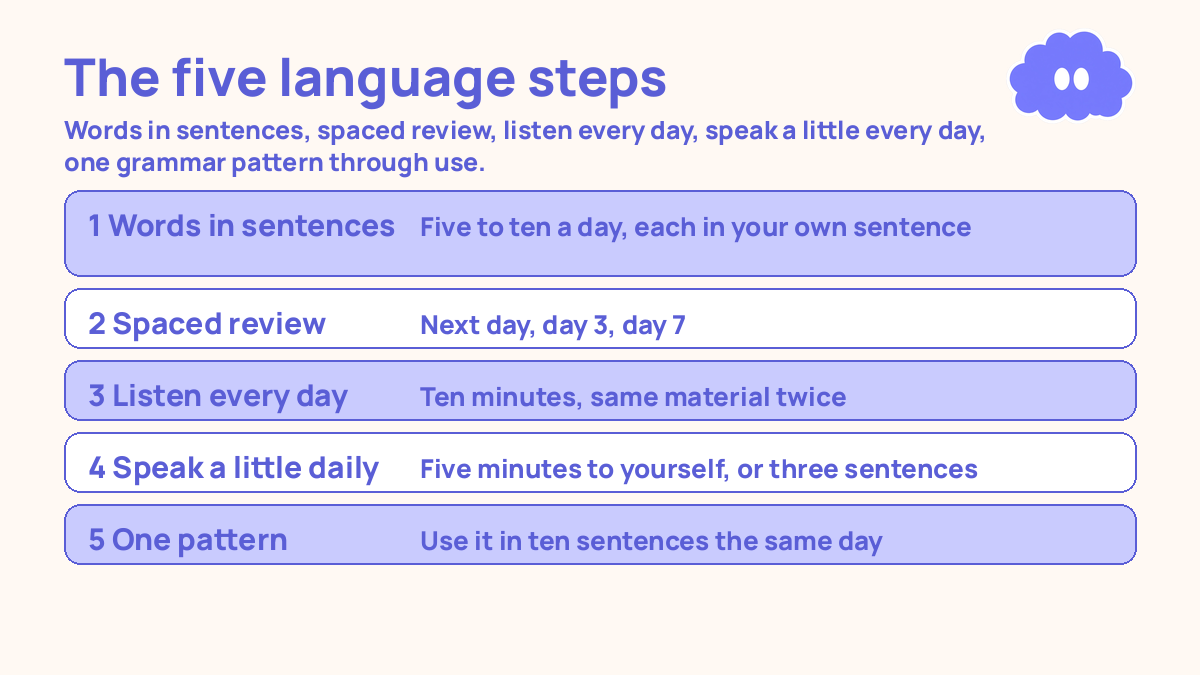
The study system for language learning students is simple: learn words in sentences, not lists; review them after a gap — next day, then after three days, then after seven; listen to the language every day, even for ten minutes; speak or write a little every day, even if it is only five minutes to yourself; and learn grammar one pattern at a time, by using it, not by reading about it. That is the whole system. It works because a language is learned by using it, and thirty minutes of real use a day beats three hours of lists once a week.
Why the study system for language learning students starts with speaking
You have been learning Spanish for six months. You know hundreds of words. Then someone asks you what you did today, and the words will not come in the right order. You studied the lists and did the app, but you never once built a sentence from nothing.
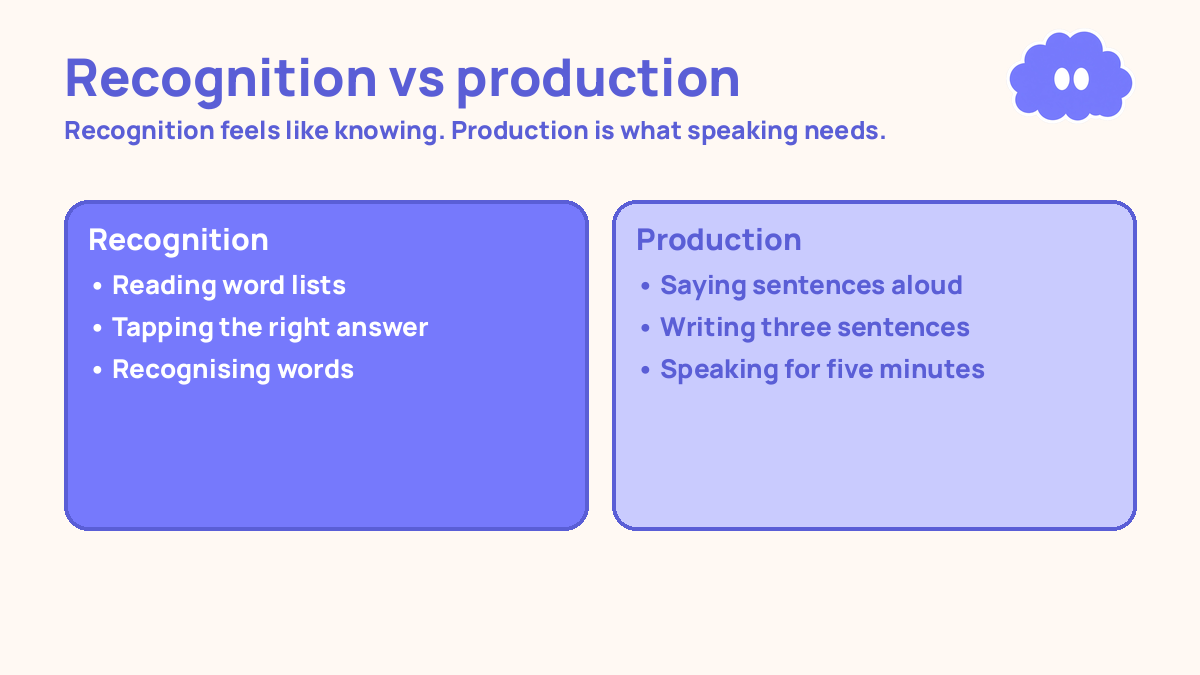
That is the trap of recognition: apps and lists teach you to recognise words, and recognition feels like knowing. But speaking needs production — pulling the word out of your memory and putting it in a sentence, in the right order, at speaking speed.
The research behind it: Dunlosky and colleagues rated distributed practice as high utility in 2013. Cepeda and colleagues showed in 2006 that spacing beats massing, and in 2008 that the best gap grows with how long you need to remember the material. Rowland’s 2014 meta-analysis found testing yourself beat restudying (g = 0.50), and recall formats beat recognition formats as practice.
The system in short
- Learn words in sentences, not lists. Five to ten new words a day, each in a sentence you wrote yourself, about your own life.
- Review them spaced: next day, then after three days, then after seven. That 1-3-7 pattern is a practical starting schedule, not a research rule.
- Listen every day: ten minutes of the language, the same material twice — once to follow it, once to catch what you missed.
- Speak or write a little every day: five minutes of talking to yourself, or three sentences written down.
- Learn grammar one pattern at a time, through use: pick one pattern, use it in ten sentences the same day, and keep using it all week.
Step 1: Learn words in sentences, not lists
Pick five to ten new words a day, each in a sentence, not on its own. A word on its own is a fact with nothing attached to it. A word in a sentence has a meaning, a grammar, and a situation. “Voy al mercado” teaches you “voy”, “al”, and “mercado” together, in the order they are used.
Write the sentences yourself, about your own life: “Voy al mercado los sábados.” “Mi hermano trabaja en un hospital.” Your own sentences are easier to remember than the textbook’s, because they connect to things you already know.
Fifty words a day lasts a week and then collapses, because you cannot review fifty words a day after a gap and keep the old ones alive. Ten words a day, kept, is 300 words a month.
Step 2: Review them spaced
Review the words after a gap: the next day, then after three days, then after seven. That 1-3-7 pattern is a practical starting schedule, not a research rule. The review is a test, not a re-read: cover the sentence, say the word and the sentence from memory, then check. Right moves to the next gap. Wrong goes back to tomorrow.
This is distributed practice, one of the two techniques Dunlosky and colleagues rated high utility in 2013.
Keep the review short: five minutes for yesterday’s words, five for the older ones. If a word fails three times, the sentence is probably wrong — rewrite it and start again. A word that survives a week of spaced review is a word you own.
Step 3: Listen every day
Ten minutes of listening a day: a podcast, a video, a song, a short dialogue — anything in the language, at a level where you understand most of it. Listen to the same material twice: once to follow it, once to catch what you missed.
Listening teaches you how the language sounds, and it shows you the words you know in real use. When you hear a word you learned yesterday in a sentence someone actually said, that word stops being a flashcard and starts being part of the language.
Do not listen to material you understand nothing of. If you catch one word in ten, you are drowning. Pick material where you follow the gist, even if you miss the detail. The detail comes with the second listen. And do not skip the listening because it feels passive: your brain is turning sound into meaning, at speed.
Step 4: Speak or write a little every day
Five minutes of speaking a day, or three sentences written down. Talk to yourself: describe what you did today, what you will do tomorrow. The point is production — pulling the words out of your memory and putting them in order, with no multiple choice to lean on.
This is the step most students skip, and it matters most for speaking. Recognition is easy. Production is hard. Five minutes of production a day closes the gap between recognising and producing, and it is the only thing that does.
Record yourself once a week: two minutes of talking, on your phone, about your week. Listen back. You will hear your own mistakes more clearly on a recording — the wrong word order, the missing article, the verb you keep getting wrong. Write down the three you hear most, and fix those next week.
Step 5: Learn grammar one pattern at a time, through use
Pick one grammar pattern: the past tense, or “ir a + infinitive” for the future, or “ser” and “estar”. One pattern, for one week. Read the rule once, then use it in ten sentences the same day, about your own life. Then keep using it all week.
Grammar learned through use sticks. Ten sentences using the pattern today, five more tomorrow, three the day after — by the end of the week the pattern is something you do, not something you know about.
One pattern at a time: two patterns in one week means neither gets used enough. If a pattern has two cases — “ser” for permanent things, “estar” for temporary ones — learn the first this week and the second next week. And do not study grammar you cannot use yet. When an exam is coming, the daily system tightens into how to revise languages for exams, planned around what the exam actually tests.
A worked example: thirty minutes a day, Monday to Friday
You are learning Spanish. You have thirty minutes a day, Monday to Friday.
6:30–6:35 — New words. Five new words, each in a sentence about your life. “Voy al mercado los sábados.” “Mi hermano trabaja en un hospital.” You write the sentences in your notebook.
6:35–6:40 — Review. Yesterday’s words, then the words from three days ago, then last week’s. Cover the sentence, say it from memory, check. Two wrong — they go back to tomorrow.
6:40–6:50 — Listen. Ten minutes of the same podcast episode you heard yesterday. You hear two of yesterday’s words in the episode. They are yours now.
6:50–6:55 — Speak. Five minutes talking to yourself: what you did yesterday, what you will do today. You stumble on the past tense twice — this week’s pattern — and use it in every sentence.
6:55–7:00 — Write. Three sentences about yesterday, using the past tense. You check them against the rule once, then close the book.
Five days, 150 minutes in the week. Twenty-five new words, reviewed after gaps. Five podcast episodes, each heard twice. Twenty-five minutes of speaking, fifteen sentences written, one grammar pattern used every day.
| Time | What you do | Minutes |
|---|---|---|
| 6:30–6:35 | Five new words, in your own sentences | 5 |
| 6:35–6:40 | Spaced review: yesterday, day 3, day 7 | 5 |
| 6:40–6:50 | Listen: same material twice | 10 |
| 6:50–6:55 | Speak: five minutes to yourself | 5 |
| 6:55–7:00 | Write: three sentences, this week’s pattern | 5 |
When it goes wrong
You learn word lists only. Fifty words from a list, no sentences, no use. Fix it by making the sentence the unit: no word enters your notebook without a sentence of your own attached to it.
You review only the easy cards. You test yourself on the words you know and skip the ones you keep getting wrong, because the wrong ones feel bad. Fix it by making the failures the review: the words you got wrong go back to tomorrow.
You never speak. You read, listen, and do the app, and you never once produce a sentence from nothing. Fix it with five minutes a day, talking to yourself. It feels strange for a week, then normal.
You only use the app. The app is comfortable: multiple choice, streaks, points. Fix it by making the app the supplement, not the system. It can be the flashcards for step 2, if the cards test production. It cannot be the whole system, because it never asks you to produce a sentence from nothing.
Weekly review checklist
Copy this list and use it each week:
- How many new words did I learn in sentences, and how many did I only read in a list?
- Which words survived a week of spaced review?
- How many minutes did I speak or write, and how many did I only recognise?
- What is the one grammar pattern I used all week, and can I use it without looking at the rule?
Downloadable infographic spec: one vertical image, title “Thirty minutes a day”, with the five steps: words in sentences, spaced review, listen every day, speak a little every day, one grammar pattern through use, plus the daily plan — 5 minutes new words, 5 review, 10 listen, 5 speak, 5 write — in Thynq cream, Cloud Purple, Dark Purple and pink, with the cloud mascot. Text taken word-for-word from this article.
What this system is not
It is not a promise of fluency, and it is not a claim that thirty minutes a day is enough for everything. Thirty minutes is the floor: if you have an hour, use the extra thirty for listening and speaking, not more words. It is also not a system for grammar alone. Bisra and colleagues noted in 2018 that the evidence for self-explanation is weak for grammar — grammar is learned by using the pattern, not by explaining it. Use the pattern in ten sentences, and the sentences will teach you the grammar.
Sources
- Dunlosky, J., et al. (2013). Improving students’ learning with effective learning techniques. Psychological Science in the Public Interest, 14(1), 4-58. Distributed practice rated high utility; only practice testing and distributed practice rated high.
- Cepeda, N. J., et al. (2006). Distributed practice in verbal recall tasks. Psychological Bulletin, 132(3), 354-380. Spaced practice beat massed practice.
- Cepeda, N. J., et al. (2008). Spacing effects in learning: a temporal ridgeline of optimal retention. Psychological Science, 19(11), 1095-1102. The best gap grows with the retention interval: about 20-40% of a one-week delay, down to about 5-10% of a one-year delay.
- Rowland, C. A. (2014). The effect of testing versus restudy on retention: a meta-analytic review of the testing effect. Psychological Bulletin, 140(6), 1432-1463. Testing beat restudy (g = 0.50); recall formats beat recognition formats as practice.
- Bisra, K., et al. (2018). Inducing self-explanation: a meta-analysis. Educational Psychology Review, 30(3), 703-725. Prompting self-explanation gave a moderate average benefit (g = 0.55); evidence for grammar is weak.
For the full system behind this method, start with how to build a study system that fits your life, and for the scheduling behind the review step, see the spaced repetition system for students.
Questions
How many new words should I learn each day?
Five to ten, in sentences. Ten words learned properly — in a sentence, reviewed after a gap, used once in speaking or writing — beat fifty words from a list.
Should I use flashcards?
Yes, if the card tests you properly. The front should be a sentence with the word missing, or a prompt in your own language — not the word alone. You have to produce the word from memory, in context, not just recognise it.
How do I practise speaking alone?
Talk to yourself for five minutes a day: describe what you did today, or what you will do tomorrow, in the language. Record it on your phone once a week and listen back. You will hear your own mistakes more clearly on a recording than while you are speaking.
Is grammar or vocabulary more important?
Vocabulary first, grammar through use. You can say a lot with words and rough grammar. You cannot say anything with perfect grammar and no words. Learn one grammar pattern at a time, and use it in ten sentences the same day you learn it.