The direct answer
How to revise languages for exams: twenty to thirty minutes every day, not two hours once a week. Each day, recall vocabulary from memory, write five of your own sentences using one grammar rule, and read or listen to something short in the language. Then practise timed writing and speaking once a week. A language is a daily habit, not a chapter to cram.
How to revise languages for exams starts with twenty minutes a day
You leave the language alone for a week, then spend Sunday afternoon reading the vocabulary list and the grammar rules. It feels productive. On Monday the words are gone — not all of them, but the ones you need, the ones that were only ever recognised, never produced.
That is the language trap. A language is not a set of facts to memorise. It is a skill: producing words, building sentences, understanding speech, all under time pressure. Skills fade without use, and they are built by use — daily, in small amounts. Cramming a language is like cramming the piano the night before a recital. The fingers do not know what the head read.
The research supports the daily pattern. In Dunlosky’s 2013 review, the only two techniques rated high utility were practice testing and distributed practice — testing yourself, and spreading study out. And habits take time: Lally’s 2010 study found the median time for a new daily behaviour to feel automatic was 66 days, with a range of 18 to 254.
The system in short
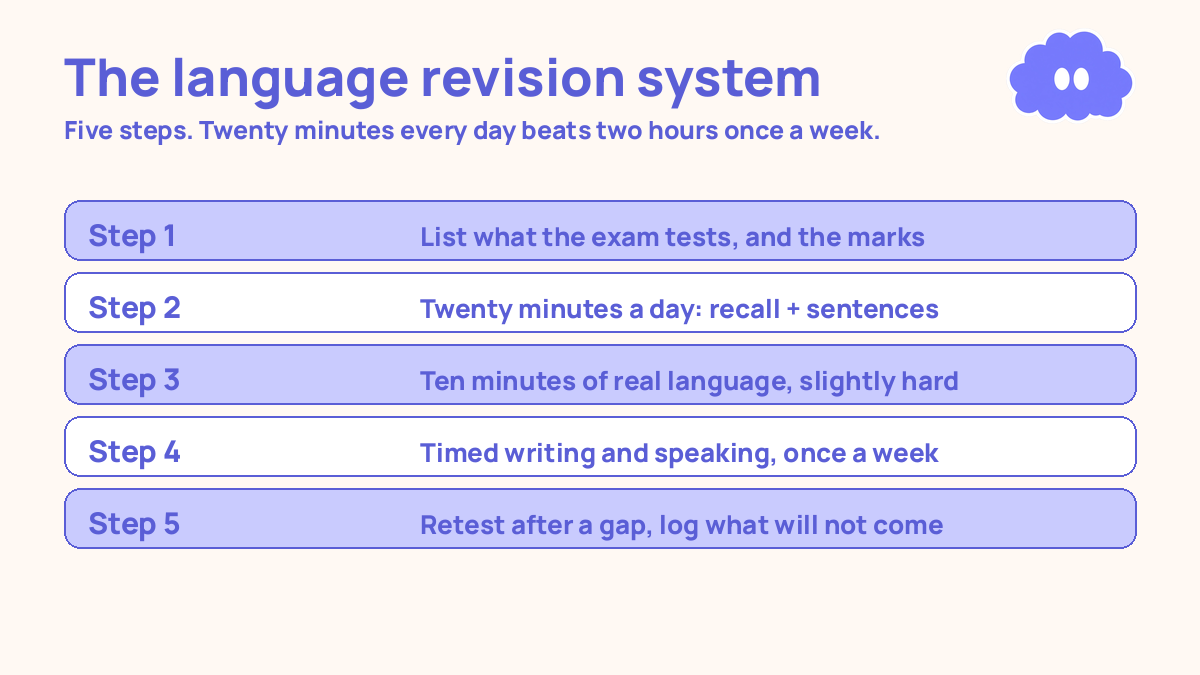
- List what the exam tests: vocabulary, grammar, reading, writing, speaking. One line each, with the marks each part carries.
- Every day, twenty minutes: recall vocabulary from memory, and write five sentences using one grammar rule.
- Every day, ten minutes of reading or listening in the language — short, and slightly hard.
- Once a week, a timed writing task and five minutes of speaking out loud, from a past paper.
- Retest every word and rule after a gap, and log what still will not come.
Step 1: List what the exam tests, and what each part is worth
Open the exam specification and the past papers. Write down every part of the exam and the marks it carries: vocabulary, grammar, reading comprehension, listening, writing, speaking. One line each, with the marks.
This list decides where your time goes. If speaking is worth a third of the marks and you never practise speaking, that is the first thing to fix — not the vocabulary list. Most students spend their time on the part they like and neglect the part that carries the marks.
Step 2: Twenty minutes a day — recall vocabulary, write your own sentences
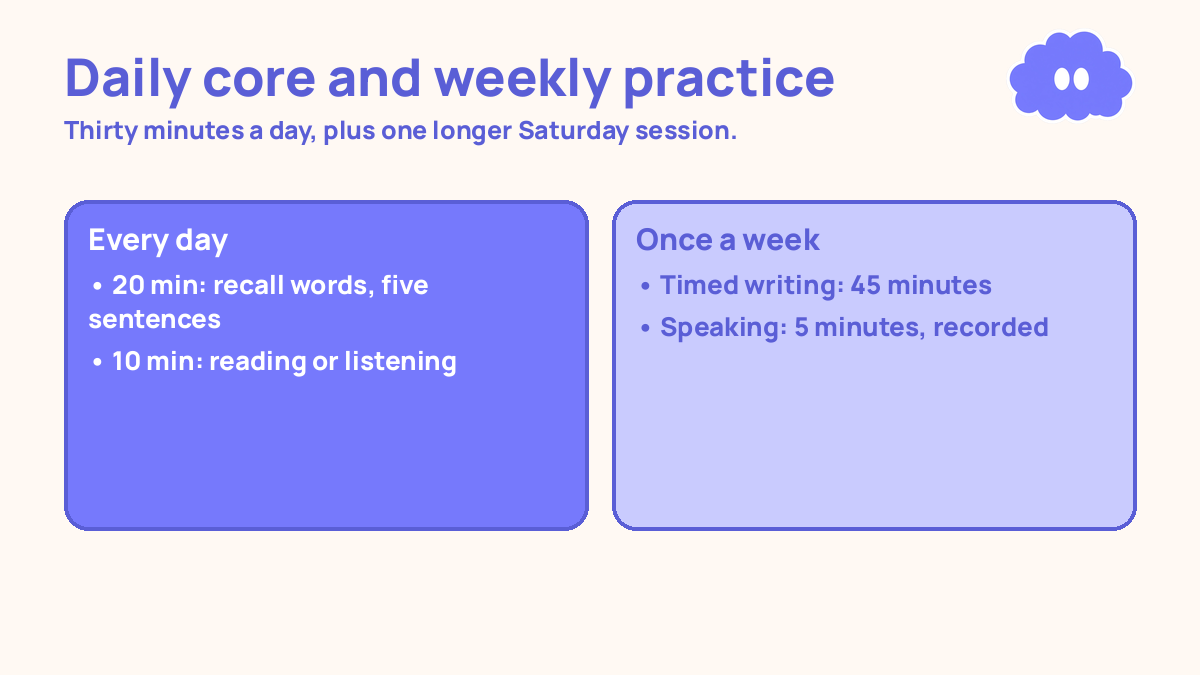
Every day, at a fixed time, do twenty minutes. Two halves, ten minutes each.
First half: vocabulary recall. Take ten words from your list. Cover the translation. Say each word from memory — the meaning, and a sentence using it — then check. Right words get retested in three days. Wrong words go back in tomorrow. This is retrieval practice: Rowland’s 2014 meta-analysis found testing yourself beat restudying, and recall formats beat recognition formats as practice.
Second half: one grammar rule, five of your own sentences. Pick a rule — the past tense, the conditional, word order — and write five sentences using it, about your own life. “Yesterday I went to the market and bought bread.” If you can use the rule in your own sentence, you know it. One rule a day, five sentences, ten minutes. A note of honesty: self-explanation works best for principle-based material, and the evidence for grammar is weak — so for grammar, the doing is the learning, not the explaining. This is the exam version — the full daily system for learning a language through the term is the study system for language learning students.
Step 3: Ten minutes of reading or listening, slightly hard
Every day, ten minutes of real language: a short article, a song, a video, a podcast episode — in the language, slightly above your level. Not a textbook passage. Real language, the kind the exam’s reading and listening parts are taken from.
Read or listen once without stopping, then once more with a dictionary for the missed words. Write down five new words and add them to tomorrow’s recall pile. Five words a day is thirty-five a week, and they are words you met in real use, not on a list.
Slightly hard is the key. If it is easy, you are not learning. If it is impossible, you are not learning either. One unknown word per sentence is about right.
Step 4: Once a week, timed writing and speaking
Once a week, do the exam parts you cannot do daily. A timed writing task from a past paper: the full time, no dictionary, no notes. Then mark it yourself — or better, ask a teacher or a classmate to mark it. Check the grammar rules you practised that week: did they appear in your writing, and were they right?
Then five minutes of speaking, out loud, alone or with a partner. Take a past-paper speaking topic and talk about it for five minutes. Record yourself. Play it back and count the pauses, the words you could not find, and the sentences that fell apart. Those are the gaps. The words you could not find go on tomorrow’s recall list.
Speaking practice is the part most students skip, and it is the part that costs the most marks when it is skipped. Five minutes a week is the minimum. Five minutes a day — saying what you did today, out loud, in the language — is better
Step 5: Retest after a gap, and log what will not come
Every word and rule gets retested after a gap: words after three days, then seven; rules after a week, in new sentences. A three-day, seven-day pattern is a practical starting schedule, not a research rule.
Keep a log of what will not come. Not the words you got wrong once — the words you got wrong three times. Those are the stubborn ones, and they need a different treatment: use them in a sentence about your own life, say the sentence out loud five times, and put the word on a card you see every day.
A worked example: a week of language revision, one month before the exam
You have a French exam in one month. Thirty minutes a day, plus one longer session on Saturday.
| Day | 20 minutes: recall + sentences | 10 minutes: reading or listening |
|---|---|---|
| Monday | 10 words recall, past tense, 5 sentences | Short news article, 5 new words |
| Tuesday | 10 words recall, conditional, 5 sentences | Song lyrics, 5 new words |
| Wednesday | 10 words recall, word order, 5 sentences | Short video, 5 new words |
| Thursday | Retest Monday’s words, future tense, 5 sentences | Podcast, 5 new words |
| Friday | 10 words recall, pronouns, 5 sentences | Short story, 5 new words |
| Saturday | Timed writing (45 min) + 5 min speaking, recorded | — |
| Sunday | Rest, or 10 minutes speaking what you did today | — |
Monday 7:00–7:30 — the daily twenty plus ten. Ten words recalled: seven right, three wrong — the three go back in tomorrow. Past tense, five sentences about yesterday. News article: five new words logged.
Saturday 10:00–10:45 — timed writing. A past-paper letter, 45 minutes, no dictionary. Marked afterwards: two grammar errors, both past tense — the rule from Monday. Five minutes speaking, recorded: three pauses where words would not come. Those three words go on Monday’s recall list.
That is a week, and it produced something a Sunday of cramming never does: thirty-five new words met in real use, five grammar rules used in your own sentences, and one recording that tells you exactly which words still will not come.
When it goes wrong
You read the vocabulary list and call it revision. Reading a word is recognition. The exam asks for recall — producing the word without looking. Cover the translation, say the word, then check. If you cannot say it, it is not learned yet.
You skip the daily twenty minutes and do two hours on Sunday. Then the habit never forms, and the words fade between sessions. Lally’s study found a daily habit takes weeks to feel automatic — a median of 66 days. Fix the time, not the amount: twenty minutes at the same time every day.
You only practise the part you like. Reading is comfortable, speaking is not, so you read. Check the marks: if speaking is worth a third of the exam and you never speak, that is the gap. Five minutes a day of speaking out loud, even alone, is the fix.
The same words keep failing three times. They are words you have never used. Write a sentence about your own life with each one, say it out loud five times, and put the word on a card you see every day. A word becomes yours when you use it, not when you read it.
Weekly review checklist
Copy this list and use it each week:
- How many days did I do the twenty minutes, and how many words did I recall correctly?
- Which grammar rule did I use in my own sentences, and did it appear correctly in my writing?
- Which words have failed three times, and what sentence did I write for each one?
- What one change will I make next week: more speaking, harder reading, or a fixed time every day?
Downloadable infographic spec: one vertical image, title “The language revision system in five steps”, with the five steps — list what the exam tests, twenty minutes a day, ten minutes of real language, timed writing and speaking weekly, retest after a gap — and the rule, twenty minutes every day beats two hours once a week, in Thynq cream, Cloud Purple, Dark Purple and pink, with the cloud mascot. Text taken word-for-word from this article.
What this system is not
It is not a promise of a grade, and it is not a claim that twenty minutes a day is enough on its own. It is the daily core. The weekly timed writing and speaking are part of the system too. What twenty minutes a day does is keep the language alive between the big sessions.
Sources
- Dunlosky, J., et al. (2013). Improving students’ learning with effective learning techniques. Psychological Science in the Public Interest, 14(1), 4–58. Only practice testing and distributed practice rated high utility; rereading rated low.
- Rowland, C. A. (2014). The effect of testing versus restudy on retention: a meta-analytic review of the testing effect. Psychological Bulletin, 140(6), 1432–1463. Testing beat restudy (g = 0.50); recall formats beat recognition formats as practice; feedback raised the effect (g = 0.73 with, 0.39 without).
- Cepeda, N. J., et al. (2006). Distributed practice in verbal recall tasks. Psychological Bulletin, 132(3), 354–380. Spaced practice beat massed practice.
- Lally, P., et al. (2010). How are habits formed: modelling habit formation in the real world. European Journal of Social Psychology, 40(6), 998–1009. Median 66 days for a behaviour to feel automatic, range 18–254.
- Bisra, K., et al. (2018). Inducing self-explanation: a meta-analysis. Educational Psychology Review, 30(3), 703–725. Self-explanation works best for principle-based material; evidence for grammar is weak.
- Bjork, R. A. (1994). Memory and metamemory considerations in the training of human beings. In Metcalfe & Shimamura (eds.), Metacognition: Knowing about knowing, MIT Press. A difficulty is only desirable if the learner has the background knowledge to respond to it.
For the full exam system this sits inside, start with how to revise for exams without cramming. If you want the recall-first habit in general, the flashcard system that works is the same idea applied to any subject.
Questions
How much time should I spend on a language each day?
Twenty to thirty minutes every day beats two hours once a week. A language is a skill that fades without use, and daily recall keeps it alive. Set a fixed time — after breakfast, before bed — and protect it.
Should I memorise vocabulary lists?
Memorise words by recalling them, not by reading lists. Cover the translation, say the word from memory, then check. A word you can produce without looking is learned. A word you only recognise on the page is not.
How do I revise grammar for an exam?
Learn one rule, then write five of your own sentences using it — about your own life, not the textbook’s examples. If you can use the rule in your own sentence, you know it. If you can only spot it in the book, you do not.
What if I am bad at speaking in the exam?
Practise speaking every day, even for five minutes, out loud, alone. Say what you did today in the language. The exam tests speaking under pressure, and the only preparation is speaking under no pressure first, every day.