
The direct answer
You can change your thesis topic halfway through, but only when it is unworkable: no literature, no data access, a question that cannot be answered, or another lab publishing it first. Hating the topic is not a reason to change. Test it against four checks, salvage what survives, trial a topic for one week, get approval and rebuild the timeline.
Changing feels like starting again, and the fear of wasted months keeps students on dead topics far too long. Most of the work survives: reading, methods training, ethics approval, skills practised. What dies is the question itself, and a dead question cannot be finished, however hard you work on it.
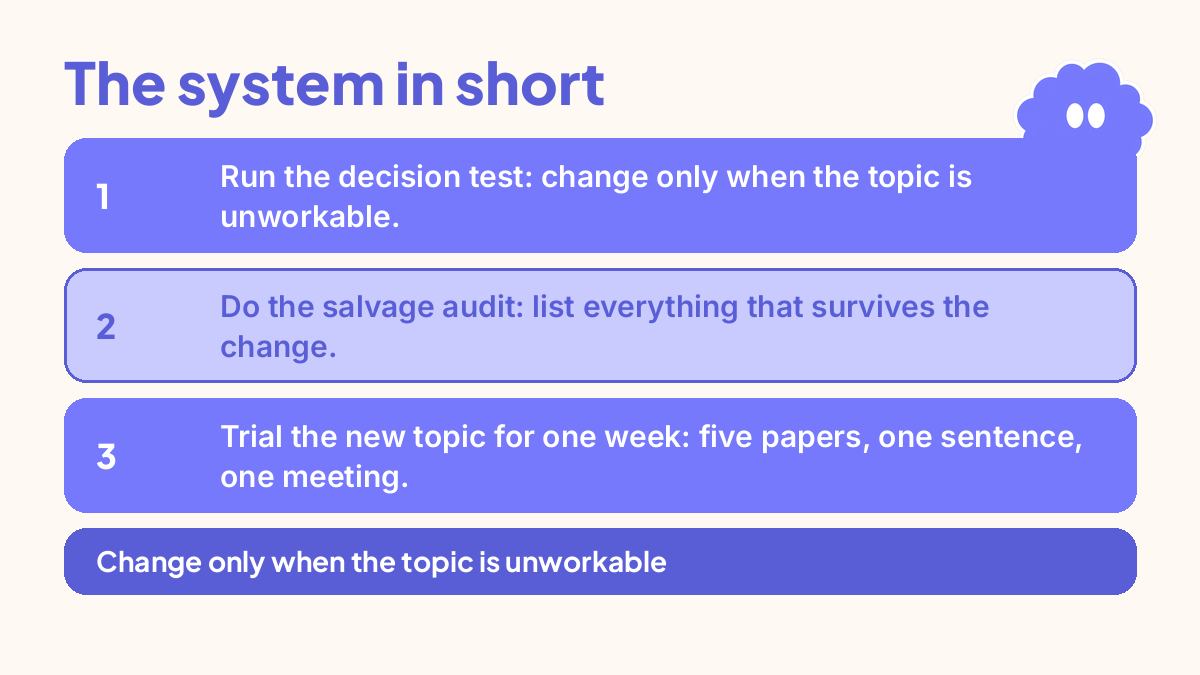
The system in short
- Run the decision test: change only when the topic is unworkable.
- Do the salvage audit: list everything that survives the change.
- Trial the new topic for one week: five papers, one sentence, one meeting.
- Get formal approval and write a revised proposal.
- Rebuild the timeline from the new submission date.
Step 1: Run the decision test
Change only when the topic is unworkable, and unworkable has a precise meaning. Write the answers to four tests down: a written test stops you changing on a bad day and staying on a dead topic out of guilt.
Test one: is there enough literature? Three months of searching that finds only a handful of papers means no foundation. A thin field with ten strong papers can still support a thesis.
Test two: can you get the data? If access is refused, participants will not reply, or the archive is closed, and two proper attempts have failed, the data test has failed.
Test three: can the question be answered with the methods and time you have? A question needing a five-year study or a sample of 500 when you can reach 30 is unanswerable as written. Sometimes the fix is to narrow the question.
Test four: has someone else published your answer? A similar study is not the same study, and a different population or method can still leave room. But an identical question, method, and finding leaves nothing to add.
Score the tests honestly. One failed test can sometimes be fixed: narrow the question, change the site, learn the method. Two or more failed tests usually means change. The article on How to choose a thesis topic says a topic you hate in month four is a topic to finish, and it is right for topics that work. Hating a workable topic is a feeling to manage; hating an unworkable topic is a signal to act. The difference is the four tests above, not the strength of the feeling.
Step 2: Do the salvage audit
Before you change anything, list everything that survives. Students imagine a change wipes out six months; the audit usually shows it wipes out six weeks. Write it on one page, in four groups, and take it to your supervisor meeting.
First, reading. Mark every paper that still matters for the new topic. A change inside the same field often keeps half the reading; a change to a neighbouring field keeps a quarter. Count them: 40 read, 25 still useful.
Second, methods and skills. Training survives almost entirely: interview technique, survey design, statistics, coding, transcription, reference management. None of these belong to the old topic. List each skill and mark it kept.
Third, documents and approvals. A proposal can be revised rather than rewritten. An ethics approval for interviews can often be amended faster than a fresh application takes, and a data management plan transfers almost word for word. Check with your supervisor first: an amendment is weeks, a fresh application is months.
Fourth, data you already hold. Pilot interviews, survey responses, field notes, and archive material may still answer the new question, or part of it. Read it against the new question and mark what fits: data that fits saves the slowest part of a thesis, which is collection.
Add up the audit before you decide. If half your work survives, the cost of changing is half what you feared, and the cost of staying is the whole thesis. The guide to How to get unstuck on a thesis covers the smaller version, a stuck chapter, and the same habit applies: count what exists before you decide what is lost.
Step 3: Trial the new topic for one week
Do not swap one untested topic for another. Trial the new topic for one week, with a fixed plan decided in advance, so the trial produces evidence instead of enthusiasm. A plan fixed in advance beats a vague intention (Gollwitzer and Sheeran, 2006).
Day one: write the new question in one sentence. If you cannot, you have a field, not a thesis. Name the population, the thing you will study, and the outcome you expect. Show it to one person: can they repeat it back?
Days two to four: read five papers. Not twenty, five, and not a month, three days. Five papers is enough to know whether the question has a literature. Take one page of notes per paper: question, method, finding, and one line on how it connects to yours. If you cannot find five papers, the literature test has already failed.
Day five: write a one-page trial note. The question at the top, the five papers underneath, the data you would need, the method you would use, and the honest answer to the four tests from step one. End with one line: change, or do not change.
Day six or seven: take the note to your supervisor. Ask the specific question the note raises: does this question have a literature, can I get this data, is this method feasible in the time left? If your supervisor says yes, or yes with changes, the trial has done its job. If they say no, you have spent one week, not six months, finding out.
Step 4: Get formal approval and write a revised proposal
Tell your supervisor first, then get the change approved in writing before serious work on the new topic. In almost every university a topic change needs formal approval, usually a revised proposal or a short change form. A verbal yes is not approval, and an unapproved change can be rejected at examination.
Ask your supervisor what the process is in your department, and get the answer in writing. Some want a full revised proposal, some a two-page change note, some a record at a progress review.
Write the revised proposal from the trial note, not from scratch: the question, the five papers, the data plan, and the method are already written. The system for How to write a thesis proposal covers the standard sections, and the same sections work for a revised proposal, with one addition: a short paragraph explaining why the topic changed and what survived.
Include the salvage audit in the proposal or as an attachment. It shows the committee the change is a decision, not a panic, and your supervisor that the months spent were not wasted. If the committee asks for changes, answer point by point, promptly, and in writing. The guide to How to handle supervisor feedback on a thesis shows how to turn feedback into a clear reply.
Step 5: Rebuild the timeline from the new submission date
A changed topic needs a new timeline, built backwards from the submission date. Subtract writing, analysis, fieldwork, and reading, and see what is left. If the numbers do not fit, narrow the topic now.
Work in months, not wishes. A masters thesis with nine months left might give one month to the proposal, three to fieldwork, two to analysis, and three to writing. A PhD with 30 months left might give two to the proposal, eight to fieldwork, four to analysis, and the rest to writing. Count the weeks: 30 months is about 130 weeks.
Build in a buffer of four weeks, and protect it: ethics approval, slow recruitment, a supervisor on leave, illness. A timeline with no buffer is a promise you cannot keep. If the buffer does not fit, cut scope: fewer interviews, a smaller sample, one case instead of three.
Then set a weekly rhythm: a fixed writing day, a fixed reading target, and one line in a log each Friday. The system for How to finish a thesis when you are behind covers the weekly counting habit, and it matters more after a change, because the new timeline is untested and the numbers are the only warning you get.
A worked example: six months in, the data cannot be collected
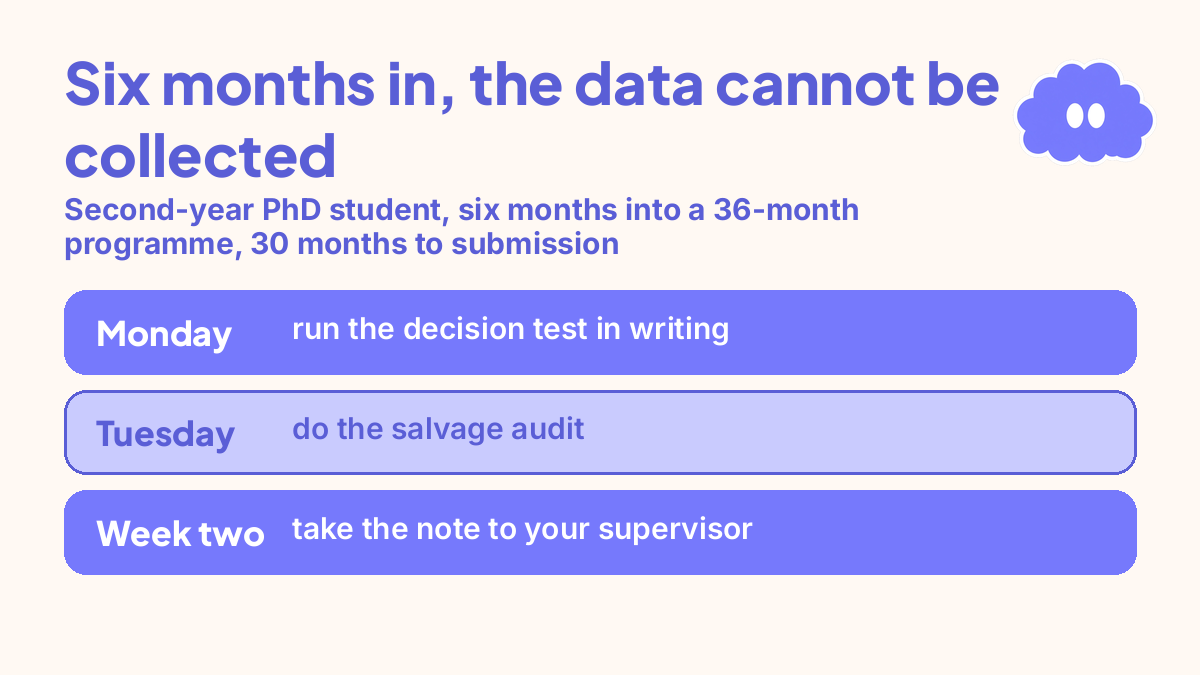
Your situation: Second-year PhD student, six months into a 36-month programme, 30 months to submission. Your topic needs 60 interviews with managers in three hospital trusts, but two trusts refused in writing and the third has not replied in eight weeks. You have read 40 papers and completed three weeks of interview training.
- Monday 9:00 to 11:00: run the decision test in writing. Literature: pass. Data: fail, two refusals and one silence. Answerable: fail as written, 60 interviews cannot happen without access. Published first: pass. Two failed tests: the topic is unworkable as written.
- Tuesday 9:00 to 11:00: do the salvage audit. Reading: 25 of 40 papers fit a neighbouring question about nurse experience. Methods: three weeks of interview training kept. Documents: ethics approval can be amended. Data: none held.
- Wednesday 9:00: write the new question in one sentence: “How do newly qualified nurses experience their first six months on a ward?” Thursday to Saturday, 9:00 to 11:00: read five papers on nurse experience, one page of notes each. Sunday: write the one-page trial note, 15 interviews, 60 minutes each.
- Monday 9:00, week two: take the note to your supervisor. She agrees the question has a literature, the data is reachable, and 15 interviews fit the time. Ask what approval the change needs: a revised proposal, due in four weeks.
- Weeks three to six: write the revised proposal, two hours each weekday morning, 9:00 to 11:00. Include one paragraph on why the topic changed and the salvage list. Submit on Friday of week six.
- Weeks seven to ten: ethics amendment submitted, approved in three weeks. Recruit through the two wards: 15 nurses, 60-minute interviews, one per weekday.
- Months four to six: 15 interviews at 60 minutes is 900 minutes, or 15 hours of recording. Transcription at roughly four hours per hour of recording is about 60 hours, or six weeks at 10 hours a week.
The new timeline fits the 30 months left: reading two months, fieldwork three, analysis four, writing eight, buffer four weeks. Total 18 months, leaving 12 for revision or the delays that always arrive.
When it goes wrong
You change the topic and the new one fails the same test. Check whether the problem is the topic or the method: two topics failing the data test usually means the data source is the problem. Fix the source before you change topic again.
Your supervisor says no to the change. Ask what exactly they object to, and write it down. If the objection is the evidence, gather more: a stronger search, a second access attempt in writing. If the objection is timing, ask what would make it acceptable.
You keep finding reasons to change every month. A topic changed three times is one thesis that never started. Set a rule: one change, one trial week, one decision, then six months of work before any second change. If the urge returns, run the four tests again in writing before you act.
The revised proposal is rejected. Read the comments, then answer point by point. A rejected proposal usually has a vague question or an unfeasible method, and both are fixable in a week. Do not treat it as a verdict on the new topic.
You feel guilty about the months spent on the old topic. Read the salvage audit again: 25 papers, three weeks of training, an ethics approval. Guilt counts the months as lost; the audit counts them as spent.
Weekly review checklist
- Which of the four decision tests has changed this week: literature, data, answerable, published first?
- What did the salvage audit save this week?
- Did I read the five papers, and can I write the new question in one sentence?
- Has my supervisor seen the trial note, and what did they actually say?
- Is the revised proposal on schedule, with approval in writing?
- Does the rebuilt timeline still fit the submission date, with the four-week buffer intact?
Downloadable infographic spec: one vertical image, title “How to change your thesis topic halfway through”, with the steps, run the decision test, do the salvage audit, trial the new topic for one week, get formal approval, rebuild the timeline, and the review questions, which test changed, what did the audit save, did I read five papers, has my supervisor seen the note, is the proposal on schedule, does the timeline fit, in Thynq cream, Cloud Purple, Dark Purple and pink, with the cloud mascot.
What this system is not
It is not permission to change topic whenever the work gets hard. Hard work, boring reading, and a chapter that will not come are normal parts of a thesis, and changing topic does not fix them. It is not a guarantee that the new topic will work: the trial week reduces the risk, it does not remove it. It does not cover changing degree, changing supervisor, or leaving a programme. It turns a frightening decision into four tests, one audit, one trial week, and a new timeline you can count.
Sources
- Gollwitzer, P. M., and Sheeran, P. (2006). Implementation intentions and goal achievement: A meta-analysis of effects and processes. Advances in Experimental Social Psychology, 38, 69-119. Supports fixing the one-week trial plan in advance.
- How to choose a thesis topic, How to get unstuck on a thesis, How to write a thesis proposal, How to handle supervisor feedback on a thesis, and How to finish a thesis when you are behind (Thynq).
Questions
Is it too late to change my thesis topic halfway through?
No, if the topic is unworkable: no literature, no data access, a question that cannot be answered, or another lab publishing first. It is too late only if the topic works and you simply dislike it.
How do I know if my thesis topic is unworkable?
Apply four tests: is there enough literature, can you get the data, can the question be answered with the methods and time you have, and has someone else already published your answer? One failed test can sometimes be fixed. Two or more usually means change.
What survives when I change my thesis topic?
More than you expect. Reading that overlaps, methods training, ethics approval for a similar design, data you already hold, and every research skill you practised all survive. The salvage audit lists each one, so you can see the true cost before you decide.
Do I need approval to change my thesis topic?
Yes, in almost every university. Tell your supervisor first, then get the change approved, usually with a revised proposal or a short change form. Do not start serious work until the approval is in writing.