The direct answer
Build one small project for each course or module you study, document it in plain words, and publish it in one place where people can see it. A portfolio is four to six finished pieces, not a list of certificates. Each piece needs three things: the thing itself, a short note saying what it is and what problem it solves, and a link someone can open. Spend about 3 hours a week on it — one block building, one short block documenting.
You are studying online, learning real skills, and you have nothing to show for it. Your course page says you completed 12 lessons. Nobody cares. The person who might hire you, or the client who might pay you, wants to see something you made. A certificate says you watched. A project says you can do.
Why certificates are not enough
A certificate is easy to get and easy to ignore. Anyone can finish a video course. The certificate does not say whether you understood it, whether you can use it, or whether you finished anything with it. It says you were present. Employers and clients have learned that, and they look past certificates to the work itself.
A project is different. It cannot be faked by watching. If you built a working page, a working spreadsheet, a working design, then you can do the thing. The project also shows how you think: what you chose to build, how you explained it, whether it works. That is what a portfolio is for. It is not a trophy cabinet. It is evidence.
The system in short
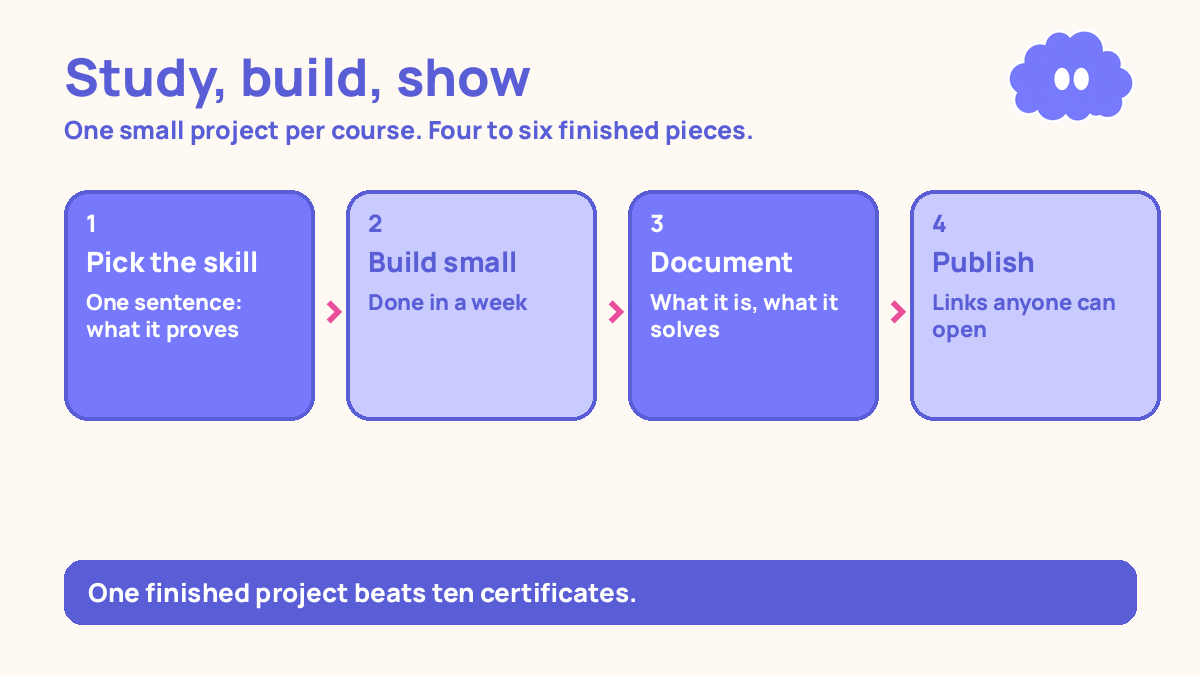
- Pick the skill your portfolio will prove, and write it in one sentence.
- For each course or module, build one small project you can finish in a week.
- Document each project as you go: what it is, what problem it solves, what you did.
- Publish every project in one place, with a link anyone can open.
- Once a month, review the portfolio and improve the weakest piece — do not just add more.
A portfolio for coders starts with the learning itself: How to learn to code online is the system to follow first.
Step 1: Pick the skill, and write it in one sentence
Before you build anything, write down what the portfolio is meant to prove. One sentence, one skill: “I can build simple websites for small businesses”, “I can analyse data and explain what it means”, “I can design clean social media graphics”. This sentence decides what you build. A project that does not prove the sentence does not belong in the portfolio, however fun it was to make.
If you are studying more than one thing, pick the one you want to be known for first. You can add a second skill later, when the first one has four finished pieces. A portfolio that proves one thing clearly beats a portfolio that hints at five things vaguely.
Keep the sentence visible while you choose projects. If an idea does not serve it, skip it.
Step 2: Build one small project per course
For each course or module you finish, build one small project that uses what you learned. Not a big project. A small one you can finish in a week, in the 3 hours you set aside. A web course becomes a one-page site. A data course becomes one analysed dataset with a one-page summary. A design course becomes three finished graphics. Small and finished beats big and half-done, every time.
Scope the project before you start. Write down what it will do, in one sentence, and what it will not do. “A one-page site for a made-up bakery, with a menu and a contact form. No online ordering.” The “will not do” list is what stops a small project from growing into a big one that never finishes. If you think of a feature halfway through, write it on a list for the next project, and keep building the one you have.
Build with the course open, not from memory alone. Look things up, re-watch the lesson, check your notes. That is not cheating — it is how real work is done. Building is also testing in disguise: you have to recall what you learned and use it, and a project that does not work tells you immediately what you got wrong. In a 2013 review, Dunlosky and colleagues rated practice testing as one of only two high-utility techniques, and Rowland (2014) found testing with feedback (g = 0.73) beat testing without it (g = 0.39).
Step 3: Document as you go, in plain words
For each project, write a short note: what it is, what problem it solves, and what you did. Four or five sentences, in plain words, no jargon. “A one-page website for a bakery. The bakery had no website, so customers could not see the menu or find the address. I built the page with a menu section, a photo, and a contact form. I used what I learned in the web course about layouts and forms.” That is enough.
Document while you build, not after. Write the note when you finish each part, while you still remember what was hard and what you changed. A note written a month later is a note full of guesses. Keep the notes in the same place as the project, so they never get separated.
Step 4: Publish in one place, with links anyone can open
Put every project in one place, and make sure a stranger can open it without asking you for a file. A simple portfolio page is best, but a public folder with links works too. What matters is that the link works, the project opens, and the note is next to it. Test every link yourself, from a different device or a friend’s phone, before you call it published.
Keep the page simple. Your one-sentence skill at the top, then the projects, newest first, each with its name, its note, and its link. No long biography, no list of courses, no certificates. The work is the page.
Update the page the week you finish a project, not in a big update every six months. A portfolio that grows one piece at a time is a portfolio that stays alive. A portfolio you update twice a year is a portfolio you forget.
Step 5: Review monthly, and improve the weakest piece
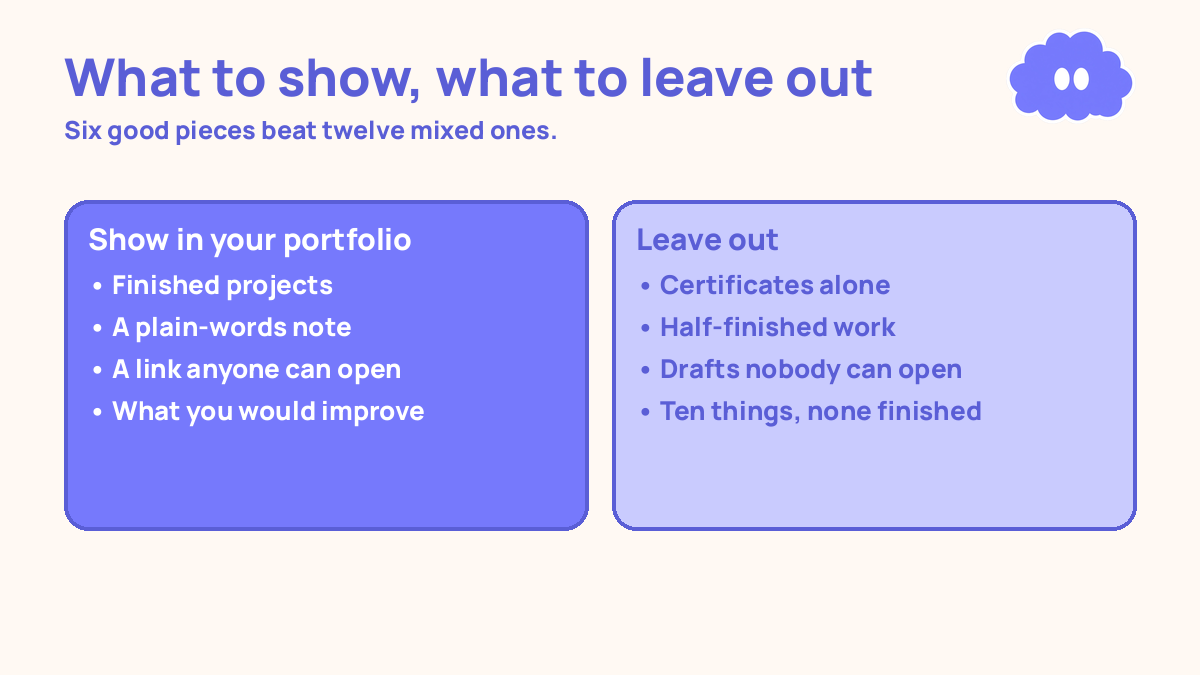
Once a month, open your portfolio and look at it as a stranger would. Which piece is weakest? Which note is unclear? Which link is broken? Pick the weakest piece and improve it, or replace it with a better one. Do not just add more pieces. Six good pieces beat twelve mixed ones.
This monthly review is also where you check the sentence from Step 1. Does the portfolio still prove what you said it proves? If your skill has changed, or you have learned something new, update the sentence. A portfolio is not a monument. It is a working document, and it should change as you do.
Fix your schedule for this too. An if-then plan helps: “If it is the first Sunday of the month, then I will review my portfolio for 30 minutes.” Across 94 studies, Gollwitzer and Sheeran (2006) found that if-then plans raised goal attainment by a medium-to-large amount (d = 0.65) over holding the goal alone. If you are learning the skill alongside a degree, the system for fitting the learning itself into your week is study system for skill learning alongside a degree.
A worked example: 8 weeks, 4 pieces, 24 hours
You are studying web design online, and your sentence is “I can build simple websites for small businesses.” You study 5 hours a week and spend 3 more hours a week on your portfolio — 24 hours over 8 weeks. You build four pieces, spending 5 hours on the first, 6 on the second, 6 on the third, and 7 on the last, which is the biggest.
| Piece | Hours | What you build | What it proves |
|---|---|---|---|
| 1 | 5 | One-page site for a made-up bakery | Layout, text, images |
| 2 | 6 | Site for a barber shop, with a price list | Layout, lists, contact details |
| 3 | 6 | Site for a clinic, with a booking form | Forms, structure, real content |
| 4 | 7 | Site for a small shop, with a menu and a map | Everything together, finished and polished |
Total: 24 hours, 4 finished pieces, 1 portfolio page with 4 links. After 8 weeks you have something to show a real business: four working sites, each with a plain-words note. None of them is perfect. All of them are finished, documented, and openable from a link. That is a portfolio.
When it goes wrong
You keep starting big projects and never finishing one. The scope is the problem, not your ability. Cut the project in half, write down what it will not do, and finish the half that is left. A finished half is a portfolio piece. An unfinished whole is nothing.
You build but never document. A project with no note is a project nobody understands, including you in three months. Fix it now: write the four-sentence note for each finished project before you start the next one.
You never publish because nothing feels good enough. Good enough is finished, documented, and openable. It is not perfect. Publish the weakest piece anyway, and improve it in next month’s review. A portfolio with four imperfect pieces beats a folder of perfect drafts nobody has ever seen.
You add certificates instead of projects. Certificates feel like progress, and they are easy to add. But they do not prove skill, and they crowd out the work. Keep certificates off the main page.
Weekly review checklist
Copy this list and use it each week:
- What did I build this week, and is it finished or still open?
- Did I write the note for it — what it is, what problem it solves, what I did?
- Is it published in one place, with a link that works?
- Which piece is weakest right now, and what would improve it?
- What one project will I build next week, and what will it not do?
Downloadable infographic spec: one vertical image, title “Study, build, show”, with the five steps — pick the skill, build one small project per course, document as you go, publish in one place, review monthly — and the weekly review checklist, in Thynq cream, Cloud Purple, Dark Purple and pink, with the cloud mascot. Text taken word-for-word from this article.
What this system is not
It is not a promise that a portfolio will get you hired, and it is not a claim that four projects are enough for every job. Some roles want more, some want different work, and no portfolio can promise a result. It does not promise a grade, and it does not promise that building is easy — some weeks the project will not work, and you will have to fix it. What it promises is simpler: proof you can show someone, built from the studying you are already doing, one finished piece at a time.
Sources
- Dunlosky, J., et al. (2013). Psychological Science in the Public Interest, 14(1), 4-58. Only practice testing and distributed practice received a high utility rating; rereading and highlighting were rated low.
- Rowland, C. A. (2014). Psychological Bulletin, 140(6), 1432-1463. Testing beat restudying (g = 0.50); with feedback the effect was larger (g = 0.73) than without it (g = 0.39).
- Gollwitzer, P. M. & Sheeran, P. (2006). Advances in Experimental Social Psychology, 38, 69-119. Across 94 studies, if-then plans raised goal attainment by a medium-to-large amount (d = 0.65) over holding the goal alone.
For the general system this one sits inside, read self-study system for online learners.
Questions
What should go in a student portfolio?
Finished pieces of work, not certificates. Four to six small projects you actually built, each with a short note saying what it is, what problem it solves, and what you did. One finished project beats ten course certificates.
How much time should a portfolio take each week?
About 3 hours a week on top of your study, in the worked example in this article. That is one focused block for building and one short block for documenting. If you have less time, make the projects smaller — do not skip the documenting.
Do I need a website for my portfolio?
No. One simple page is enough to start, and a public folder of your work with links works too. What matters is that someone else can open it and see what you made, without asking you for a file.
What if my projects are too simple to show?
Simple and finished beats big and half-done. A small project that works, with a clear note about what it does, shows more than an ambitious project that never ran. Improve the weakest piece each month instead of starting something bigger.