The direct answer
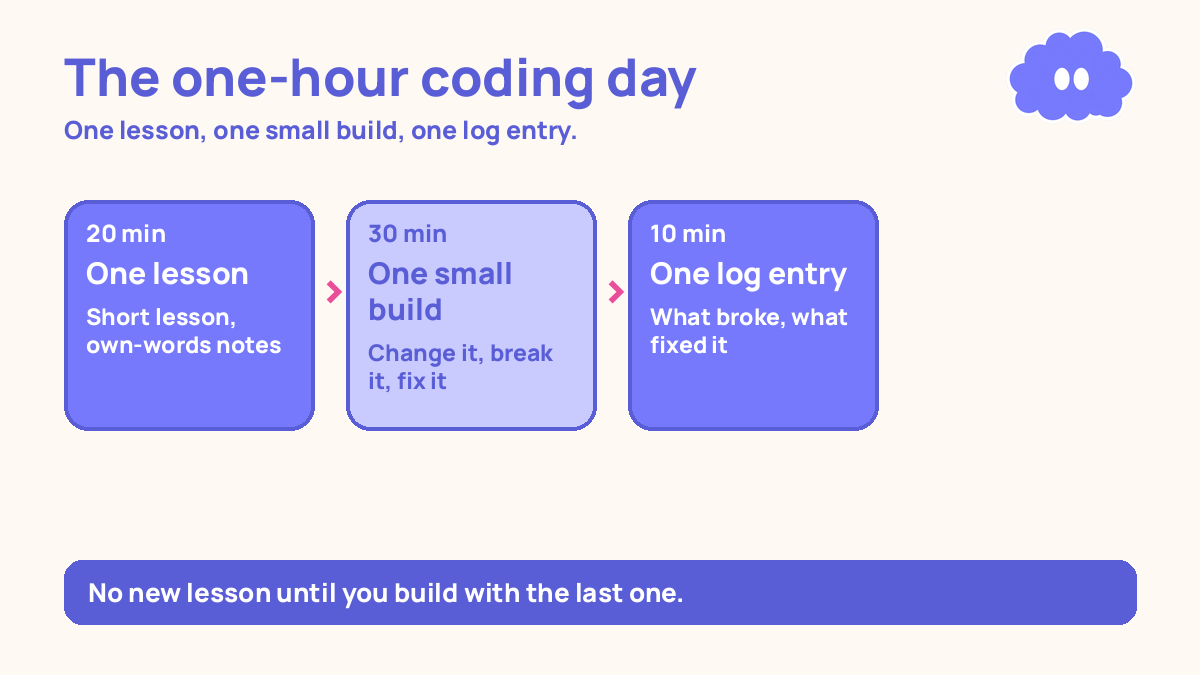
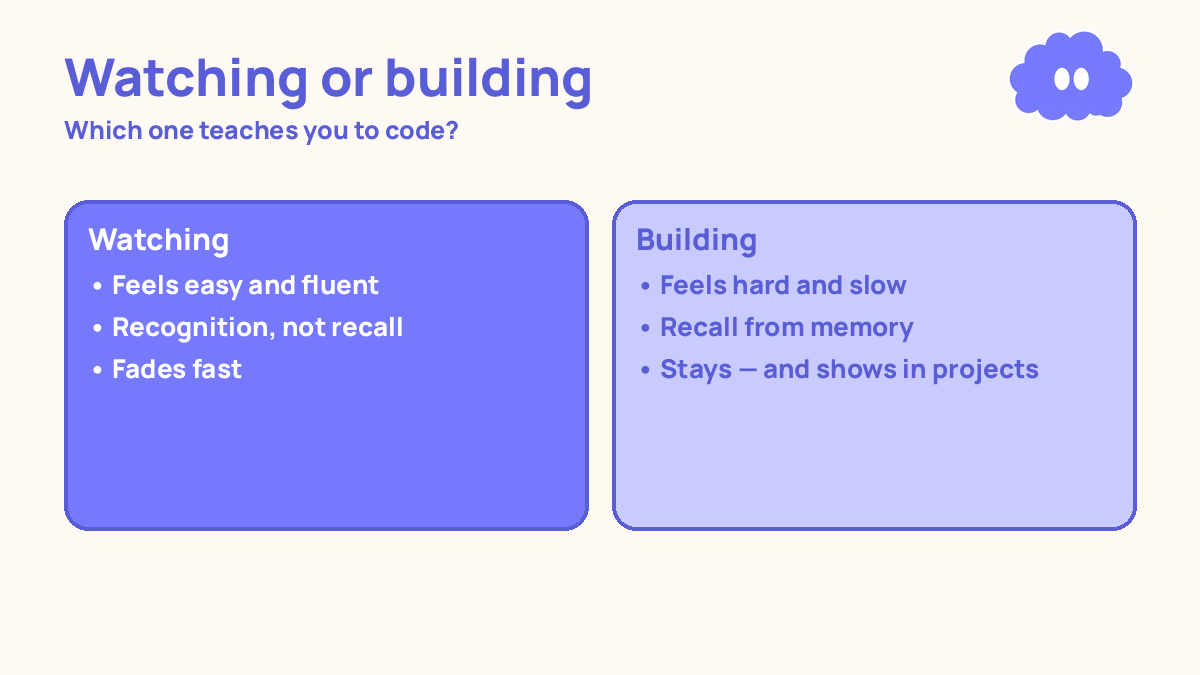
Learn to code online with one hour a day: 20 minutes on one short lesson, 30 minutes building something small with what the lesson taught, and 10 minutes writing down what broke and how you fixed it. One language, one course, one small project at a time. That is the whole system. Watching lessons without building is not learning to code. Building is.
You have finished three courses, watched a hundred hours of video, and you still freeze when you open a blank file. The moment you have to write code yourself, nothing comes.
This system is for a student teaching themselves to code online, with no teacher and no classroom. It needs one laptop, one free course, and one hour a day. For the wider self-study system, read the self-study system for online learners. When you start a course and want to finish it, the guide to finishing an online course covers the finishing part.
The system in short
- Pick one language and one course. Stick to both for three months.
- Study one hour a day, at the same time, in three parts.
- Part 1, 20 minutes: watch or read one short lesson. Take notes in your own words.
- Part 2, 30 minutes: build something with what the lesson taught. Change it, break it, fix it.
- Part 3, 10 minutes: write down what broke, what fixed it, and one question for tomorrow.
- The next day, rebuild yesterday’s small piece from memory before the new lesson.
- Every week, finish one small project you can show someone, even if it is ugly.
For the subject itself, Study system for coding students plans the practice, not just the course.
Step 1: Pick one language and one course
Pick the language that fits what you want to build. If you want websites, pick JavaScript. If you want data or scripts, pick Python. If you want phone apps, pick the language your app needs. The right first language is the one that builds the thing you care about, not the one a list calls best.
Pick one course and finish it before you start another. A course with a clear order, short lessons, and exercises after each lesson is worth more than ten half-watched playlists. The course is not the learning. The building is.
Decide the cue and the action in advance: “When I finish dinner, I will open the laptop and code for one hour.” That is an if-then plan, and across 94 studies, if-then plans raised goal attainment by a medium-to-large amount (d = 0.65) over holding the goal alone (Gollwitzer and Sheeran, 2006). A plan decided tonight is a session that starts tomorrow without a debate.
Do not start a second language until you have built three small projects in the first one.
Step 2: Part 1 — one lesson, in your own words
Twenty minutes. Watch or read one short lesson, and only one. If the lesson is an hour long, watch the first 20 minutes and stop. A lesson you finish and use beats a lesson you half-watch and forget.
Take notes in your own words. Write what the lesson taught, in one or two lines, and one example of your own. Explaining why each step works, in your own words, is a moderate-utility technique (Dunlosky, 2013), and a 2018 meta-analysis found prompting self-explanation produced a moderate average benefit (Bisra and colleagues, 2018). The original study was only 8 students, so say so.
If the lesson shows code, type it yourself. Do not copy and paste it. Typing is slow, and slow is the point: your fingers learn the shape of the code, and your eyes catch the parts you do not understand.
Step 3: Part 2 — build something small
Thirty minutes. Build something small with what the lesson taught. If the lesson was about lists, build a list of your own books. If it was about buttons, build a page with three buttons that do three different things. Small means you can finish it in 30 minutes. If you cannot finish it, it is too big. Cut it in half.
Change the code from the lesson. Use your own words, your own numbers, your own data. Changing one thing forces you to understand what that thing does.
When it breaks — and it will — read the error message before you search for the answer. Error messages feel rude, but they usually say exactly what is wrong and where. Spend five minutes on the error yourself before you look it up. Five minutes of struggle on code you have just seen is a desirable difficulty: practice that feels harder and slower, and improves retention later (Bjork, 1994). But a difficulty is only desirable if you have the background to respond to it. If the error is about something you have never seen, look it up.
Step 4: Part 3 — write down what broke
Ten minutes. Write three lines in a notebook: what broke, what fixed it, and one question for tomorrow. That is your debugging log, and it is the most useful thing you will write all week. The same errors come back. Next time, your own log answers them in ten seconds.
Then close the laptop. One hour is one hour. Coding until midnight after a full day of study or work is how you burn out in week two.
Step 5: Rebuild yesterday’s piece from memory
Before the new lesson, rebuild yesterday’s small piece from memory. Open a blank file and write it again, without looking at yesterday’s code. Then compare. The parts you forget are the parts you need to practise.
This is retrieval practice, and it is the strongest tool in the system. Roediger and Karpicke (2006) found students who recalled a passage remembered more a week later than students who restudied it, even though the restudiers felt more confident straight after studying.
Come back to each idea after a gap: tomorrow, in three days, in seven days. That 1–3–7 schedule is a practical starting point, not a rule from the research. The research says the best gap grows with how long you need to remember the material (Cepeda and colleagues, 2006).
Check your rebuild against the working version. Feedback matters: Rowland (2014) found testing beat restudying, and the benefit was larger with feedback (g = 0.73) than without it (g = 0.39).
A worked example: a Tuesday with one hour
You study after dinner, 7:00 to 8:00pm. Today’s lesson is about functions.
7:00–7:20pm — Lesson. Watch the 20-minute lesson on functions. Take notes in your own words: “A function is a named block of code I can run again with different inputs.” Type the lesson’s example yourself.
7:20–7:50pm — Build. Build a small tip calculator: a function that takes a bill amount and returns the tip. Change it: add a second function for splitting the bill between three people. It breaks. Read the error. You passed a word where a number was expected. Fix it.
7:50–8:00pm — Log. Write three lines: “Broke: passed a word, needed a number. Fixed: converted the input to a number first. Question for tomorrow: how do I check the input is a number before I use it?”
Wednesday 7:00pm — Rebuild first. Before the new lesson, rebuild the tip calculator from memory in a blank file. Compare it with Tuesday’s version. The splitting function is the part you forgot. Rebuild it again, then start the new lesson.
By Sunday you have five lessons, five small builds, and five log entries.
When it goes wrong
You watch lessons for hours and build nothing. This is tutorial hell, and the fix is a rule, not willpower: no new lesson until you have built something with the last one. Build first, watch second. If you have watched three lessons without building, stop watching. Build with the first one, then carry on.
You copy code from the lesson and it works, but you cannot explain it. Delete it and rebuild it from memory, one line at a time, saying what each line does out loud. If you cannot say what a line does, you do not understand it yet. Retrieval beat concept mapping by about half as much again a week later in one study of 200 students, and the students who felt most confident were the ones who had done worst (Karpicke and Blunt, 2011).
You get stuck on one error for an hour. Stop at 20 minutes. Write the error down, write what you tried, and look it up or ask someone. An hour on one error is not learning. It is grinding. The rule is: 20 minutes alone, then help.
You miss a week and feel as if you have failed. You have not. A daily habit takes weeks to feel automatic — a median of 66 days in one study, with a range of 18 to 254 — and one missed day does not reset it (Lally and colleagues, 2010). Start again with the rebuild, not with guilt.
Weekly review checklist
Copy this list and use it each Sunday:
- How many small builds did I finish this week, and can I explain each one?
- How many errors did I fix myself, and how many needed a search?
- Which idea from this week can I still rebuild from memory?
- What one change will I make next week: a shorter lesson, a smaller build, or a stricter no-new-lesson rule?
Downloadable infographic spec: one vertical image, title “The one-hour coding day”, with the three parts — one lesson, one small build, one log entry — and the rule “no new lesson until you build with the last one”, in Thynq cream, Cloud Purple, Dark Purple and pink, with the cloud mascot.
What this system is not
It is not a promise of a job in three months, and it is not a claim that one hour is the scientifically correct length for every learner. It is a practical daily system for a student teaching themselves to code online, with one laptop, one course, and small projects.
Sources
- Dunlosky, J., et al. (2013). Improving students’ learning with effective learning techniques. Psychological Science in the Public Interest, 14(1), 4-58. Only practice testing and distributed practice received a high utility rating; rereading was rated low.
- Roediger, H. L. & Karpicke, J. D. (2006). Test-enhanced learning. Science, 311, 1535-1539. Students who recalled a passage remembered more a week later than students who restudied it.
- Cepeda, N. J., et al. (2006). Distributed practice in verbal recall tasks. Psychological Bulletin, 132(3), 354-380. Spaced practice beat massed practice, and the best gap grows with how long you need to remember the material.
- Rowland, C. A. (2014). The effect of testing versus restudy on retention. Psychological Bulletin, 140(6), 1432-1463. Testing beat restudying, and the benefit was larger with feedback (g = 0.73) than without it (g = 0.39).
- Gollwitzer, P. M. & Sheeran, P. (2006). Implementation intentions and goal achievement: a meta-analysis. Advances in Experimental Social Psychology, 38, 69-119. Across 94 studies, if-then plans raised goal attainment by a medium-to-large amount (d = 0.65).
- Bjork, R. A. (1994). Memory and metamemory considerations in the training of human beings. A difficulty is only desirable if the learner has the background knowledge to respond to it.
- Karpicke, J. D. & Blunt, J. R. (2011). Retrieval practice produces more learning than elaborative studying with concept mapping. Science, 331(6018), 772-775. Retrieval beat concept mapping by about half as much again a week later.
- Bisra, K., et al. (2018). Inducing self-explanation: a meta-analysis. Educational Psychology Review, 30(3), 703-725. Prompting self-explanation produced a moderate average benefit (g = 0.55).
- Lally, P., et al. (2010). How are habits formed. European Journal of Social Psychology, 40(6), 998-1009. Median time for a behaviour to feel automatic was 66 days, range 18 to 254 days.
For the wider self-study system behind this path, read the self-study system for online learners, and when you start a course, use the guide to finishing an online course.
Questions
How much time do I need each day to learn to code?
One hour is enough: 20 minutes on one lesson, 30 minutes building something small with it, and 10 minutes writing down what broke and how you fixed it. Daily practice beats one long weekend session.
Which programming language should I start with?
Pick one language that fits what you want to build, and stick to it for three months. For websites, that is usually JavaScript. Switching languages every few weeks is the fastest way to learn none of them.
What is tutorial hell, and how do I avoid it?
Tutorial hell is watching lesson after lesson without building anything yourself. You avoid it by building after every lesson: change the code, break it, fix it, and add one small feature of your own before you watch the next lesson.
Do I need a computer science degree to learn to code online?
No. You need one language, one course, one hour a day, and small projects you can show. Employers and clients look at what you built. A degree is one route, not the only route.