The direct answer
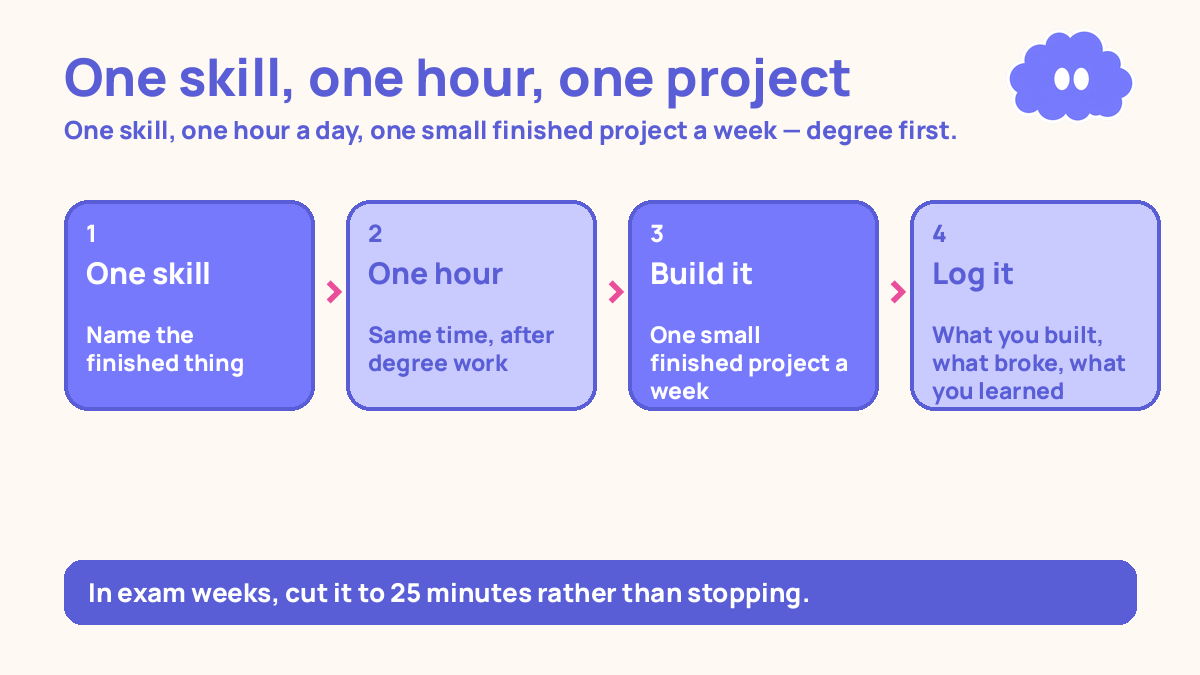
A skill-learning system alongside a degree is: one skill, one hour a day at the same time, and one small finished project each week. The degree comes first — the skill hour is protected, but it shrinks in exam weeks instead of disappearing. You learn by building, not by watching courses, and you test yourself by showing the work, not by re-reading notes.
You do not need more hours. You need one hour that belongs to the skill, every day, doing real work.
Why skills die next to degrees
A degree has deadlines, exams and grades. A skill has none of those. So the skill always loses. You start with energy, watch ten hours of tutorials in a weekend, build nothing, and by week three the skill is a folder of half-finished courses you feel guilty about.
The problem is not the degree. It is that the skill has no shape: no daily time, no finished thing, no way to tell whether you are improving. This system gives it all three. One hour, one project a week, one check at the end of the week: what did I build?
For the full system behind this one, start with how to build a study system that fits your life. This article is that system, fitted to a student learning a skill on the side.
The system in short
- Pick one skill and name the finished thing: a small website, a short video, ten pages of writing, a working program. One skill, for one term.
- Give it one hour a day, at the same time, after degree work. Same time, same place, same hour.
- Learn by building. Every week ends with something finished, even if it is small and rough.
- Keep a practice log: what you built, what broke, what you learned. One line a day.
- Review the skill’s notes by testing yourself, not re-reading: rebuild a piece from memory, explain it out loud, redo it without the tutorial.
- Once a week, check the balance: did degree work come first, and did the skill still get its hour?
Step 1: Pick one skill, and name the finished thing
“Learn coding” is not a skill plan. “Build a small booking page for a clinic, with a working form” is. “Learn design” is not a plan. “Redesign one landing page a week” is. The finished thing is what turns a vague skill into a real one — and it is what you show people later.
Pick the skill by its ending, not its beginning. Ask: in three months, what will I be able to show someone? If you cannot answer in one sentence, the skill is too vague. Narrow it until you can. One skill, for one term. A second skill can wait until the first one has something finished to show.
Do not pick a skill because a course is on sale, or because everyone is talking about it. Pick the one you will still want to do on a tired Tuesday in week six. That is the test that matters.
Step 2: One hour, same time, after degree work
The skill hour goes after degree work, not before it. The degree has deadlines; the skill does not. If the skill hour comes first, it will expand, and the degree will pay for it.
Pick an hour that survives most days. For most students that is early evening, after classes and homework, or early morning before classes. Same time every day — the habit is the time, not the motivation. On a good day you will want more than an hour. Take it, but only after the degree work is done. On a bad day, the hour is still the hour.
In exam weeks, shrink the skill hour to 25 minutes. Do not cancel it. A 25-minute block keeps the habit alive and the skill warm. Cancelling for a month means starting again from zero, and starting again is the hardest part. One short block a day through exams is worth more than a heroic restart after them.
Step 3: Build from week one
Do not finish a course before building anything. Build from the first week, even badly. A small finished project teaches more than a finished course with nothing built, because building forces you to make decisions a tutorial never asks you to make.
Keep the weekly project small enough to finish in seven hours — one hour a day. A single page, a single feature, a single short piece. Finished and rough beats perfect and unfinished, every week. At the end of the week, you have something to show. After a month, you have four things. After a term, you have a body of work.
When you get stuck, learn what the project needs, when it needs it. That is the opposite of watching a whole course first: the project tells you what to learn next, so the learning has a purpose. A tutorial watched without a project is entertainment. The same tutorial watched to fix a real problem is study.
Step 4: Test yourself by rebuilding, not re-reading
Skill notes are useless if you never test them. Once a week, rebuild one small piece from memory — no tutorial open, no notes open. Explain it out loud, as if teaching someone. Then check against the tutorial or your notes, and write down what you got wrong.
This is the same rule that governs degree revision. In a 2013 review, Dunlosky and colleagues rated ten common study techniques, and only two received a high utility rating: practice testing and distributed practice. Re-reading was rated low. Watching a tutorial again is the skill-learning version of re-reading: it feels fluent, and it does not stick. Rebuilding from memory feels harder, and it is the work that makes the skill yours.
Space the practice out, too. Return to last week’s project after a gap and improve one thing in it, instead of starting a new project every week. In a 2006 synthesis, Cepeda and colleagues found that spaced practice beat massed practice across materials and retention intervals. A skill revisited after a gap is a skill that lasts.
Step 5: Keep a one-line practice log
One line a day, in a notebook or a plain file: the date, what you built, what broke, what you learned. “Oct 31 — booking form, validation broke on empty phone field, learned to check empty first.” That is enough.
The log does three jobs. It shows you the skill growing, which keeps you going in week six. It shows you what keeps breaking, so you can fix the pattern instead of the same bug. And it is the record you show people later — not a certificate, a trail of real work.
If you study online, the same log works for your degree. A self-study system for online learners runs on the same rule: one daily time, one task, and a weekly check of what actually got done.
A worked example: a week learning to build web pages
You are studying a degree, and your skill is building small websites. Your skill hour is 6 to 7pm, after degree work.
Monday: Build a one-page site for a made-up bakery: heading, menu, contact form. It looks rough. It works. Tuesday: The form breaks when the phone field is empty. Fix it, and write the fix in your log. Wednesday: Rebuild Monday’s page from memory, no tutorial open. Two things you forgot — look them up, write them down. Thursday: Add one new thing the page needs: a booking button that shows available times. Friday: Show the page to a friend. They say the text is too small on a phone. Fix it. Saturday: Review the week’s log. What broke twice? Form validation. Next week’s project will start with validation. Sunday: Rest. Plan next week’s project in 15 minutes: a booking page for a clinic, one page, one form.
Seven hours, one finished page, one fixed bug, one lesson that will not need relearning. That is a good week.
When it goes wrong
You start three skills at once. Three skills get one hour each, badly, or one hour shared, which is nothing. Pick one. The other two will still be there next term, and by then you will have something finished to show for the first.
You watch courses for a month and build nothing. Watching feels like progress because it is easy and it fills time. The test is simple: what did you build this week? If the answer is nothing, stop watching and build the smallest possible thing today — one page, one paragraph, one function. Bad and finished beats good and unwatched.
Exam week arrives and the skill dies for a month. It does not have to. Shrink to 25 minutes a day, one tiny task: fix one bug, rebuild one piece, write one paragraph. The habit survives on 25 minutes. It does not survive on zero.
The degree starts slipping and you blame the skill. The skill is not the problem — the order is. Degree work first, skill hour second, and the skill hour shrinks when the degree needs the time. If the degree is slipping, check the balance in the weekly review before you blame the hour.
Weekly review checklist
Copy this list and use it each week:
- What did I build this week, and can I show it to someone?
- What broke, and did it break before — is there a pattern to fix?
- Did degree work come first, and did the skill still get its hour (or its 25 minutes in a busy week)?
- What one change will I make next week: a smaller project, a different hour, rebuilding from memory more often, or dropping a second skill I started?
Downloadable infographic spec: one vertical image, title “One skill, one hour, one project a week”, with the weekly loop — build, break, fix, show, review — and the three rules: degree first, build from week one, rebuild from memory, in Thynq cream, Cloud Purple, Dark Purple and pink, with the cloud mascot. Text taken word-for-word from this article.
What this system is not
It is not a promise of a job, a grade, or a finished portfolio in a month. A skill learned alongside a degree grows slowly, one hour at a time, and some terms the degree will need almost all of you. This is a practical system for keeping a skill alive next to a degree: one skill, one hour, one finished thing a week, and an honest log. If the term changes, change the system — one step at a time, and check after a week whether the change helped.
Sources
- Dunlosky, J., et al. (2013). Improving students’ learning with effective learning techniques. Psychological Science in the Public Interest, 14(1), 4-58. Only practice testing and distributed practice received a high utility rating; rereading was rated low.
- Cepeda, N., et al. (2006). Distributed practice in verbal recall tasks. Psychological Bulletin, 132(3), 354-380. Spaced practice beat massed practice; the best gap grows with how long you need to remember the material.
For the full system behind this one, start with how to build a study system that fits your life, and if your skill learning happens mostly online, the self-study system for online learners runs on the same rule. For the daily timer that holds the skill hour together, use the Pomodoro technique for students.
Questions
How do I pick which skill to learn?
Pick the one with a job at the end of it: something you can show, not just something you can describe. One skill, for one term, beats three skills started and none finished. If you cannot name the finished thing, the skill is too vague.
How much time should the skill get each day?
One hour, at the same time every day. That is enough to build steadily and small enough that degree work still comes first. In exam weeks, cut it to 25 minutes rather than stopping completely — a stopped skill is much harder to restart.
Should I finish a course before building anything?
No. Build from week one, even badly. A small finished project teaches more than a finished course with nothing built, and it gives you something to show. Learn what the project needs, when it needs it.
What if my degree workload suddenly grows?
Shrink the skill hour, do not cancel it. One 25-minute block keeps the habit alive through a busy week. Cancelling for a month means starting again from zero, and starting again is the hardest part.