The direct answer
Use WhatsApp to study with a friend: pick one friend and one subject, agree one time, and before each session each of you sends the other three short-answer questions from your own notes. Answer by voice note with your notes closed, check each answer against your notes, teach one topic back to each other, and end by sending tomorrow’s questions. The phone you already have becomes a study partner who tests you.
You study alone. Not because you like it — because there is nobody to study with. Your friend is in another house, another town, maybe another country, and the only thing between you is WhatsApp. That is enough. WhatsApp is a question sender, a voice recorder, and a check-in clock, all in one app you already open every day. This system turns it into a study partner.
It works because testing each other is testing yourself, twice over. Writing three questions forces you to decide what matters in a topic. Answering your friend’s questions with the notes closed is retrieval practice, and testing yourself was one of only two techniques rated high utility in a 2013 review by Dunlosky and colleagues — re-reading was rated low. And checking the answers together adds the part that makes testing work best: feedback. Across 61 studies, testing beat restudying, and the advantage was larger with feedback than without it (Rowland, 2014).
This is different from how to study with a study buddy online — that system is about finding a buddy and running a session together. This one is about the tool you already have in your hand: WhatsApp, questions, voice notes, and a daily check-in. It also fits with how to revise with a study group — a pair is the smallest possible group, and it works the same way.
The system in short
- Pick one friend, one subject, and one time — and write it as an if-then plan.
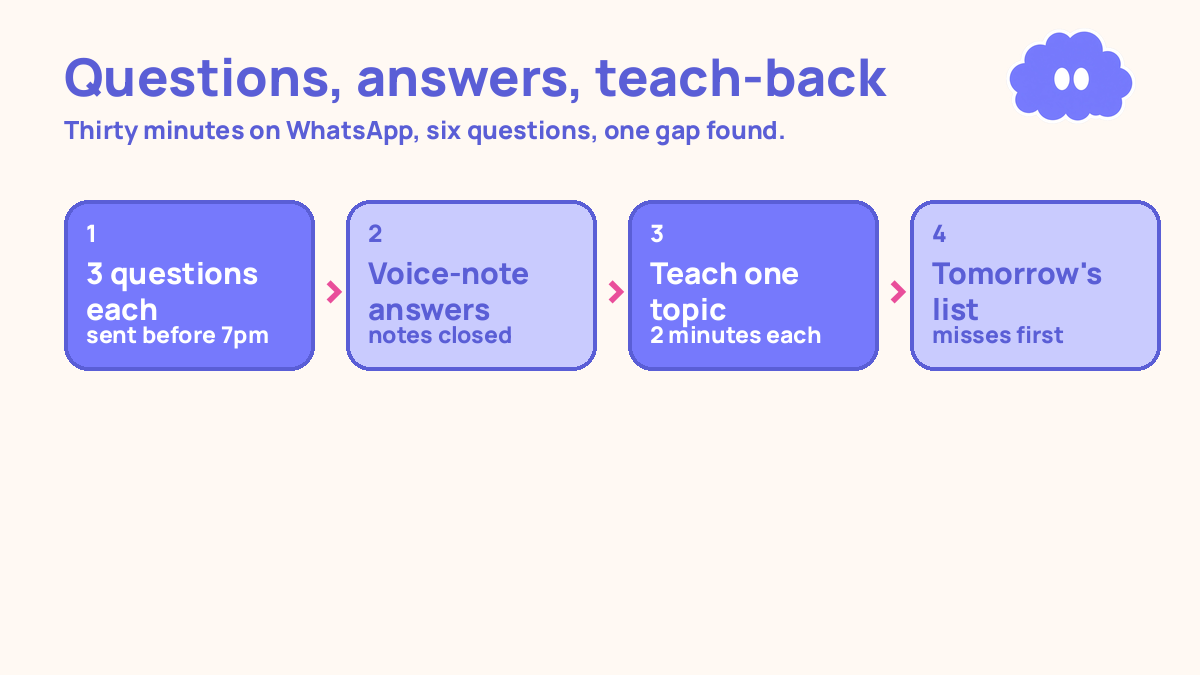
- Before each session, each of you sends the other three short-answer questions from your own notes.
- Answer the questions by voice note, with your notes closed, then check each answer against your notes.
- Teach one topic back to each other in a two-minute voice note, and note where the explanation breaks.
- End the session by sending tomorrow’s questions and agreeing tomorrow’s time.
Step 1: Pick one friend, one subject, and one time
One friend. One subject. One time. Not three friends, not five subjects, not “whenever we are free.” A system with one friend and one time is a system that happens. A system with three friends and no time is a group chat.
Pick the subject you both have a test in, and the time you are both actually free — after school, after dinner, whenever the house is quiet. Then write it as an if-then plan, and send it to each other: “If it is 7pm, then we send each other three questions about today’s topic.” An if-then plan names the cue and the action in advance, so starting does not need a fresh decision every evening. Across 94 studies, if-then plans raised goal attainment by a medium-to-large amount over holding the goal alone (Gollwitzer & Sheeran, 2006).
Agree the rules in the first message, and keep them short: three questions each, short answers, voice notes, notes closed, check after. If a rule is not agreed in advance, it will be argued about in the session, and the session will become the argument.
Step 2: Send three questions each, before the session
Before the session starts, each of you sends three short-answer questions from your own notes. Not multiple choice — short answers, one fact per question, with the answer in a separate message that you do not open until you have answered. Recall beats recognition as practice (Rowland, 2014): a multiple-choice question lets you recognise the answer, and a short-answer question makes you produce it.
Write the questions from your notes, not from memory. The notes are the source of truth, and a question your notes cannot answer is a question to throw out. If you write a question and then cannot answer it yourself, that is fine — it is a question you both need to learn, and it goes on tomorrow’s list.
Send the questions at least an hour before the session, so neither of you is writing questions during study time. The session is for answering, not for writing. If one of you has no questions ready, the session still happens: the one who is ready sends three, and the other answers them and sends three back tomorrow.
Step 3: Answer by voice note, notes closed, then check
When the session starts, answer the three questions by voice note, with your notes closed. One voice note per question, one minute each. Say the answer in your own words, out loud, before you look at anything. Writing the answer down works too, but a voice note has an advantage on WhatsApp: your friend hears the hesitation, the pause, the part where you slow down. The hesitation is the gap, and your friend can hear it even when you cannot.
Then open your notes and check each answer, and send the check as a message: right, partly right, or wrong, with the correct answer written in your own words. “Partly right” counts as wrong — a half-remembered definition will fail you just as surely as a blank one. Do not copy the answer from a website. Your notes are the source of truth, and if you and your friend disagree about an answer, the notes decide. If the notes do not settle it, ask the teacher — a question you bring with your notes open is a good question.
Keep the misses. The questions you got wrong are tomorrow’s first questions. That is the re-test list, and it is the whole point of the session. Re-testing what you already know feels good and teaches nothing.
Step 4: Teach one topic back to each other
After the questions, each of you teaches one topic back to the other in a two-minute voice note. Pick the topic you are weakest on, not the one you know best. Teaching the weak topic is where the gaps show up. “Explain the two stages of photosynthesis in two minutes, as if I had never heard of it.” Then the other person asks one question about the explanation — the question they would ask if they were confused, not the question they already know the answer to.
Explaining in your own words is a moderate-utility technique (Dunlosky et al., 2013), and a 2018 meta-analysis across 64 reports found a moderate average benefit for prompting self-explanation (Bisra et al., 2018). The original study behind it was small — 8 physics students, thinking aloud while they studied worked examples (Chi et al., 1989) — so treat the teach-back as a practical check, not a proven method. The check is simple: if your explanation breaks, the break is the next day’s work.
If you cannot explain a topic in two minutes, you do not know it yet. That is not a failure. It is the most useful thing a session can tell you, because it tells you exactly what to study tomorrow.
Step 5: End by sending tomorrow’s questions and agreeing tomorrow’s time
End every session the same way. Each of you sends tomorrow’s three questions — starting with the ones you got wrong today — and confirms tomorrow’s time. “Same time tomorrow, 7pm, chemistry, three questions each.” Then stop. The session is done, and the chat goes quiet until tomorrow.
Do not let the study chat become a general chat. A study chat that fills up with memes and videos is a study chat that stops being a study chat. Keep a separate chat for the study, or keep the study messages in one thread and everything else in another. The separation is the system.
If your friend does not reply one day, the session still happens, alone. Answer your own three questions by voice note, send them anyway, and study the topic by yourself. A study partner who replies late is still a study partner — but the system must not depend on their reply. If your friend stops replying for a week, find another friend, or use the same system alone: three questions, voice notes, check, teach-back recorded to yourself. The system works with one person. It works better with two.
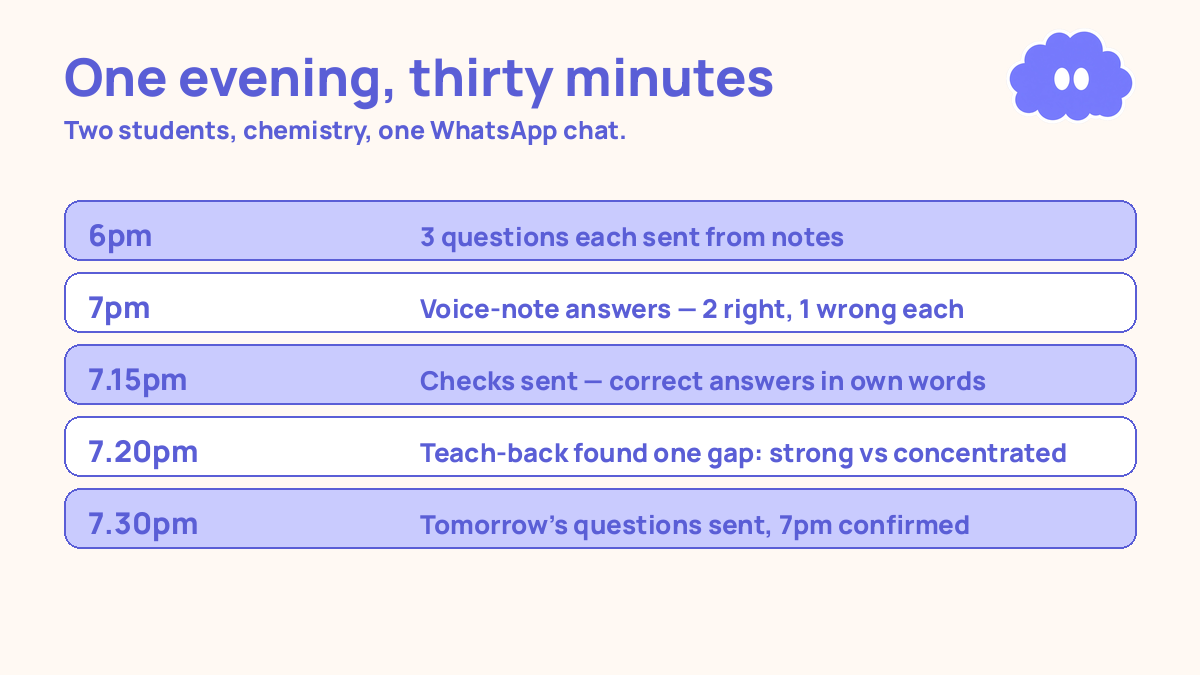
A worked example: two students, chemistry, one evening
This is a worked example, with the article’s own numbers — not real students, and not a promise of a grade.
You and your friend both have a chemistry test in two weeks. You agree: 7pm, every evening, chemistry, three questions each, voice notes, notes closed.
6pm — questions sent: You send three questions from your notes on acids and bases: “What is the pH of a neutral solution?”, “Write the equation for hydrochloric acid reacting with sodium hydroxide”, “What does a base do to litmus paper?” Your friend sends three on the same topic: “Name two strong acids”, “What is neutralisation?”, “What colour does universal indicator turn in an acid?”
7pm — answers by voice note: You answer your friend’s three by voice note, notes closed. Two right, one wrong — you say “neutralisation makes a salt and hydrogen” and it is wrong, it makes a salt and water. Your friend answers yours: two right, one partly right — the equation is missing the state symbols.
7.15pm — check: You both send the checks as messages, with the correct answers in your own words. The two misses go on tomorrow’s list.
7.20pm — teach-back: You teach acids and bases in two minutes. You stumble on the difference between a strong acid and a concentrated acid. Your friend asks one question: “So can a strong acid be dilute?” You cannot answer it. That is tomorrow’s first question.
7.30pm — tomorrow: You send tomorrow’s three questions — the two misses, plus “Can a strong acid be dilute?” — and confirm 7pm tomorrow. Session done, in thirty minutes.
| Time | What happened | The check |
|---|---|---|
| 6pm | 3 questions each sent | From notes, short answers |
| 7pm | Voice-note answers, notes closed | You: 2 right, 1 wrong; friend: 2 right, 1 partly right |
| 7.15pm | Checks sent as messages | Correct answers in your own words |
| 7.20pm | Teach-back, 2 minutes each | One gap found: strong vs concentrated |
| 7.30pm | Tomorrow’s questions sent | 2 misses + 1 new question, 7pm confirmed |
When it goes wrong
The session becomes a chat. You open WhatsApp to study and spend forty minutes talking about everything except the topic. The fix is the structure: questions first, voice notes second, teach-back third, tomorrow’s questions last. If the chat drifts, send the next question. The question is the steering wheel.
One of you does all the work. You write the questions, you answer, you check, and your friend sends “ok”. Then you have a student, not a partner. Say so, once, plainly: “Three questions each, or it does not work.” If it does not change in a week, find another partner, or run the system alone.
You both get a question wrong and decide it must be a trick question. It is probably not a trick question. It is a gap you both share, and that is the best result a session can give you. Look it up in the notes together, write the correct answer in your own words, and make it tomorrow’s first question.
You check the answers during the test, not after. If you open the notes while you answer, the test is not a test. Notes closed means notes closed. The voice note is the proof: if you cannot say it with the notes closed, you cannot say it in the exam either.
Your friend stops replying. It happens. Do not chase them for a week. Run the session alone — three questions, voice notes, check, teach-back recorded to yourself — and find another partner for the next subject. The system works with one person. It works better with two, but it does not break with one.
Weekly review checklist
Copy this list and use it each week:
- How many sessions did we actually hold this week, and how many were lost to chat?
- Which questions are still wrong on the second test, and did we make them tomorrow’s first questions?
- Did the teach-back find a gap this week, and did we study that gap the next day?
- What one change will we make next week: earlier questions, stricter notes-closed rule, or a separate study chat?
Downloadable infographic spec: one vertical image, title “Use WhatsApp to study with a friend”, with the five steps — one friend, three questions each, voice-note answers, teach one topic back, tomorrow’s questions — and the rule “the phone you already have becomes a study partner who tests you” in Thynq cream, Cloud Purple, Dark Purple and pink, with the cloud mascot. Text taken word-for-word from this article.
What this system is not
It is not a claim that studying with a friend is better than studying alone, and it is not a claim that WhatsApp is a study tool. It is a way to use the app you already open every day to do the two things that make study work — testing yourself, and getting feedback on the test — with a partner who is somewhere else, and to measure whether the work actually happened, instead of hoping it did.
Sources
- Dunlosky, J., et al. (2013). Psychological Science in the Public Interest, 14(1), 4-58. Only practice testing and distributed practice rated high utility.
- Rowland, C. A. (2014). Psychological Bulletin, 140(6), 1432-1463. Across 61 studies, testing beat restudying, with a larger advantage with feedback; recall formats beat recognition formats.
- Gollwitzer, P. M. & Sheeran, P. (2006). Advances in Experimental Social Psychology, 38, 69-119. Across 94 studies, if-then plans raised goal attainment by a medium-to-large amount.
- Roediger, H. L., & Karpicke, J. D. (2006). Psychological Science, 17(3), 249-255. Retrieval practice beat restudying after a delay.
- Chi, M. T. H., et al. (1989). Cognitive Science, 13(2), 145-182. The 8 students who explained most solved problems best.
- Bisra, K., et al. (2018). Educational Psychology Review, 30(3), 703-725. Prompting self-explanation gave a moderate average benefit across 64 reports.
For the study-buddy system this fits with, read how to study with a study buddy online, and for the group version, read how to revise with a study group.
Questions
What if my friend does not reply on time?
Then the session still happens, alone. Answer your own three questions by voice note, send them anyway, and study the topic by yourself. A study partner who replies late is still a study partner — but the system must not depend on their reply. Your questions are yours.
Should we study the same subject?
Yes, for the question exchange to work. If you study different subjects, you can still use the check-in part — same time, same blocks, report back after each block — but you cannot test each other. Pick the subject you both have a test in, and use that one.
How is this different from just chatting about the subject?
Chatting is talking about the topic. This system is testing each other on it: questions written before the session, answered with notes closed, checked against the notes, and the misses re-tested tomorrow. The questions and the checking are what make it study instead of chat.
What if we both get a question wrong?
Then you have found a real gap, and that is the best result a session can give you. Look it up together in the notes or textbook, write the correct answer in your own words, and make it tomorrow’s first question. Two people wrong on the same point means the teaching missed it, not just you.