The direct answer
Use ChatGPT to test yourself before an exam: give any AI chat app your own notes, ask it to quiz you in short answers, and answer from memory with your notes closed. Then check every mark against your notes, because AI gets things wrong.
Your exam is coming up, and you have a pile of notes and nobody to test you. So you re-read the notes, and re-reading feels like learning. It is not. Feeling fluent right after re-reading is not the same as remembering a week later — in one study, students who recalled a passage remembered more a week later than students who restudied it, even though the restudiers felt more confident right after studying (Roediger & Karpicke, 2006).
This system gives you an examiner you already have: any AI chat app on your phone, plus your own notes. The AI asks the questions and checks your answers, and you verify every mark yourself — AI is a fast examiner and an unreliable one.
This is different from the general retrieval practice system for students, where you test yourself with your own questions. Here, AI writes the questions from your notes.
The system in short
- Pick one topic, and gather your notes for it — your own notes, from class or your textbook.
- Open any AI chat app you already have on your phone. ChatGPT is named in the title, but any AI chat app works.
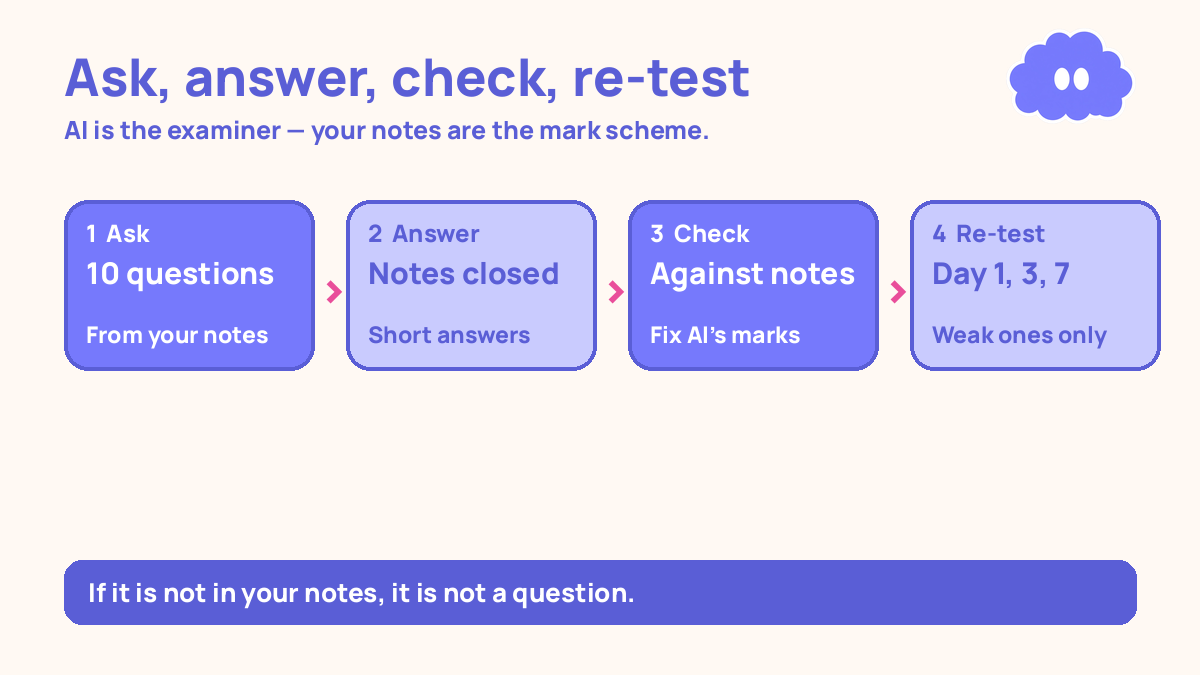
- Paste the notes in, and tell it to ask you ten short-answer questions, one at a time, only from those notes.
- Answer each question from memory, notes closed, before the AI shows you anything.
- Ask it to check each answer against your notes, and say exactly what was missing.
- Check its marking yourself against your notes — no mark stands until you have seen the note behind it.
- Write the gaps down, fix them, and repeat the topic on day 1, day 3, and day 7.
Step 1: Pick one topic and gather your notes
Pick one topic — one chapter, one lecture, one section of the syllabus. Not the whole subject. A quiz on the whole subject asks one shallow question per topic and tells you nothing.
Gather the notes for that one topic: your own notes, in your own words, from class or from your textbook. The questions can only be as good as the notes they come from, so thin notes make a thin quiz — and that is useful information in itself.
Step 2: Open any AI chat app and give it the rules
Open any AI chat app you already have on your phone. ChatGPT is named in this article because it is the one most students already have, but any AI chat app that can read your notes and reply will do.
Paste the notes in, with clear rules in the same message:
“Quiz me on these notes. Ask me ten short-answer questions, one at a time, only about what is in these notes. Wait for my answer before you ask the next question. When I answer, check it against the notes and tell me what I got right, what I missed, and the exact line in my notes that has the answer.”
“One at a time” stops the AI dumping all ten questions at once. “Only about what is in these notes” is the rule it will break most often. “Wait for my answer” is what makes this a test instead of a lecture.
Step 3: Answer from memory, notes closed
Answer each question from memory, with your notes closed. Type the answer in your own words — a sentence or two, not a copied line. Short-answer recall is the format that works best as practice: across 61 studies, testing yourself beat restudying, and recall formats like short answers beat recognition formats like multiple choice as practice (Rowland, 2014).
Do not ask the AI for a hint before you have tried. If you genuinely cannot answer, say “I don’t know” and move on — an honest blank is more useful than a guessed answer the AI marks right by luck, because the blank goes on your fix list and the lucky guess does not.
Step 4: Let AI check your answer, then check its check
When you answer, the AI checks it against your notes and tells you what was missing. This is feedback, and feedback is what makes testing work: across the same 61 studies, the advantage of testing over restudying was larger with feedback than without it (Rowland, 2014).
So check the AI’s check. Open your notes and find the line it quoted. If the line is there and your answer matches it, the mark stands. If the AI says your answer was wrong but your notes say the same thing in different words, your answer was right — wording differences are its most common error. If the AI says your answer was right but you cannot find the point in your notes, the mark does not stand.
This check takes a minute per question. Do not skip it because the AI sounded confident. Your notes are the judge, not the AI.
Step 5: Handle the questions that are not in your notes
AI will ask questions your notes do not cover. It fills gaps from its own knowledge — it has read the whole internet about your subject, and when your notes run out, it reaches for that instead.
Do not answer those questions as if they count, and do not add them to your fix list. If the answer is not in your notes, say so to the AI — “that is not in my notes, ask me another question from the notes” — and move on. If more than two or three questions in a round of ten are off-notes, stop the round and paste in more notes, or narrow the topic.
Step 6: Turn the gaps into a fix list, and repeat on day 1, 3, and 7
Once the round is checked, write the gaps down — the questions you missed, in your own words, one line each. Group them by sub-topic: three missed questions about one idea is one gap, not three.
Then fix each gap by testing yourself again, not by re-reading. In a 2013 review, Dunlosky and colleagues rated practice testing and distributed practice high utility, and re-reading low. For each gap, close the notes and answer again from memory, then check.
Repeat the whole topic on day 1, day 3, and day 7 after the first quiz. That 1-3-7 pattern is a practical starting schedule, not a research rule — the research says spacing beats cramming, and the exact gap is yours to adjust.
A 25-minute session fits one round plus the checking. That 25/5 timer is a practical choice, not a number from cognitive science — Cirillo picked 25 minutes for his own kitchen timer, and a 50-minute block works just as well.
A worked example: biology, one topic, three rounds
This is a worked example, with the article’s own numbers — not a real student, and not a promise of a grade.
Your exam is in two weeks, and your topic is cell respiration. Your notes cover the stages, where each happens, the energy carriers, and aerobic versus anaerobic respiration. You paste them in and ask for ten short-answer questions, one at a time, only from the notes.
Round 1, day 1: you answer 6 out of 10 from memory. The AI says 6, and you check it — one answer the AI marked wrong was right in different words, so your checked score is 7 out of 10. The gaps: where the Krebs cycle happens, NADH confused with FADH2 twice, and the net ATP from glycolysis. You fix them that evening, one note at a time, answers from memory.
Round 2, day 3: ten new questions from the same notes. You answer 8 out of 10, and the AI’s check agrees. The two misses are both on the ATP numbers, wrong in the same way. That is one gap, not two, and it goes back on the fix list.
Round 3, day 7: ten new questions again. You answer 9 out of 10. The one miss is a question about a detail that is not in your notes — an enzyme your teacher never mentioned. You ignore it, tell the AI it is off-notes, and your checked score stands at 9 out of 9 questions that were actually in your notes.
| Round | Day | Questions | Checked score | What the gaps were |
|---|---|---|---|---|
| 1 | Day 1 | 10 | 7 / 10 | Krebs cycle location, NADH vs FADH2, ATP from glycolysis |
| 2 | Day 3 | 10 | 8 / 10 | ATP numbers, same mistake twice |
| 3 | Day 7 | 10 | 9 / 9 in-notes | One off-notes question ignored |
| Total | 30 asked | 24 / 29 in-notes | One gap left: ATP numbers |
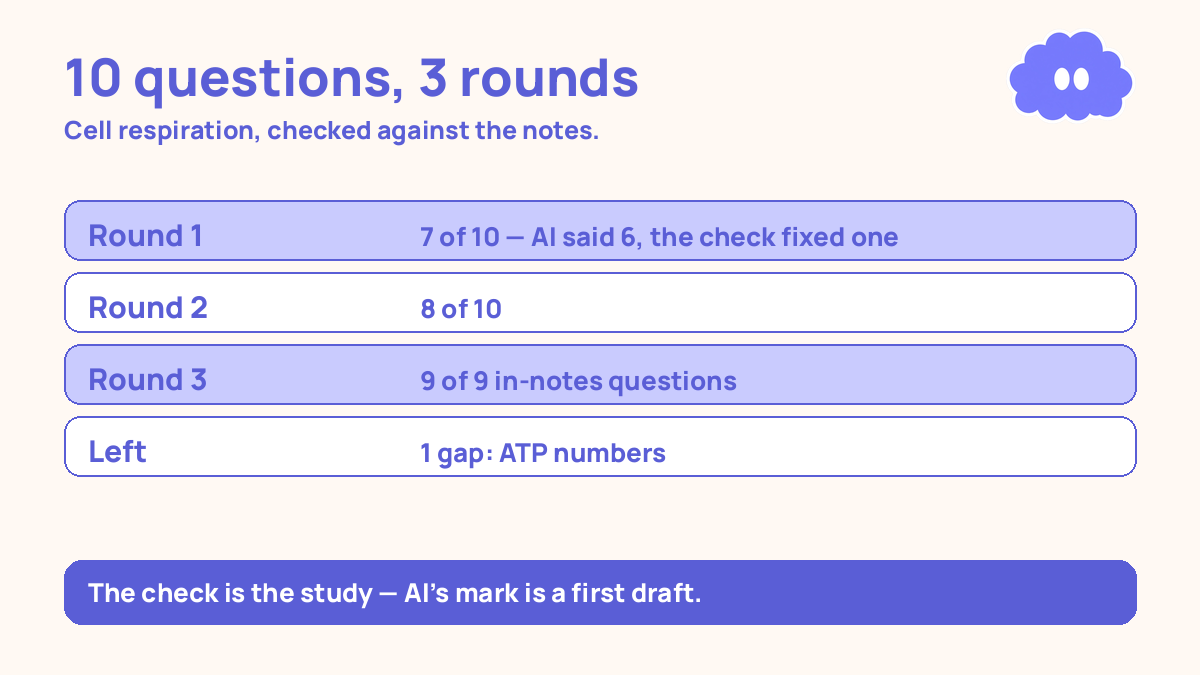
The score rose, but the score is not the point. The fix list shrank: three gap groups after round 1, one after round 2, and one small gap — the ATP numbers — left after round 3. If you have a mock exam coming up, use it the way how to use mock exams to prepare describes it: the mock is a rehearsal, not a verdict.
When it goes wrong
You let AI give you the answers before you try. If the AI explains the answer first, you have not tested yourself. You have copied. Answer first, always, even if the answer is “I don’t know”.
You trust the AI’s marking without checking it. A generous mark hides a weak topic; a strict mark wastes a week on a strong one. The check takes a minute per question. Do it every time.
You answer questions that are not in your notes. If half the quiz is about things your teacher never taught, you are studying for a different exam. Pull the AI back to your notes.
You ask for multiple-choice questions. Multiple choice is easier to answer and weaker as practice — Rowland (2014) found recall formats beat recognition formats as practice. If the AI gives you multiple choice, tell it to switch to short answers.
You quiz the whole subject in one session. One topic, ten questions, one fix list.
You use this on work that counts. This system is for practice quizzes from your own notes only. Do not paste coursework or assessed work into an AI app.
Weekly review checklist
Copy this list and use it each week:
- Which topics did I quiz with AI this week, and did every round use only my notes?
- Did I check every AI mark against my notes, and how many marks did the check move?
- Which gap is still on my fix list after the day 7 round?
- Did I answer from memory every time, notes closed, before the AI showed me anything?
Downloadable infographic spec: one vertical image, title “Use ChatGPT to test yourself before an exam”, with the seven steps and the rule “AI asks, you answer, your notes decide” in Thynq cream, Cloud Purple, Dark Purple and pink, with the cloud mascot. Text taken word-for-word from this article.
What this system is not
It is not a promise of a better grade, and it is not a replacement for a teacher. A teacher knows your subject, your syllabus, and your common mistakes. This system is for the weeks when no one is free to test you — honest questions from your own notes, checked against those same notes, from the tools already on your phone.
Sources
- Rowland, C. A. (2014). Psychological Bulletin, 140(6), 1432-1463. Across 61 studies, testing beat restudying; the advantage was larger with feedback, and short-answer recall beat multiple-choice.
- Roediger, H. L., & Karpicke, J. D. (2006). Science. Students who recalled a passage remembered more a week later than restudiers, though the restudiers felt more confident right after studying.
- Dunlosky, J., et al. (2013). Psychological Science in the Public Interest, 14(1), 4-58. Only practice testing and distributed practice rated high utility; rereading rated low.
For the full system, read the retrieval practice system for students, and for mocks, read how to use mock exams to prepare.
Questions
Can ChatGPT test me properly before an exam?
Yes, if you give it your own notes and tell it exactly what to ask. It asks short-answer questions from your notes and checks your answers. It cannot replace a teacher, and you must check its marking yourself.
What if it asks questions that are not in my notes?
It will, sometimes — AI adds questions from its own knowledge. Tell it to ask only about what is in the notes you pasted, and ignore any question you cannot find in your notes.
Should I let it give me the answers?
No. You answer first, from memory, notes closed. AI checks your answer against your notes and tells you what was missing. If AI gives the answer before you try, you have not tested yourself.
How many questions should I do in one session?
Ten questions per round, in a 25-minute session, is a practical starting point. Repeat the whole topic on day 1, day 3, and day 7.