
The direct answer
Use AI to find gaps in your thesis argument: take one section of your draft chapter, paste it into an AI chat app, and ask it to question the argument — what is assumed, what is not supported, where the reasoning jumps. Then check every question yourself against your sources, because AI invents problems that are not there. The gaps you confirm are the ones worth fixing.
You have read your own chapter so many times you can no longer see the holes in it. Your supervisor has not replied yet, and you do not want to sit still for a week. That is the moment this system is for — not to replace your supervisor, but to give you a reader who asks awkward questions while you wait.
The tool is one you already have: any AI chat app on your phone, plus your draft. Explaining your argument in plain words is the work that finds the gaps. That is self-explanation. The original study was tiny — 8 students, observed while they studied worked examples (Chi et al., 1989) — but a meta-analysis across 64 reports found prompting self-explanation gave a moderate average benefit, strongest for principle-based material (Bisra et al., 2018).
The system in short
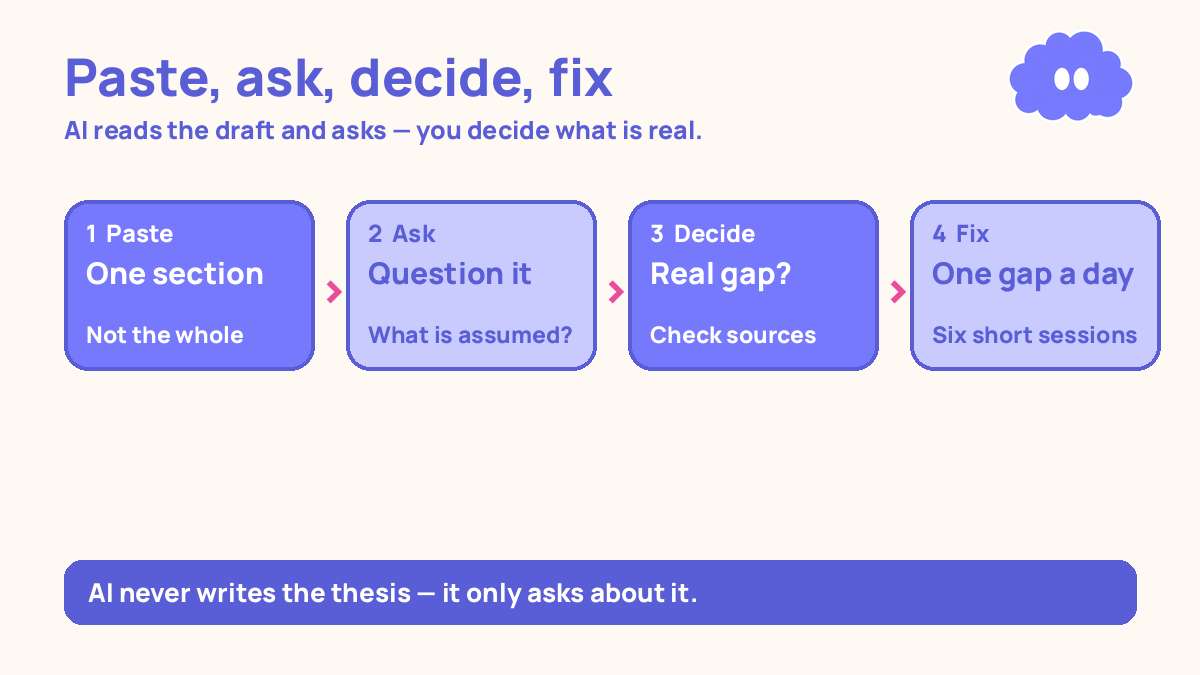
- Pick one section of your draft chapter — about 800 to 1,200 words — and read it once yourself, aloud if you can.
- Paste that section into an AI chat app, with a prompt that tells it to question the argument, not praise it.
- Ask AI to list every assumption, every claim without evidence, and every place the argument jumps — as questions.
- Check every question against your sources. Sort them: real gap, unclear wording, or false alarm.
- Fix one real gap per session, then re-read the section aloud.
- Repeat for the next section. After a week, send the chapter to your supervisor with a short list of what you changed.
Step 1: Pick one section, and read it aloud first
Do not start with the whole chapter. Pick one section — the part where you make one argument, not three. About 800 to 1,200 words. AI asks better questions about a small passage, and you can check its questions properly when there are only a few of them.
Read the section aloud, slowly, before you paste anything. Your ear catches sentences your eye skips over. When you stumble over a sentence, mark it. When you cannot say in one line what a sentence proves, mark that too.
Step 2: Tell AI to question the argument, not praise it
Open any AI chat app you already have on your phone — no paid app or special thesis tool needed. The questions you get are only as good as your instructions, so give it clear ones.
AI is trained to be helpful and encouraging. Left alone, it will tell you the argument is strong and well structured, and it will be wrong. You need the opposite: a reader who argues with you.
Use a prompt like this:
“Read this section of my thesis draft. Do not praise it and do not rewrite it. Question the argument: list every claim with no evidence, every assumption I make without saying so, and every place the argument jumps without a link. Put each one as a single question.”
Paste one section, then wait for the questions. Do not paste a second section in the same chat until you have finished checking the first.
Step 3: Make AI explain its questions in simple words
Once you have the list of questions, pick the ones you cannot answer straight away. For each one, ask AI to put it in the simplest terms it can.
“Explain this question in simple words. What exactly is missing — evidence, a definition, or a link between two ideas?”
Explaining an argument in simple words is where the gaps show up. A claim that needs three paragraphs of jargon to defend is usually a claim with a hole in it.
In the study that started this idea, 8 physics students studied worked examples while thinking aloud. The 4 who later solved problems best had explained 15.3 things per example; the 4 who did worst had explained 2.8 (Chi et al., 1989). That was a small observational study — a pattern, not proof. The stronger evidence is the meta-analysis: prompting self-explanation gave a moderate average benefit across about 5,917 learners, best for principle-based material (Bisra et al., 2018).
There is no peer-reviewed study of the Feynman technique itself — “explain it in simple words, find the gaps” is a practical method, not a research finding. Use it as a method. Do not cite it as proof.
Step 4: Check every question against your sources
This is the step that makes the system work, and the one most students skip. AI questions are suspects, not verdicts. Check each one against your own sources, one at a time.
First, the real gaps. These are the questions where the answer is no — the claim is in your chapter, but the evidence is not. The claim might be true, but the reader cannot see why.
Second, the unclear wording. These are the questions where the evidence is there, but buried — in a footnote, in the wrong paragraph, or written in a way a tired reader would miss. The argument is fine. The writing is not. Mark these as wording fixes.
Third, the false alarms. AI will invent problems. It will question a claim that is properly supported two paragraphs down. When the evidence is clearly there, say so, cross the question out, and move on.
Step 5: Fix one real gap per session
Pick one real gap — the one that matters most to the argument, not the easiest one — and fix it in one session. One gap, one session. Fixing five in a day means fixing none of them properly.
There are only three honest fixes. Add the evidence: cite the source, or add the data, or name the study. Qualify the claim: write the weaker claim the evidence supports — “suggests” instead of “proves”. Or cut the sentence: if the claim does no work for the argument, delete it.
Do not ask AI to write the fix. AI finds the gap; you write the words. If AI writes the paragraph, you have tested AI, not yourself — and your supervisor will hear a different voice in the middle of your chapter. Use AI to check your fix instead: paste your rewritten sentence and ask, “does this sentence now have the evidence it needs?”
When the fix is done, re-read the section aloud once more. If your fix broke the flow, the fix was too big, or the gap was bigger than one sentence. Note it, and take it to your supervisor.
See how to write a thesis discussion chapter for building an argument section by section, and how to handle supervisor feedback on a thesis for what to do when the feedback arrives.
Step 6: Repeat for the next section, then send the chapter
Work through the chapter one section at a time, in the order a reader meets them. Do not jump to the section you are most worried about and skip the rest — the gaps you are least worried about are often the ones you have stopped noticing.
Keep a running list as you go: real gaps found, real gaps fixed, false alarms dropped. Three columns, one page. If the same kind of gap keeps appearing — missing evidence, or claims that jump too far — that is a pattern, not a set of accidents.
After a week of this, send the chapter to your supervisor, with a short note: two or three lines about what you changed and why.
A worked example: one discussion section, 18 questions, one afternoon
This is a worked example, with the article’s own numbers — not a real student, and not a promise of a grade.
You have a draft discussion section, 1,100 words, arguing that a new teaching method improved student results. You read it aloud once and mark two sentences you stumble over. Then you paste the section into an AI chat app. AI asks 18 questions.
You check all 18 against your sources. Six are real gaps: two claims with no evidence given, two unstated assumptions, and two jumps where the argument skips a step. Five are unclear wording: the evidence is there, but buried in the wrong paragraph. Seven are false alarms: AI questioned claims that are properly supported two paragraphs down, or misunderstood a term.
You fix one real gap per session, in 25-minute blocks with 5-minute breaks — a practical starting timer, not a research rule. The first gap: you wrote “the method worked better for weaker students” with no evidence in the section. Your data does show that, but it is in your results chapter, not here. The fix is one sentence pointing to the result. The second gap: you assumed all students used the method the same way, without saying so.
| Question type | Asked by AI | Real | Wording fix | False alarm |
|---|---|---|---|---|
| Claim with no evidence | 6 | 2 | 2 | 2 |
| Unstated assumption | 5 | 2 | 1 | 2 |
| Argument jump | 4 | 2 | 1 | 1 |
| Definition or term | 3 | 0 | 1 | 2 |
| Total | 18 | 6 | 5 | 7 |
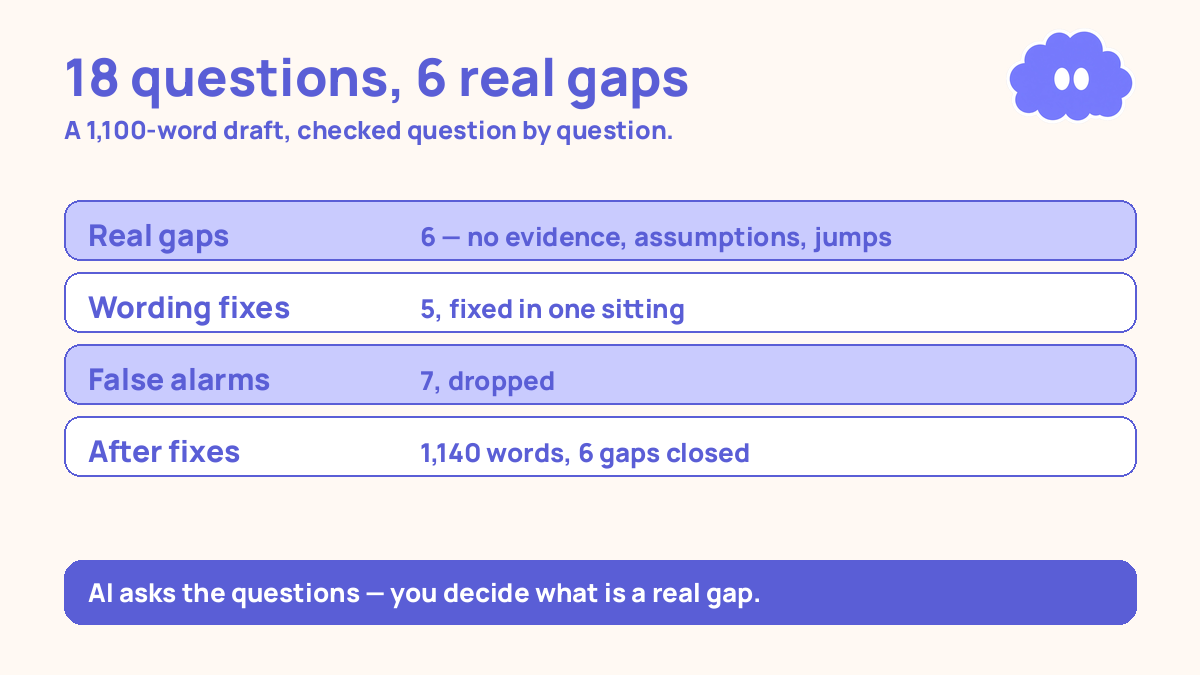
Six real gaps, five wording fixes, seven false alarms. You fix the six real gaps over six short sessions, one per day, and the five wording fixes in one sitting. The seven false alarms you drop without touching the text.
After the fixes, you re-read the section aloud. It is 1,140 words now — forty words longer, because the evidence you added takes space. Every claim now has something behind it.
When it goes wrong
You accept every AI question as a real gap. This fails quietly. You spend a week fixing problems that were never there, and your chapter gets longer and weaker. AI invents roughly a third of its questions in the worked example above — seven out of eighteen. Check every question against your sources before you touch the text.
You paste the whole chapter in at once. A whole chapter in one message gets shallow questions, and AI starts inventing things to fill the gaps. One section at a time, about 800 to 1,200 words.
You let AI rewrite the paragraphs. If AI writes the fix, the voice changes, the argument drifts, and your supervisor will notice. AI finds gaps. You write the words. That line never moves.
You use this on work that counts, or on someone else’s words. This system is for your own draft. Do not paste coursework or assessed work into an AI app if your university’s rules forbid it — your institution’s rules come first.
Weekly review checklist
Copy this list and use it each week:
- Which section did I run through AI this week, and how many questions did it ask?
- How many were real gaps, wording fixes, and false alarms?
- Did I fix one real gap per session, and did the section read better aloud afterwards?
- Did the same kind of gap keep appearing, and what does that tell me about how I write?
Downloadable infographic spec: one vertical image, title “Use AI to find gaps in your thesis argument”, with the six steps and the rule “AI asks, you check, your sources decide” in Thynq cream, Cloud Purple, Dark Purple and pink, with the cloud mascot. Text taken word-for-word from this article.
What this system is not
It is not a promise of a better grade, and it is not a replacement for your supervisor. A supervisor knows your field, your data, and your argument in a way no AI app does. This system is for the weeks when you are waiting — honest questions about a draft from the tools already on your phone, checked against your own sources. It is also not a way to write a thesis by AI. If AI is writing your argument, it is not your argument.
Sources
- Chi, M. T. H., et al. (1989). Cognitive Science, 13(2), 145–182. In a small observational study of 8 students, the 4 who solved problems best had explained 15.3 things per example; the 4 who did worst had explained 2.8.
- Bisra, K., et al. (2018). Educational Psychology Review, 30(3), 703–725. Across 64 reports, prompting self-explanation gave a moderate average benefit, strongest for principle-based material.
- Dunlosky, J., et al. (2013). Psychological Science in the Public Interest, 14(1), 4-58. Practice testing and distributed practice rated high utility; self-explanation rated moderate.
Questions
Can AI understand my thesis argument?
Well enough to ask useful questions. AI can spot where a claim has no evidence, where a paragraph assumes something, and where the argument jumps. It cannot judge whether your argument is right.
What if AI invents a problem that is not there?
It will, more than once. Treat every AI question as a suspect, not a verdict. Check each one against your sources.
Should I paste my whole chapter into AI?
No. Work one section at a time, about 800 to 1,200 words per pass. A whole chapter in one message gets shallow questions.
What do I do with the gaps once I find them?
Sort them first: real gaps, unclear wording, and false alarms. Fix one real gap per session, then re-read the section aloud.