The direct answer
Stuck on a topic with no tutor? Ask a free AI chat app to explain it in simple words, read the explanation, then explain it back in your own words out loud or on paper. The parts you cannot explain are the gaps. Ask AI about those exact gaps, re-explain, and check everything against your textbook before trusting it.
You are staring at a topic that will not move. The textbook paragraph is dense, the class notes are thin, and there is no tutor to ask. You have a phone and a free AI chat app. That is enough to start, but only if you use the AI the right way.
Most students use AI as a shortcut: type the question, copy the answer, move on. That feels like studying. It is not. You have read an answer, not learned a topic, and the next time the topic appears — in a test, in a harder chapter — it will be just as stuck as it was before.
This system uses AI differently. The AI explains, but you do the learning. You explain the topic back in your own words, and the places where your explanation breaks are the exact places you need to work on. That gap-finding is the whole point. Explaining is not a test of what you already know. It is the work that builds the knowing.
The system in short
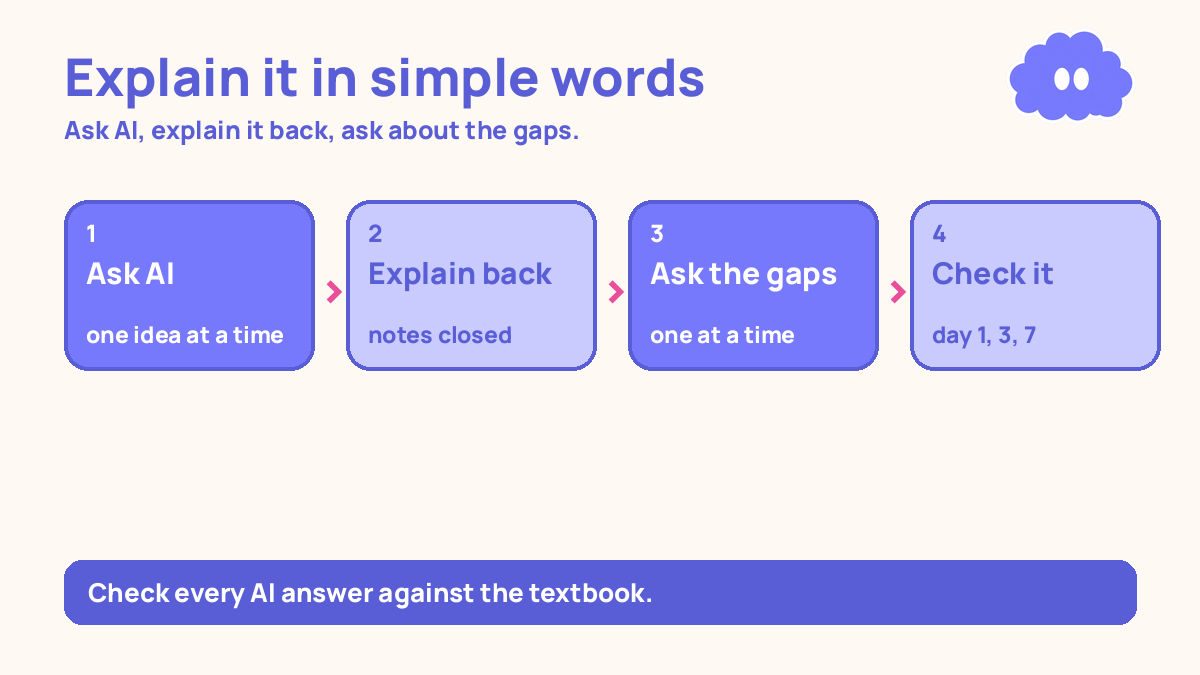
- Pick one topic and ask AI to explain it in simple words, one idea at a time.
- Read the explanation slowly and mark every sentence you do not really follow.
- Close the phone and explain the topic back in your own words, out loud or on paper.
- List the exact parts you could not explain, and ask AI about those gaps only.
- Check every AI explanation against your textbook or class notes before you trust it.
- Re-explain the whole topic, then re-test it the next day, in three days, and in seven days.
Step 1: Ask AI to explain it in simple words
Pick one topic, not a whole chapter. “Photosynthesis” is a topic. “Biology” is not. A topic you can explain in five minutes is the right size. If you cannot say what the topic is in one sentence, it is too big — cut it down until you can.
Then ask the AI for a simple explanation, with rules attached. Do not type “explain photosynthesis” and accept whatever comes back. Type something like this:
“Explain photosynthesis in simple words, one step at a time, with an everyday example for each step. Use short sentences. Do not use words I have not met before without explaining them first.”
That prompt does three things. It asks for simple words, so the answer comes back at your level instead of the textbook’s level. It asks for one step at a time, so the answer is a sequence you can follow instead of a wall of text. And it asks for an everyday example for each step, because an example you already understand is the fastest way to hold a new idea.
If the answer comes back too hard, say so plainly: “Explain that again like I am 12.” If it comes back too long, say: “Give me the same explanation in five short steps.” You are allowed to push back. The AI is not a teacher with a fixed lesson. It is a tool that answers the question you actually asked, so ask a better question when the first answer misses.
Ask for one idea at a time. If the topic has three parts, ask about the first part, understand it, then ask about the second. A long answer that covers everything at once is hard to read, hard to remember, and hard to explain back. Short answers are easier to work with, and this system is built on working with the answer, not just reading it.
Step 2: Read the explanation slowly and mark what you do not follow
Read the AI’s explanation with a pen in your hand, or with your finger on the screen. Read it one sentence at a time, and after each sentence ask yourself: could I say this sentence in my own words? If yes, move on. If no, mark it.
Marking matters because most students read an explanation, feel that it makes sense, and move on — and the feeling is not evidence. In one study, students who recalled a passage remembered more a week later than students who restudied it, even though the restudiers felt more confident immediately after studying (Karpicke & Blunt, 2011). Feeling that something makes sense while you are reading it is not the same as being able to explain it when the phone is closed. The mark is the difference between those two things.
So be strict with yourself. A sentence you half-understand is a marked sentence. A word you have seen before but could not define is a marked word. A step that follows from the previous step in a way you cannot see is a marked step. You are not collecting marks to feel bad about. You are collecting the exact list of what to ask about next.
Write the marks down as a short list. Not “I don’t get photosynthesis” — that is too big to fix. Write “I don’t know what a stomata is”, “I don’t see why the plant needs sunlight and water at the same time”, “I can’t explain what happens to the oxygen”. Each item on that list is a question you can actually ask.
Step 3: Close the phone and explain it back in your own words
This is the step that does the learning, and it is the step most students skip.
Close the phone. Put the AI’s explanation away. Then explain the topic in your own words — out loud to an empty room, or written on paper. Do not look at the explanation while you do it. If you can only explain it while looking at it, you cannot explain it.
Start simple: “Photosynthesis is how a plant makes its own food. It takes in sunlight, water, and carbon dioxide, and it makes glucose and oxygen.” Then keep going, one step at a time, in the order the AI gave you. Use your own words, not the AI’s words. If you catch yourself repeating the AI’s exact sentence, stop and say it differently. Repeating is not explaining.
This works because explaining forces you to find the connections. Reading lets you glide over the parts you do not understand. Explaining does not let you glide. The moment you reach a part you cannot say, you have found a gap — and that gap is the most useful thing this system gives you.
There is research behind this, and it is worth knowing what it actually says. In a 1989 study, Chi and colleagues watched 8 physics students study worked examples while thinking aloud. The 4 students who later solved problems best — 82% correct — generated 15.3 explanations per example. The 4 who did worst — 46% correct — generated 2.8. That is a small observational study, and it is a pattern, not proof that prompting anyone to explain causes the same result. But the pattern is consistent: the students who explained more, understood more.
A larger review backs it up. Bisra and colleagues (2018) looked across 64 reports, 69 effect sizes, about 5,917 learners, and found that prompting self-explanation produced a moderate average benefit (g = 0.55), and the benefit held when time on task was controlled. It worked best for principle-based material — physics, maths, medicine — the kind of material where understanding the why matters more than memorising the what.
Dunlosky and colleagues (2013) rated self-explanation as moderate utility. Only two techniques rated high: practice testing and distributed practice. Rereading rated low. So explaining is a good technique, but it is not the best one on its own — which is why this system pairs explaining with testing yourself on the gaps, and with spacing the re-tests out.
That is also why this system is built around feynman-technique-for-students. The explain-it-simply method is the same idea: if you cannot explain it simply, you do not understand it yet. But be clear about one thing. The Feynman Technique itself has no peer-reviewed study proving it. Teach explain-it-simply as a practical method, never cite Feynman as research, and never claim Feynman proved anything about it. The research above is about self-explanation in general, and that is what you are doing here.
Step 4: Ask AI about the exact gaps, nothing else
Take the list from Step 3 — the parts you could not explain — and ask AI about those parts only. Not the whole topic again. The whole topic again gives you the same long answer, and you will glide over the same gaps. Ask about the gap, by name, with the exact sentence you could not explain.
“I tried to explain photosynthesis and I could not explain what a stomata is. Explain what a stomata is in simple words, with an everyday example.”
“Explain why the plant needs sunlight and water at the same time. I can explain each one on its own but I cannot explain how they work together.”
That kind of question gets a short, useful answer, because it is a small question. And because you asked about the exact gap, the answer lands on the exact place that was missing.
After each gap answer, explain that part back again, out loud or on paper, before moving to the next gap. Do not collect five gap answers and then try to explain them all at once. One gap, one answer, one re-explanation. Then the next gap.
This is also where you can ask AI to draft practice questions for you. “Give me five questions about photosynthesis that test whether I understand it, not whether I can repeat a definition.” Answer them with the notes closed. Then ask AI to check your answers — and check its checking against your textbook, because AI can mark a right answer wrong and a wrong answer right. This connects to elaborative-interrogation-for-students: asking why and how, not just what, is what turns a fact into something you understand.
Work through the whole gap list this way. When the list is empty — when you can explain every part — you have finished the topic for today. That does not mean you know it forever. It means you know it now, and the next step is to make it stick.
Step 5: Check everything against your textbook before you trust it
AI can be wrong. It can state a wrong fact confidently, mix up two similar terms, or invent a detail that sounds right and is not in your course. It does this without warning, and the simpler the explanation, the harder it is to spot, because a simple wrong answer feels just as smooth as a simple right one.
So this step is not optional. For every AI explanation you plan to keep — every fact you write into your notes, every step you will revise from — check it against your textbook or your class notes. Open the textbook to the same topic and compare. Does the textbook say the same thing? Does it use the same terms? Does the AI’s version leave out a step the textbook includes?
If the textbook and the AI disagree, the textbook wins. Your exam is set from your course, not from the AI. If you cannot find the point in the textbook at all, do not write it into your notes. Leave it out, or ask a teacher about it. An explanation you cannot verify is a guess, and a guess in your notes becomes a wrong answer in the exam.
This is also the line between using AI and letting AI do the work. AI is for explaining, for drafting practice questions, and for finding the gaps in what you understand. It must not write the work — your homework, your essay, your assignment — and it must not be trusted without checking. If AI writes it, you have not learned it. If you hand in AI’s words, you cannot explain them when you are asked about them, and you will not remember them when the topic comes back in a harder chapter.
A practical rule: your notes should be in your own words, from your own explaining. If a sentence in your notes sounds like the AI wrote it, rewrite it in your words, or delete it. Your notes are the record of what you understood, not a copy of what the AI said.
Step 6: Re-explain the whole topic, then re-test it on day 1, day 3, and day 7
Once the gaps are closed and the explanations are checked, explain the whole topic from start to finish, out loud or on paper, with the phone closed and the notes closed. This is the proof that the system worked. If you can explain the whole topic, in order, in your own words, without looking, you understand it today.
Then make it stick. Test yourself again the next day, in three days, and in seven days. That 1-3-7 pattern is a practical starting schedule, not a research rule. The research says spacing beats massing, and the right gap grows with how long you need to remember the material. A gap is what turns the second explanation into a real test instead of a repeat of the first one.
Each re-test is short. Explain the topic again, in your own words, and see which parts come back easily and which parts have gone soft. The soft parts go back on the gap list, and you ask AI about them again — the same way, one gap at a time, checked against the textbook. Three short re-tests beat one long re-read, and they take less time in total.
Use a 25-minute timer for each session, with a 5-minute break after it, or a 50-minute session with a 10-minute break if you are working on a bigger topic. 25/5 and 50/10 are practical timers, not prescriptions. The point of the timer is to keep the session short enough that you stay sharp, and to give you a clear stopping point so you do not drift into copying AI answers for an hour.
A worked example: a student stuck on photosynthesis, with a phone and no tutor
This is a worked example, with the article’s own numbers — not a real student, and not a promise of a grade.
A student has a biology test in two weeks. The topic is photosynthesis. The textbook paragraph is dense, the class notes are one page, and there is no tutor. The student has a phone and a free AI chat app. The whole topic has 7 parts: what photosynthesis is, sunlight, water, carbon dioxide, chlorophyll, glucose, and oxygen.
Day 1, session 1 — ask and read: The student asks AI to explain photosynthesis in simple words, one step at a time, with an everyday example for each step. The answer comes back in 7 steps. The student reads it slowly and marks 4 sentences they cannot say in their own words.
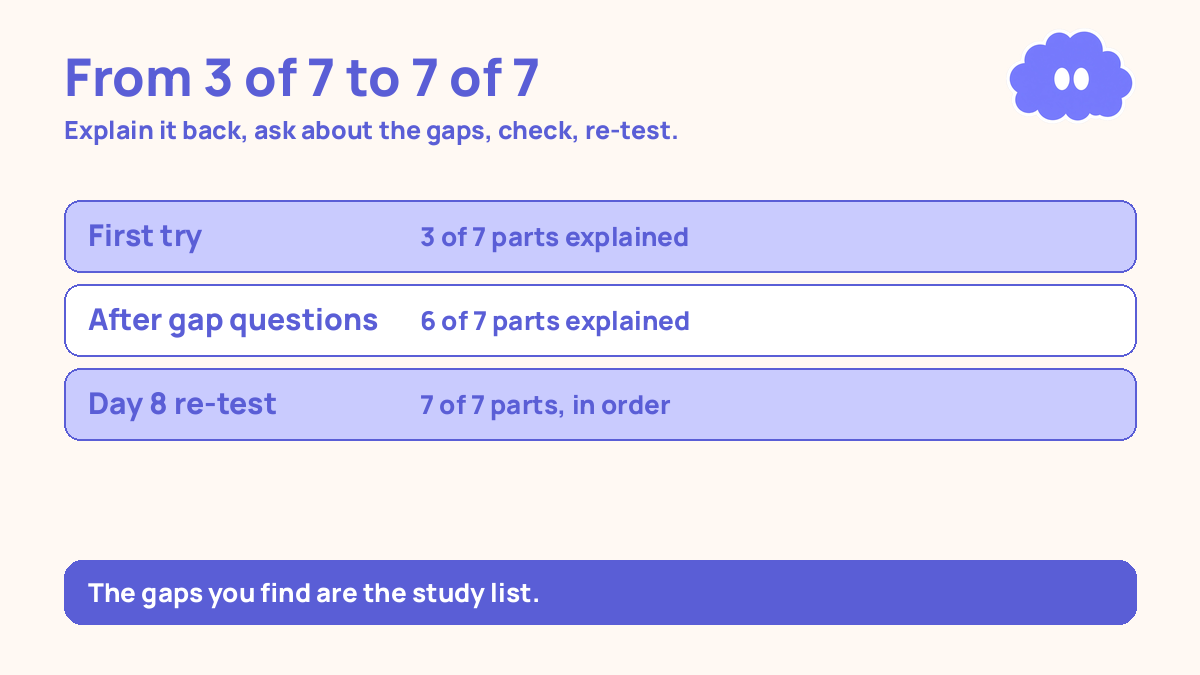
Day 1, session 2 — explain it back: Phone closed, the student explains photosynthesis out loud. They can explain 3 of the 7 parts: what photosynthesis is, sunlight, and oxygen. They cannot explain water, carbon dioxide, chlorophyll, or glucose. The gap list has 4 items.
Day 1, session 3 — ask about the gaps: The student asks AI about chlorophyll first: “I cannot explain what chlorophyll is. Explain it in simple words, with an everyday example.” After the answer, they explain chlorophyll back. Then water, then carbon dioxide, then glucose — one gap at a time, each explained back before moving on. By the end of the session they can explain 6 of the 7 parts. Glucose is still shaky, so it stays on the list.
Day 1, session 4 — check: The student opens the textbook and checks the AI’s version against it. The textbook agrees on 6 parts. On glucose, the AI left out a step the textbook includes — that the plant stores glucose as starch. The student adds that step to their notes in their own words.
Day 2 — re-test: The student explains the whole topic again, notes closed. They get 6 of the 7 parts smoothly. Glucose is still slow, so they ask AI one more question about it, explain it back, and check it in the textbook.
Day 4 — re-test: The full explanation comes out clean, 7 of 7 parts, in order, in their own words. No phone, no notes.
Day 8 — re-test: One more full explanation, notes closed. 7 of 7 again. The topic is done for now, and it goes on the weekly review list instead of the daily one.
| Part of the topic | First explain-back | After gap questions | Day 8 re-test |
|---|---|---|---|
| What photosynthesis is | Could explain | Could explain | Could explain |
| Sunlight | Could explain | Could explain | Could explain |
| Water | Gap | Could explain | Could explain |
| Carbon dioxide | Gap | Could explain | Could explain |
| Chlorophyll | Gap | Could explain | Could explain |
| Glucose | Gap | Shaky | Could explain |
| Oxygen | Could explain | Could explain | Could explain |
| Total | 3 of 7 | 6 of 7 | 7 of 7 |
When it goes wrong
You copy the AI’s answer into your notes and call it studying. Reading is not learning, and copying is not understanding. If your notes are the AI’s words, you have a copy, not knowledge. Close the phone and explain it back. If you cannot, the topic is not learned yet.
You trust the AI without checking. AI can be confidently wrong, and a wrong fact in your notes becomes a wrong answer in the exam. Check every explanation against the textbook or class notes. If they disagree, the textbook wins.
You ask vague questions and get vague answers. “Explain biology” gives you a wall of text you cannot use. Name the topic, ask for simple words, ask for one step at a time, and ask about the exact gap by name. Small questions get useful answers.
You skip the explain-back step. This is the step that does the learning, and it is the one that feels hardest, because it shows you what you do not know. Skipping it feels better and works worse. The gaps you find by explaining are the real study list — without them, you are studying blind.
You let AI write the work. If AI writes your homework or essay, you have not learned the topic, and you cannot explain it when you are tested. AI is for explaining, drafting practice questions, and finding gaps. The writing is yours.
You re-explain the same topic the same day and think it is learned. Explaining it twice in one day is mostly repeating what is still in your short-term memory. The real test is the next day, in three days, and in seven days. Space the re-tests out, and let the gap do the work.
Weekly review checklist
Copy this list and use it each week:
- Which topics did I explain back this week, and how many parts could I explain on the first try?
- What is on my gap list right now, and did I ask AI about each gap by name?
- Did I check every AI explanation I kept against the textbook or class notes?
- Did I re-test each topic on day 1, day 3, and day 7, and which parts went soft?
- What one change will I make next week: smaller topics, better questions, stricter checking, or more re-tests?
Downloadable infographic spec: one vertical image, title “Use AI to explain a topic in simple words”, with the six steps — ask for simple words, mark what you do not follow, explain it back, ask about the exact gaps, check against the textbook, re-test on day 1, 3 and 7 — and the rule “AI explains, you do the learning” in Thynq cream, Cloud Purple, Dark Purple and pink, with the cloud mascot. Text taken word-for-word from this article.
What this system is not
It is not a promise of a better grade, and it is not a claim that explaining something once means you know it forever. It is a way to use a free AI chat app as a tutor that explains in simple words — while you do the actual learning by explaining it back, finding the gaps, and checking everything against the textbook.
It is not a shortcut around the textbook. The textbook is the authority, and AI is the helper that puts the textbook’s ideas into simpler words. If you skip the textbook, you are studying the AI’s version of the course, not the course.
It is not proof that the Feynman Technique works as a method — there is no peer-reviewed study proving it. The research behind this system is about self-explanation in general: students who explain more tend to understand more, and prompting self-explanation helps, especially for principle-based material. That is what you are doing here, and that is enough.
Sources
- Chi, M. T. H., et al. (1989). Self-explanations: How students study and use examples in learning to solve problems. Cognitive Science, 13(2), 145-182. In a small observational study, 8 physics students studied worked examples while thinking aloud; the 4 who later solved problems best (82% correct) generated 15.3 explanations per example, while the 4 who did worst (46%) generated 2.8.
- Bisra, K., et al. (2018). Educational Psychology Review, 30, 1037-1065. Across 64 reports (69 effect sizes, about 5,917 learners), prompting self-explanation produced a moderate average benefit (g = 0.55), and the benefit held when time on task was controlled; it worked best for principle-based material.
- Dunlosky, J., et al. (2013). Psychological Science in the Public Interest, 14(1), 4-58. Self-explanation rated moderate utility; only practice testing and distributed practice rated high; rereading rated low.
- Karpicke, J. D. & Blunt, J. R. (2011). Science, 331(6018), 772-775. Students are systematically wrong about which strategy is helping them — the retrieval group predicted worst and did best.
Questions
Can AI explain a topic better than my textbook?
It can explain it in simpler words, which is useful when the textbook feels dense. But the textbook is still the authority. AI can get details wrong or invent them, so check every explanation against your textbook or class notes before you trust it or write it down.
What should I type to get a simple explanation?
Name the topic and ask for simple words, one idea at a time, with an everyday example. Try: ‘Explain photosynthesis in simple words, one step at a time, with an everyday example for each step.’ If the answer is still too hard, say so: ‘Explain that again like I am 12.’
What if I still cannot explain it back after asking AI twice?
Stop asking the same question and make the topic smaller. Pick one part of it — one step, one word, one diagram — and ask about that part only. Then check that part in your textbook. If it still will not click, write down the exact sentence you cannot explain and ask a teacher about that sentence.
Can I use AI to write my homework or essay?
No. AI in this system is for explaining, drafting practice questions, and finding the gaps in what you understand. The writing is your work. If AI writes it, you have not learned it, and you cannot explain it when you are tested on it.