The direct answer
Study with voice notes on your phone: record yourself explaining one topic in your own words, listen back later on the move, note where your explanation stalls or goes wrong, and re-record it until you can explain it cleanly. The recorder is the tool — no new app, no account, no desk needed.
You have no desk time. Your day is a commute, a walk, a bus ride, and the only free time is the time your hands and eyes are busy. So the reading never happens, and the exam keeps getting closer.
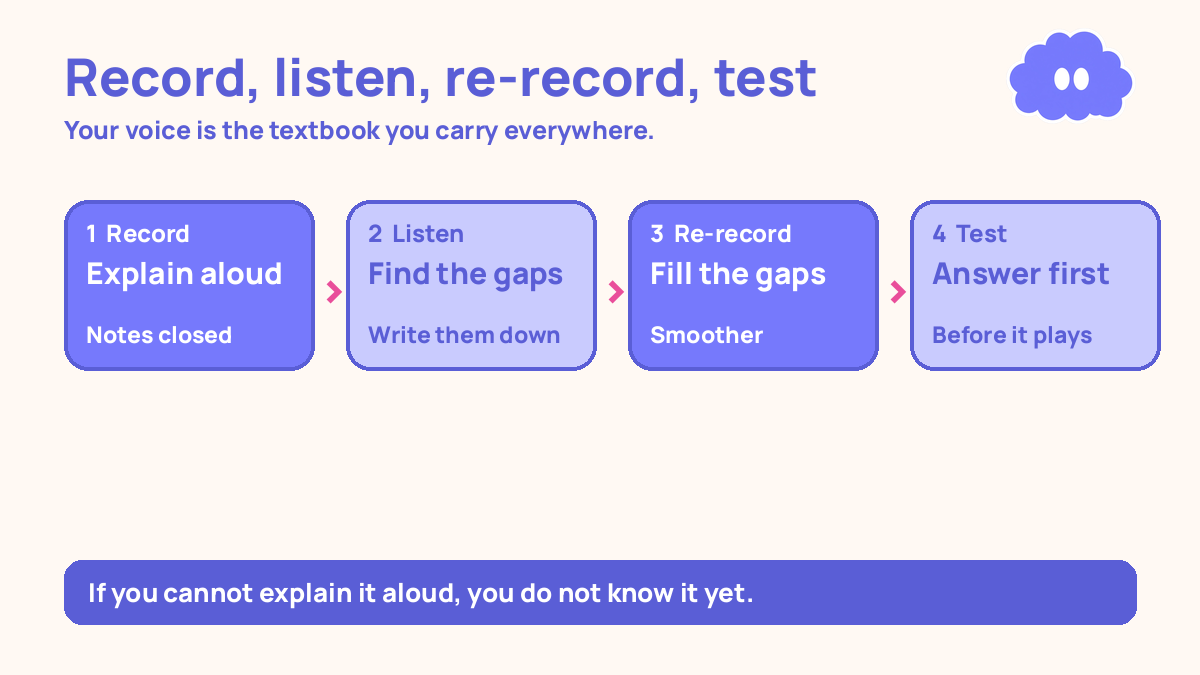
This system turns that dead time into study time. Record the explanation when you have ten minutes at home, then listen where the reading cannot happen — on the bus, on a walk, in a queue. And do not just listen: pause the recording before it gives the answer and say the next step out loud. If you cannot say it, that is a gap, and the gap is what you fix.
The system in short
- Pick one topic you have already studied once — this system explains, it does not teach from scratch.
- Record yourself explaining it in your own words, five to ten minutes, notes closed, in the voice recorder already on your phone.
- Listen back the next day, on the move, and write down every place where you stalled, guessed, or got it wrong.
- Fix each gap from your notes, then re-record the topic with the gaps closed.
- Test yourself on the move: pause the recording before the answer and say the next step out loud.
- Re-test each topic on day 1, day 3, and day 7, and record one new topic each week.
Step 1: Pick a topic you have already met
This system is for explaining, not for first learning. Pick a topic you have already read or been taught once — photosynthesis, supply and demand, the causes of the First World War. If you have never seen the material, a voice note will just record your guesses.
One topic per note. “Photosynthesis” is a topic; “all of biology” is not. If you cannot say what the topic is in one sentence, split it.
Step 2: Record yourself explaining it, notes closed
Find ten quiet minutes. Open the voice recorder on your phone and explain the topic out loud as if you were teaching a friend who has never heard of it. Notes closed.
Start with the big idea, then the steps in order, in your own words. If you catch yourself repeating a phrase from the book without knowing what it means, say that out loud too: “I know the word ‘stroma’ but I do not know what it does.” That admission is the whole point.
Aim for five to ten minutes. Shorter than five, and you are naming facts, not explaining them. Longer than ten, and you will never listen to the whole thing twice.
The first recording will be messy — pauses, wrong turns, sentences that trail off. That is normal: the mess shows you exactly where your understanding is thin.
Step 3: Listen back the next day, on the move
Listen to the recording the next day, not the same evening — you want the explanation to be a little unfamiliar, so the gaps sound like gaps.
Listen where you would otherwise be doing nothing — the bus, the walk, a queue. Headphones in, phone in your pocket. Keep a small notebook or your notes app open, and write down every gap you hear:
- a place where you stalled or went silent
- a place where you guessed, or said “I think” and moved on
- a place where you corrected yourself
- a place where you used a word you could not have defined
Five to eight gaps from a ten-minute recording is normal. Zero gaps means you were not listening honestly — or the topic was too easy.
Why does explaining out loud work at all? In a 1989 study, Chi and colleagues watched 8 physics students study worked examples while thinking aloud. The 4 who later solved problems best had generated about 15 explanations per example; the 4 who did worst had generated about 3. That was a small observational study — it shows a pattern, it does not by itself prove that prompting anyone to explain will cause the same result. A 2018 meta-analysis by Bisra and colleagues, across 64 reports, found that prompting self-explanation produced a moderate average benefit, and the benefit held even when time on task was controlled for. Dunlosky’s 2013 review rated self-explanation as moderate utility too — not the strongest technique, but a real one, and it fits the time you actually have.
Step 4: Fix the gaps, then re-record
Take your gap list back to your notes — this is the one part that needs a desk or a quiet corner. For each gap, find the answer and write it in one plain sentence. “The stroma is where the light-independent reactions happen.” No copying whole paragraphs.
Then re-record the topic, notes closed again, with the gaps closed. This second recording should be shorter and smoother, because you now know what you are saying. If it is still full of stalls, the topic needs a third pass — or splitting into two smaller topics.
Step 5: Test yourself on the move
Listening is not studying. Listening without testing is just a podcast you made for yourself, and it feels fluent — which is the trap. In a 2006 study, Roediger and Karpicke found that students who recalled a passage remembered more a week later than students who restudied it, even though the restudiers felt more confident immediately after studying. Feeling fluent right after listening is not the same as remembering a week later.
Turn the recording into a test. As you listen, pause before the recording gives the answer and say the next step out loud yourself. If you said it right, keep walking. If you could not say it, that is a gap — note it, and fix it in the next re-record.
You can also record a question version: five questions, with a five-second pause after each one, then answer out loud in the pause. This is the same testing idea Dunlosky and colleagues rated highest in their 2013 review — practice testing — and the recording is just a way to carry the test with you. If you have a commute, the study system for commute study shows how to build that time into a daily habit, and how to learn from podcasts while studying shows the same pause-and-answer trick on other people’s audio.
Step 6: Re-test on day 1, day 3, and day 7
Fixes fade if you do not re-test them. Listen to each recording again on day 1, 3, and 7, and pause-and-answer each time. That 1-3-7 pattern is a practical starting schedule, not a research rule — the research says spacing beats cramming.
Keep the re-tests short: one listen, five minutes, on the move. If you can answer every pause on day 7, the topic is done — archive the recording and move on. If you still cannot, re-record once more and re-test again.
A worked example: photosynthesis, one week, no desk
This is a worked example, with the article’s own numbers — not a real student, and not a promise of a grade.
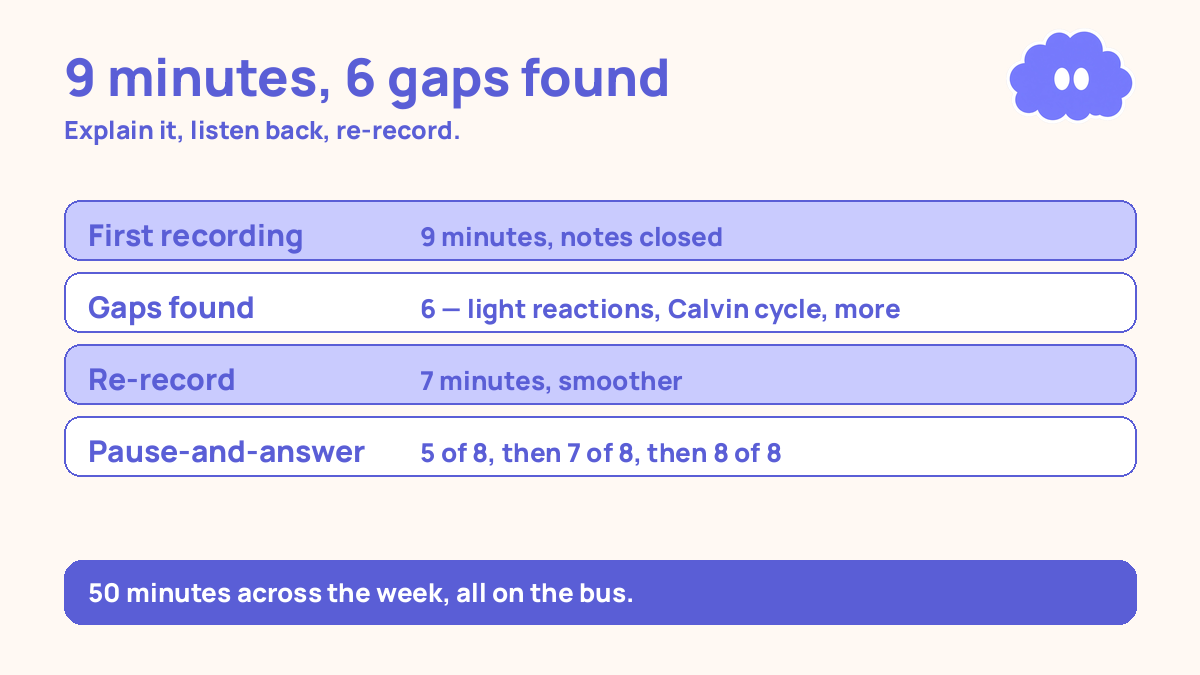
You have a biology topic, photosynthesis, a 40-minute bus ride to college, and you have already read the chapter once in class. On Monday evening you record yourself explaining it, notes closed. The recording runs 9 minutes.
Tuesday morning, on the bus, you listen back and list the gaps. There are 6: you stalled on where the light reactions happen, you corrected yourself on the Calvin cycle, you could not say what NADPH is for, you skipped the role of water, you mixed up the stroma and the thylakoid, and you could not say why plants need light.
Tuesday evening you fix the 6 gaps from your notes, one plain sentence each. Wednesday evening you re-record: 7 minutes, smoother, no long stalls. Thursday morning you run the pause-and-answer test on the new recording: 8 questions, and you answer 5 out loud before the recording does. The 3 you miss are about NADPH and the Calvin cycle, so you write one sentence for each and listen again on Friday.
By the next Monday, day 7, you answer all 8 questions before the recording gives them. The topic is done. Total time: 9 minutes recording, 7 minutes re-recording, and roughly 25 minutes of listening across the week — all on the bus, none of it at a desk.
| Day | What happened | Time | Result |
|---|---|---|---|
| Monday | First recording, notes closed | 9 minutes | 6 gaps found on listen-back |
| Tuesday | Listen-back on the bus, gap list written | 10 minutes | 6 gaps: stroma, Calvin cycle, NADPH, water, thylakoid, why light |
| Wednesday | Re-record with gaps closed | 7 minutes | Smoother, no long stalls |
| Thursday | Pause-and-answer test on the bus | 8 minutes | 5 of 8 questions answered first try |
| Friday | Re-listen, fix the 3 missed questions | 8 minutes | 7 of 8 answered first try |
| Monday (day 7) | Final listen and pause test | 8 minutes | 8 of 8 answered first try |
| Total | One topic, one week | 50 minutes | 6 gaps found, 8 of 8 by day 7 |
When it goes wrong
You record yourself reading the textbook aloud. A recording of you reading is not an explanation. If it sounds like the book, you have tested your reading voice, not your understanding. Notes closed, every time.
You listen without pausing. Listening straight through feels productive because it feels fluent, and fluency is not learning. If you finish a listen and cannot remember what you heard, you were not testing. Pause before every answer and say it out loud.
You cannot stand your own voice and stop listening. Almost everyone dislikes their recorded voice at first, and it fades after a few listens. Listen for the gaps, not the sound.
You record ten topics and listen to none of them. Recording feels like studying, so it is easy to collect recordings and never use them. One topic at a time: record it, listen, fix, re-record, re-test, then record the next one.
You use this for a topic you have never studied. Explaining from zero records your guesses. Read or watch the material once first, then record.
Weekly review checklist
Copy this list and use it each week:
- Did I record one topic this week, notes closed, in five to ten minutes?
- Did I listen back and write down the gaps — how many did I find?
- Did I fix the gaps and re-record?
- Did I pause-and-answer on day 1, 3, and 7, and could I answer every question by day 7?
Downloadable infographic spec: one vertical image, title “Study with voice notes on your phone”, with the six steps and the rule “Record, listen for gaps, fix, re-record” in Thynq cream, Cloud Purple, Dark Purple and pink, with the cloud mascot. Text taken word-for-word from this article.
What this system is not
It is not a promise of a better grade, and it is not a replacement for reading or for a teacher. It is a way to use the time you already spend moving to find out what you cannot yet explain and fix it. It works best when you have already met the material once. The recording is the mirror; the fixing still happens with your notes open.
Sources
- Chi, M. T. H., Bassok, M., Lewis, M. W., Reimann, P. & Glaser, R. (1989), Cognitive Science 13(2), 145-182. In a small observational study of 8 physics students, the best problem-solvers generated about 15 explanations per example; the worst generated about 3.
- Bisra, K., Liu, Q., Nesbit, J. C., Salimi, F. & Winne, P. H. (2018), Educational Psychology Review 30(3), 703-725. Across 64 reports, prompting self-explanation produced a moderate average benefit.
- Roediger, H. L. & Karpicke, J. D. (2006), Science. Students who recalled a passage remembered more a week later than students who restudied it, even though restudiers felt more confident immediately after studying.
- Dunlosky, J., et al. (2013), Psychological Science in the Public Interest 14(1), 4-58. Only practice testing and distributed practice rated high utility; self-explanation rated moderate.
For the full system, read the study system for commute study, and for audio learning, read how to learn from podcasts while studying.
Questions
Do I need a special app to study with voice notes?
No. The voice recorder already on your phone does the job. Record, listen, delete, re-record — nothing to install, no account, no cost.
How long should each voice note be?
Five to ten minutes, one topic per note. Shorter than five and you are naming facts, not explaining them. Longer than ten and you stop listening.
What if I hate hearing my own voice?
Most people do, and it fades after the first few listens. Listen for the gaps in the explanation, not the sound of your voice — the gaps are the study material.
Can I use this for any subject?
It works best for subjects where you have to explain why something works — science, economics, history causes, maths. It is weaker for subjects that are mostly lists of facts to memorise.