The direct answer
Study with the phone you already have: use its timer for 25-minute study blocks, its voice recorder to explain each topic aloud, its notes app to keep one page of questions per topic, and its camera to photograph anything you need to test yourself on later. No new app, no account, no money. The phone you own is already a timer, a recorder, a notebook, and a test bank.
You do not have a laptop, you do not have money for apps, and the phone in your hand is the only device you own. That is not a disadvantage. It is a complete study kit that you are already carrying. The timer counts down. The recorder records. The notes app saves text. The camera photographs a page. Between those four, you can time your work, test yourself, explain topics aloud, and keep the questions that show you what you still do not know.
The one thing the phone is bad at is staying quiet. It is also a messaging app, a video app, and a game. So this system has a rule for that too: the phone works for you during a block, and it goes away between blocks. One study found a phone on the desk cost focus even when it was off — but a later pre-registered replication did not find the effect, so the evidence is mixed (Ward et al., 2017; Ruiz Pardo & Minda, 2022). This article presents “phone in another room” as a practical system, not as a proven fact. Try it for a week and keep it if your blocks get longer.
It fits with the phone focus system for distracted students, and it builds the daily study habit one block at a time. A habit takes weeks to feel automatic — in one study the median time was 66 days, with a range of 18 to 254 days — and one missed day does not reset it (Lally et al., 2010). So this system is built for a missed day: it restarts with the next block, not with a double day.
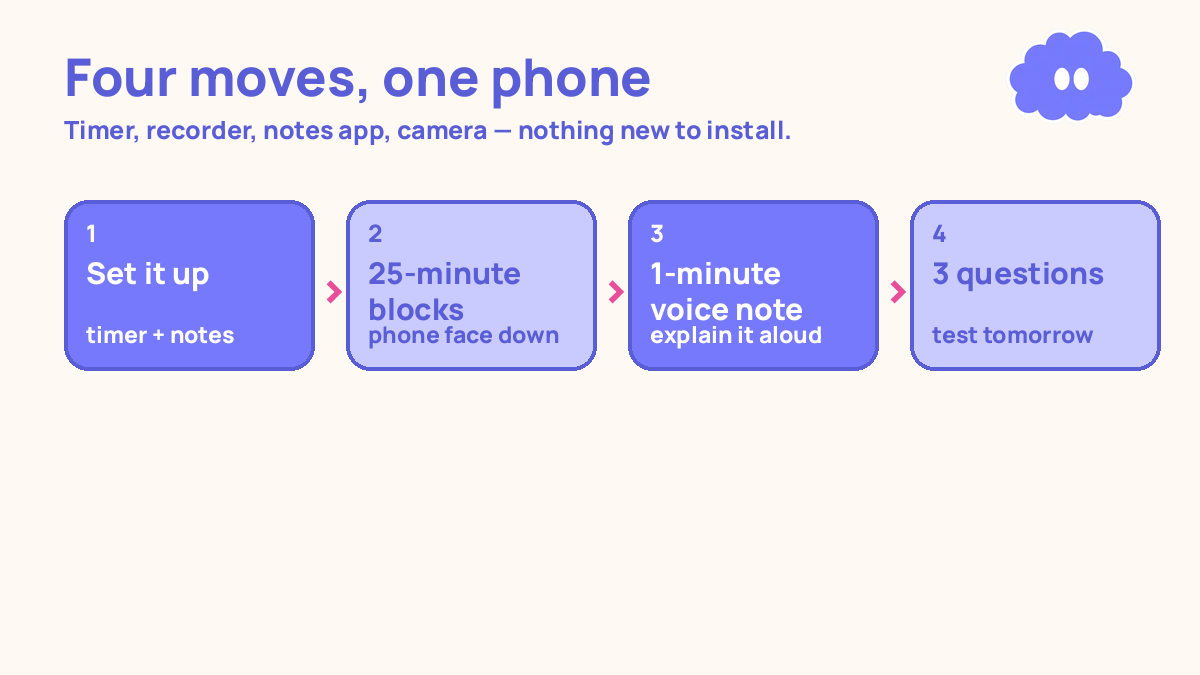
The system in short
- Set up the phone before you start: timer ready, notifications off, notes app open to today’s topic.
- Study in 25-minute blocks with a five-minute break, phone face down except for the timer.
- After each block, record a one-minute voice note explaining what you just studied, in your own words.
- Turn each voice note into three questions in your notes app, and answer them the next day with the notes closed.
- End the day by photographing anything unfinished and writing tomorrow’s first block as an if-then plan.
Step 1: Set the phone up before you start
Open the clock app and set a 25-minute timer. Open the notes app to a new note for today’s topic. Turn notifications off — silent mode, or the built-in focus mode if your phone has one. Put the phone face down on the desk, or on the other side of the room if you know you will pick it up. The setup takes two minutes, and it is the whole system: everything after this is just blocks.
Write the topic at the top of the note, and one sentence about what you want to be able to do by the end of the day. Not “study biology” — “explain photosynthesis in my own words without looking.” That sentence is the test for the day. If you cannot do it by the last block, the day’s work is not finished, however many pages you read.
Charge the phone if the battery is low, and keep it plugged in while you study. A dead phone halfway through a block is a broken system, and the fix is a cable, not a new phone.
Step 2: Study in 25-minute blocks
Start the timer. Twenty-five minutes of work, five minutes of break. That 25/5 pattern is a practical starting choice, not a number from science — Francesco Cirillo picked 25 minutes for his own kitchen timer in the late 1980s, and it became the Pomodoro Technique. If 25 minutes feels too short for the task, use 50 minutes with a ten-minute break. The length matters less than the rule: the timer decides when the block ends, not your attention.
During a block, the phone does one job: it counts down. Do not check messages, do not open a video, do not “just look something up.” If a thought comes up — a message to send, a video to watch — write it in the notes app and go back to the topic. The note takes five seconds; the message takes the block.
In the five-minute break, stand up, drink water, look away from the screen. Do not use the break to check messages. The break is for rest, not for a different kind of screen. After four blocks, take a longer break of twenty to thirty minutes. Four blocks is a hundred minutes of study, and that is a full day for most students.
Step 3: Explain each block aloud in a one-minute voice note
When the timer ends a block, open the voice recorder and explain what you just studied in one minute, in your own words. Not a summary of the page — an explanation, as if you were telling a friend. “Photosynthesis has two stages. The light reactions happen in the thylakoid membrane and make ATP. The Calvin cycle uses the ATP to build sugar.” If you cannot say it, you do not know it yet, and that is useful information, not a failure.
Explaining in your own words is a moderate-utility technique (Dunlosky et al., 2013), and a 2018 meta-analysis across 64 reports found a moderate average benefit for prompting self-explanation (Bisra et al., 2018). The original study behind it was small — 8 physics students, thinking aloud while they studied worked examples (Chi et al., 1989) — so say so, and treat the voice note as a practical check, not a proven method. The check is simple: if the explanation has gaps, the gaps are the next block’s work.
Name each voice note by topic and day, so you can find it later. “Photosynthesis, day 1.” Listen to yesterday’s note before today’s first block. Listening back shows you what you forgot overnight, and it takes one minute.
Step 4: Turn each voice note into three questions
After the last block of the day, listen to your voice notes once and write three questions per topic in the notes app. The questions come from the gaps you heard yourself stumble over. If you hesitated on the two stages of photosynthesis, the question is “What are the two stages of photosynthesis, and where does each happen?” If you could not say the equation, the question is “Write the photosynthesis equation from memory.”
Answer the questions the next day, with the notes closed, before you start the new topic. That is the test, and it is the part that makes the whole system work: testing yourself was one of only two techniques rated high utility in Dunlosky’s 2013 review, and re-reading was rated low. The questions are the test bank, and the phone already holds it.
If a question is still wrong after two days, do not just re-test it. Record a new voice note explaining that one point, then test it again the next day. A question that fails three times is an understanding problem, and explaining it aloud is the fix.
Step 5: Photograph what is unfinished and plan tomorrow’s first block
End the day by photographing anything unfinished — the page you stopped on, the problem you could not solve, the diagram you need to copy. The photo is a bookmark, not a study method. Tomorrow, open the photo first, and you know exactly where to start.
Then write tomorrow’s first block as an if-then plan, in the notes app: “If I sit down after breakfast, then I will test myself on yesterday’s three questions before I open the new topic.” An if-then plan names the cue and the action in advance, so starting does not need a fresh decision every morning. Across 94 studies, if-then plans raised goal attainment by a medium-to-large amount over holding the goal alone (Gollwitzer & Sheeran, 2006).
Then put the phone away. The day is done. If you missed a block, do not do a double block tomorrow to catch up. Do the next block, at the normal length, and cut the topic list to the one that matters most. A missed day does not reset a habit (Lally et al., 2010), and a double day does not repair one.
A worked example: one day, four blocks, one phone
This is a worked example, with the article’s own numbers — not a real student, and not a promise of a grade.
You have a biology test in two weeks, a phone, and no other device. Today is a study day, and you have two hours after school.
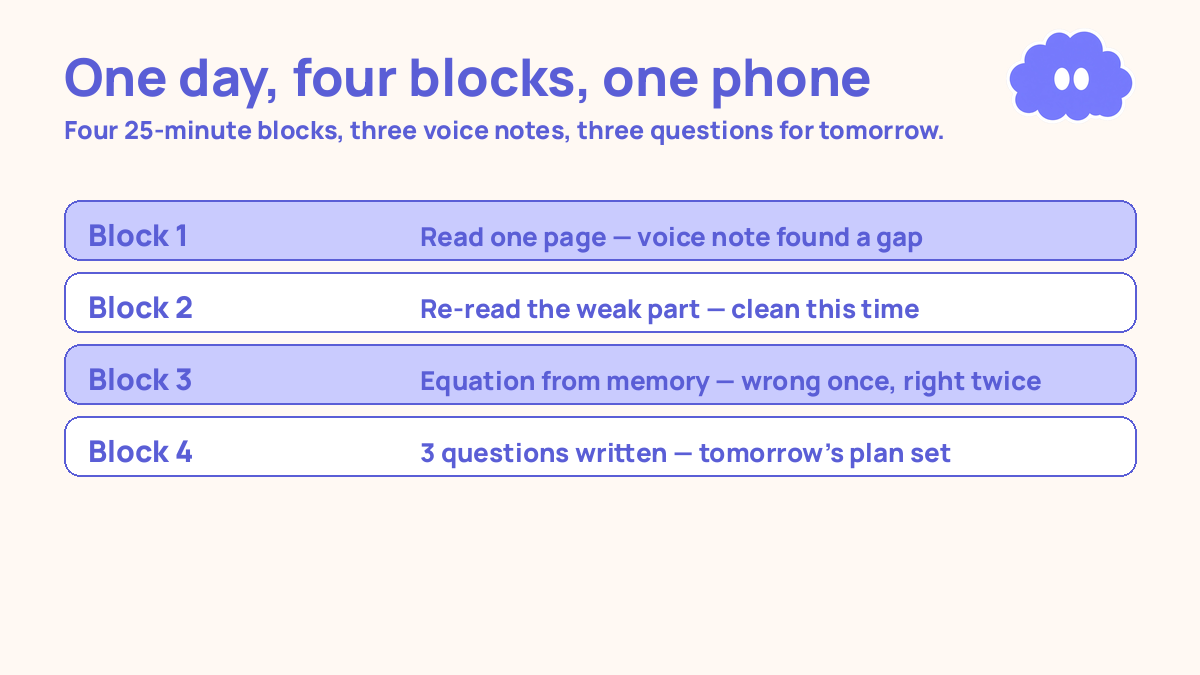
Block 1, 25 minutes: You set the timer, open your notes on photosynthesis, and read one page. Timer ends. You record a one-minute voice note: “Photosynthesis has two stages. Light reactions in the thylakoid make ATP. Calvin cycle uses ATP to make sugar.” You stumble on where the Calvin cycle happens. You write it down.
Break, 5 minutes: You stand up, drink water, and do not touch the phone.
Block 2, 25 minutes: You read the page on the Calvin cycle, the part you stumbled on. Timer ends. Voice note, one minute: “Calvin cycle happens in the stroma. It uses ATP and NADPH to build sugar from carbon dioxide.” This time it comes out clean.
Break, 5 minutes: Water, stand up, phone still face down.
Block 3, 25 minutes: You test yourself. Notes closed, you write the photosynthesis equation from memory, then check it. Wrong on the first try, right on the second. Voice note: the equation, said aloud, once.
Block 4, 25 minutes: You write three questions in the notes app from the day’s gaps: the two stages and where each happens, the equation, and what the Calvin cycle uses. You photograph the page you stopped on. You write tomorrow’s if-then plan: “If I sit down after breakfast, then I will answer yesterday’s three questions before I open respiration.”
| Block | The work | The phone’s job | The check |
|---|---|---|---|
| Block 1 | Read one page: photosynthesis | Timer, 25 minutes | 1-minute voice note |
| Block 2 | Re-read the weak part: Calvin cycle | Timer, 25 minutes | 1-minute voice note, clean |
| Block 3 | Test: equation from memory | Notes closed | Wrong once, right twice |
| Block 4 | Write 3 questions, photo, plan | Notes app, camera | Tomorrow’s if-then plan |
When it goes wrong
You check messages during a block. One check becomes five minutes, and five minutes becomes the block. The fix is the setup: notifications off before the timer starts, phone face down, and any thought that comes up goes in the notes app, not in the message app.
You record the voice note by reading the page aloud. Reading aloud is not explaining. If the note sounds like the textbook, delete it and record again with the notes closed. The note must be in your own words, or it tells you nothing.
You skip the questions and just re-read the notes. Re-reading was rated low utility (Dunlosky et al., 2013). The questions are the system. If you have no questions, you have no test, and the day’s work evaporates by tomorrow.
You do eight blocks in one day and none the next. Four blocks a day, every day, beats eight blocks once a week. The habit builds on repetition, not on hero days — and a missed day does not reset it (Lally et al., 2010).
Your phone dies mid-block. Charge it while you study, and keep paper and a pen beside you. If the phone dies, the paper takes over: same block, same timer on a clock, same questions written by hand.
Weekly review checklist
Copy this list and use it each week:
- How many blocks did I actually finish this week, and how many were lost to the phone?
- Which voice notes had gaps in them, and did I turn those gaps into questions?
- Did I answer yesterday’s questions before starting each new topic?
- What one change will I make next week: phone in another room, shorter blocks, or a stricter break rule?
Downloadable infographic spec: one vertical image, title “Study with the phone you already have”, with the five steps — set it up, 25-minute blocks, one-minute voice note, three questions, photo and plan — and the rule “the phone you own is already a timer, a recorder, a notebook, and a test bank” in Thynq cream, Cloud Purple, Dark Purple and pink, with the cloud mascot. Text taken word-for-word from this article.
What this system is not
It is not a claim that a phone is the best study tool, and it is not a claim that keeping your phone in another room is proven to help — the evidence on that is mixed, and this article says so. It is a way to study with the device you already own, using the timer, recorder, notes app and camera that are already on it, and to measure whether the work actually happened, instead of hoping it did.
Sources
- Dunlosky, J., et al. (2013). Psychological Science in the Public Interest, 14(1), 4-58. Only practice testing and distributed practice rated high utility.
- Ward, A. F., et al. (2017). Journal of the Association for Consumer Research, 2(2). A phone on the desk cost focus even when off — but see the replication below.
- Ruiz Pardo, A. & Minda, J. P. (2022). Pre-registered direct replication of Ward et al. (2017); found no significant difference by phone proximity or power state.
- Lally, P., et al. (2010). European Journal of Social Psychology, 40(6), 998-1009. Median time for a behaviour to feel automatic was 66 days, range 18 to 254; one missed day did not reset it.
- Chi, M. T. H., et al. (1989). Cognitive Science, 13(2), 145-182. The 8 students who explained most solved problems best.
- Bisra, K., et al. (2018). Educational Psychology Review, 30(3), 703-725. Prompting self-explanation gave a moderate average benefit across 64 reports.
- Gollwitzer, P. M. & Sheeran, P. (2006). Advances in Experimental Social Psychology, 38, 69-119. Across 94 studies, if-then plans raised goal attainment by a medium-to-large amount.
For the focus system this fits with, read phone focus system for distracted students, and for the habit it builds, read how to build a daily study habit.
Questions
Do I need to buy a study app for this to work?
No. Everything in this system uses apps that are already on the phone: the clock or timer, the voice recorder, the notes app, and the camera. A paid app would only add features you do not need yet — a timer, a place to write, and a way to hear yourself explain.
Should I keep my phone in another room while I study?
One study found a phone on the desk cost focus even when it was off, but a later replication did not find the effect, so the evidence is mixed. Treat “phone in another room” as a practical system, not a proven fact: try it for a week, and keep it if your blocks get longer.
How long should a study block be?
Twenty-five minutes of work and a five-minute break is a practical starting point — it was the personal choice of Francesco Cirillo, who invented the Pomodoro Technique in the late 1980s, not a number from cognitive science. Fifty-minute blocks with a ten-minute break work just as well for longer tasks.
What if my phone is old and slow?
This system needs almost nothing from the phone: a timer that counts down, a recorder that records, and a notes app that saves text. Any phone made in the last ten years can do all three. If the battery is weak, charge it while you study and use paper for the written parts.