
The direct answer
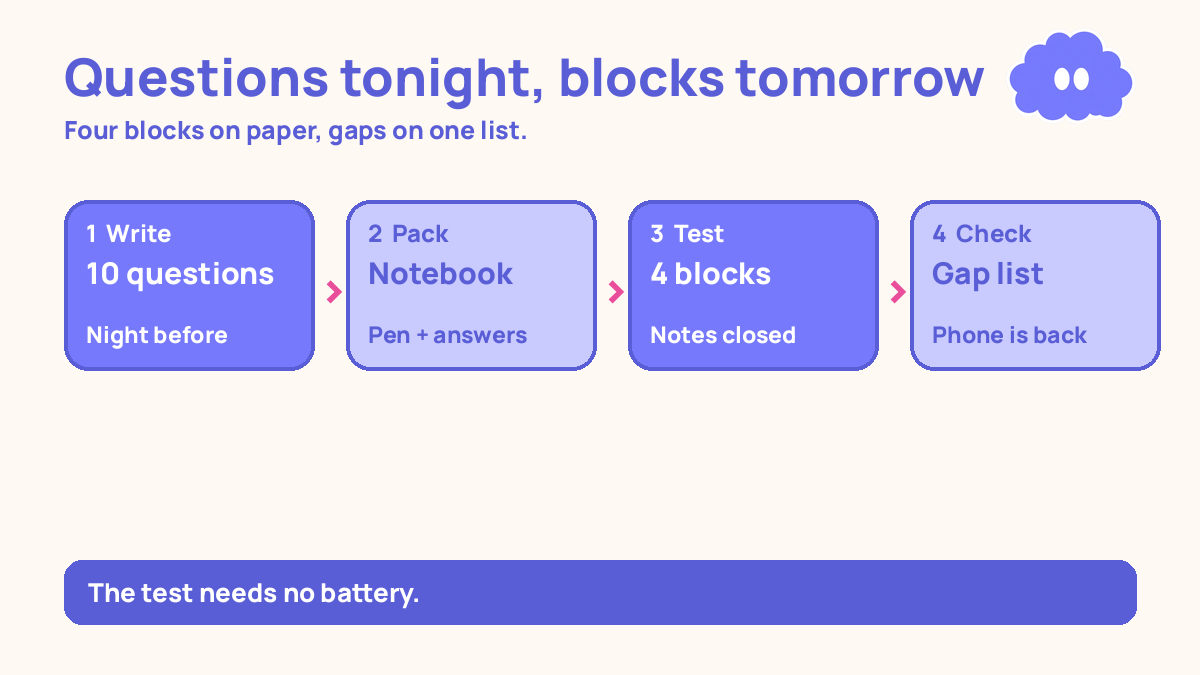
Study with a paper notebook when your phone dies: the night before, write ten questions per topic on paper, with the answers on a separate page — then on the phone-free day, run four 25-minute blocks with a pen, a notebook, and any clock you can see, test yourself from memory, and write every gap on one list to check when the phone is back. That is the whole system.
Your phone dies at the worst moment. No battery, no charger, no data, and the study day you planned is suddenly a day with no timer, no notes app, no AI chat app, and no videos. Most students take the day off. The day is not lost — it is just a different kind of day. Paper and a pen can do the most important part of studying: testing yourself from memory. What paper cannot do is look things up, so the day is built on what you already have in your head and on paper.
This is a fallback day, not a new system. It is one day, with one topic, and it works because the questions were written the night before. Without that preparation, a phone-free day is a blank notebook and good intentions. With it, the day is four blocks of real testing — and in a 2013 review, Dunlosky and colleagues rated practice testing as one of only two high-utility techniques, while re-reading was rated low.
This is different from the study system for students with no internet, which is a standing system for studying without internet over weeks. This one is a single day: the phone is dead, the day is today, and the paper is already prepared. If the day goes badly anyway, the recovery is in how to get back on track after a bad study day.
The system in short
- The night before, write ten questions per topic on paper, with the answers on a separate page.
- Pack the kit the night before too: notebook, pen, the question page, the answer page, and a clock you can see.
- On the day, run four 25-minute blocks with a 5-minute break, one topic per block, notes closed.
- Answer every question from memory, mark it right or wrong on the spot, and write every gap on one list.
- When the phone is back, check the gap list against your notes, fix each gap, and re-test the next day.
Step 1: The night before — write the questions on paper
The night before a phone-free day, write ten questions on paper for the topic you will study. Ten questions, in your own words, with the answers on a separate page. The questions are the day. Without them, the day is a blank notebook.
Write questions whose answers are the ideas, in two or three sentences — not single words, and not whole chapters. A question whose answer is one word tests recognition. “What are the three steps of photosynthesis, and what does each one do?” is a question you can answer from memory and mark honestly.
Write the answers on a separate page, and do not look at it while you write the questions. If you check the answers while writing, the questions will be easier than they should be. The questions should be hard enough to get some wrong — a test you pass perfectly tells you nothing.
One topic per day, ten questions. The same ten questions come back in every block, with a gap between — a practical starting schedule, not a research rule. The research says spacing beats massing, and the right gap grows with how long you need to remember the material (Cepeda et al., 2006).
Step 2: Pack the kit the night before
Pack the kit the night before, not in the morning. Notebook, pen, the question page, the answer page, and a clock you can see. A wall clock, a watch, the kitchen timer — anything that shows the time without a phone. If there is no clock at all, count the blocks by pages: one block is one page of questions answered.
Put the answer page in a separate pocket of the bag, or folded inside the back of the notebook — somewhere you will not see it by accident while you work. If the answers sit on the same page as the questions, the day is re-reading, and re-reading was rated low utility while practice testing was rated high (Dunlosky et al., 2013).
Add one more page: a blank page titled “Gaps”. That page is where the day’s findings go, one line per gap. It is the page that turns a phone-free day into a fixed gap the next day.
Step 3: Run four 25-minute blocks, notes closed
On the day, run four 25-minute blocks with a 5-minute break between them. One topic, the same ten questions, notes closed, answer page out of sight. A 25-minute block with a 5-minute break is a practical starting point — the 25-minute length was the Pomodoro Technique’s practical choice, not a number from cognitive science — and a 50-minute block works better if one topic needs longer.
In each block, answer the ten questions from memory, in writing, in the notebook. Writing matters: a spoken answer fades, a written answer can be marked. Write the answer in your own words, two or three sentences, then move on. Do not skip a question you cannot answer — write “I don’t know” and move on. An honest blank is more useful than a guessed answer, because the blank goes on the gap list and the lucky guess does not.
Do not check the answers during a block. The block is the test. Checking mid-block turns the test into re-reading. The answers wait until the block ends.
Step 4: Mark it, and write every gap on one list
At the end of each block, take out the answer page and mark your ten answers: right, half-right, wrong. Be honest — a half-right answer marked right is a gap you will never fix. Across 61 studies, testing beat restudying, and the advantage was larger when the test came with feedback (Rowland, 2014). The marking is the feedback.
Write every gap on the “Gaps” page, one line each: the question, what you got wrong, and what the right answer is, in your own words. Three or four gaps per block is normal. Ten gaps means the topic was too new for a test day — it needs learning before it needs testing.
Between blocks, take the 5-minute break properly. Stand up, drink water, look away from the notebook. The next block starts when the clock says so, not when you feel ready.
Step 5: When the phone is back, check the gaps and re-test
When the phone is back, check the gap list against your notes or your textbook, one gap at a time. The answer page told you what the right answer was, but your notes tell you why, and the why is what stops the gap coming back. If a gap does not match your notes, trust the notes.
Fix each gap by testing it again, not by re-reading it. Cover the answer, say it from memory, check it. Then re-test the whole ten questions the next day, notes closed, and count the score. A topic that goes from 6 right to 9 right is a topic the fallback day fixed.
If the phone stays dead for a second day, repeat the system with a new topic, and new questions written the night before. Two fallback days in a row is fine.
A worked example: one dead phone, one day, four blocks
This is a worked example, with the article’s own numbers — not a real student, and not a promise of a grade.
Your phone dies on Sunday night. No charger until Monday evening. Monday is a study day, and the topic is cell biology. Sunday night, you write ten questions on paper, with the answers on a separate page.
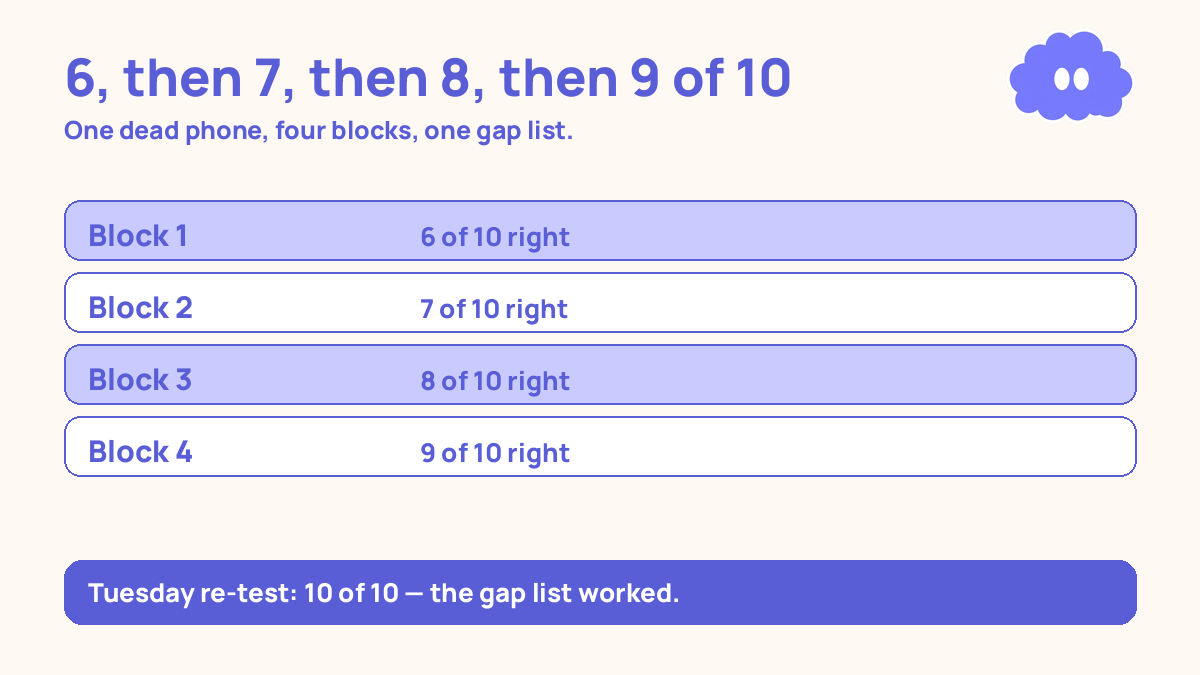
Monday, block 1 — 9:00: Ten questions, notes closed, written in the notebook. You mark them after the block: 6 right, 2 half-right, 2 wrong. The gaps go on the “Gaps” page.
Block 2 — 9:30: The same ten questions, from memory. 7 right, 2 half-right, 1 wrong.
Block 3 — 10:00: The same ten questions again. 8 right, 1 half-right, 1 wrong. The same gap, still wrong — it needs the textbook, not another guess.
Block 4 — 10:30: The same ten questions. 9 right, 1 half-right, 0 wrong. Monday evening, the phone is back: you check that one gap against your notes, fix it, and re-test it on Tuesday. Tuesday’s re-test: 10 of 10.
| Block | Questions right | Gaps found |
|---|---|---|
| Block 1, 9:00 | 6 of 10 | 2 — cell theory, rough/smooth ER |
| Block 2, 9:30 | 7 of 10 | 1 — rough/smooth ER |
| Block 3, 10:00 | 8 of 10 | 1 — rough/smooth ER |
| Block 4, 10:30 | 9 of 10 | 0, 1 half-right |
| Tuesday re-test | 10 of 10 | 0 |
When it goes wrong
You write the questions on the morning of the dead-phone day. Then the first block is spent writing, not testing. Write them the night before, answers on a separate page.
You keep the answer page where you can see it. Then the day is re-reading, and the scores mean nothing. The answer page comes out only to mark a finished block.
You study a brand-new topic on a phone-free day. Then every question is a gap. A fallback day is for testing what you have already learned, not for learning something new.
You take the day off because the phone is dead. Then a dead battery costs you a study day as well as a phone. Four blocks on paper is a real day.
You never check the gaps when the phone is back. Then the day’s findings sit on a page, and the gaps stay gaps. The check is the point of the list.
Weekly review checklist
Copy this list and use it each week:
- Did I have a phone-free day this week, and did the questions get written the night before?
- How did the scores move across the four blocks, and which gap came back most?
- Did I check every gap against my notes when the phone was back?
- What one change will I make next week: better questions, a better clock, or a second fallback topic ready?
What this system is not
It is not a claim that paper is better than a phone, and it is not a promise that one day on paper will fix a weak topic. Paper cannot look things up, and a topic you have never learned cannot be tested into knowledge. This system is a fallback for one day: questions written the night before, four blocks on paper, every gap on one list, and the list checked when the phone is back.
Sources
- Dunlosky, J., et al. (2013). Psychological Science in the Public Interest, 14(1), 4-58. Only practice testing and distributed practice rated high utility; rereading rated low.
- Rowland, C. A. (2014). Psychological Bulletin, 140(6), 1432-1463. Across 61 studies, testing beat restudying, and the advantage was larger with feedback (g = 0.73) than without it (g = 0.39).
- Cepeda, N. J., et al. (2006). Psychological Bulletin, 132(3), 354-380. Spaced practice beat massed practice, and the right gap grows with how long you need to remember the material.
- Roediger, H. L. & Karpicke, J. D. (2006). Psychological Science, 17(3), 249-255. Retrieval beat restudying after a delay, despite restudiers feeling more confident immediately after studying.
For the standing no-internet system this day fits inside, read the study system for students with no internet, and if the day goes badly, read how to get back on track after a bad study day.
Questions
Can I really study a whole day with no phone?
Yes, for one day. Paper, a pen, and a clock are enough to test yourself, write summaries from memory, and fix the gaps. What you cannot do without the phone is look things up — so the day is built on questions you wrote the night before, not on new material.
What should I prepare the night before?
Ten questions per topic, written on paper, with the answers on a separate page. One topic for the day. Without the questions ready, a phone-free day turns into staring at a blank notebook.
How do I time blocks without a phone timer?
Use any clock you can see — a wall clock, a watch, the kitchen timer. A 25-minute block with a 5-minute break is a practical starting point, and a 50-minute block works for longer tasks.
What do I do with the gaps I find?
Write them on one page, in one list. When the phone is back, check each gap against your notes or your textbook, fix it, and re-test it the next day. A gap written down is a gap you can fix; a gap only noticed is a gap you will forget.