The direct answer
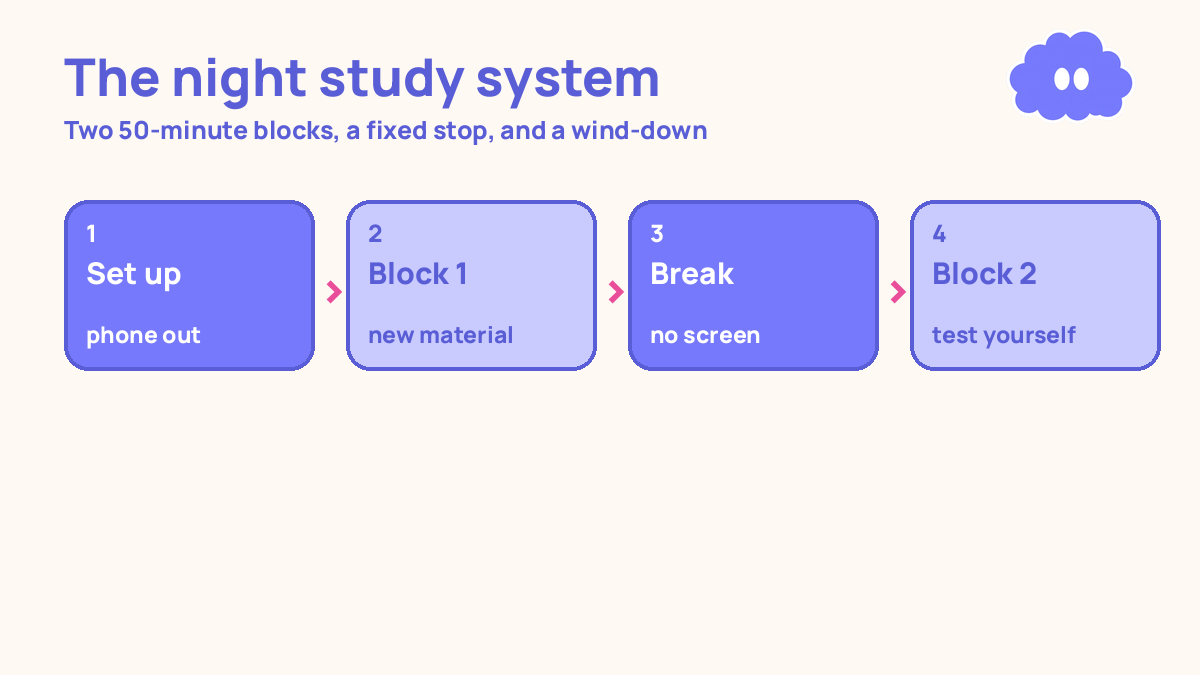
Study at night online with a fixed window, two 50-minute blocks, and a fixed stop time. Block one is new material from your course. Block two is testing yourself on it from memory. Finish with a 10-minute review, then wind down for 30 minutes with no screen, and go to bed at the same time every night. That is the whole system.
Your days belong to someone else. Classes, work, family, chores — by the time the house is quiet, it is 8pm and you are already tired. So you open the laptop, watch half a lesson, check your phone, and by 11pm you have done very little.
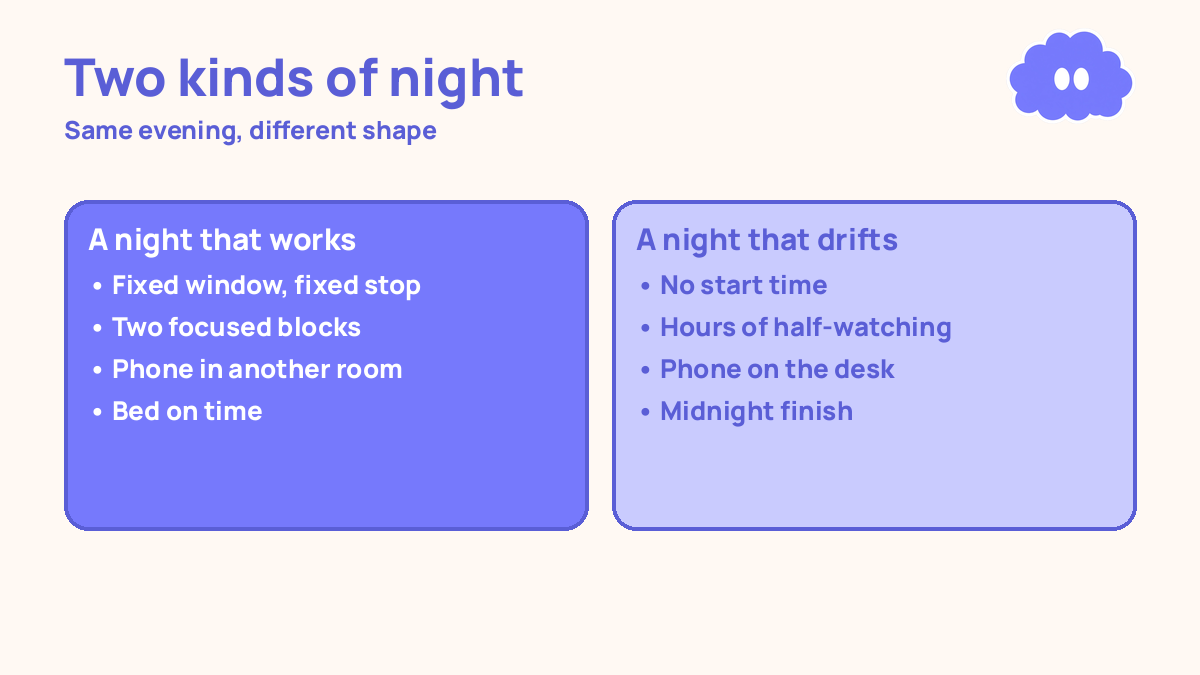
The problem is not that you study at night. Plenty of students only have nights. The problem is that night study usually has no shape: no start, no stop, no plan for what happens in between.
The system in short
- Fix your window. Same start, same stop, every study night. A good default is 8:00 to 10:30pm.
- Set up before 8:00. Lesson open, charger in, water beside you, phone in another room.
- Block one, 50 minutes: new material. Watch or read one lesson, and write questions as you go.
- Break, 10 minutes: stand up, stretch, get water. No phone, no new video.
- Block two, 50 minutes: test yourself. Answer yesterday’s questions and today’s questions from memory, then check.
- Review, 10 minutes: write down what you finished, what is still weak, and tomorrow’s first task. Then wind down for 30 minutes with no screen, and sleep.
Step 1: Fix the window and the stop time
Pick the window first. The window is the deal you make with yourself: study starts at this time, study stops at this time, every night you study. A good default is 8:00 to 10:30pm — two 50-minute blocks, two breaks, and a review, with time to wind down before bed. If your evenings start later, shift the whole window later.
The stop time matters more than the start time. Without a stop time, a night session stretches until you fall asleep at the desk, and then tomorrow starts tired. Sleep is when the day’s learning is consolidated — a short night after a long study day means the work was done but the consolidation was cut short (Diekelmann & Born, 2010).
Step 2: Set up before the window opens
Five minutes of setup before 8:00 saves twenty minutes of drifting after it. Do the setup at 7:55, standing up, before you sit down to study. Open the lesson you will study, and nothing else. Close the other tabs. Put the charger in, put water beside you, and put a notebook and a pen on the desk — you will need them in block two.
Then deal with the phone. Put it in another room. One study found a phone on the desk cost focus even when it was off — but a later replication did not find the effect, so the evidence is mixed, and this is a practical system, not a proven fact (Ward et al., 2017). If you need it for a login code, keep it face down, on silent, on the far side of the room, and fetch it only for that one job.
Step 3: Block one — new material, 50 minutes
Block one is for new material only. One lesson, one chapter, one module — whichever your course calls it. Not two lessons, and not “whatever I feel like”. One named piece, decided before the timer starts.
Watch or read at normal speed. Do not watch at double speed to “save time” — at night, tired, double speed is how a lesson passes through you without leaving anything behind. Pause when you need to. Rewind when you missed something.
While you watch or read, write questions in your notebook. Not notes that copy the lesson — questions the lesson should let you answer. “What are the three steps of the process?” “When would you use method A instead of method B?” You need at least five questions by the end of the block. They are the raw material for block two.
Step 4: Break properly for 10 minutes
The break is ten minutes, away from the screen. Stand up. Stretch. Walk to the kitchen and back. Get water. Look out of a window. Do not open your phone, do not start another video, and do not “quickly check” anything.
A break at night is not a reward for finishing block one. It is what makes block two possible. Your eyes have been on a screen for 50 minutes, in a dark room, after a full day.
Step 5: Block two — test yourself, 50 minutes
Block two is the part most night students skip, and it is the part that does the learning. Do not watch another lesson. Do not re-read your notes. Test yourself.
Open your notebook to the questions from block one, and answer them from memory, with the lesson closed. Write the answers down. Then open the lesson and check. Mark each question right or wrong, and write the correct answer beside the wrong ones. Then do the same for yesterday’s questions.
This is the spacing that makes the system work: review after a gap, not in the same hour you learned it. In a 2013 review, Dunlosky and colleagues rated ten common study techniques, and only two received a high utility rating: practice testing and distributed practice. Re-reading was rated low. The gap rule is simple: the longer you need to remember something, the longer the gap before you review it should be (Cepeda et al., 2006). A practical starting schedule is to review a topic the next day, then after 3 days, then after 7 days — a starting point to try, not a rule from the research.
Step 6: Review, wind down, sleep
The last 10 minutes are for the review, and the review is three lines in your notebook: what I finished tonight, what is still weak, tomorrow’s first task. Three lines, five minutes — and it is what makes tomorrow start without a twenty-minute argument with yourself about what to do first.
Then wind down for 30 minutes with no screen. This is the hardest part of the system, because the night feels like the only time that is yours, and a screen feels like rest. It is not rest. It is light, noise, and one more video. Read a paper book, stretch, prepare tomorrow’s clothes, sit with a drink.
A worked example: a Tuesday night after work
You work during the day and your course is a free online course in data analysis. Your window is 8:00 to 10:30pm, and bed is 11:00pm.
| Time | What you do |
|---|---|
| 7:55–8:00 | Set up: lesson open, charger in, water, phone in the kitchen |
| 8:00–8:50 | Block one: lesson 7, “Cleaning data with filters”, write 6 questions |
| 8:50–9:00 | Break: stand, stretch, water, no screen |
| 9:00–9:50 | Block two: answer today’s 6 questions from memory, then yesterday’s 5, check both |
| 9:50–10:00 | Review: 3 lines — finished lesson 7, still weak on filter order, tomorrow start with question 3 |
| 10:00–10:30 | Wind down: no screen, paper book, prepare tomorrow’s bag |
| 11:00 | Bed |
You finished one lesson, tested yourself on two sets of questions, and you know exactly what is weak. That is a complete night.
For the wider system this sits inside, start with the self-study system for online learners, the full system for learning on your own with no teacher. If your week is packed as well as your nights, the study system for students with a busy week shows how to fit the same blocks into a week with almost no free time. The evening study routine for tired students covers the tired-evening part — a routine for studying when you are already tired, while this article is a system for online study at night specifically.
When it goes wrong
You keep starting at 9:30 instead of 8:00. The window is slipping because nothing marks the start. Set an alarm for 7:55, and make the setup the first thing you do when it rings.
You fall asleep in block two. You are not lazy; you are tired, and the screen in a dark room is a sleep aid. Study with a light on, and make block two active — writing answers from memory keeps you awake in a way that watching never will. If you fall asleep three nights in a row, the window is too late: move it 30 minutes earlier and cut one block, not the sleep.
You finish block one and have no questions written down. That means you watched the lesson like a video, not like a student. Next night, pause the lesson every ten minutes and write one question before you continue. Five pauses, five questions.
You skip the review because it feels like admin. The review is three lines, and it is the only part of the system that makes tomorrow easy. Skip it and tomorrow starts with twenty minutes of deciding what to do — twenty minutes of your window gone. Write the three lines even when you are tired. Especially when you are tired.
Weekly review checklist
Copy this list and use it at the end of each week:
- How many nights did I study this week, and did I keep the window on each one?
- How many lessons did I finish, and how many questions did I answer from memory?
- Which questions am I still getting wrong after two tries — and what will I do differently with them?
- What time did I actually go to bed, and did the wind-down happen or did the screen win?
- What one change will I make next week: an earlier window, a shorter window, or a phone rule that actually holds?
Downloadable infographic spec: one vertical image, title “Your night study system”, with the window 8:00–10:30pm, block one new material, break 10 minutes, block two test yourself, review 3 lines, wind down 30 minutes no screen, bed 11:00pm, and the rule “phone in another room”, in Thynq cream, Cloud Purple, Dark Purple and pink, with the cloud mascot. Text taken word-for-word from this article.
What this system is not
It is not a promise that night study is as good as day study, and it is not a claim that you can cut your sleep and make it up later. It is a practical system for students whose only free hours are at night. It works by giving those hours a shape and by protecting sleep, because sleep is when the day’s learning is consolidated.
Sources
- Diekelmann, S. & Born, J. (2010). The memory function of sleep. Nature Reviews Neuroscience, 11(2), 114–126. Sleep improves the consolidation of what was learned; a short night after a long study day means the work was done but the consolidation was cut short.
- Roediger, H. L. & Karpicke, J. D. (2006). Test-enhanced learning. Science, 311, 1539–1540. Students who recalled a passage remembered more a week later than students who restudied it.
- Dunlosky, J., et al. (2013). Improving students’ learning with effective learning techniques. Psychological Science in the Public Interest, 14(1), 4–58. Only practice testing and distributed practice received a high utility rating; rereading was rated low.
- Cepeda, N. J., et al. (2006). Distributed practice in verbal recall tasks. Psychological Bulletin, 132(3), 354–380. The optimal gap is not fixed: it grows with how long you need to remember the material.
- Ward, A. F., et al. (2017). Brain drain: the mere presence of one’s own smartphone reduces available cognitive capacity. Journal of the Association for Consumer Research, 2(2). A phone on the desk cost focus even when off — but a later replication did not find the effect, so the evidence is mixed.
Questions
What time should I study at night?
Pick a fixed window and keep it, for example 8:00 to 10:30pm. A fixed start and a fixed stop matter more than the exact hour. The stop time is what protects your sleep.
How do I stay awake while studying late?
Study in 50-minute blocks with a real 10-minute break, standing up and moving, not scrolling. If you are falling asleep at the desk, stop and sleep — a session you sleep through teaches you nothing.
Should I learn new material or revise at night?
Use the first block for new material and the second block for testing yourself on it from memory. Testing yourself beats re-reading: students who recalled a passage remembered more a week later than students who restudied it (Roediger & Karpicke, 2006).
Does studying late hurt what I learned?
Sleep is when the day’s learning is consolidated, so a short night after a long study day means the work was done but the consolidation was cut short (Diekelmann & Born, 2010). That is why this system has a fixed stop time and a wind-down.