
The direct answer
When you are working to save for fees, set the fees target first, cap your work hours so study survives, and hold a five-hour weekly study floor. Work out the total you need and divide it by the weeks until it is due — that is your weekly savings number. Work the hours that number needs, and no more. Study five hours a week, on fixed days, testing yourself on old material. That is the whole system: a money number, a work cap, and a study floor that nothing is allowed to eat.
You do not need a budgeting app or a second job. You need one number for the fees, one cap on the hours, and five study hours a week that are fixed in the diary before anything else gets booked in.
Why saving for fees eats study time
Saving for fees is a good reason to work. It is also the reason most often given for stopping study altogether. The pattern is always the same: you take extra shifts to reach the fees total faster, the shifts eat the evenings, the evenings were your study time, and by the time the fees are saved, you have not studied for a month.
The problem is not the work. The problem is that there was no cap on it. Work without a cap expands to fill every hour, because there is always another shift and always another expense. Study without a floor shrinks to nothing, because it is the only thing in your week that nobody else is asking for.
The system in short
- Work out the fees number: total due, divided by weeks until it is due. That is your weekly savings.
- Cap the work hours at the number that leaves five study hours a week. For most students, that is around 20 hours.
- Fix the study floor: five hours a week, on the same days, testing yourself on old material.
- Save on payday, before anything else. The weekly amount leaves your account the day you are paid.
- Review once a month: savings on track, hours under the cap, floor kept. One change if something is off.
Saving for fees is a full-time-job problem first: the Study system for students with a full-time job plans study around a full working week.
Step 1: Work out the fees number
Write down three numbers: the fees total, the date it is due, and the weeks between now and then. Divide the total by the weeks. That is your weekly savings number, and it is the only number that matters for the money side of this plan.
If the total is 1,200 and it is due in 24 weeks, the weekly number is 50. If the total is 600 and it is due in 12 weeks, the weekly number is also 50. The maths is simple, and simple is the point — you need a number you can check every payday without a spreadsheet.
Write the number on paper, next to the date: “50 a week, 24 weeks, 1,200 by the 12th.” That line is the money plan. Everything else follows from it.
Step 2: Cap the work hours
The cap is the number of work hours that leaves five study hours a week and enough sleep. For most students that is around 20 hours a week. Past that point, extra hours come straight out of study time and sleep, and both are harder to get back than money.
Work out your cap from your own week, not from someone else’s. Add up the hours you must spend: classes, travel, meals, sleep. What is left is the time you can split between work and study. Give study five hours first, then give work what is left. If what is left is 20 hours, your cap is 20.
Tell your employer the cap, and mean it. “I can do 20 hours a week” is a sentence an employer can plan around. “I can do as many as you need” is a sentence that ends with you working 30 hours and studying none.
Step 3: Fix the five-hour study floor
Five hours a week is the floor: the minimum study that keeps you moving. Fix it on the same days every week, so it becomes a routine instead of a decision. A good shape is one hour on Monday, Wednesday and Friday, and two hours on Saturday morning. Five hours, four sessions, same times each week.
Spend the floor testing yourself, not re-reading. In a 2013 review, Dunlosky and colleagues rated ten common study techniques, and only two received a high utility rating: practice testing and distributed practice. Testing yourself is one of the two best-supported things you can do — and it fits in a one-hour session. Close the book, write down what you remember, check your answers, and move on. Spacing helps too: spaced practice beat massed practice in a major synthesis, and the right gap grows with how long you need to remember the material (Cepeda et al., 2006).
If a week goes wrong and you only get three of the five hours, do not try to do all five on Sunday. Do the three, note the two you missed, and start the next week at the floor.
Step 4: Save on payday, before anything else
The weekly amount leaves your account the day you are paid, before you spend anything else. Move it to a separate place — a different account, an envelope, a jar — somewhere you will not spend it by accident. Money that sits in the same account as your spending money will be spent. That is not a character flaw. That is how spending works.
An if-then plan makes the saving automatic. Decide the cue and the action in advance: “When I am paid on Friday, I will move 50 to the fees account before I buy anything.” Across 94 studies, if-then plans raised goal attainment by a medium-to-large amount (d = 0.65) over holding the goal alone (Gollwitzer & Sheeran, 2006). The plan works because the decision is already made.
If your pay varies week to week, save a fixed amount from the smallest week’s pay, and add extra in the good weeks.
Step 5: The monthly review
Once a month, on the same day, answer three questions. Is the savings on track — have I saved the weekly number every week this month? Are the work hours under the cap? Did I keep the five-hour floor?
Write the answers down, one line each. The review is how you catch a slip early, while it is still small. A month where the savings are short by 50 is a month you can fix with a few extra hours next month.
If the review shows the same problem three months in a row — the savings always short, or the hours always over the cap — the plan does not fit your life. Change the date, change the cap, or change the target.
A worked example: 1,200 in 24 weeks
You need 1,200 for fees, due in 24 weeks. Your weekly savings number is 50. You work in a cafe, 20 hours a week, and you study on fixed days.
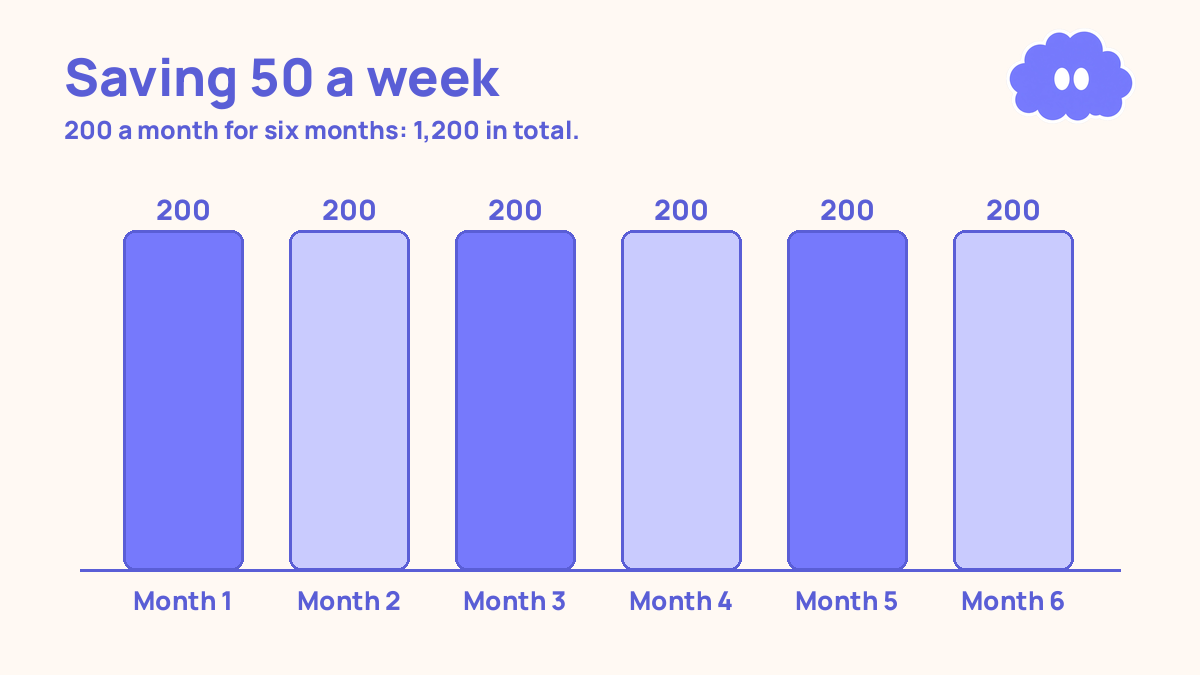
The money: You are paid every Friday. Every Friday, before anything else, you move 50 to the fees account. After 4 weeks you have saved 200. After 12 weeks, 600. After 24 weeks, 1,200 — the full total, on the date it is due.
The work: Your cap is 20 hours a week: four five-hour shifts, Monday, Tuesday, Thursday and Saturday afternoon. You told your manager the cap when you started, and the rota fits it. You do not take extra shifts, even in busy weeks, because extra shifts come out of study time.
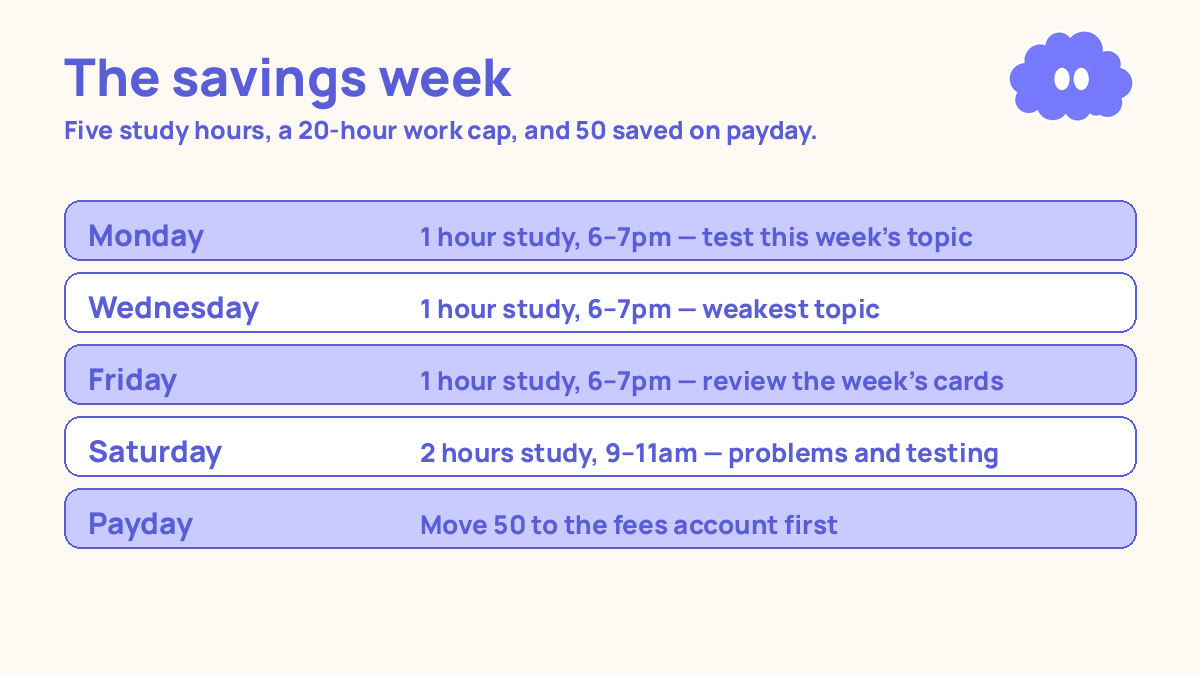
The study floor — five hours a week: Monday, Wednesday and Friday 6:00–7:00pm, one hour each testing yourself — Monday on the week’s topic, Wednesday on the weakest topic, Friday reviewing the week’s cards. Saturday 9:00–11:00am, two hours: one hour working problems, one hour testing yourself on the whole week and checking every answer. Four weeks, 200 saved, 80 hours worked, 20 hours studied. The numbers fit.
When it goes wrong
You take extra shifts and the study floor disappears. The extra money feels good for a week, and then the study is a month behind. The fix is a rule: no extra shift without a study swap. If you take a Saturday shift, you move the Saturday study to Sunday morning, the same week, before you agree to the shift.
The savings fall behind and you panic. You missed two weeks and you are 100 short. Do not take the missing money out of study time by working more hours. Add a few hours next month, or move the fees date if you can, or pay in parts. The study floor is what keeps you a student. Protect it first, and fix the money second.
You save the money but stop studying because the fees feel like the real goal. The fees are a step, not the goal. The goal is the course, and the course needs the study. If the money is on track and the study has stopped, the plan has failed in the more important half. Go back to the floor: five hours, fixed days, this week, starting Monday.
Weekly review checklist
Copy this list and use it each week:
- Did I move the weekly savings amount on payday, before anything else?
- Did I stay under the work hours cap this week?
- Did I keep all five study floor hours, on the fixed days?
- Is the total saved so far on track for the due date?
- What one change will I make next week: a different shift, a different study day, or a new savings cue?
Downloadable infographic spec: one vertical image, title “Saving for fees”, with the three numbers — the weekly savings, the work hours cap, the five-hour study floor — and the two rules: save on payday before anything else, and never take an extra shift without a study swap, in Thynq cream, Cloud Purple, Dark Purple and pink, with the cloud mascot. Text taken word-for-word from this article.
What this system is not
It is not a budgeting system, and it is not financial advice. It does not tell you how to earn more or spend less — it tells you how to keep studying while you save, which is a different job. It is also not a promise that five hours a week will carry you through a course on their own. Five hours is a floor, not a full plan. It keeps you moving and keeps the material warm while the money is being saved. When the fees are paid, the floor goes up — and the habit of fixed study days is already there to build on.
Sources
- Dunlosky, J., et al. (2013). Improving students’ learning with effective learning techniques. Psychological Science in the Public Interest, 14 (1), 4-58. Only practice testing and distributed practice received a high utility rating.
- Cepeda, N. J., et al. (2006). Distributed practice in verbal recall tasks: a review and quantitative synthesis. Psychological Bulletin, 132(3), 354-380.
- Gollwitzer, P. M. & Sheeran, P. (2006). Implementation intentions and goal achievement: a meta-analysis of effects and processes. Advances in Experimental Social Psychology, 38 , 69–119. If-then plans raised goal attainment (d = 0.65) over holding the goal alone. For the full system this fits inside, start with the two-hour study system for working students , and if the hours are the problem rather than the money, read the study system for students with a part-time job .
For the full system this fits inside, start with the two-hour study system for working students, and if the hours are the problem rather than the money, read the study system for students with a part-time job.
Questions
How much should I save each week for fees?
Divide the fees total by the number of weeks until it is due. That is your weekly number. If the number needs more work hours than leave you five hours a week to study, the plan is wrong — change the date, not the study floor.
How many hours a week can I work and still study?
Work the hours that leave a five-hour study floor intact, and no more. For most students that means capping work at around 20 hours a week. Past that point, extra hours come straight out of study time and sleep.
What if I fall behind on savings one month?
Do not take the missing money out of study time. Add a few hours of work the next month, or move the fees date if you can. The study floor is what keeps you a student — protect it first.
Should I save first, or study first?
Both, every week. Save the weekly amount on payday, before anything else, and study the floor hours on the same fixed days. A week where one of them happens and the other does not is a week the plan is slipping.