The direct answer
Watch a short lesson, then practise the skill the same day, with your hands, on real material. Record what you did and what went wrong. Then find small real jobs — for family, friends, or your community — and do the work for real. That is the whole system: watch a little, practise a lot, record everything, and use real jobs as your test.
You have watched ten videos on fixing taps, or wiring a plug, or sewing a shirt. You understand the steps. Then you pick up the tools and your hands do not know what to do. That gap — between understanding and doing — is the whole problem of learning a trade online. The videos teach your eyes. The trade lives in your hands.
Why watching a trade is not learning one
A trade is a physical skill. Knowing the steps is not the same as doing them. You can watch someone solder a joint a dozen times and still burn your fingers the first time you try, because your hands have never felt how hot the iron gets, how fast the solder flows, or how steady you need to hold it. That knowledge does not live in the video. It lives in the doing.
Watching also feels like learning, and that feeling is the trap. In a 2013 review, Dunlosky and colleagues rated ten common study techniques, and only two received a high utility rating: practice testing and distributed practice. Re-reading was rated low. Watching a video twice is re-reading. Doing the task, getting it wrong, and doing it again is practice testing — and the mistake is the feedback. Rowland (2014) found that testing with feedback (g = 0.73) beat testing without it (g = 0.39). A joint that leaks is feedback. A seam that comes apart is feedback.
The system in short
- Pick the trade and the first real task you want to be able to do.
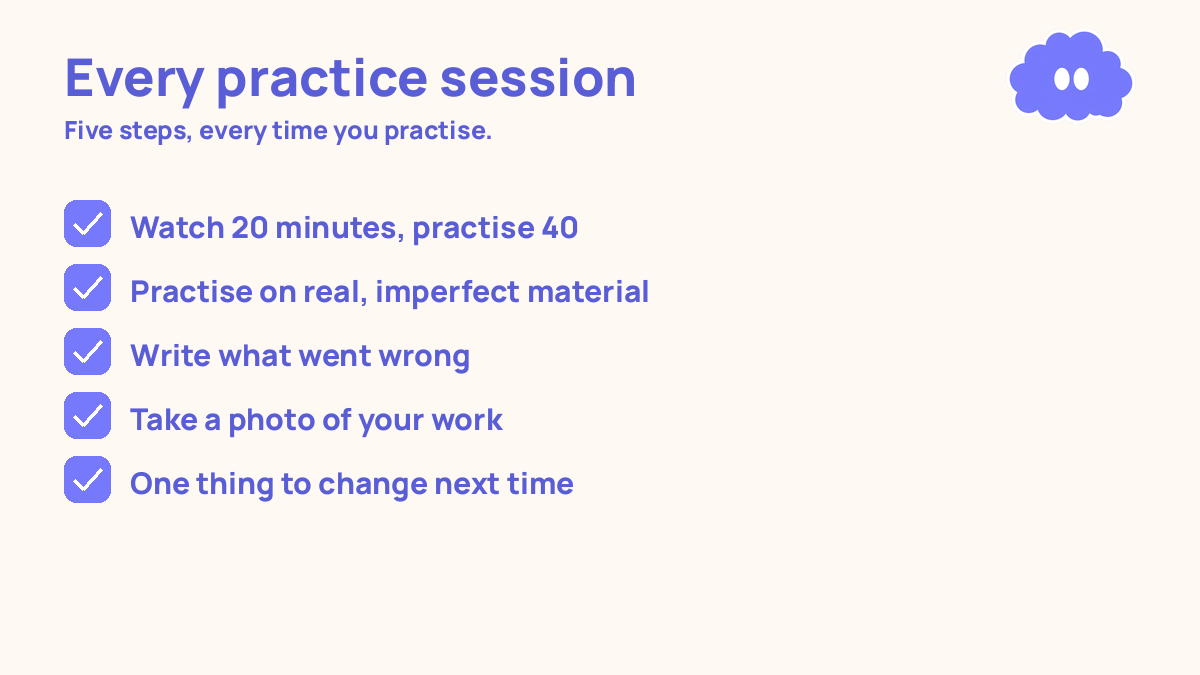
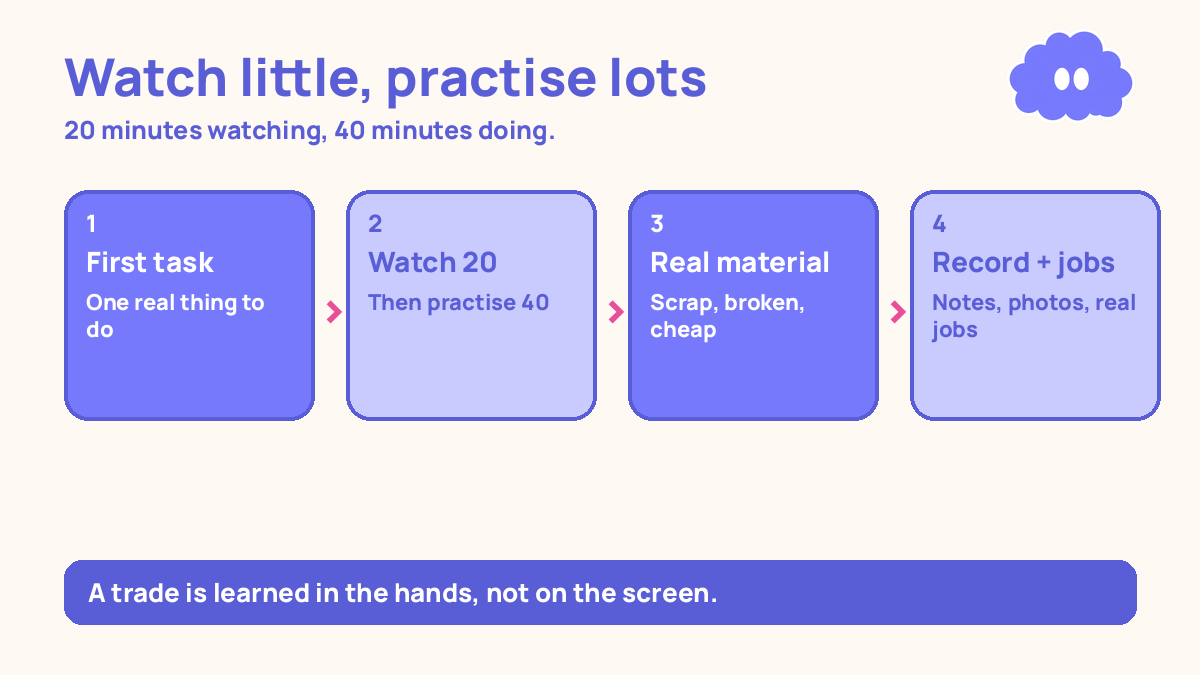
- Watch short: 20 minutes of video, then 40 minutes of practice, in the same session.
- Practise on real material — scrap, broken, or cheap — not just on demonstrations.
- Record every practice session: what you did, what went wrong, and what you will change.
- Find small real jobs for family, friends, or your community, and review your work every week.
Coding is the closest trade to learn this way — How to learn to code online covers the build-and-test loop this article uses.
Step 1: Pick the trade and the first real task
Write down the trade, and then write down the first real task you want to be able to do. Not “learn plumbing”. Something concrete: “Fix a dripping tap”, “Sew a straight seam on a shirt”, “Wire a plug safely”, “Bake a loaf of bread that rises”. One task, one thing you can test. If you can do it, you have learned something real. If you cannot, you know exactly what to practise next.
Keep the first task small. A first task that takes a week to finish is a first task you will abandon. A first task you can finish in an afternoon teaches you something and gives you a result to show. Check the safety rules for your trade first: some work, like live electrics or gas, must never be practised alone as a beginner.
Step 2: Watch short, practise long
In each session, watch for 20 minutes, then practise for 40 minutes. The video shows you the steps. The practice teaches your hands. If you watch for an hour and practise for ten minutes, you have spent the session learning with your eyes, and your hands learned nothing.
Watch actively. Pause the video after each step and say what the step was, in your own words, before you move on. If you cannot say it, rewind and watch it again. Explaining why each step works, in your own words, is a moderate-utility technique, and a 2018 meta-analysis found a moderate average benefit (g = 0.55) from prompting self-explanation.
Then put the video away and practise. Do the whole task, from start to finish, without the video running. If you get stuck, watch that one step again — and only that step — then go back to practising. Practice that feels hard is often practice that works: Bjork and Bjork (2011) describe desirable difficulties — harder practice feels worse now and improves retention later — but only if you already know the basic steps.
Step 3: Practise on real material
Practise on scrap, broken, or cheap material first. Old pipes, offcuts of wood, spare fabric, a broken appliance nobody wants. Real material is uneven, dirty, and difficult, and that is the point. If you only practise on perfect material, you are practising a different skill from the one the real job needs.
Use the tools you will use for real. If the job needs a wrench, practise with a wrench, not with your fingers. If it needs a sewing machine, practise on the machine, not by hand. The tool is part of the skill. Your hands need to learn the weight of it, the grip, the way it moves.
Keep your practice material organised. One box for scrap to practise on, one box for finished practice pieces. When the scrap box is empty, find more. Ask family, friends, and neighbours for broken things — most people have a drawer of things they meant to fix.
Step 4: Record every session
After every practice session, write down three things: what you did, what went wrong, and what you will change next time. Keep it short — five lines in a notebook, or a photo with a caption. “Fixed the tap washer. The washer was the wrong size, so it still drips. Next time, measure the old washer before buying a new one.” That is a record, and it is also a lesson you will not have to learn twice.
Take a photo of your work, before and after, when you can. Photos show you what your memory hides: the joint that looked neat in your hands and crooked in the photo, the seam that wandered. A photo is feedback you can look at again, and it is also the start of a record you can show someone.
Step 5: Find small real jobs, and review weekly
As soon as you can do the first task, do it for someone real. Fix a family member’s tap. Sew a friend’s torn shirt. Bake bread for the house. A real job is different from practice: someone is waiting for it, it has to work, and the result matters. That pressure is the best teacher you will find, and it is free.
Start small and free. Do not charge for your first jobs. You are learning, and the job is your practice. Tell the person honestly: “I am learning this. I will do it carefully, and if it does not work, I will fix it or tell you.” If a job needs a qualified person, say so, and do not attempt it. Every week, review: what did I practise, what did I make, what went wrong, and what will I do next week? Write it down.
A worked example: a week learning tap repairs, 6 hours
You are learning basic home plumbing repairs, and your first task is “Fix a dripping tap”. You have 6 hours this week: 2 hours watching, 3 hours practising, and 1 hour reviewing what you did.
| Day | Hours | What you do |
|---|---|---|
| Monday | 1 | Watch 20 minutes on tap washers, then practise taking a tap apart on a scrap tap |
| Tuesday | 1 | Practise putting the tap back together, twice, without the video |
| Wednesday | 1 | Watch 20 minutes on measuring washers, then practise measuring and fitting |
| Thursday | 1 | Fix a real dripping tap at home, with a family member watching |
| Friday | 1 | Practise on a second scrap tap; photograph your work |
| Sunday | 1 | Review the week’s notes and photos; write what went wrong and what changes next week |
Total: 6 hours — 2 watching, 3 practising, 1 reviewing. By Sunday you have taken a tap apart twice, fitted washers, fixed one real tap, and you have photos and notes showing what went wrong. That is a week of learning a trade.
When it goes wrong
You watch videos for weeks and never touch a tool. Watching feels like progress, and it is not. Fix it today: put the video away after 20 minutes and do the task, even badly. A bad first attempt teaches you more than a tenth video.
Your practice keeps failing and you think you cannot do it. Failing is the practice working. A joint that leaks tells you exactly what to fix. The danger is not failing — it is failing the same way every time without recording it. Write down what went wrong, change one thing, and try again. If the same step fails three times, watch that one step again, or ask someone who knows.
You take a real job that is too big or unsafe. Stop. Tell the person honestly that it is beyond what you can do safely, and do not attempt it. Live electrical work, gas work, and anything that could hurt someone is not practice material.
You practise alone and nobody ever sees your work. A trade is a social skill: someone has to trust your work. Show your practice pieces to someone — a family member, a friend, a local tradesperson if you know one.
Weekly review checklist
Copy this list and use it each week:
- How many hours did I practise this week, and how many did I watch?
- What did I make or fix, and do I have a photo of it?
- What went wrong, and what one thing will I change next time?
- Did I do any real job this week — and was it safe to do?
- What is my next real task, and what do I need to practise for it?
Downloadable infographic spec: one vertical image, title “Watch little, practise lots”, with the five steps — pick the first real task, watch short and practise long, practise on real material, record every session, find small real jobs — and the weekly review checklist, in Thynq cream, Cloud Purple, Dark Purple and pink, with the cloud mascot. Text taken word-for-word from this article.
What this system is not
It is not a promise that you can learn any trade fully online, and it is not a claim that watching videos plus practice makes you qualified. Some trades need formal training, certification, and supervised work before you can do them for paying customers, and this system does not replace any of that. What it promises is simpler: a way to turn online lessons into real skill, one small task at a time.
Sources
- Dunlosky, J., et al. (2013). Psychological Science in the Public Interest, 14(1), 4-58. Only practice testing and distributed practice received a high utility rating; rereading was rated low.
- Rowland, C. A. (2014). Psychological Bulletin, 140(6), 1432-1463. Testing beat restudying (g = 0.50); with feedback the effect was larger (g = 0.73) than without it (g = 0.39).
- Bisra, K., et al. (2018). Educational Psychology Review, 30(3), 703-725. Prompting self-explanation produced a moderate average benefit (g = 0.55) across about 5,917 learners.
- Bjork, E. L. & Bjork, R. A. (2011). Making things hard on yourself, but in a good way: creating desirable difficulties to enhance learning. Psychology and the Real World. Practice that feels harder can improve retention later — but only if you have the background knowledge to respond to it.
For the general system this one sits inside, read self-study system for online learners.
Questions
Can you really learn a trade online?
You can learn the knowledge online — the steps, the tools, the safety rules. But the skill itself only comes from doing it with your hands, on real material. This system pairs every online lesson with same-day practice, so the watching turns into skill.
How much should I watch versus practise?
In this system, about one hour of watching for every two hours of practice. A typical week is 2 hours watching, 3 hours practising, and 1 hour reviewing what you did. If you watch more than you practise, you are studying a trade, not learning one.
What if I have no tools or materials to practise with?
Start with what you have, and practise on scrap, broken, or cheap material first. Ask family and friends for old items to fix. Buy one tool at a time, for the next skill you need, not a full kit at once.
Is it safe to practise a trade at home?
Some things are safe to practise and some are not. Never practise live electrical work, gas work, or anything that could hurt you or someone else without a qualified person beside you. Learn the safety rules from your course first, and follow them every time.