
The direct answer
Turn each lecture into about 10 questions, answer them from memory, check every answer, mix the topics once you know the basics, and explain the mechanism out loud before you move on. The syllabus is too big to re-read — test it, one small pile at a time.
Medical school has a specific problem: the volume. One lecture can contain more facts than a whole week of an undergraduate course, and the next lecture arrives tomorrow. The students who keep up are not the ones with the best memory, but the ones with a system that turns each lecture into a small, testable pile on the same day.
The system in short
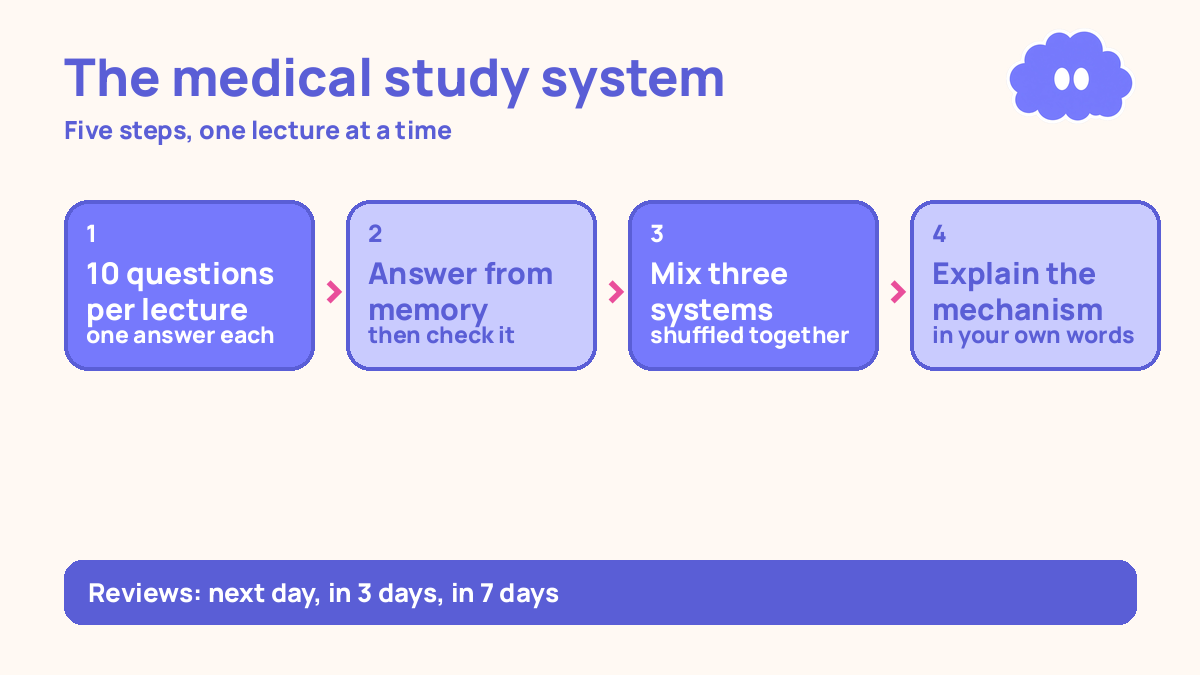
- After each lecture, write about 10 questions, each with one answer.
- Answer every question from memory, then check. Never check before answering.
- Mix topics in your review sessions once you know the basics of each one.
- Explain the mechanism out loud: why does this disease cause this symptom?
- Review on a 1-3-7 day schedule: next day, in 3 days, in 7 days. That is a practical starting schedule, not a research rule.
- If the review pile grows past what one session can clear, stop making new cards until it is clear.
Step 1: Turn each lecture into 10 questions
Do this on the same day as the lecture, while it is still fresh. Open your lecture notes and write 10 questions, each with one answer.
Write the question on one side and the answer on the other, on paper cards or in a flashcard app. The format does not matter; the rule does: one question, one answer, no lists.
Ten questions per lecture is the target. A lecture with 60 slides does not need 60 cards — it needs the 10 facts you will be tested on: the mechanism, the presentation, the investigation, the treatment, and the complication.
For the bigger picture, the memorisation system for heavy syllabuses shows how to break a large syllabus into testable pieces.
Step 2: Answer from memory, then check every answer
This is the step that makes the system work, and the step that feels worst. Answering from memory is slow and you will get things wrong.
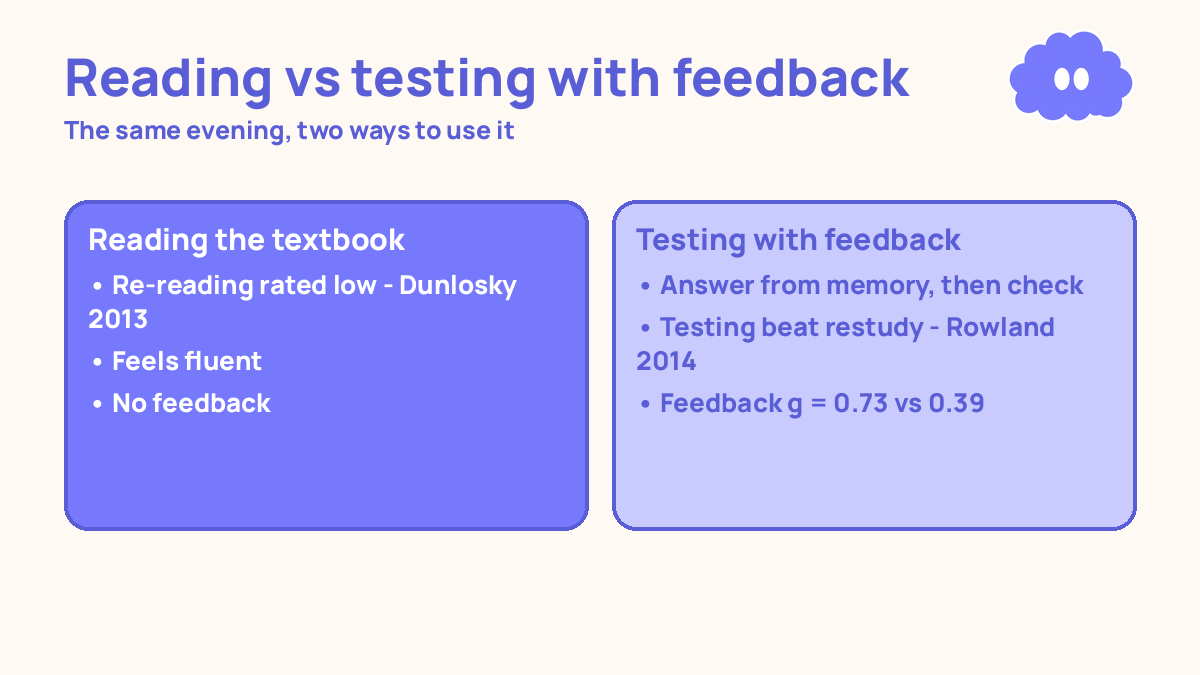
Rowland’s 2014 meta-analysis of 61 studies found testing beat restudying by a medium amount (g = 0.50), and 81% of the comparisons showed a benefit for testing. The advantage grows with time: on an immediate test, restudying often wins; after a delay, testing wins. Feedback mattered: with feedback the effect was larger (g = 0.73) than without it (g = 0.39).
The rule is strict: never look at the answer before you have tried to recall it. Not a peek, not a glance at the first word. The effort of trying to remember is what strengthens the memory. Read the answer first and you have turned a test into a re-read.
Do your reviews in short sessions: 25 minutes, then a 5-minute break. A session holds about 40 to 60 cards if you are honest about the ones you miss. Three sessions a day is serious; six ends in burnout.
Step 3: Mix the topics once you know the basics
Studying one system at a time feels good — you get faster at cardiology questions, and by the end you feel like you know cardiology. Then the exam mixes the topics, and you have to decide which system a question belongs to, a skill you never practised.
Mixing topics is called interleaving, and it works the other way round from how it feels. Rohrer and Taylor found in 2007 that students who practised four kinds of maths problems mixed together scored 63% on a test a week later, against 20% for students who practised them blocked by type — even though the blocked group did far better during practice, 89% against 60%.
The rule for medicine: learn a topic blocked first, then mix it. When a topic is brand new and you have no procedure to choose between, mixing cannot help — it can only confuse. Once you know the basics of two or three systems, mix their cards in review, so a session feels like the exam.
A practical mix: one review session holds cards from three systems — say cardiology, respiratory, and renal — shuffled together, 20 cards from each, 60 in total. A card you get wrong because you used the wrong system’s reasoning is the most useful kind of wrong.
Step 4: Explain the mechanism out loud
Medicine is full of lists: symptoms, causes, drugs, side effects. Lists are hard to remember and useless on their own, because a patient does not present as a list — a patient presents as a story, and the story makes sense only if you know the mechanism.
After you finish a topic, explain the mechanism out loud: why does this disease cause this symptom? Why does this drug help, and what does it do that causes the side effect? If you cannot explain it, you have memorised the list.
Self-explanation has real support. In a 1989 study, Chi and colleagues watched eight physics students think aloud while studying worked examples: the best solvers gave about 15 explanations per example; the weakest gave fewer than 3, and scored 46% correct against 82%. Small, so it shows a pattern rather than proving a rule — but a 2018 meta-analysis across 64 reports found a moderate average benefit (g = 0.55), best for principle-based material.
Do this for one topic a day, five minutes, out loud — to a study partner if you have one, or to an empty chair if you do not. Say it, do not write it again.
Step 5: Space the reviews, and protect your sleep
Review a set of cards the next day, then in 3 days, then in 7 days — a practical starting schedule, not a research rule. Cepeda and colleagues’ 2006 synthesis found spaced practice beat massed practice, and the best gap grows with how long you need to remember the material. A 2008 study by the same group found the best gap was about 20 to 40% of a one-week delay and 5 to 10% of a one-year delay.
One thing the schedule depends on: sleep. Diekelmann and Born’s 2010 review found sleep improves the consolidation of what was learned — during slow-wave sleep, patterns of brain activity from learning are re-activated, and memories are gradually moved into long-term storage.
Plan your reviews so the last session ends at least an hour before bed. Use that hour for something that is not study.
A worked example: a Thursday with two lectures
You have lectures at 9am and 11am, and a free afternoon from 2pm to 6pm.
2:00–2:30 — New cards: 10 questions from the 9am lecture, 10 from the 11am lecture. Twenty cards, same day. 2:30–3:00 — First test: Answer all 20 new cards from memory, then check every answer. Mark the 6 you missed for tomorrow. 3:10–3:40 — Mixed review: 60 cards from three systems — cardiology, respiratory, renal — shuffled together. 3:40–4:10 — Mechanism: Pick one topic from today and explain the mechanism out loud for five minutes. 4:20–4:50 — Spaced review: Cards due today on the 1-3-7 schedule — yesterday’s 20, and the set from 3 days ago. 4:50–5:00 — Tidy up: Count the pile. New cards made: 20. Cards due tomorrow: 40. If the pile due tomorrow is over 80, tomorrow has no new cards.
Four hours, 20 new cards made and tested, 100 cards reviewed, one mechanism explained, and a pile count that says whether tomorrow is a normal day or a catch-up day.
| Time | Block | Cards |
|---|---|---|
| 2:00–2:30 | New cards | 20 made (10 per lecture) |
| 2:30–3:00 | First test | 20 answered, 6 missed |
| 3:10–3:40 | Mixed review | 60 cards, 3 systems shuffled |
| 3:40–4:10 | Mechanism | One topic, explained aloud |
| 4:20–4:50 | Spaced review | 40 cards due today |
When it goes wrong
You have 400 cards and you never review them. You made cards faster than you can review them. Stop making new cards until the pile is clear. Cut it to the cards you have missed twice — the rest can wait a week.
You keep peeking at the answer before trying to recall it. You have turned testing into re-reading. Cover the answer with your hand, or use an app that hides it. The rule is simple: try first, then check.
You study one system for a week and feel confident, then mix the topics and fall apart. That is the interleaving gap. Blocked practice feels good because you never have to choose which system a question belongs to. The exam will make you choose.
You study until 2am and cannot remember anything the next day. You cut the consolidation short. Diekelmann and Born’s review is clear that sleep is when the day’s learning is consolidated.
Weekly review checklist
Copy this list and use it each week:
- Did I make about 10 questions per lecture, on the same day?
- Did I answer every card from memory before checking?
- Did I mix at least three systems in my reviews?
- Did I explain one mechanism out loud each day?
- Did I review cards on the 1-3-7 schedule, and is tomorrow’s pile under 80?
- Did I stop studying at least an hour before bed?
- What one change will I make next week: fewer new cards, more mixing, or earlier reviews?
Downloadable infographic spec: one vertical image, title “The medical study system”, with the five steps — 10 questions per lecture, answer from memory then check, mix three systems, explain the mechanism out loud, reviews on a 1-3-7 schedule — and the daily numbers — 20 new cards, 60 mixed review cards, 40 spaced review cards — in Thynq cream, Cloud Purple, Dark Purple and pink, with the cloud mascot.
What this system is not
It is not a promise of a grade, and not a claim that flashcards are the only way to learn medicine. It is a practical system built on the two techniques researchers rated highest — testing yourself and spacing study out — plus mixing and self-explanation, which suit a syllabus this large.
Sources
- Dunlosky, J., et al. (2013). Improving students’ learning with effective learning techniques. Psychological Science in the Public Interest, 14(1), 4-58. Only practice testing and distributed practice rated high utility; rereading rated low.
- Rowland, C. A. (2014). The effect of testing versus restudy on retention. Psychological Bulletin, 140(6), 1432-1463. Testing beat restudy (g = 0.50) in 81% of comparisons; feedback raised the effect (g = 0.73 with, 0.39 without); the advantage grows with the delay.
- Rohrer, D. & Taylor, K. (2007). The shuffling of mathematics problems improves learning. Instructional Science, 35(6), 481-498. Interleaved 63% a week later vs blocked 20%, though blocked did better during practice (89% vs 60%).
- Taylor, K. & Rohrer, D. (2010). The effects of interleaved practice. Applied Cognitive Psychology, 24, 837-848. Fourth-graders 77% interleaved vs 38% blocked a day later.
- Chi, M. T. H., et al. (1989). Self-explanations. Cognitive Science, 13(2), 145-182. Best solvers gave 15.3 explanations per example against 2.8 for the weakest, in a small study of 8 students.
- Bisra, K., et al. (2018). Inducing self-explanation: a meta-analysis. Educational Psychology Review, 30(3), 703-725. Moderate average benefit (g = 0.55) across 64 reports, best for principle-based material including medicine.
- Cepeda, N. J., et al. (2006). Distributed practice in verbal recall tasks. Psychological Bulletin, 132(3), 354-380. Spaced beat massed; the best gap grows with the retention interval.
- Cepeda, N. J., et al. (2008). Spacing effects in learning. Psychological Science, 19(11), 1095-1102. Best gap about 20-40% of a one-week delay, 5-10% of a one-year delay.
- Diekelmann, S. & Born, J. (2010). The memory function of sleep. Nature Reviews Neuroscience, 11(2), 114-126. Sleep improves consolidation; during slow-wave sleep, learning patterns are re-activated.
For the full system behind this one, start with how to build a study system that fits your life. The memorisation system for heavy syllabuses shows how to break a large syllabus into testable pieces, and the flashcard system that works covers the card rules.
Questions
How many flashcards should I make per lecture?
About 10 questions per lecture, each with one answer. More than that and the pile grows faster than you can review it. Ten honest questions beat thirty copied facts.
Should I study one system at a time or mix them?
Mix them once you know the basics. Mixing feels worse during practice and works better on the test — in one study, interleaved practice scored 63% a week later against 20% for blocked practice.
How do I revise a topic I learned months ago?
Test it from memory first, then check. Start with your old questions, not your old notes. The questions you miss tell you what to re-learn; the ones you get right are done.
What if I fall behind on reviews?
Cut new cards to zero until the review pile is clear. New material on top of a review backlog is how the pile becomes unmanageable. One week of catch-up beats a month of falling further behind.