
The direct answer
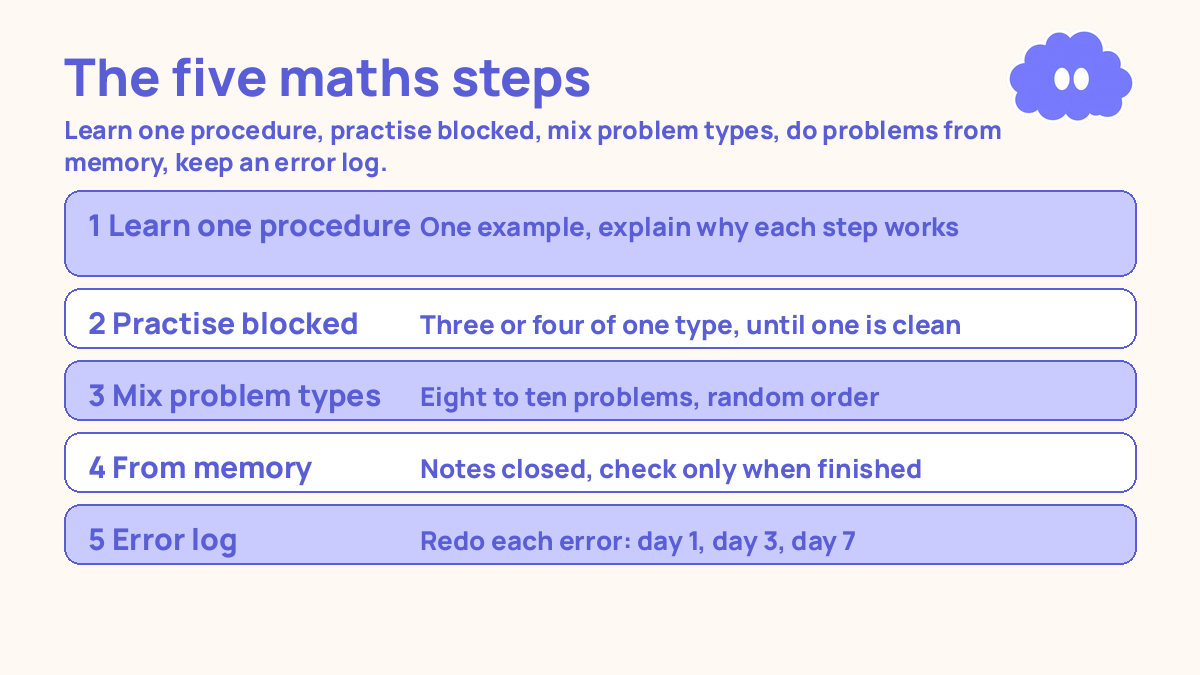
The study system for maths students is simple: learn one procedure properly, practise a few problems of that type, mix problem types, do them from memory, and keep an error log to redo after a gap. It works because maths is learned by doing problems, not by reading about them — and because mixing forces you to choose the right method, which is the skill the test measures.
Why the study system for maths students starts with doing
You did the homework. You watched the teacher work the examples. Then the test came, and the first question was a type you had done a dozen times — and you could not start it. You learned it with the notes open, in a set of ten identical problems, where the heading gave you the method.
Maths has a specific trap: the feeling of understanding you get from watching someone else solve a problem. The steps make sense while you watch, and your brain mistakes that for knowing how to do them yourself.
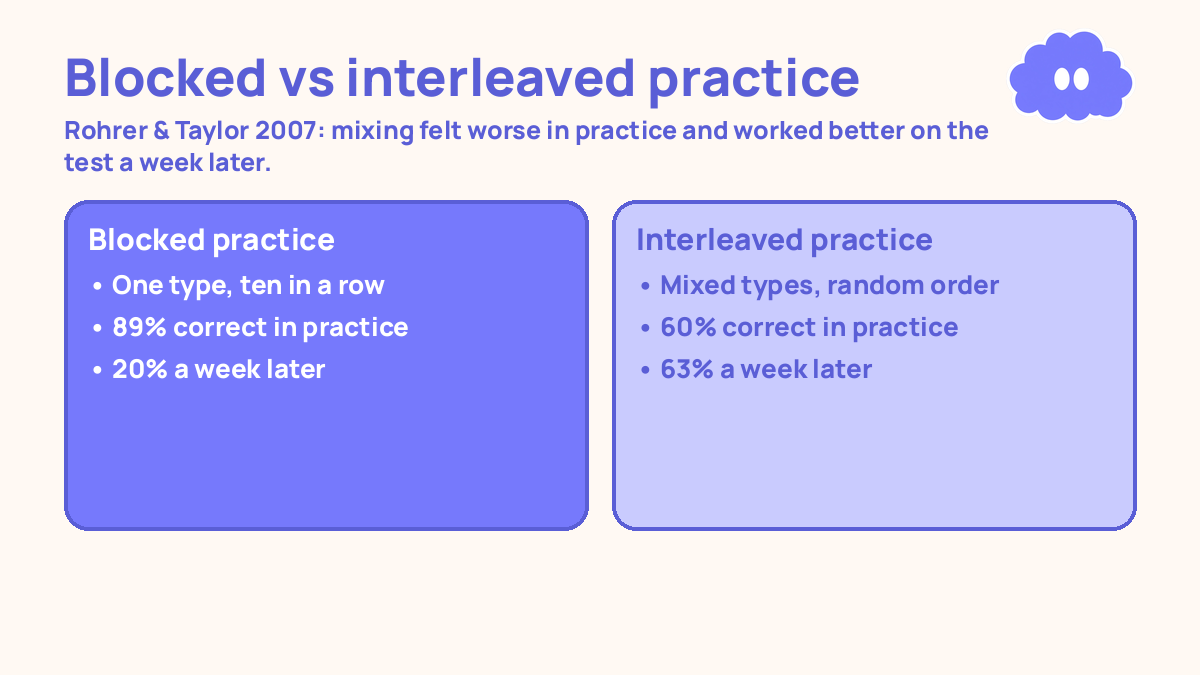
The research behind it is strong. In 2007, Rohrer and Taylor found students who practised volume problems mixed scored 63% a week later, against 20% for the blocked group — even though the blocked group had done far better during practice, 89% against 60%. Fourth-graders showed the same pattern in 2010: 77% against 38%. Mixing feels worse during practice and works better on the test.
The system in short
- Learn one procedure properly: work through one example slowly, and explain why each step works, in your own words.
- Practise blocked: three or four problems of that one type, until you can do one without looking at the example.
- Mix problem types: build a set of eight to ten problems from different topics and do them in random order.
- Do the problems from memory: notes closed, no worked example open, timer on. Check only when you finish.
- Keep an error log: every problem you get wrong goes in the log, with the step where it went wrong. Redo it after a gap — next day, then after three days.
Step 1: Learn one procedure properly
Pick one procedure: solving quadratics by factorising, or differentiating a product, or finding a probability. Work through one example slowly. Not ten examples — one. Read each step, then cover the next one and ask: why does this step happen? Say the answer in your own words, or write it next to the step.
This is self-explanation. In 1989, Chi and colleagues found the physics students who solved problems best had given 15.3 explanations per worked example, against 2.8 for the students who did worst. The explanations were the learning, not the reading. If you cannot say why a step works, that step is a gap.
One procedure per session. If it has two cases, learn the first today and the second tomorrow.
Step 2: Practise blocked, until you can do one without looking
Now do three or four problems of that one type, all in a row. Blocked practice builds the procedure into something you can run without thinking about each step. The first problem, do it with the example open beside you. The second, with the example covered. The third and fourth, from memory.
Stop blocked practice as soon as you can do one problem cleanly without looking. Three or four problems is usually enough.
If you cannot do one problem cleanly after four tries, go back to step 1. The problem is almost always in one step you cannot explain, not in the number of problems you have done.
Step 3: Mix problem types
Build a set of eight to ten problems from different topics and do them in random order. Quadratics, then probability, then trig, then another quadratic that needs a different method. The heading no longer tells you the method. You have to choose.
This is interleaving, and it is the step that feels worst and works best. Mixing forces you to choose the right procedure for each problem instead of repeating the last one — and choosing is the skill the test measures. A test is a mixed set. Practising in mixed sets is practising the test.
Start mixing from the second session on a topic, not the first. Interleaving helps you tell things apart; it cannot teach the things themselves. Learn it blocked first, then mix it.
Step 4: Do the problems from memory, notes closed
Do the mixed set with your notes closed and no worked example open. Timer on. One problem at a time, start to finish, without checking the answer halfway. Check only when you finish the problem.
This is retrieval practice applied to maths. Rowland’s 2014 meta-analysis found testing yourself beat restudying (g = 0.50), and feedback mattered: g = 0.73 with feedback against 0.39 without it. The check at the end is the feedback. A problem done with the notes open is not a problem done. It is a problem copied.
If a mixed set of ten takes an hour, that is fine. Ten problems done from memory beat thirty done with the book open. If you get half of them wrong, that is a session that told you exactly what to work on next.
Step 5: Keep an error log and redo the errors after a gap
Every problem you get wrong goes in the error log: the date, the topic, and the step where it went wrong. One line each. “Tue: quadratics — factorising, forgot to check both factors.” “Tue: trig — used sin instead of cos in step 2.” The step is the important part, not the problem. The step is what you will fix.
Redo each error after a gap: the next day, then after three days, then after seven. That 1-3-7 pattern is a practical starting schedule, not a research rule. Redo the problem from scratch, notes closed, not by reading your old solution. If you get it wrong in the same step, that step needs re-learning — go back to step 1 and explain it again.
The error log is also your revision plan: a week before the test, redo the whole log in mixed order, and you revise the things that actually need revising. When the exam gets close, that log becomes the core of how to revise maths for exams, which turns your errors into a timed revision plan.
A worked example: a Tuesday evening, quadratics, 6:00–7:30pm
You have a maths test on Friday. Quadratics by factorising is on it, and so are trig equations and probability from last month.
6:00–6:15 — Learn the procedure. One worked example: factorise x² + 5x + 6. You go through it slowly: the two numbers must multiply to 6 and add to 5, so they are 2 and 3, and the answer is (x + 2)(x + 3).
6:15–6:30 — Practise blocked. Three quadratics. First with the example open, second with it covered, third from memory. The third one is clean.
6:30–7:00 — Mixed set. Ten problems in random order: three quadratics, three trig, two probability, two simultaneous equations. Notes closed, timer on. Six right, four wrong. The four go in the error log with the step where each went wrong.
7:00–7:15 — Check and log. Two were factorising errors in the same step — you keep picking numbers that multiply right but add wrong. One trig, one probability. Four lines in the log.
7:15–7:30 — Fix the step. You re-explain the step: list the factor pairs of the constant first, then pick the pair that adds to the middle number. Two more quadratics, both clean. Tomorrow you redo the four errors.
| Day | Session | What you do |
|---|---|---|
| Monday | 45 minutes | Learn one procedure, practise blocked |
| Tuesday | 60 minutes | Mixed set of 10, notes closed, error log |
| Wednesday | 30 minutes | Redo Tuesday’s errors, then 5 mixed problems |
| Thursday | 45 minutes | Mixed set of 10, new topic + old topics |
When it goes wrong
You copy the worked examples. You read the example, follow the steps, and call it practice. Fix it by covering the example and doing the problem yourself. If you cannot, you have watched the procedure, not learned it.
You only practise blocked. Ten problems of the same type, all correct, and you feel ready. Then the test mixes the types and you cannot choose. Fix it by making every second session a mixed set: blocked builds the procedure, mixed builds the choosing.
You check the answer mid-problem. You get stuck, look at the answer, and finish the problem following it. Fix it by checking only when the problem is done. A problem finished by following the answer is not a problem solved. It is a problem copied, and it teaches you nothing about the step where you got stuck.
You never redo the errors. The error log fills up and you never open it again. Fix it by making the redo the first fifteen minutes of the next session. An error you never redo is an error you will make again on the test.
Weekly review checklist
Copy this list and use it each week:
- How many procedures did I learn properly, and how many did I only watch?
- How many mixed sets did I do, and how many sessions were blocked only?
- Which errors are still in the log after two redos?
- Did I redo the errors after a gap, or only in the same session?
Downloadable infographic spec: one vertical image, title “Learn it, mix it, test it”, with the five steps: learn one procedure, practise blocked, mix problem types, do problems from memory, keep an error log, plus the rule “blocked builds the procedure, mixed builds the choosing”, in Thynq cream, Cloud Purple, Dark Purple and pink, with the cloud mascot. Text taken word-for-word from this article.
What this system is not
It is not a promise of a grade, and it is not a claim that doing more problems is always better. Ten problems done from memory beat thirty done with the book open — Rohrer and Taylor’s numbers say so, 63% against 20% a week later. It is also not a system for every subject. Maths is learned by doing problems. A subject that is mostly facts needs retrieval practice and interleaving in a different shape: mixed questions, not mixed problem types. Use the system that fits the subject.
Sources
- Rohrer, D. & Taylor, K. (2007). The shuffling of mathematics problems improves learning. Instructional Science, 35(6), 481-498. Interleaved maths practice scored 63% a week later against 20% blocked; blocked did better during practice, 89% vs 60%.
- Taylor, K. & Rohrer, D. (2010). The effects of interleaved practice. Applied Cognitive Psychology, 24, 837-848. Fourth-graders: interleaving 77% vs blocked 38% a day later.
- Chi, M. T. H., et al. (1989). Self-explanations: how students study and use examples in learning to solve problems. Cognitive Science, 13(2), 145-182. In 8 physics students, the 4 who solved problems best (82% correct) gave 15.3 explanations per example, against 2.8 for the 4 who did worst (46%).
- Rowland, C. A. (2014). The effect of testing versus restudy on retention: a meta-analytic review of the testing effect. Psychological Bulletin, 140(6), 1432-1463. Testing beat restudy (g = 0.50); with feedback g = 0.73, without feedback g = 0.39.
- Dunlosky, J., et al. (2013). Improving students’ learning with effective learning techniques. Psychological Science in the Public Interest, 14(1), 4-58. Interleaved practice rated moderate utility; practice testing rated high.
For the full system behind this method, start with how to build a study system that fits your life.
Questions
How much maths should I do each day?
About 45 to 60 minutes on a school day. Thirty minutes of new material and fifteen of mixed review beats two hours once a week. Mixed problems from earlier topics are what keep old procedures alive.
Should I practise one type of problem or mix them?
Both, in order. Practise one type blocked first, until you can do one without looking. Then mix the types. In a 2007 study, students who practised volume problems mixed scored 63% a week later, against 20% for students who practised them blocked.
What do I do when I get stuck on a problem?
Work on it for ten minutes first. Write down what you have tried and where it stops. Then look at the first step of the worked example only, and try again. If you are still stuck, write down the exact step that stops you and ask about that step — not “I don’t get it”.
Is watching worked examples enough?
No. Watching feels like learning because the steps make sense while you watch. In a 1989 study, the physics students who solved problems best had given 15.3 explanations per worked example, against 2.8 for the students who did worst. Explain each step in your own words, then do the problem yourself.