
The direct answer
Brief every case in five lines, turn each rule into a one-line statement you can say from memory, and practise issue-spotting on past problem questions under time pressure. Law exams test whether you can find the issues and apply the rules — practise that, not re-reading.
Law reading expands to fill every hour you give it — always another case, another article, another chapter. The students who cope are not the ones who read the most, but the ones who turn what they read into something they can use: a rule they can state, a case they can apply, a habit of spotting the issue before they start writing. A law exam asks you to read facts, find the issues hidden in them, and apply the rules.
The system in short
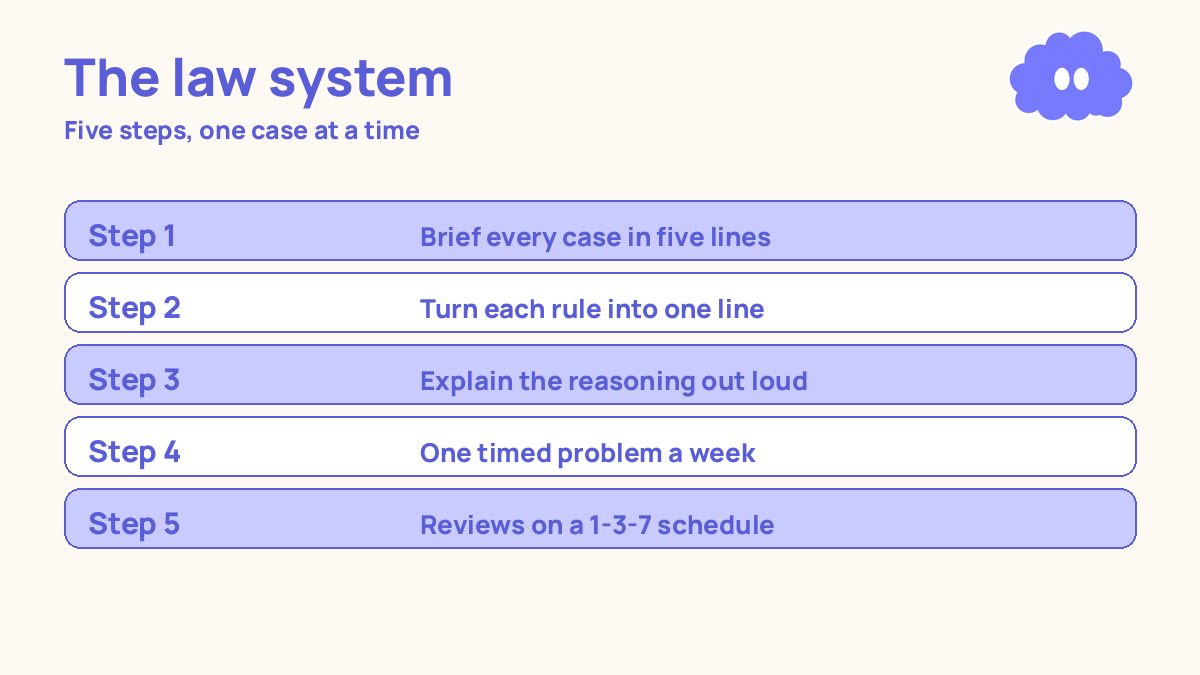
- Brief every case in five lines: facts, issue, rule, reasoning, outcome.
- Turn each rule into a one-line statement and learn it by testing yourself.
- Explain the reasoning out loud: why did the court decide this way, and not the other way?
- Practise issue-spotting on one past problem question per week, timed, from memory.
- Review on a 1-3-7 day schedule: next day, in 3 days, in 7 days. That is a practical starting schedule, not a research rule.
- Keep a one-page list of the rules you keep getting wrong, and review only that list.
Step 1: Brief every case in five lines
A case brief has five lines, and only five — facts, issue, rule, reasoning, outcome. One line each.
Five lines forces you to decide what matters. A brief that runs to a page is a second set of notes, and a pile of page-long briefs is one you will never open again. Two-minute briefs are a revision system.
Write the brief after reading the case, not during it. Read the case once, close it, and write the five lines from memory. Then check them — the checking is where the learning happens. Rowland’s 2014 meta-analysis of 61 studies found testing beat restudying, and feedback mattered: with feedback the effect was larger (g = 0.73) than without it (g = 0.39).
Keep the briefs in one notebook or one file, in the order the cases appear in your course.
Step 2: Turn each rule into a one-line statement
A rule you cannot state in one line is a rule you do not know yet. Shorten it until it fits: the test, the elements, and the exception if there is one. “A contract needs offer, acceptance, consideration, and an intention to create legal relations.”
Learn the rules by testing yourself, not by reading the list. Cover the rule, say it from memory, check it — five rules a day, and the ones you get wrong go back into tomorrow’s five. In a 2013 review, Dunlosky and colleagues rated practice testing one of only two high-utility techniques, alongside distributed practice.
Keep a separate list of the rules you keep getting wrong — the “wrong list”, one page long. If it grows past a page, you are adding rules you have not learned yet rather than rules you keep missing. Review it daily for two minutes: two minutes on the rules you miss beats an hour re-reading the ones you already know.
Step 3: Explain the reasoning out loud
The reasoning line is the most important line of your brief, and the one students skip — and the line the exam rewards, because applying a rule means explaining why it fits these facts.
After you write a brief, say the reasoning out loud in your own words: why did the court decide this way, and what would have changed the decision? If you cannot say it, you have memorised the outcome without understanding the case.
Self-explanation has real support behind it. In a 1989 study, Chi and colleagues watched eight physics students think aloud while studying worked examples: the best solvers — 82% correct against 46% — gave about 15 explanations per example, against fewer than 3 for the weakest. Small, so it shows a pattern rather than proving a rule — but a 2018 meta-analysis across 64 reports found a moderate average benefit (g = 0.55), best for principle-based material. Law is principle-based material.
Do this with a study partner if you have one — explaining a case to another person shows you the gaps in about thirty seconds. If you have no partner, explain it to an empty chair. Say it, do not write it again.
Step 4: Practise issue-spotting on past problems, timed
A problem question is a story with the legal issues hidden inside it. Finding them is a skill, and skills only improve with practice under realistic conditions.
Once a week, take a past problem question and set a timer for the exam’s time — usually 45 minutes to an hour. Read the facts once, then spend 10 minutes listing the issues before you write a word. That list is the whole exercise.
Then check your list against a model answer or your notes. The issues you missed go onto your wrong list; the ones you spotted but applied badly go into next week’s practice. After four weeks you will see a pattern — the same two or three issues keep getting missed. Those are your weak spots.
Do not practise issue-spotting with your notes open — that turns it into a reading exercise, and the exam will not let you bring your notes. The discomfort of spotting issues from memory is the practice. Karpicke and Blunt found in 2011 that students who practised retrieval scored about 0.67 against 0.45 for students who built concept maps a week later, and the mappers had predicted they would do best. They did worst.
Step 5: Space your reviews, and review the wrong list daily
Review a case the next day, then in 3 days, then in 7 days — a practical starting schedule, not a research rule. Cepeda and colleagues’ 2006 synthesis found spaced practice beat massed practice, and the best gap grows with how long you need to remember the material. A 2008 study by the same group found the best gap was about 20 to 40% of a one-week delay and 5 to 10% of a one-year delay.
A review takes 15 minutes: read your five-line briefs, cover the rules and say them from memory, and check the wrong list. If a rule is still on the wrong list after three reviews, rewrite it — the problem is usually the wording.
The wrong list gets two minutes every day, even on days you do not study.
A worked example: a Wednesday after lectures
You have a 6pm to 9:30pm evening and a contract law exam in four weeks.
6:00–6:30 — Briefs: Read two cases from today’s lecture, close the book, write a five-line brief for each from memory, then check. 6:30–7:00 — Rules: Turn the rules from those two cases into one-line statements. Test yourself on five rules from earlier in the week; add the misses to the wrong list. 7:10–7:40 — Reasoning: Pick one case from this week and explain its reasoning out loud for five minutes. Say the sentence you stumbled on again until it is smooth. 7:40–8:25 — Problem question: A past problem on offer and acceptance — 10 minutes listing issues, then 35 minutes writing the answer. 8:35–9:00 — Check and review: Check your issue list against the model answer. Two issues missed — both go on the wrong list. 9:00–9:30 — Spaced review: Briefs from three days ago, rules from memory, one topic from last week.
Three and a half hours, two cases briefed, five rules tested, one problem practised, and a wrong list that says what to study tomorrow.
| Time | Block | What you do |
|---|---|---|
| 6:00–6:30 | Briefs | Two cases, five lines each, from memory |
| 6:30–7:00 | Rules | One-line statements, test five |
| 7:10–7:40 | Reasoning | Explain one case out loud |
| 7:40–8:25 | Problem question | 10 minutes issues, 35 minutes answer |
| 8:35–9:00 | Check | Model answer, update wrong list |
| 9:00–9:30 | Review | Older briefs and rules from memory |
When it goes wrong
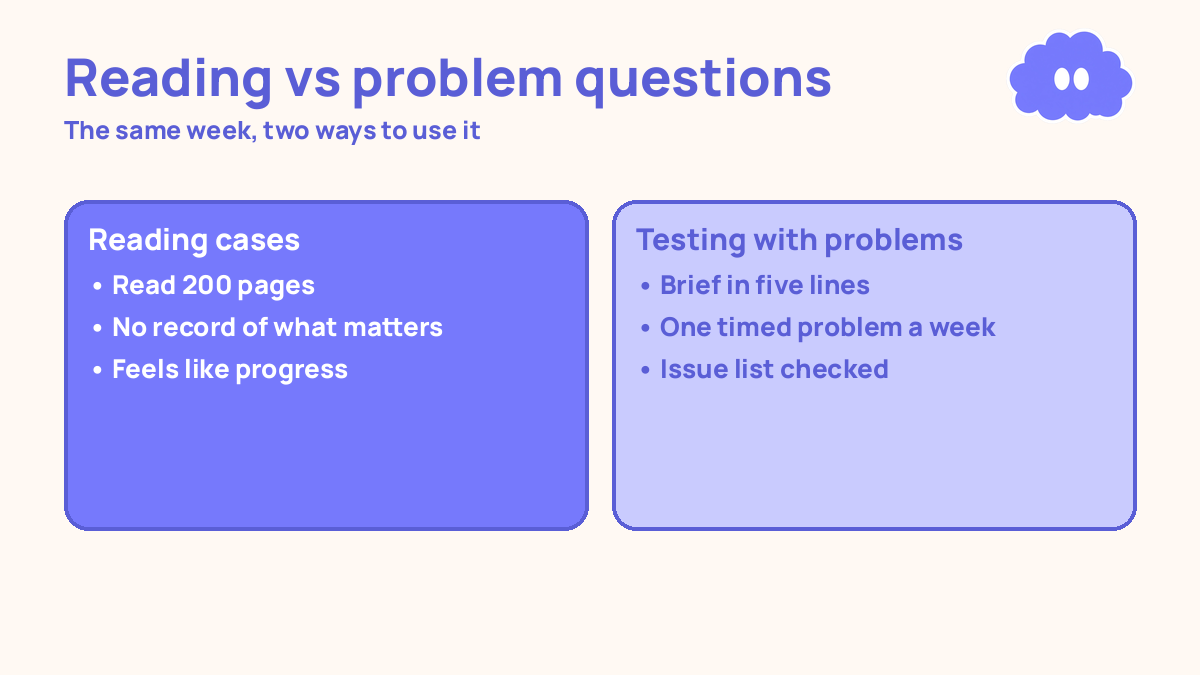
You have read 200 pages and briefed nothing. Reading without briefing is reading without a record. Stop reading and brief the last three cases from memory. The briefs will be thin — that thinness tells you what the reading left behind.
Your briefs are a page long each. You are copying the case, not deciding what matters. Cut each brief to five lines. If a line does not fit, shorten the sentence, not the rule.
You can state the rules but cannot spot the issues in a problem. You have been learning rules in isolation. Do the weekly problem question and spend the full 10 minutes on the issue list before writing — the list is the skill.
You feel confident after organising your notes, then blank in the exam. That is the fluency trap. Karpicke and Blunt’s concept-mappers predicted they would do best and did worst a week later. Organising feels like learning because it is fluent — test yourself instead: cover the rule, say it, check it.
Weekly review checklist
Copy this list and use it each week:
- Did I brief every case this week in five lines, from memory, then check?
- Can I state each rule in one line?
- Did I explain one case’s reasoning out loud?
- Did I do one timed problem question and check my issue list?
- Did I review older briefs on the 1-3-7 schedule?
- Is my wrong list one page, and did I spend two minutes on it daily?
- What one change will I make next week: shorter briefs, more problems, or earlier reviews?
Downloadable infographic spec: one vertical image, title “The law system”, with the five steps — five-line briefs, one-line rules, explain the reasoning out loud, one timed problem a week, reviews on a 1-3-7 schedule — and the five brief lines — facts, issue, rule, reasoning, outcome — in Thynq cream, Cloud Purple, Dark Purple and pink, with the cloud mascot.
What this system is not
It is not a promise of a grade, and not a claim that five-line briefs are the only way to learn law. It is a practical system built on the two techniques researchers rated highest — testing yourself and spacing study out — applied to what a law exam asks for: finding issues and applying rules. If your course is assessed by essays rather than problem questions, spend more time on step 3 and less on step 4.
Sources
- Dunlosky, J., et al. (2013). Improving students’ learning with effective learning techniques. Psychological Science in the Public Interest, 14(1), 4-58. Only practice testing and distributed practice rated high utility; rereading rated low.
- Rowland, C. A. (2014). The effect of testing versus restudy on retention. Psychological Bulletin, 140(6), 1432-1463. Testing beat restudy (g = 0.50) in 81% of comparisons; feedback raised the effect (g = 0.73 with, 0.39 without).
- Chi, M. T. H., et al. (1989). Self-explanations. Cognitive Science, 13(2), 145-182. Best solvers gave 15.3 explanations per example against 2.8 for the weakest, in a small study of 8 students.
- Bisra, K., et al. (2018). Inducing self-explanation: a meta-analysis. Educational Psychology Review, 30(3), 703-725. Moderate average benefit (g = 0.55) across 64 reports, best for principle-based material.
- Karpicke, J. D. & Blunt, J. R. (2011). Retrieval practice produces more learning than elaborative studying with concept mapping. Science, 331(6018), 772-775. Retrieval 0.67 vs concept mapping 0.45 a week later; mappers predicted best and did worst.
- Cepeda, N. J., et al. (2006). Distributed practice in verbal recall tasks. Psychological Bulletin, 132(3), 354-380. Spaced beat massed; the best gap grows with the retention interval.
- Cepeda, N. J., et al. (2008). Spacing effects in learning. Psychological Science, 19(11), 1095-1102. Best gap about 20-40% of a one-week delay, 5-10% of a one-year delay.
For the full system behind this one, start with how to build a study system that fits your life. If your syllabus feels too big to hold, the memorisation system for heavy syllabuses shows how to break it into testable pieces, and how to read research papers for a thesis covers reading academic text for its argument.
Questions
How long should a case brief be?
Five lines: facts, issue, rule, reasoning, outcome. If a brief runs to a page, it is a second set of notes, not a tool you can review in minutes.
How do I revise for a problem question?
Practise issue-spotting on past problems under time pressure, then check against a model answer. Spotting the issues is the skill — writing the answer follows from it.
Should I memorise cases or understand them?
Understand first, then memorise the rule in one line and the facts in one line. A case you can explain in two sentences is one you can use in an exam.
What if my reading list is too long to finish?
Read for the rule and the reasoning, not for every paragraph. Brief the case, write the rule in one line, and move on. The system works on cases you have briefed, not pages you have read.