
The direct answer
Read in short chunks, listen to the material while following a one-page summary, use three colours for structure only, and test yourself by speaking before you write. This is a system for getting the ideas in and the answers out with less friction — not a treatment, not a diagnosis.
If reading takes you longer than it takes the people around you, the problem is not the subject. It is the format. A dense page of small text is a format that fights you, and fighting the format for three hours leaves nothing for the ideas. This system changes the format: shorter chunks, a summary you can follow while you listen, colour that marks structure, and testing that starts with speaking. Nothing here is medical advice. One thing this system does not do: it does not match methods to a “learning style”. Pashler and colleagues found in 2008 that there is no adequate evidence for the idea that matching teaching to a learning style improves learning. What decides the best way to learn something is the content, not your type.
The system in short
- Break every reading into short chunks: one section, 20 minutes, then a break.
- Make a one-page summary per topic, with big headings and short lines.
- Listen to the lecture or the text while following the summary, not instead of it.
- Use three colours, one job each: headings, key terms, and questions.
- Test yourself by speaking first, then write the first line of the answer.
- Review on a 1-3-7 day schedule: next day, in 3 days, in 7 days. That is a practical starting schedule, not a research rule.
Step 1: Read in short chunks, one section at a time
Do not sit down to read a chapter. Sit down to read one section — 20 minutes, one section, then a 5-minute break. A chapter is four or five sections, and four or five sessions is a day’s work.
Before you read a section, look at its heading and write down one question it should answer — “What causes this?” or “Why does this matter?” Then read the section looking for the answer. Reading with a question turns a wall of text into a search, and a search has an end.
After the section, close the book and say the answer in one sentence, out loud. If you cannot say it, read the section once more — not the whole chapter, just that section.
This is elaborative interrogation and self-explanation in practical form. Dunlosky and colleagues rated both as moderate-utility techniques in 2013 — below testing yourself and spacing, above re-reading and highlighting.
Step 2: Make a one-page summary per topic
After you have read a topic in chunks, make a one-page summary. Big headings, short lines, lots of white space. One page, not two.
The summary has four parts: the heading for each section, the one-sentence answer to each section’s question, the key terms in bold, and one question at the bottom.
Write the summary by hand if you can, or type it in a large font with wide spacing — whichever you read more easily. The format is yours to choose. The rule is the same either way: one page, short lines, big headings, key terms standing out.
Use the summary as your review tool. When you review a topic, you review the summary, not the chapter. If it does not let you reconstruct the topic, add one line, not ten.
For the wider picture of notes you can actually use, the notes system that you can actually review covers the same ground for any student.
Step 3: Listen while following the summary
Listen to the lecture recording, or to a text-to-speech reading of the chapter, while following your one-page summary with your eyes. The listening gives you the ideas in a form that does not fight you. The summary gives the listening a shape to follow.
Do not listen instead of having a summary. Listening without a shape to follow is as hard to hold onto as reading without one. The two together are the system.
Listen at normal speed. Faster speeds save minutes and cost understanding. If a section is hard, listen to it twice — once to hear it, once to follow it on the summary.
Pause the recording after each section and say the answer to that section’s question out loud, in one sentence. The pause is the test — a recording that plays for an hour without a pause is a lecture you attended, not a topic you learned. In a 2013 review, Dunlosky and colleagues rated practice testing one of only two high-utility techniques.
Step 4: Three colours, one job each
Colour helps when it marks structure. It does not help when it decorates. This system uses three colours, each with one job.
The first colour is for headings, so you can see the shape of the topic at a glance. The second is for key terms — the words you will be tested on, and only those words. The third is for questions.
Three colours, three jobs, no more. If you cannot say what a colour means, it is decoration. If a page has seven colours, it has no structure.
Use the same three colours every time, in every subject. The point is not the colours themselves — it is that your eye learns where to look: headings first, then terms, then questions.
Step 5: Test by speaking, then write the first line
When you revise, test yourself by speaking first. Cover the summary, look at the heading, and say the answer out loud. Then check it. Speaking shows you what you know, without the friction of writing.
Then, for the exam, add one more step: write the first line of the answer. Not the whole answer — the first line. “The main cause was…” or “The three factors are…” The first line is the hardest line to start, and in the exam you will be writing under time pressure.
Rowland’s 2014 meta-analysis of 61 studies found testing beat restudying by a medium amount (g = 0.50), and recall formats like short answers beat recognition formats like multiple choice as practice. Speaking an answer from memory is a recall format — it counts as testing.
Do the speaking test in short sessions: 20 minutes, then a break. Five topics, one question each, spoken and checked.
Step 6: Space the reviews on a 1-3-7 schedule
Review a topic the next day, then in 3 days, then in 7 days — a practical starting schedule, not a research rule. Cepeda and colleagues’ 2006 synthesis found spaced practice beat massed practice, and the best gap grows with how long you need to remember the material. A 2008 study by the same group found the best gap was about 20 to 40% of a one-week delay and 5 to 10% of a one-year delay.
A review takes 20 minutes: read the one-page summary, cover it, say each section’s answer out loud, check it. If you cannot say an answer, that section goes back to step 1.
For video material, the same rules apply in a different shape: watch in short sections, write one question per section, and say the answer before you press play again. How to study video lectures properly covers that in full.
A worked example: a Wednesday evening after lectures
You have a 7pm to 9:30pm evening and a sociology test in two weeks.
7:00–7:20 — Chunk 1: Read one section of the chapter on social class, 20 minutes. One question first. 7:25–7:45 — Chunk 2: Listen to the lecture recording for that section while following your summary. Pause after the section and say the answer out loud. 7:50–8:10 — Summary: Add the section to your one-page summary: a heading in colour one, the three explanations in short lines, the key terms in colour two, the question in colour three. 8:15–8:35 — Speaking test: Cover the summary. Five headings, five answers spoken out loud, then checked. Two wrong — they go on tomorrow’s card. 8:40–9:00 — First lines: For the two answers you got wrong, write the first line of each answer on paper. 9:00–9:30 — Spaced review: Two older topics on the 1-3-7 schedule: read the summary, speak the answers, check.
Two and a half hours, one section read and listened to, one summary page built, five answers tested by speaking, two first lines written, and two older topics reviewed.
| Time | Block | What you do |
|---|---|---|
| 7:00–7:20 | Chunk 1 | Read one section, one question first |
| 7:25–7:45 | Chunk 2 | Listen, follow summary, say answer |
| 7:50–8:10 | Summary | Add section to one-page summary |
| 8:15–8:35 | Speaking test | Five answers spoken, then checked |
| 8:40–9:00 | First lines | Write first line of two weak answers |
| 9:00–9:30 | Review | Two older topics, 1-3-7 schedule |
When it goes wrong
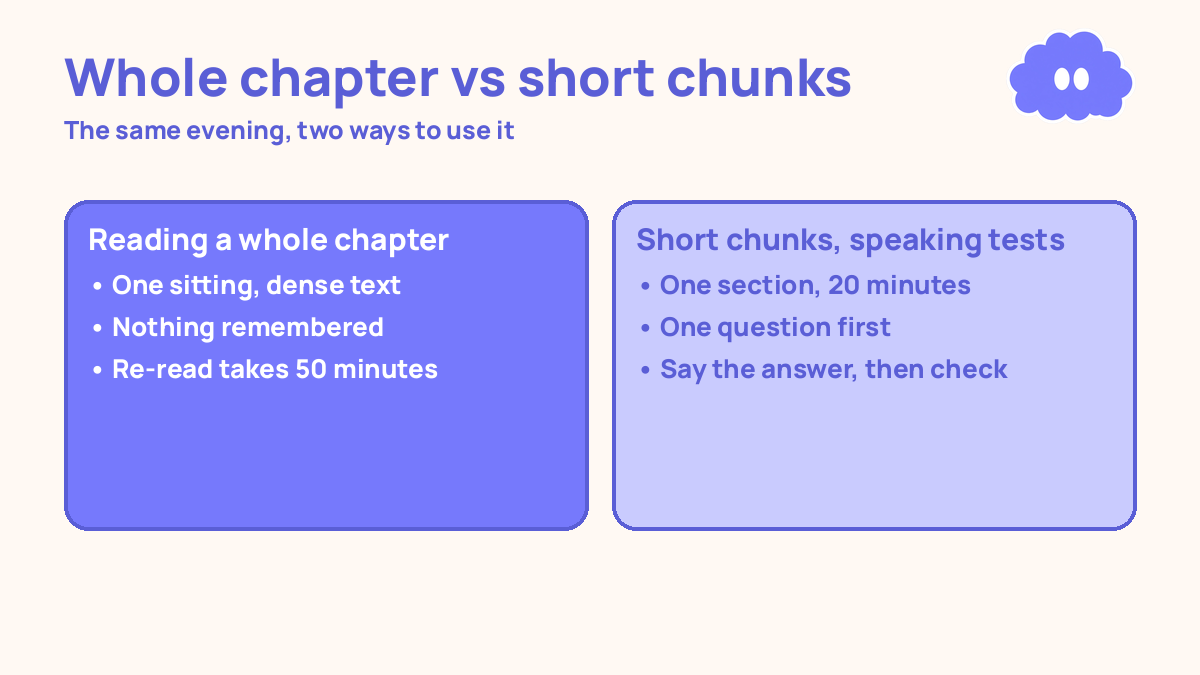
You read a whole chapter in one sitting and remember nothing. The chunk was too big. Go back to one section, 20 minutes, one question first.
Your summary is four pages long. It is a second set of notes. Cut it to one page: headings, one-sentence answers, key terms, one question at the bottom.
Your notes have seven colours and you cannot remember what any of them mean. You have decoration, not structure. Start again with three colours, one job each.
You test yourself by writing and freeze on the first line. Test by speaking first. Say the answer out loud, then write the first line.
Weekly review checklist
Copy this list and use it each week:
- Did I read in short chunks — one section, 20 minutes, one question first?
- Is each topic’s summary one page, with big headings and short lines?
- Did I listen while following the summary, pausing after each section to say the answer?
- Did I use only three colours, one job each, the same three every time?
- Did I test myself by speaking first, then write the first line of weak answers?
- Did I review older topics on the 1-3-7 schedule?
- What one change will I make next week: shorter chunks, a tighter summary, or more speaking tests?
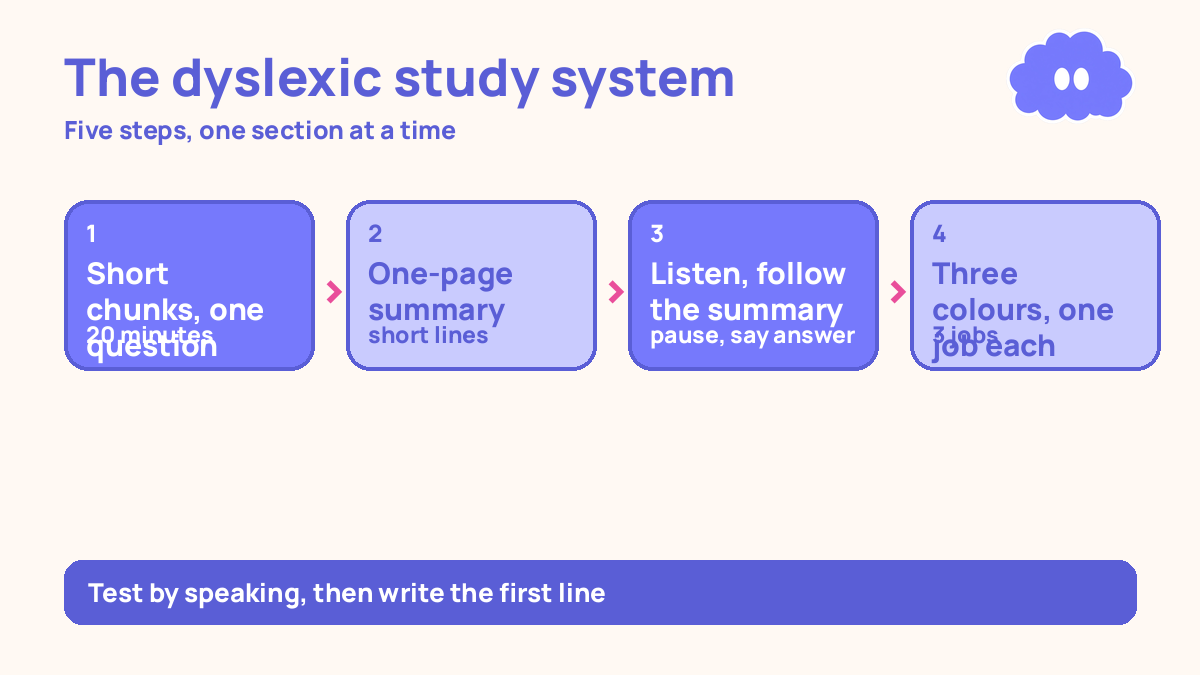
Downloadable infographic spec: one vertical image, title “The dyslexic study system”, with the five steps — short chunks with one question, one-page summary, listen while following the summary, three colours one job each, test by speaking then write the first line — and the chunk rule — 20 minutes, one section, 5-minute break — in Thynq cream, Cloud Purple, Dark Purple and pink, with the cloud mascot.
What this system is not
It is not a treatment, a diagnosis, or a claim about how any brain works. It is a practical system for getting ideas in and answers out with less friction: shorter chunks, a summary you can follow while you listen, colour that marks structure, and testing that starts with speaking. It does not match methods to a learning style — Pashler and colleagues found no adequate evidence for that.
Sources
- Pashler, H., McDaniel, M., Rohrer, D. & Bjork, R. (2008). Learning styles: concepts and evidence. Psychological Science in the Public Interest, 9(3), 105-119. No adequate evidence base to justify incorporating learning-styles assessments into general educational practice.
- Dunlosky, J., et al. (2013). Improving students’ learning with effective learning techniques. Psychological Science in the Public Interest, 14(1), 4-58. Only practice testing and distributed practice rated high utility; elaborative interrogation and self-explanation moderate; rereading low.
- Rowland, C. A. (2014). The effect of testing versus restudy on retention. Psychological Bulletin, 140(6), 1432-1463. Testing beat restudy (g = 0.50) in 81% of comparisons; recall formats beat recognition as practice.
- Cepeda, N. J., et al. (2006). Distributed practice in verbal recall tasks. Psychological Bulletin, 132(3), 354-380. Spaced beat massed; the best gap grows with the retention interval.
- Cepeda, N. J., et al. (2008). Spacing effects in learning. Psychological Science, 19(11), 1095-1102. Best gap about 20-40% of a one-week delay, 5-10% of a one-year delay.
For the full system behind this one, start with how to build a study system that fits your life. The notes system that you can actually review covers notes you can use, and how to study video lectures properly covers short-section watching with a question first.
Questions
Should I listen to lectures instead of reading?
Listen while following a one-page summary, not instead of having one. The summary gives the listening a shape to follow, and the listening gives the summary a voice to remember.
How long should a study session be?
Start with 20 minutes of reading or writing, then a 5-minute break. Short chunks with a real break beat a long session that ends in frustration.
Does colour-coding help?
Colour helps when it marks structure — three colours, one job each. Colour that decorates every page does not help. If you cannot say what a colour means, it is decoration.
How do I revise for a written exam?
Test yourself by speaking first. Say the answer out loud, then write the first line of it. Speaking shows you what you know; the writing is only the last step.