The direct answer
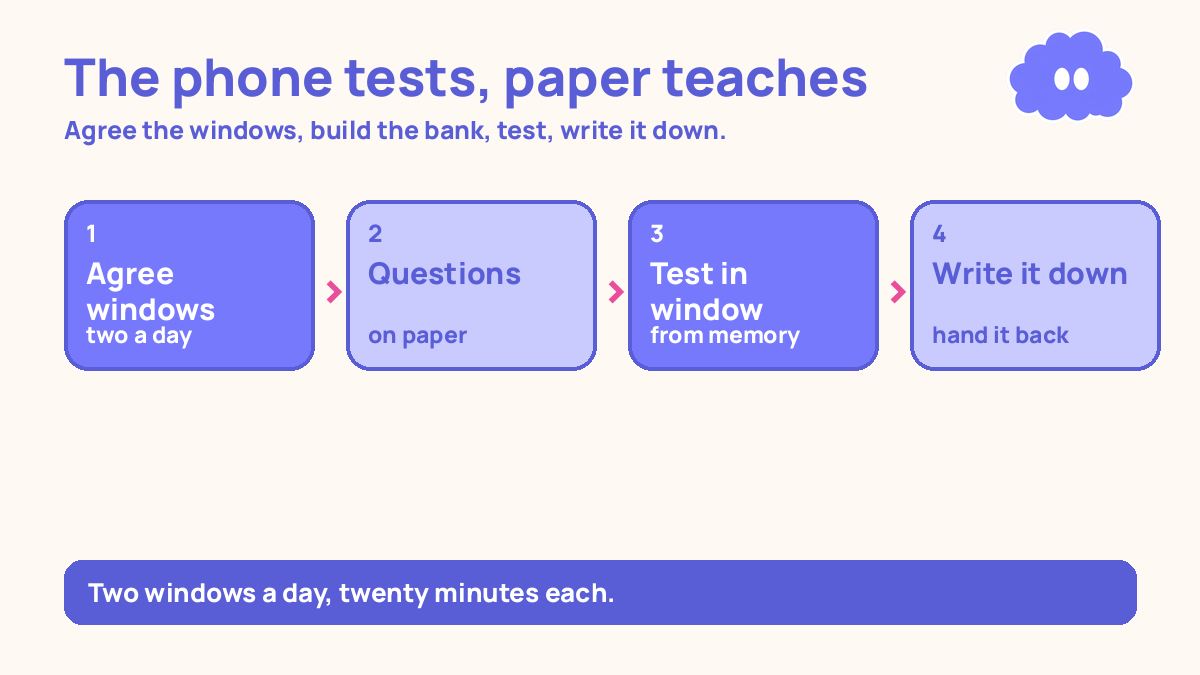
Study on a shared phone by splitting the work in two: learn on paper between phone windows, and use each short window only to test yourself on the questions you wrote down. Agree fixed windows, keep a paper question bank ready, and write every correction on paper before the phone goes back.
You do not have a phone of your own. The phone belongs to the family, and you borrow it in short windows — twenty minutes after dinner, ten minutes before bed, whenever nobody else needs it. The data runs out, the battery is shared, and someone will always need it back.
A shared phone cannot be your notebook or your library — it leaves your hands, and you cannot read on it for an hour. So this system gives the phone one job only: testing. The learning happens on paper, between windows. Paper is yours, and it is still on your desk tomorrow morning.
It fits beside study system for students with no internet — which still assumes you have a device — and study system for students in a shared house, about finding quiet when the house is full. Here the scarce thing is not space. It is the phone.
The system in short
- Agree two fixed phone windows a day with your family, and write them down.
- Between windows, study on paper and build a question bank — one question per thing to remember.
- In each window, answer your questions from memory first, then check the ones you missed.
- Use AI in the window only to test you, explain a gap, or make questions — never to write your work.
- Before the phone goes back, write every correction and tomorrow’s questions on paper.
Step 1: Agree two fixed windows a day
Do not borrow the phone whenever it happens to be free — every day becomes a negotiation, and the negotiation eats the study time. Agree two windows once — twenty minutes after dinner and twenty before bed, say — and write them where everyone can see them.
Two windows of twenty minutes beat one window of forty: the first tests what you studied during the day, the second tests it again after a gap. Spaced practice beat massed practice in a 2006 synthesis by Cepeda and colleagues, and the right gap grows with the retention interval.
Make each window an if-then plan: “If dinner is finished, then I take the phone for twenty minutes and test myself.” Across 94 studies, if-then plans raised goal attainment by a medium-to-large amount over holding the goal alone (Gollwitzer & Sheeran, 2006).
Decide in advance what happens when a window is lost: it moves to the next free twenty minutes. Do not double the next window — doubling it takes someone else’s time, and the agreement only works if everyone trusts it.
Step 2: Build the question bank on paper
Between windows, study on paper — read the chapter, take notes, work the problems — with the phone in another room. When you meet something you are not sure of, write it down as a question.
A question bank is a list of questions you wrote yourself — “What is the formula for the area of a circle?” is one. Ten questions a day is a good start.
Write each question the moment you think of it — wait for the window, and half of them will be forgotten.
The phone’s absence helps here. One study found people with their phone in another room did better on tests of memory and focus than people with it on the desk, even when it was off (Ward et al., 2017) — but a later replication found no effect, so the evidence is mixed. Treat “phone in another room” as a practical system, not a proven fact.
Do not write the answers in the bank yet — they come in the window, from your memory first.
Step 3: In the window, test yourself first
When the window starts, answer the questions from memory, on paper, before you touch anything on the phone. Ten questions, notes closed. This is the test, and it is the whole point of the window.
In a 2013 review, Dunlosky and colleagues rated ten common study techniques, and only two received a high utility rating — practice testing and distributed practice. Re-reading was rated low. Reading your notes on the phone is re-reading; answering from memory is practice testing, and that is what the window is for.
Only after you have answered from memory do you check — the textbook if you have one, or the phone for the answers you missed. Write each correction on paper, in your own words, next to the question. Across 61 studies, testing beat restudying, and the advantage was larger with feedback (Rowland, 2014). A test without checking is only half a test.
Count the score: “7 right out of 10” is the evidence the paper study worked; “3 right out of 10” tells you which questions to carry into the next window.
If the window is short, test five questions instead of ten. Five answered properly beat ten skimmed.
Step 4: Use AI in the window to test you, not to write for you
If the phone has an AI chat app, it can be the most useful thing in the window — used the right way. AI has three jobs here, and only three: testing you, explaining a gap, and making questions from your notes.
Ask it to test you: “Ask me ten questions about photosynthesis, one at a time, and wait for my answer.” Answer on paper, then ask it to mark them. Ask it to explain a gap in simple words, or to make questions from your notes.
What AI must not do is write your work. Do not ask it to write your notes, your homework, or your essay — if AI writes it, you have not learned it, and the next test without a phone will show that. Explaining a gap in your own words is a real technique — prompting self-explanation produced a moderate average benefit across 64 reports (Bisra et al., 2018). Copying an AI explanation is not self-explanation.
Check every AI answer against your textbook or class notes. AI gets things wrong and sounds confident doing it — if the AI answer and the book disagree, the book wins. And keep AI use inside the window: one quick question outside it becomes five, and someone else is waiting for the phone.
Step 5: Close the window on paper
The last two minutes of every window belong to paper: write down today’s corrections, the questions still wrong, and tomorrow’s question list.
The questions you still got wrong go back into the bank. Test them again tomorrow, then in three days, then in seven days. That 1-3-7 pattern is a practical starting schedule, not a research rule — spacing beats massing, and the right gap grows with the retention interval (Cepeda et al., 2006).
Tomorrow’s question list comes from today’s corrections and the next chapter — write it before the phone goes back, or you will forget what the window showed you. Then hand the phone back on time: ten minutes over is ten minutes of someone else’s time.
A worked example: chemistry, one chapter, one week
Worked example, with the article’s own numbers — not a real student, and not a promise of a grade.
One chemistry chapter, one week before the class test, two twenty-minute windows a day — after dinner and before bed. A textbook, a notebook, a pen.
Monday: You read the chapter and write 10 questions. Evening window: all 10 from memory, 6 right, 4 wrong. You check the 4; the 4 wrong ones stay in the bank.
Tuesday: You add 5 new questions. Evening window: the 4 old ones plus 5 new — 7 right out of 9.
Wednesday: You work 5 textbook problems on paper. Evening window: the 2 wrong ones plus 5 problem questions — 6 right out of 7. One is wrong a third time, so you rewrite its explanation.
Thursday: No new questions. You re-test the bank of 14 on paper; evening window, 12 right out of 14.
Friday: You write 6 questions from the last section. Evening window: the full bank of 20 from memory — 17 right.
| Day | Phone windows used | Questions tested | Right from memory |
|---|---|---|---|
| Monday | 2 × 20 minutes | 10 | 6 |
| Tuesday | 2 × 20 minutes | 9 | 7 |
| Wednesday | 2 × 20 minutes | 7 | 6 |
| Thursday | 2 × 20 minutes | 14 | 12 |
| Friday | 2 × 20 minutes | 20 | 17 |
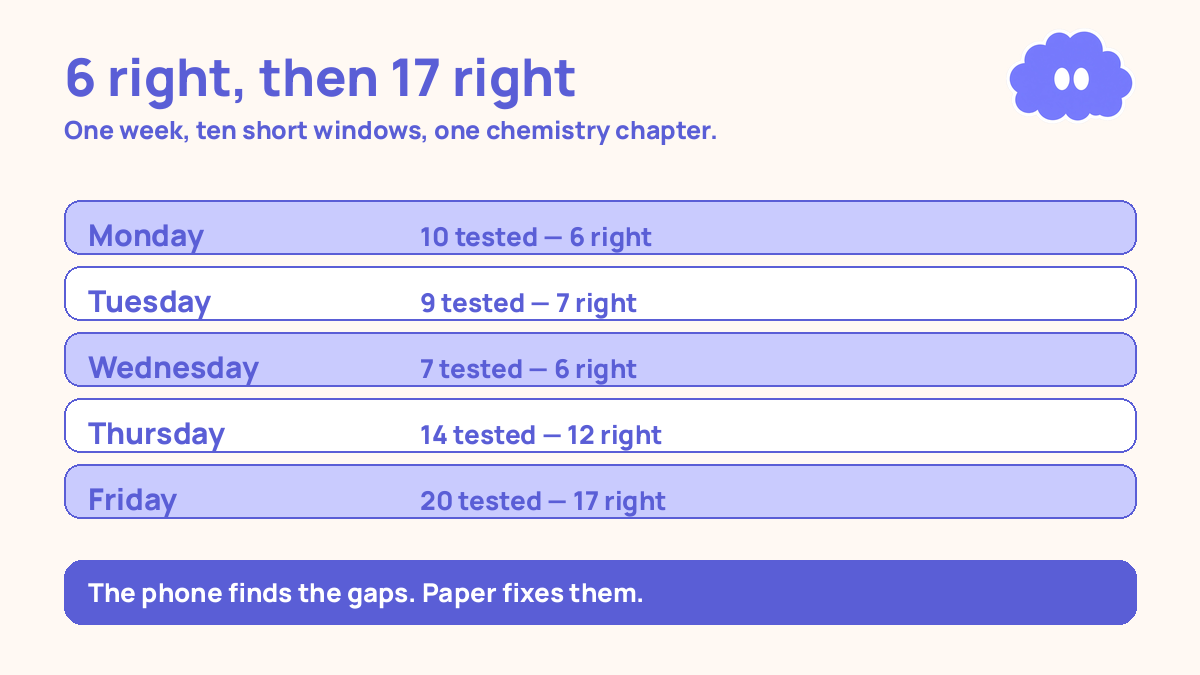
Five days, ten windows, two hundred minutes of phone time — all of it testing, not reading. The score rose from 6 out of 10 to 17 out of 20.
When it goes wrong
You use the window to read, not to test. Reading notes on the phone feels like studying, and it is rated low utility. If the window ends with no score and no corrections, it was wasted. Next window: questions first, notes closed.
The question bank is empty when the window starts. Then the window is spent deciding what to study, and twenty minutes goes in a blink. If the bank is empty, spend the window writing questions on paper, and test them tomorrow.
You let AI write the answers. If the corrections on your paper are copied from the AI chat, they are not yours. Write every correction in your own words and check it against the book.
One lost window becomes a lost week. A family emergency takes the phone for a day, and the system stops. It does not have to: the paper study continues without the phone. When the window comes back, the bank is full and ready.
You double the next window to catch up. Do not — a doubled window takes someone else’s time and breaks the agreement. Do the next window at its normal length and let the rest wait a day.
You keep the phone after the window ends. The agreement is the system. Hand it back on time, every time, even mid-test.
Weekly review checklist
Copy this list and use it each week:
- Did I have two windows most days, and did I hand the phone back on time?
- How many questions are in the bank, and how many did I test from memory this week?
- Which questions are still wrong after three tests, and what one change will I make for them?
- What one change will I make next week: more questions, a longer gap, or a different window time?
Downloadable infographic spec: one vertical image, title “Study on a shared phone with your family”, the five steps and the rule “the phone tests, paper teaches”, in Thynq cream, Cloud Purple, Dark Purple and pink. Text taken word-for-word from this article.
What this system is not
It is not a promise of a better grade, and it is not a claim that a shared phone suits every kind of studying. It is a way to do steady work with what you actually have — a borrowed phone, short windows, and paper — and to measure whether the paper study worked.
Sources
- Dunlosky, J., et al. (2013). Psychological Science in the Public Interest, 14(1), 4-58. Practice testing and distributed practice rated high; rereading low.
- Cepeda, N. J., et al. (2006). Psychological Bulletin, 132(3), 354-380. Spaced practice beat massed practice; the right gap grows with the retention interval.
- Rowland, C. A. (2014). Psychological Bulletin, 140(6), 1432-1463. Testing beat restudying across 61 studies; the advantage was larger with feedback.
- Gollwitzer, P. M. & Sheeran, P. (2006). Advances in Experimental Social Psychology, 38, 69-119. Across 94 studies, if-then plans raised goal attainment (d = 0.65).
- Ward, A. F., et al. (2017). Journal of the Association for Consumer Research, 2(2). A phone on the desk cost focus even when off — but a later replication found no effect; evidence mixed.
- Bisra, K., et al. (2018). Educational Psychology Review, 30(3), 703-725. Prompting self-explanation gave a moderate average benefit across 64 reports.
Questions
What if I only get the phone for ten minutes a day?
One short window is enough if the paper work is ready first. Write questions on paper during the day, then use the ten minutes to answer them from memory and check the misses.
Can I just study on the phone instead of on paper?
Not with a shared phone — it leaves your hands, and anything you only read on a screen leaves with it. Paper stays. Learn on paper, and use the phone to test what you learned.
What if someone else needs the phone during my window?
Agree the windows with your family in advance, and treat a lost window as moved, not doubled. Do the next window at its normal length — doubling it eats into someone else’s time and breaks the agreement.
Should I ask AI to write my notes or my homework?
No. Use AI to test you, explain a gap in simple words, or turn your notes into questions. Check every AI answer against your textbook. Writing the work is your job — if AI writes it, you have not learned it.