The direct answer
To write up negative results in a thesis, report the result plainly in the results chapter, then use the discussion to show what the study could and could not rule out. A non-significant result means the data provide little evidence against the null hypothesis. It does not mean the null is true, and it does not mean the study failed.
The moment a student sees a p-value above the threshold, the thesis feels ruined. It is not. The students who lose marks are not the ones who found nothing; they are the ones who hid the finding, apologised for it, or claimed more than the data support.
The system in short
- Name the result plainly: non-significant, unexpected, or opposite to the hypothesis.
- Report the effect size and the confidence interval, not just the p-value.
- Decide whether the null is informative or uninformative, and write that down.
- List every other explanation, and test each one against your data.
- Write the discussion in four moves: finding, detection, explanations, meaning.
- Check the whole chapter for hidden results, apologies, and overclaims.
Step 1: Name the result plainly
Start by writing one sentence that says what happened, in plain words, with no apology and no spin. “The intervention group did not score significantly higher than the control group.” “The expected relationship between sleep and recall did not appear.” “The effect went in the opposite direction to the hypothesis.” That sentence goes in the results chapter, at the start of the section, and it is the sentence the discussion builds on.
Naming matters because the most common error happens in the first sentence. “There was no effect” is not what a non-significant result means, and neither is “the study failed”. A p-value above the threshold tells you the data are reasonably compatible with the null hypothesis. It does not tell you the null is true: absence of evidence is not evidence of absence, as Altman and Bland put it.
There are three kinds of negative result. A non-significant result means the test did not reach the threshold. An unexpected result means the effect appeared, but in the wrong direction or the wrong place. A null result means the data support no effect at all, which is a stronger claim and needs stronger evidence. Write down which one you have before you write anything else.
Step 2: Report the effect size and the confidence interval, not just the p-value
A p-value on its own says almost nothing useful about a negative result: it says the data are compatible with no effect, but not how large an effect might still be hiding, or how precise the estimate is. The two numbers that do that work are the effect size and the confidence interval, and both belong in the results chapter, next to the p-value, for every key test.
Report them in this order: the effect size first, then the interval, then the p-value. “The difference between the groups was 2.1 points (95% CI -1.4 to 5.6, p = .21).” The interval does the work: the true effect could be as large as 5.6 points, or as small as -1.4 in the opposite direction. A reader who sees only “p = .21” learns nothing.
If the interval is wide, say so, and say why: the sample was small, the measure was noisy, or the effect itself varies. If it is narrow and centred near zero, say that too: that is the closest a study comes to showing there is no meaningful effect. The interval is the evidence; the p-value is the label.
Step 3: Decide whether the null is informative or uninformative, and write that down
Before you write a word of discussion, establish which kind of null you have, because the two lead to completely different chapters. Ask one question: does the confidence interval exclude the effects you would consider meaningful? If it is narrow, clustered around zero, and excludes the effects you care about, you have an informative null. If it is wide and spans trivial to substantial effects, you have an uninformative null, and the honest conclusion is that the question remains open.
Write the answer down in one sentence, and put it at the top of your discussion notes. “The interval excludes effects larger than 3 points, so the null is informative for effects of that size.” Or: “The interval runs from -4 to 9 points, so the study cannot rule out a meaningful effect, and the null is uninformative.” That sentence is the spine of the discussion. Everything else hangs off it.
Two things you must not do here. Never use post hoc observed power to explain the result: it adds nothing beyond the p-value, and examiners know it. And never rewrite your hypothesis after seeing the data. Both are easy to spot, and both cost more marks than the negative result ever would.
Step 4: List every other explanation, and test each one against your data
A negative result always has more than one possible explanation, and the discussion has to work through them. List them all before you write: the effect is genuinely absent, the sample was too small, the measure was unreliable, the intervention was too weak or too short, the wrong population was tested, or the design could not detect the effect. Then test each one against your own data.
The test is simple: what would you expect to see if this explanation were true? If the sample was too small, the interval should be wide. If the measure was unreliable, the control group should show the same noise. If the intervention was too weak, the dose should be lower than in the studies that found an effect. An explanation you cannot test is a speculation, and speculations belong in one clearly marked paragraph.
This is also where you check the design honestly. Did the study run as planned, or did something change: a smaller sample than planned, a measure swapped halfway, a group that dropped out? If something changed, say so, and say what it means. Examiners respect a student who reports a problem plainly.
Step 5: Write the discussion in four moves
Write the discussion in four moves, in this order. First, the finding: restate the result in one plain sentence, with the effect size and the interval. Second, detection: say what the study could and could not rule out, using the answer from Step 3. Third, explanations: work through the list from Step 4, giving each the evidence for and against it. Fourth, meaning: say what the result means for the field, and what a next study should do differently.
The fourth move is where most students go wrong. Some write nothing, as if a negative result has no meaning. Others overclaim, as if the result proves the whole field wrong. The honest middle is specific: “This study suggests the effect, if it exists, is smaller than 3 points in this population, which means future studies need a larger sample or a stronger intervention to detect it.” That is a contribution.
End the discussion with one paragraph on what you would change: a larger sample, a longer intervention, a different measure, a different population. Three changes at most, each one tied to an explanation from Step 4. That paragraph is the part examiners remember, because it shows the student learned from the result instead of hiding from it.
Step 6: Check the whole chapter for hidden results, apologies, and overclaims
Before the chapter goes to your supervisor, read it once looking for three faults. First, hidden results: every outcome you set out to find must appear in the results chapter, whether it supported the hypothesis or not. Check the methods chapter’s list against the results chapter, one by one.
Second, apologies. Search for “unfortunately”, “disappointingly”, “failed”, and “only”: each one invites the reader to discount the work. Replace them with plain statements: “The difference was not statistically significant” instead of “Unfortunately, the difference was not significant”.
Third, overclaims. Search for “proves”, “shows there is no effect”, and “confirms”: a non-significant result proves none of these. Replace each one with what the data support: “did not detect”, “could not rule out”, “is consistent with”. The guide to writing a thesis results chapter covers the results side of this check.
A worked example: a writing exercise that did not reduce test anxiety
Your situation: Masters student, psychology. You ran a study testing whether a ten-minute writing exercise before an exam reduces test anxiety in first-year students. 60 students, 30 in each group. The difference was not statistically significant.
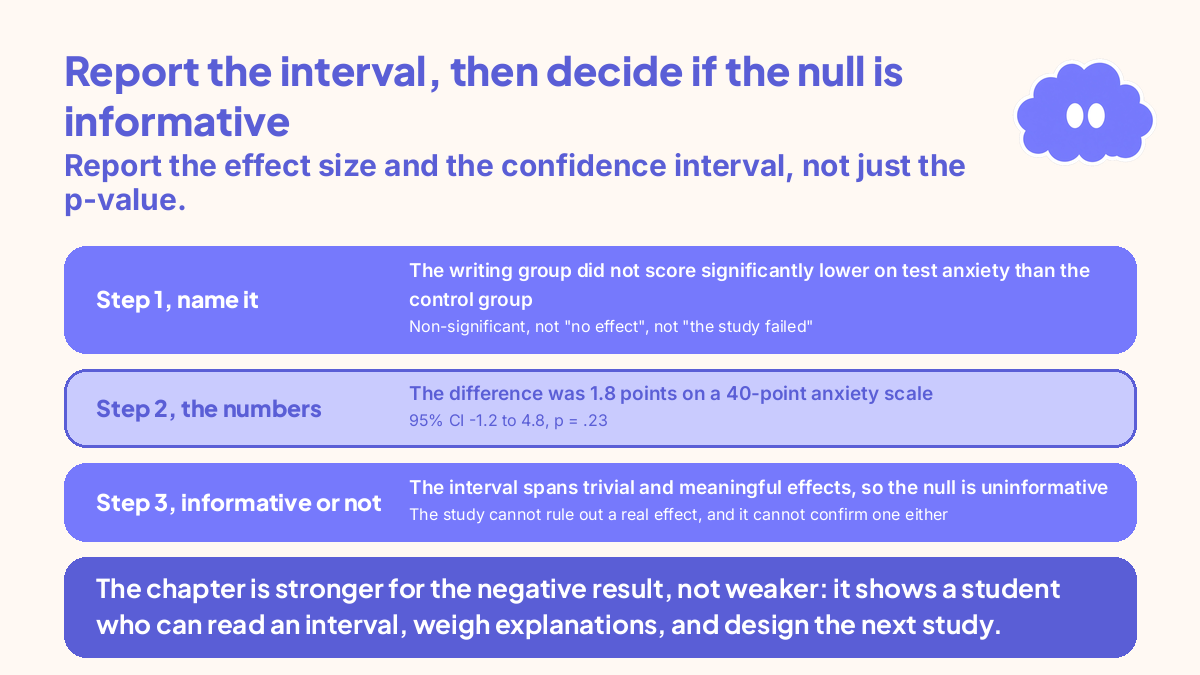
- Step 1, name it: “The writing group did not score significantly lower on test anxiety than the control group.” Non-significant, not “no effect”, not “the study failed”.
- Step 2, the numbers: The difference was 1.8 points on a 40-point anxiety scale (95% CI -1.2 to 4.8, p = .23). The interval shows the true effect could be as large as 4.8 points, which would matter, or as small as -1.2, which would not.
- Step 3, informative or not: The interval spans trivial and meaningful effects, so the null is uninformative. The study cannot rule out a real effect, and it cannot confirm one either. You write that sentence at the top of your discussion notes.
- Step 4, explanations: Four candidates. The sample was small and the interval is wide, which supports that. The exercise lasted ten minutes, once, while studies that found an effect used three sessions, which supports the dose explanation. The measure was reliable and the groups were similar at the start, which weakens the other two.
- Step 5, the discussion: Finding, one sentence with the numbers. Detection, the interval and the uninformative null. Explanations, the four candidates with the evidence for and against each. Meaning, the effect, if it exists, needs a larger sample and a longer exercise, and a next study should run three sessions with 120 students.
- Step 6, the check: Every outcome from the methods chapter appears in the results. The word “unfortunately” appears once, and you cut it. One overclaim, “the exercise does not work”, becomes “the study did not detect an effect of the exercise”.
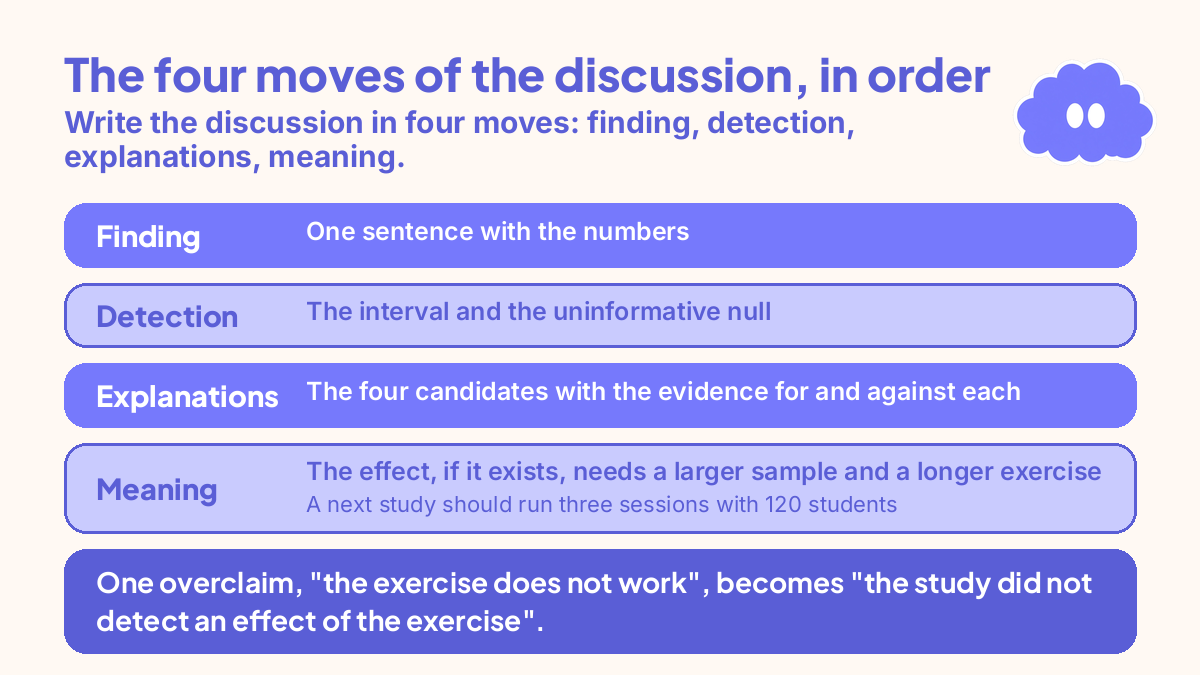
The chapter is stronger for the negative result, not weaker: it shows a student who can read an interval, weigh explanations, and design the next study.
When it goes wrong
You write “there was no effect” in the results. Fix it now, before your supervisor sees it. A non-significant result does not prove the null is true. Write what the data show: the difference, the interval, and the p-value, and let the reader draw the conclusion.
You hide the result and hope the examiner does not notice. They will notice. A missing outcome breaks the logic of the thesis, and an examiner who finds one will trust nothing else in the chapter. Put the result back in, plainly, and let the discussion explain it.
You apologise for the result in every paragraph. Cut the apologies and keep the facts. “Unfortunately” and “disappointingly” do not make the result smaller; they make the writer look smaller. The result is a finding, not a confession.
You claim the result proves the field wrong. It does not, and the overclaim costs more than the negative result. Scale the claim back to what the interval supports: what the study could and could not rule out, in this population, with this design.
Your supervisor says the result is a problem. Ask what exactly the problem is: the design, the writing, or the result itself. Usually it is the writing, and the fix is Steps 1 to 5. If it is the design, the discussion’s fourth move is where you show you know it.
Weekly review checklist
- Is every outcome from the methods chapter in the results chapter, including the negative ones?
- Does each key test report the effect size and the confidence interval, not just the p-value?
- Have I written down whether the null is informative or uninformative, in one sentence?
- Have I listed every other explanation and tested each one against my data?
- Does the discussion follow the four moves in order, without skipping one?
- Have I cut the apologies and the overclaims from the whole chapter?
Downloadable infographic spec: one vertical image, title “How to write up negative results in a thesis”, with the six steps from “The system in short” and the six review questions above, in Thynq cream, Cloud Purple, Dark Purple and pink, with the Cloud mascot. Text taken word-for-word from this article.
What this system is not
It is not a way to make a disappointing study look successful; nothing here dresses up a result, and the honest version is also the more defensible one. It is not a statistics textbook: if your design needs equivalence testing or a Bayes factor, your supervisor or a statistics adviser should check the analysis. It does not replace your supervisor’s judgement, and it does not guarantee a pass.
Sources
- Altman, D. G., & Bland, J. M. (1995). Absence of evidence is not evidence of absence. BMJ, 311(7003), 485. The distinction between a non-significant result and proof of no effect, which the whole article rests on.
- Roediger, H. L., & Karpicke, J. D. (2006). Test-enhanced learning. Psychological Science, 17(3), 249-255. The verified citation form is used as the model reference in this batch’s journal article.
- Dunlosky, J., et al. (2013). Improving students’ learning with effective learning techniques. Psychological Science in the Public Interest, 14(1), 4-58. Supports the retrieval-based checking in Step 6 rather than rereading the chapter and hoping.
For the wider thesis system behind this one, start with How to write a thesis discussion chapter.
Questions
Do negative results mean my thesis has failed?
No. A thesis is assessed on the quality of the question, the soundness of the design, and the rigour of the reasoning, not on whether the result crossed a threshold. A well-run study that finds no effect is a valid result, and examiners can tell the difference between a null finding and a flawed study.
How do I write a non-significant result without saying there is no effect?
Say what the data actually show: the difference was not statistically significant, and the confidence interval shows which effects the study could and could not rule out. Never write that there is no effect, or that the intervention does not work, because a non-significant result does not prove the null is true.
Should I hide negative results in my thesis?
No. Report every result you set out to find, whether it supported the hypothesis or not. Hiding a result breaks the logic of the thesis: the discussion cannot explain a finding the reader never sees, and an examiner who finds a missing outcome will trust nothing else in the chapter.
What do I write in the discussion when the results are negative?
Work through four questions in order: what did the study actually find, what could it have detected, what else could explain the result, and what does it mean for the field. Answer each one with evidence from your own data, not with apologies, and end with what a next study should do differently.