The direct answer
How to write a thesis when your supervisor leaves: protect your data and your milestones first, get interim supervision in writing, and rebuild the plan with the new supervisor. A supervisor leaving does not end a thesis, but it does change it, and the students who come through it best act quickly and keep everything in writing.
Most advice on this problem is about university rules, which is useful but not enough. Rules tell you who appoints a new supervisor. They do not tell you how to keep writing while you wait, or what to do when the new supervisor wants a different topic. The system below covers the practical side, week by week, so the thesis keeps moving through the gap.
The system in short
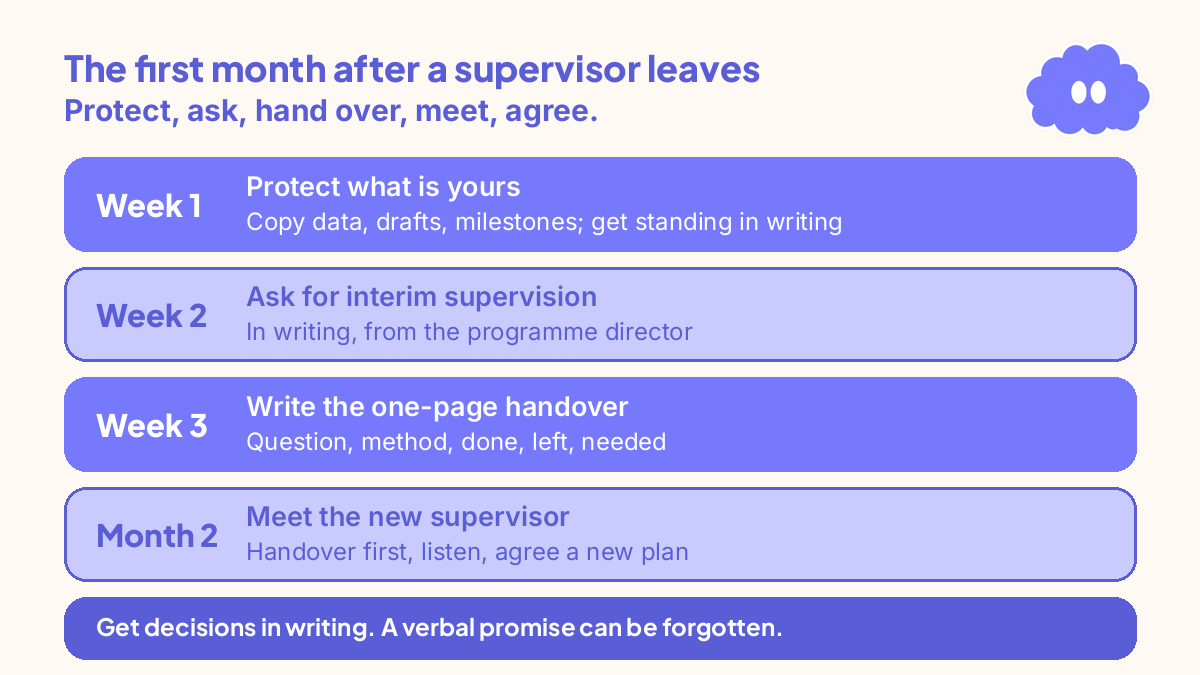
- Protect what is yours in the first week: copy your data, drafts, and approved milestones, and get them in writing.
- Ask for interim supervision in writing, from your programme director, so you have someone to answer to while you wait.
- Write a one-page handover of your thesis: the question, the method, what is done, and what is left.
- Meet the new supervisor with the evidence in front of you, and agree a new plan in the first month.
- Renegotiate the timetable honestly: a change of supervisor costs time, and the plan should say so.
- Review for 15 minutes each week: what is decided, what is still open, and what needs to be asked in writing.
Step 1: Protect what is yours in the first week
Do this in the first week, before the leaving supervisor is gone and before anyone else’s timetable takes over. Copy everything: your data, your drafts, your notes, your references, and your approved milestones. Put the copies somewhere you control, not only on a university drive your supervisor administers. If your data lives in a lab or on a supervisor’s server, ask for a copy now, in writing, and keep the email.
Then get a written record of what has been approved so far: which chapters your supervisor signed off, which milestones the department approved, and which ethics approvals are in place, and in whose name. Ask your programme director or your graduate school for a written account of your standing. That document is what protects you when the new supervisor arrives and asks what is already done.
Keep a record of every conversation from now on, in writing. After each meeting, send a short email: “Thank you for meeting. As I understand it, we agreed…” That email is not rude, and it is not suspicious. It is how you make sure a verbal promise becomes a fact. If a promise is not in writing, it can be forgotten, and a forgotten promise about your funding or your data is a problem you cannot afford.
Step 2: Ask for interim supervision in writing
Do not wait for the department to appoint a new supervisor. Ask, in writing, for interim supervision, from your programme director or your director of graduate studies. Interim supervision means someone is responsible for you while the permanent appointment is made: someone to sign forms, approve milestones, and answer questions. Without it, you are in a gap, and a gap with no supervisor is a gap where nothing can be approved.
Your email should be short and specific. Say that your supervisor is leaving, say when, and ask who will provide interim supervision and by when. Ask for a reply in writing. If the answer is slow, ask again, and keep a record of each request.
While you wait, keep writing. The gap is not a holiday. Use it for the work that does not need a supervisor: drafting a chapter, organising your data, writing the handover in Step 3, and preparing the evidence for the new supervisor. A student who arrives at the first meeting with a finished draft is in a much stronger position than one who arrives with nothing.
Step 3: Write a one-page handover of your thesis
The handover is one page, and it is the most useful document you will write during the change. It says five things: the thesis question, the method, what is done, what is left, and what you need. One page, plain words, no jargon. It is for the new supervisor, for the programme director, and for yourself, because writing it forces you to see the thesis clearly.
Be honest in it. If a chapter is half done, say so. If the data is incomplete, say so. If a method did not work and you changed it, say so, and say why. A handover that hides problems does not help you, because the new supervisor will find them anyway. A handover that is honest earns trust.
Attach the evidence to the handover: the approved milestones, the data summary, and the best draft you have. The handover is the summary, and the attachments are the proof. Keep a copy for yourself, and send it to the new supervisor before the first meeting, so the meeting is about the plan, not about explaining the thesis from the start.
Step 4: Meet the new supervisor with the evidence in front of you
The first meeting with a new supervisor sets the tone for the rest of the thesis, so prepare for it. Bring the handover, the approved milestones, the data, and the best draft. Start by explaining the thesis in two minutes, using the handover. Then ask the new supervisor what they need to know, and listen. The first meeting is for listening, not for arguing, and a supervisor who feels heard is a supervisor who will help.
Ask three questions in that meeting. First, what does the new supervisor think of the topic and the method, and is there anything they would change? Second, what is the new timetable, and what are the next milestones? Third, who else is on the committee, and does anything about it need to change? Write the answers down, and confirm them in a short email after the meeting.
If the new supervisor wants to change the topic or the method, do not agree in the first meeting. Listen, take notes, and take a week to think. Bring the evidence to the second meeting: what is already done, what it would cost to change, and what the change would gain. A new supervisor can ask for changes, but they should not throw away finished work without a good reason, and the evidence is what makes that case. For the wider skill of using feedback without losing a week to it, the system in How to handle supervisor feedback on a thesis covers it in detail.
Step 5: Renegotiate the timetable honestly
A change of supervisor costs time. It costs the weeks of waiting, the weeks of the new supervisor getting up to speed, and the weeks of any changes they ask for. The new timetable should say so, honestly, and it should be agreed in writing, in the first month. A timetable that pretends nothing happened is a timetable that will fail, and a failed timetable is worse than a longer one.
Work out the new dates together. Which milestones move, and by how much? Does the submission date move, and if so, by how long? Does the funding cover the extra time, and if not, who pays for it? These questions need answers in writing, not in a conversation that no one remembers. If the funding does not cover the delay, ask your programme director what the options are, and ask early.
If the new supervisor is a good fit, the timetable may not need to move much. If the topic changes, it may need to move a lot. Either way, the new timetable is the plan, and it is better to agree a longer plan that holds than a short plan that collapses. For the wider problem of a thesis that is behind schedule, the system in How to finish a thesis when you are behind covers the recovery in detail.
Step 6: Review for 15 minutes each week
While the change is happening, spend 15 minutes each week on three questions. First, what is decided now, and what is still open? Second, what have I asked for in writing, and what am I still waiting to hear? Third, what did I write this week, and is the thesis still moving?
Write the answers in two or three lines, and keep them in one place. The review is what stops the change from swallowing the thesis: it keeps the writing going, and it keeps the requests tracked. If nothing is decided for three weeks, ask again, in writing, and copy in your programme director.
A worked example: a second-year PhD student loses a supervisor to a new university
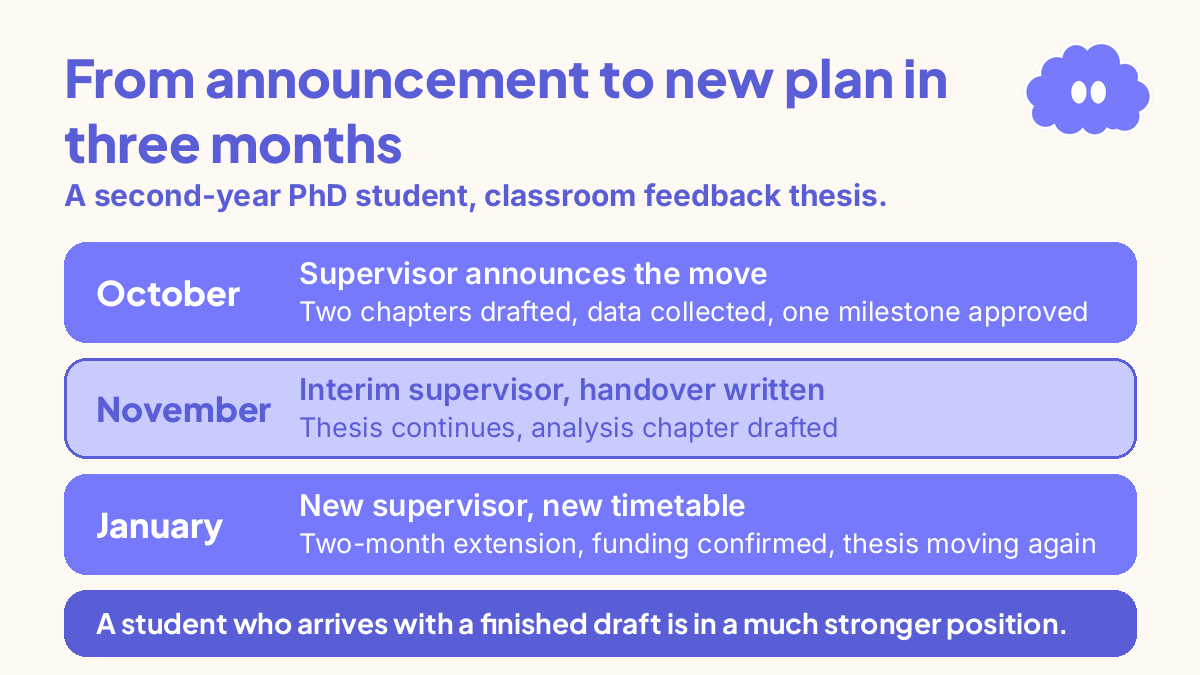
Your situation: Second-year PhD student, thesis on classroom feedback. Supervisor announces in October that she is moving to another university in December. Two chapters drafted, data collected from 12 schools, ethics approval in place, one milestone approved. New supervisor not yet appointed.
- Week one, protect what is yours: Copy all data, drafts, and notes to a personal drive. Email the programme director asking for a written account of standing: which milestones are approved, who holds the ethics approval, and who will provide interim supervision. The reply confirms the milestone and the ethics approval, and names an interim supervisor.
- Week two, handover: Write the one-page handover. Question, method, what is done (two chapters drafted, data collected), what is left (analysis, two more chapters, conclusion), what is needed (a supervisor who knows qualitative research, and a decision on whether the topic stays). Attach the best draft and the data summary.
- Week three, interim supervision: Meet the interim supervisor, with the handover. Agree that the thesis continues as planned, and that the interim supervisor will sign the next milestone. Keep writing the analysis chapter during the gap.
- Month two, new supervisor appointed: Send the handover before the first meeting. First meeting: explain the thesis in two minutes, listen, ask the three questions. The new supervisor is happy with the topic, suggests one change to the analysis, and agrees the timetable moves by two months.
- Ongoing, weekly review: Each week, 15 minutes. What is decided, what is still open, what was written. By month four, everything is decided, and the review goes back to the normal question: what did I write this week?
When it goes wrong
No new supervisor is appointed after three months. Ask your programme director in writing what the plan is, and keep a record of every request. If the answer is still nothing, ask to speak to the head of department or the graduate school. A student without a supervisor for three months is a problem the department owns, and it needs to be raised as one.
The new supervisor wants a different topic. Do not agree in the first meeting. Take a week, bring the evidence to the second meeting, and show what is already done and what it would cost to change. If the change is still the right call, because the old topic depended on the leaving supervisor’s lab or funding, then change, and renegotiate the timetable to match. If the change is not justified, say so, with the evidence, and ask the programme director to help resolve it.
You feel like giving up. That feeling is normal, and it is not a sign that the thesis is over. It is a sign that the change has been hard. Talk to someone: your interim supervisor, a colleague, a student support service. A thesis that survives a supervisor leaving is a thesis that is stronger for it, but only if you keep writing through the gap.
Weekly review checklist
- What is decided now, and what is still open?
- What have I asked for in writing, and what am I still waiting to hear?
- What did I write this week, and is the thesis still moving?
- Is my data, my drafts, and my approved milestones all copied and safe?
- Does the new supervisor have the handover, and have we agreed a new timetable?
- What must next week protect: a writing day, a meeting, or a request in writing?
Downloadable infographic spec: one vertical image, title “How to write a thesis when your supervisor leaves”, with the six steps from “The system in short” and the six review questions above, in Thynq cream, Cloud Purple, Dark Purple and pink, with the Cloud mascot. Text taken word-for-word from this article.
What this system is not
It is not a promise that a supervisor leaving does not hurt. It hurts, and it costs time, and some theses do change direction because of it. It is not a way to force a department to appoint a new supervisor on your timetable, and it will not work if you wait silently for someone else to fix it. What it does is smaller: it protects what you have built, and keeps the thesis moving through the gap.
Sources
- McGill University, Human Genetics. Conflict Resolution: Guidance on Supervisory Changes. The department arranges a new permanent supervisor or co-supervisor when a supervisor leaves, and the replacement must have sufficient time, expertise, and funds, which supports the interim supervision and written record steps in this article.
- Dunlosky, J., et al. (2013). Improving students’ learning with effective learning techniques. Psychological Science in the Public Interest, 14(1), 4-58. Practice testing and distributed practice rated high; the same spacing principle supports short weekly review sessions over long irregular ones.
- Roediger, H. L., & Karpicke, J. D. (2006). Test-enhanced learning. Psychological Science, 17(3), 249-255. Testing from memory beat restudying, which supports the habit of explaining your thesis argument from memory before writing it down.
For the wider thesis system behind this one, start with How to choose a thesis supervisor.
Questions
What should I do first when my thesis supervisor leaves?
Protect what is yours, in writing, before anything else. Copy your data, your drafts, and your approved milestones, and get a written record of what has been approved so far. Then ask your programme director for interim supervision, so you have someone to answer to while a permanent supervisor is found.
Can I keep my thesis topic if my supervisor leaves?
Usually yes, if the topic does not depend on your supervisor’s lab, funding, or data. If it does, you may need to change the topic or the method, and that decision belongs to you and the new supervisor together. Do not agree to a new topic in the first meeting; take a week to think.
How long does it take to get a new thesis supervisor?
It varies, but plan for one to three months, and ask for interim supervision to cover the gap. If no one is appointed after three months, ask your programme director in writing what the plan is, and keep a record of every request you make.
What if my new supervisor wants me to change my thesis?
Listen first, then negotiate with the evidence in front of you. Bring your approved milestones, your data, and your drafts to the first meeting, and show what is already done. A new supervisor can ask for changes, but they should not throw away finished work without a good reason.