
The direct answer
How to write a thesis in your second language: draft in simple sentences first, build a phrase bank from papers in your own field, and separate writing days from editing days. The language is a second job on top of the research, so the system keeps the two jobs apart and never lets the language block the thinking.
Writing a thesis is hard in any language. Writing one in a second language adds a second task to every sentence: you are working out what you mean and how to say it in English at the same time. Most students try to do both at once, and the result is slow writing and long sentences that hide the meaning. The system below splits the work, so the thinking happens in simple words first and the academic English comes later.
The system in short
- Draft in simple sentences first: one idea per sentence, short words, no attempt to sound academic yet.
- Build a phrase bank from papers in your own field: the openings, linking phrases, and verbs that published authors actually use.
- Write the outline in your first language if it helps, but draft the thesis itself in English.
- Separate writing days from editing days: never edit a sentence on the day you wrote it.
- Get feedback on one paragraph at a time, with one question for the reader, not on whole chapters at once.
- Review for 15 minutes each week: which sentences were clear, which ones hid the meaning, and what the phrase bank is missing.
Step 1: Draft in simple sentences first
The first draft of a section is written in short, simple sentences, one idea per sentence, in plain words. Do not try to sound academic. Do not try to write the final sentence. Write what you mean, in the simplest English you can, and get the ideas on the page. “The results show that X increases when Y increases” is a good first-draft sentence. “The results demonstrate a positive correlation between X and Y” is a sentence for later.
The reason is simple: a thesis is judged on its ideas, and ideas hidden in long, tangled sentences cannot be judged. A short sentence that says what you mean is better than a long sentence that almost says it. And short sentences are easier to fix later, because you can see what is wrong with them. A paragraph of long sentences hides its own problems.
Set a daily target in words, not in hours: 300 words of first draft a day is a good target for most students writing in a second language. That is about one page, and it is a pace you can hold for months. Count only first-draft words, not edited words. At 300 words a day, five days a week, a thesis chapter of 8,000 words takes about six weeks of drafting.
Step 2: Build a phrase bank from papers in your own field
A phrase bank is a list of the sentence openings, linking phrases, and verbs that published authors in your field actually use, collected from papers you have read. It is not a list of fancy words. It is the ordinary language of your field: how authors introduce a result, how they disagree with a previous study, how they move from one idea to the next.
Build it by reading with a pen. When you read a paper and a sentence does a job you will need to do, copy the shape of it, not the content: “Previous research has shown that…” “These results suggest that…” “Taken together, these findings indicate…” Keep the list in one place, grouped by job: introducing, comparing, disagreeing, concluding. Aim for 30 to 40 phrases.
Use the phrases in your own sentences. When you are revising a first draft and a sentence sounds wrong, look in the phrase bank for a shape that fits the job, and rebuild the sentence around it. The phrase bank is what stops you from repeating the same three phrases in every paragraph, and it is what makes your writing sound like it belongs in your field. For the wider skill of reading papers closely enough to collect these phrases, the method in How to read research papers for a thesis covers it in detail.
Step 3: Write the outline in your first language if it helps, but draft in English
The outline is where the thinking happens, and it can happen in any language. If it is easier to work out the argument in your first language, do that: write the outline, the headings, and the key points in your first language, and make sure the argument makes sense before you start drafting. A clear outline in your first language is worth more than a confused outline in English.
But draft the thesis itself in English, from the start. Translating a full draft takes longer than writing it directly, and the translation often keeps the sentence shape of your first language, which is what makes the English sound awkward. Write the first draft in English, in the short sentences from Step 1, and the English will be yours from the start.
If a sentence will not come in English, write it in your first language, in brackets, and move on. Come back to it the next day, with the phrase bank open, and rebuild it in English. Do not stop the draft for one sentence. A draft with three bracketed sentences in it is a draft that is moving. A draft that stopped at the first hard sentence is a draft that is not.
Step 4: Separate writing days from editing days
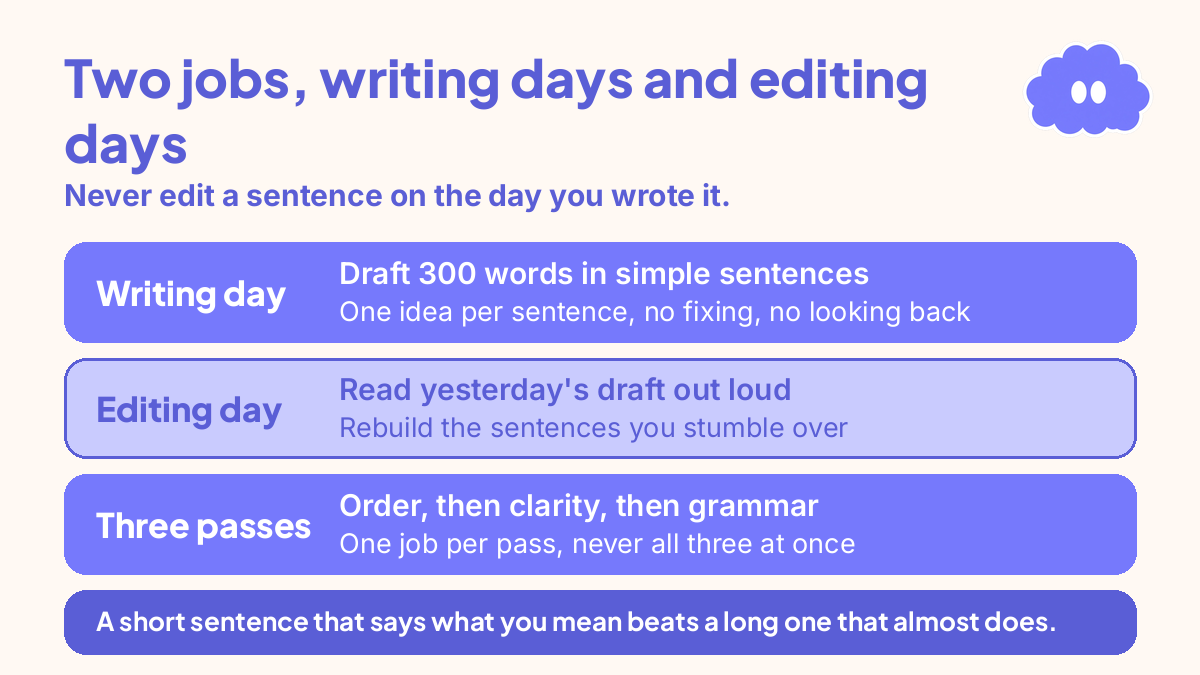
Never edit a sentence on the day you wrote it. Writing and editing are different jobs, and doing them at the same time is what makes writing in a second language so slow. On a writing day, you draft: 300 words, simple sentences, no fixing, no looking back. On an editing day, you revise: you take yesterday’s draft, read it out loud, and fix the sentences that hide the meaning.
Reading out loud is the most useful editing tool you have. A sentence that sounds clear when you say it is usually clear on the page. A sentence you stumble over needs rebuilding, usually by splitting it in two. Read the paragraph, mark the sentences you stumbled on, and rebuild those first.
Edit in passes, one job per pass. First pass: does each paragraph say one thing, and does the order make sense? Second pass: does each sentence say what you mean, in short words? Third pass: grammar, spelling, and the small errors. Do not try to do all three passes at once. Three short passes are faster than one long one, and they catch more.
Step 5: Get feedback on one paragraph at a time, with one question
Do not send a whole chapter to your supervisor and ask if it is good. A whole chapter gets general feedback, and general feedback does not fix your writing. Send one paragraph, or one page, and ask one question: “Where did you have to guess what I meant?” That question is specific, and the answer tells you exactly which sentences need rebuilding.
Ask the same question of a writing centre, a colleague, or a friend who writes well in English. The person does not need to know your field. They need to be able to tell you where they got lost, because a reader who gets lost is a reader who cannot follow your argument, whatever the field. One paragraph a week, with one question, is enough to improve steadily.
Keep a list of the sentences that get flagged, and look for the pattern. If the same problem appears three times, it is one habit, not three mistakes, and fixing the habit fixes all three. Common habits are long sentences with three ideas in them, and passive sentences that hide who did what. For the wider conversation about feedback, the system in How to handle supervisor feedback on a thesis covers how to use it without losing a week to it.
Step 6: Review for 15 minutes each week
At the end of each writing week, spend 15 minutes on three questions. First, which sentences were clear, and which ones hid the meaning? Second, what is the phrase bank missing: a phrase for disagreeing, a phrase for introducing a method, a phrase for concluding a section? Third, how many words of first draft did you write, and is the pace enough to finish on time?
Write the answers in two or three lines. If the pace is too slow, cut the target to 200 words a day and hold it every day. A smaller target held every day beats a bigger target held twice a week. If the phrase bank is missing a kind of phrase, add five the next week, from the next paper you read.
A worked example: a methods chapter in eight weeks
Your situation: International masters student, writing a thesis in English. First language is Mandarin. The methods chapter is 6,000 words, and it is the first chapter you are drafting. You have eight weeks.
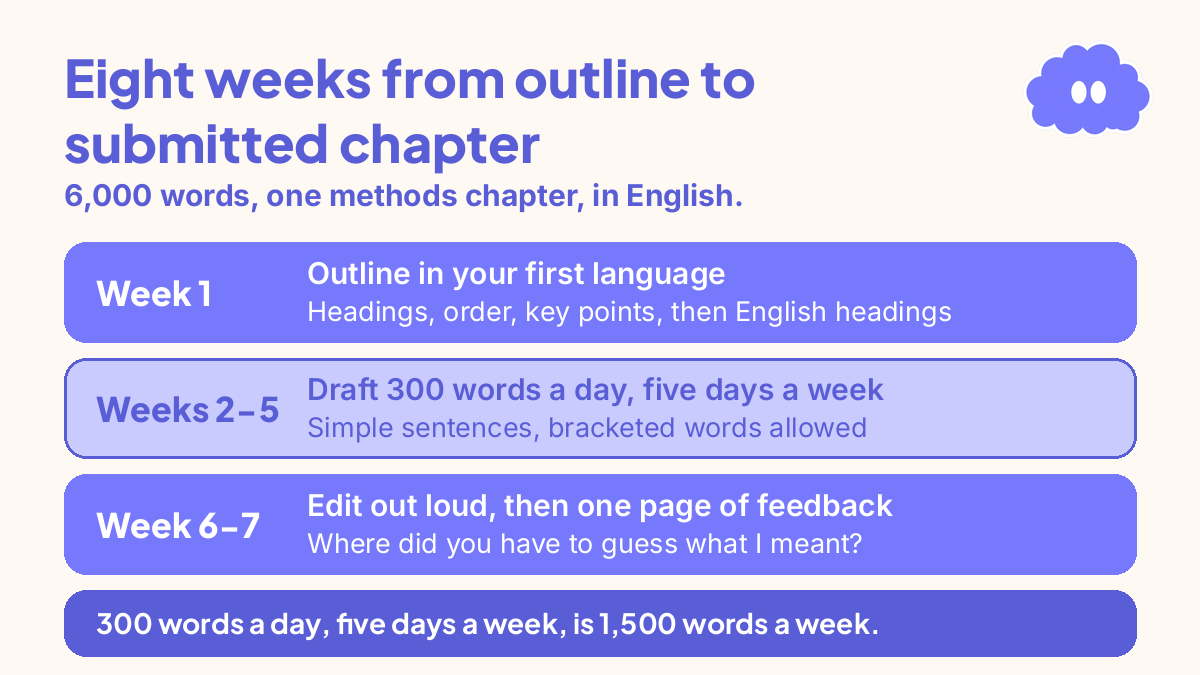
- Week one, outline: Write the outline in Mandarin first: the headings, the order of the methods, and the key point of each section. Check the argument makes sense. Then write the headings in English, and the outline is done.
- Weeks two to five, drafting: 300 words a day, five days a week, in simple English sentences. Monday to Friday are writing days. Each day starts by reading the outline for that section, then writing. Bracketed Mandarin sentences are allowed, three at most per day, and they are rebuilt the next day.
- Weeks two to five, phrase bank: Every paper you read for the chapter adds two or three phrases to the bank. By week five the bank has 40 phrases, grouped by job: introducing a method, justifying a choice, describing a result.
- Week six, editing pass one: Read the whole chapter out loud, in sections. Mark the sentences you stumble on. Rebuild them, usually by splitting them in two. Check each paragraph says one thing.
- Week eight, feedback and fix: The supervisor flags three sentences in the first page, all with the same problem: long sentences with two ideas in them. Fix the habit across the chapter, not just the three sentences. The chapter is submitted, 6,000 words, in eight weeks.
When it goes wrong
You cannot start, because every sentence feels wrong in English. Start in your first language, in the outline, and write the first paragraph in the simplest English you can, even if it sounds childish. A simple sentence that says what you mean is a start. A perfect sentence that never gets written is not.
Your supervisor keeps writing “improve your English” on your drafts. That feedback is too general to use. Ask for one specific thing: “Can you mark the three sentences in this page where you had to guess what I meant?” That question turns general feedback into something you can fix, and it shows your supervisor what you need.
The thesis takes much longer than a native speaker’s thesis, and you feel behind. It does take longer, and that is normal, not a failure. Plan for it: a thesis in a second language needs more weeks than the same thesis in a first language, and the plan should say so from the start. Tell your supervisor early, and build the extra weeks into the schedule.
Weekly review checklist
- How many words of first draft did I write this week, and is the pace enough?
- Which sentences hid the meaning, and what habit caused them?
- What is the phrase bank missing, and what did I add this week?
- Did writing days and editing days stay separate, or did they merge?
- Did I get feedback on one paragraph, with one question, or did I send a whole chapter?
- What must next week protect: a writing day, an editing day, or a feedback request?
Downloadable infographic spec: one vertical image, title “How to write a thesis in your second language”, with the six steps from “The system in short” and the six review questions above, in Thynq cream, Cloud Purple, Dark Purple and pink, with the Cloud mascot. Text taken word-for-word from this article.
What this system is not
It is not a promise that writing in a second language stops being harder. It is harder, and it takes longer, and no system changes that. It is not a way to write a thesis without ever asking for help, and it will not work if you try to write perfect academic English in the first draft. What it does is smaller: it splits the work so the thinking and the language never block each other.
Sources
- Amano, T., et al. (2023). The manifold costs of being a non-native English speaker in science. PLOS Biology, 21(7), e3002184. Non-native English speakers face higher costs in time and effort when writing and publishing in English, which is why the system plans for extra weeks and separates drafting from editing.
- Dunlosky, J., et al. (2013). Improving students’ learning with effective learning techniques. Psychological Science in the Public Interest, 14(1), 4-58. Practice testing and distributed practice rated high; the same spacing principle supports short daily drafting sessions over long irregular ones.
- Roediger, H. L., & Karpicke, J. D. (2006). Test-enhanced learning. Psychological Science, 17(3), 249-255. Testing from memory beat restudying, which supports the habit of explaining your argument from memory before writing it down.
For the wider thesis system behind this one, start with How to write a thesis introduction.
Questions
How do I write a thesis in English when it is not my first language?
Separate the thinking from the language. Draft each section in short, simple sentences first, in your own words, and do not try to sound academic while you are still working out what you mean. Once the ideas are on the page, revise the sentences for clarity and tone in a separate pass.
Should I write my thesis in my first language and then translate it?
Write the outline and the hard thinking in your first language if that helps, but draft the thesis itself in English. Translating a full draft takes longer than writing it directly, and the translation often keeps the sentence shape of your first language, which is what makes the English sound awkward.
How can I improve my academic English while writing a thesis?
Build a phrase bank from papers in your own field: the sentence openings, the linking phrases, and the verbs that published authors use for your kind of argument. Use those phrases in your own sentences, and ask a supervisor or a writing centre to read one paragraph at a time, not whole chapters.
Is it acceptable to get help proofreading my thesis?
Yes, in most universities, as long as the help is limited to language and the ideas stay yours. Check your university’s rules first, because they differ, and ask your supervisor what is allowed. A proofreader who fixes grammar is fine; someone who rewrites your argument is not.