The direct answer
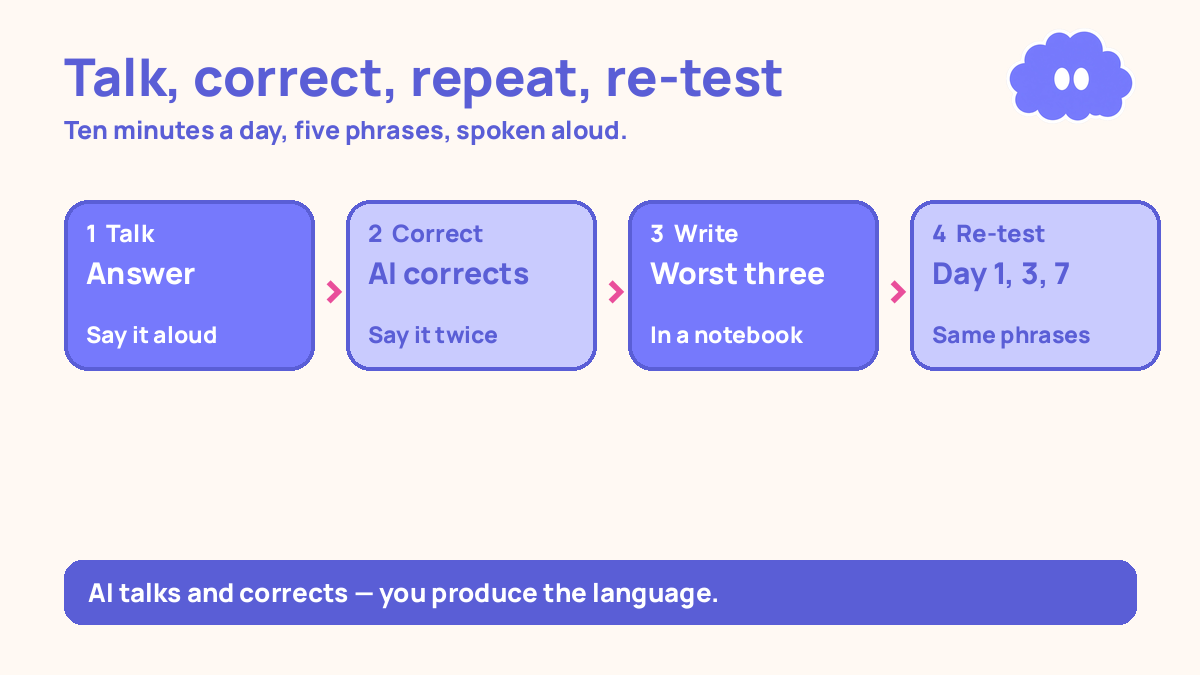
How to use AI for language practice: open any AI chat app, talk to it in the language you are learning for ten minutes a day, say every answer aloud, let it correct your mistakes, and re-test the same phrases on day 1, day 3, and day 7. That is the whole system.
The problem it solves is simple: you are learning a language alone, with no one to talk to. A textbook can teach you the words, but it cannot answer you back, and it cannot tell you when a sentence is wrong. So most students read and memorise, and never speak — and then freeze the first time they have to say something out loud.
AI is a practice partner you already have. It is not a teacher, and it is not a native speaker. It will talk to you for ten minutes whenever you ask, and it will correct your mistakes. What it must not do is write the sentences for you, and what you must not do is trust its corrections without checking them.
This is different from how to learn a language online, which is the full system for learning a language on your own, and from the study system for language learning students, which covers the weekly plan. This article is one piece of both: the daily ten minutes of speaking practice, using the AI chat app already on your phone.
The system in short
- Pick five phrases for the day, from your textbook or your class notes — not from AI.
- Open any AI chat app and tell it to talk to you only in the language you are learning.
- Answer every question aloud, in your own words, before you type anything.
- Let AI correct each answer, then say the corrected sentence aloud twice.
- Write down the three mistakes you made most, and re-test the same five phrases on day 3 and day 7.
Step 1: Pick five phrases from your own material
Pick five phrases for the day from your textbook or your class notes. Five, not twenty. Five phrases you can say aloud, get corrected, and repeat inside ten minutes.
The phrases must come from your own material, not from AI. AI will happily invent phrases, and some of them will be wrong, unnatural, or above your level. Your textbook chose those phrases for a reason: they match what you are supposed to learn this week. AI’s job starts at step 2.
Write the five phrases on paper, in the language you are learning, with the meaning beside each one. Keep the paper where you can see it during the session, but do not read from it when you answer — the paper is the list, not the answer. If a phrase is one you keep getting wrong, it stays on the list for the next session too. A phrase you got right twice in a row leaves the list.
Step 2: Tell AI the rules, in the language you are learning
Open any AI chat app you already have on your phone and give it clear rules in one message:
“Talk to me in [the language]. Ask me one question at a time about my day, using simple words. When I answer, correct my mistakes and tell me why. Do not switch to English. Do not write my answers for me.”
“One question at a time” matters, because AI will otherwise dump five questions at once and you will answer none of them properly. “Do not switch to English” matters because AI switches the moment you struggle, and the struggle is the practice. “Correct my mistakes and tell me why” matters because a correction without a reason is just a new sentence to memorise — and explaining why each step works, in your own words, is what self-explanation is about (Chi et al., 1989; Bisra et al., 2018).
If AI starts writing long explanations in English, stop it and repeat the rule. If it keeps switching, start a new chat and paste the rule again.
Step 3: Answer aloud, then type
Answer every question aloud first, in your own words, before you type anything. Say it out loud, in the room, even if you feel silly. Speaking is the skill you are practising, and typing the answer instead of saying it practises typing. If you are somewhere you cannot speak aloud, whisper it. The sound matters: you hear your own mistakes when you say a sentence, and you do not hear them when you only think it.
Then type the answer, exactly as you said it, mistakes and all. Do not fix it before you send it. A typed answer you polished before sending is not a test of what you can say — it is a test of what you can edit. The mistakes are the point: they are what AI corrects, and the correction is what you learn from.
Across 61 studies, testing yourself beat restudying, and the advantage was larger when the test came with feedback than without it (Rowland, 2014). A spoken answer with a correction is a test with feedback. A sentence you read and nodded at is restudying.
Step 4: Get the correction, say it twice, write down the worst three
When AI corrects you, do three things. First, read the correction and the reason. Second, say the corrected sentence aloud twice. Third, write the mistake in a small notebook: the wrong version, the right version, and the reason, in one line each.
At the end of the session, pick the three mistakes you made most — the ones that came up twice, or the ones you have made before. Those three go on tomorrow’s list. The rest you let go. Five phrases a day, three mistakes kept: that is a list that fits on one page and a list you can actually re-test.
Check every correction against your textbook or your notes before you learn it by heart. AI gets things wrong, and a wrong correction learned by heart is worse than no correction. If a correction does not match your textbook, trust the textbook, and tell the AI so — it will usually agree, which tells you how little its first answer was worth.
Step 5: Re-test the same phrases on day 3 and day 7
Come back to the same five phrases on day 3 and again on day 7. Not new phrases — the same five. Test yourself on them: say each one aloud from memory, then check it against the paper. That 1-3-7 pattern is a practical starting schedule, not a research rule — the research says spacing beats massing, and the right gap grows with how long you need to remember the material (Cepeda et al., 2006).
A phrase you get right on day 7 leaves the list for good. A phrase you still get wrong on day 7 stays, and gets a new session of its own. Do not add new phrases until the old ones pass day 7, or the list grows faster than you can test it.
This is the part most students skip, because re-testing feels like going backwards. In a 2013 review, Dunlosky and colleagues rated practice testing and distributed practice as the only two high-utility techniques out of ten — and re-reading was rated low. The test is the study, and the second test after a gap is a real test.
A worked example: five phrases, ten minutes, seven days
This is a worked example, with the article’s own numbers — not a real student, and not a promise of a grade.
You are learning French, and your textbook chapter is about daily routines. Monday’s five phrases: “Je me lève à six heures”, “Je prends le petit-déjeuner”, “Je vais à l’école à pied”, “Je rentre à la maison à quatre heures”, “Je fais mes devoirs le soir”. Ten minutes, one session, phone timer running.
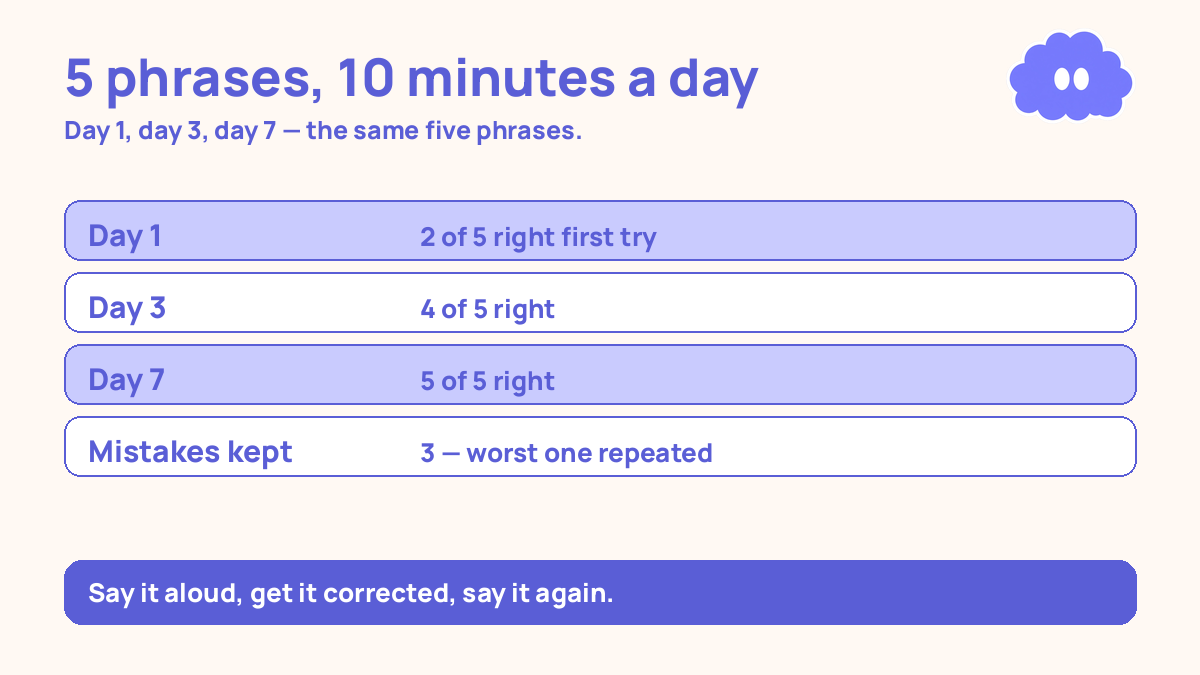
Day 1 — Monday: You talk to AI for ten minutes. It asks about your morning, and you answer aloud, then type. It corrects three things: “à six heures” not “à six heure”, “je prends” not “je prend”, and the word order in “à pied à l’école”. You say each corrected sentence aloud twice. Three mistakes go in the notebook.
Day 3 — Wednesday: You re-test the same five phrases, notes closed. Four right, one wrong: “je prend” comes back. AI corrects it again. You say it aloud twice more.
Day 7 — Sunday: You re-test the same five phrases. Five right, none wrong. The phrases leave the list, and Monday starts five new ones from the next chapter.
| Day | What happened | Score |
|---|---|---|
| Day 1 | 10-minute talk, 5 phrases, 3 corrections | 2 of 5 right first try |
| Day 3 | Re-test the same 5 phrases | 4 of 5 right |
| Day 7 | Re-test the same 5 phrases | 5 of 5 right |
| Mistakes kept | 3 in the notebook, worst one repeated | “je prend” → “je prends” |
When it goes wrong
AI writes the sentences and you only read them. Then you have practised reading, not speaking. Stop, and write the sentence yourself first. AI corrects; it does not produce.
You type the answers and never speak aloud. Then the first real conversation will still freeze you, because you have never said these sentences. Whisper them if you cannot speak aloud. The sound is the practice.
You trust every correction. AI corrects things that were right, and it does so confidently. Check each correction against your textbook. If it does not match, trust the textbook.
You add new phrases every day and never re-test. The list grows, the old phrases fade, and a month later you have seen 150 phrases and can say none of them. Five phrases, day 1, 3, 7 — then new ones.
You practise for an hour once a week instead of ten minutes a day. An hour once a week is one test with no gap. Ten minutes a day is seven tests with gaps, and the gaps are what make the second test a real test.
Weekly review checklist
Copy this list and use it each week:
- How many ten-minute sessions did I actually do, out of the seven I planned?
- How many phrases passed day 7, and how many are still on the list?
- Which mistake came back most, and did I check it against my textbook?
- What one change will I make next week: a different time of day, fewer phrases, or stricter speaking aloud?
What this system is not
It is not a promise that AI will make you fluent, and it is not a claim that ten minutes a day replaces a teacher, a class, or real conversation. AI cannot hear your pronunciation the way a person can, and it sometimes corrects things that were right. This system is a daily ten minutes of speaking practice with the partner you already have: you produce the language, AI corrects it, you check the correction, and you re-test after a gap. If the phrases pass day 7, the system worked.
Sources
- Rowland, C. A. (2014). Psychological Bulletin, 140(6), 1432-1463. Across 61 studies, testing beat restudying, and the advantage was larger with feedback (g = 0.73) than without it (g = 0.39).
- Dunlosky, J., et al. (2013). Psychological Science in the Public Interest, 14(1), 4-58. Only practice testing and distributed practice rated high utility; rereading rated low.
- Cepeda, N. J., et al. (2006). Psychological Bulletin, 132(3), 354-380. Spaced practice beat massed practice, and the right gap grows with how long you need to remember the material.
- Bisra, K., et al. (2018). Educational Psychology Review, 30(3), 703-725. Across 64 reports, prompting self-explanation produced a moderate average benefit (g = 0.55).
- Chi, M. T. H., et al. (1989). Cognitive Science, 13(2), 145-182. The students who solved problems best had generated far more explanations per example — a small study of 8 students, so say so.
For the full system this fits inside, read how to learn a language online, and for the weekly plan, read the study system for language learning students.
Questions
Can AI really help me practise speaking a language?
Yes, as a practice partner, not as a teacher. It gives you someone to talk to in short sessions, corrects your mistakes, and never gets tired of the same question. It cannot hear your pronunciation the way a person can, and it sometimes corrects things that were right.
Should I let AI write sentences for me to learn?
No. You write the sentence first, in your own words, and AI corrects it. If AI writes it and you only read it, you have practised reading, not speaking. The learning is in producing the sentence yourself, then getting the correction.
How long should a practice session be?
Ten minutes a day is a practical starting point. Five new phrases, spoken aloud, corrected, and repeated. A short session you actually do beats a long session you skip.
What if AI corrects something that was right?
Check it against your textbook, your class notes, or a dictionary. AI gets things wrong, and a wrong correction learned by heart is worse than no correction. Your notes are the check, not the AI.