The direct answer
To study when you care for a family member, map your care week, then protect two short anchor sessions a day in the hours when care is lightest. Study in 25-minute sessions, keep a backup plan for the days care takes over, and tell your university early, so a deadline can move before it is missed.
Caring does not follow a timetable, and that is what breaks most study plans: a plan that needs two quiet hours a day fails on the first day a hospital appointment runs long. This system starts from the care week as it is, finds the hours that are usually free, and protects them.
The system in short
- Map your care week, hour by hour, and find the quiet hours.
- Protect two anchor sessions a day in those hours, and no more.
- Tell your university, and ask what help exists, before a deadline is at risk.
- Study in 25-minute sessions, one topic, one job, tested from memory.
- Keep a backup plan for the days care takes over, and use it without guilt.
- Check the week every Sunday, and move the anchors to fit next week’s care.
Step 1: Map your care week, hour by hour, and find the quiet hours
Take a blank week, one row per day, and write in every care task with its time: mornings, meals, medication reminders, appointments, evenings, and the nights when sleep is broken. Be honest about the time each one takes, including the waiting: a hospital appointment is not one hour, it is the travel, the waiting, and the tired hour after. Then mark the hours that are usually free, and the hours that are never free.
Look for the quiet hours: the hour after lunch when the person you care for rests, the evening after dinner, the morning before the day starts. Most carers have two or three quiet hours a day, and they are not always in the same place. Circle them: those are the anchor hours, and everything else in this system hangs on them.
Write the map down and keep it where you study. When the week changes, which it will, the map changes with it, and the anchors move to the new quiet hours.
Step 2: Protect two anchor sessions a day in those hours, and no more
An anchor session is 25 minutes of study in a quiet hour, at the same time each day, in the same place, with the phone on silent and the door closed. Two anchors a day is the plan: one in the morning quiet hour, one in the evening, or both in the afternoon. Two sessions is about one hour of focused study, and that hour is enough to keep a course moving, if it happens every day.
Protect the anchors the way you protect a care task: they are in the diary, they have a time, and they are not the first thing to go when the day gets busy. Tell the person you care for, and the rest of the family, that those two hours are your study time, and ask them to hold calls and visits until after. A study hour nobody knows about is a study hour that gets interrupted. Students who care for children as well as a family member face the same problem, and the protected-hours idea is the same: How to study with kids.
Do not add a third anchor until the first two have happened every day for two weeks. A plan that asks for three hours from a student who has one fails in week one, and the failure feels like proof that studying and caring cannot fit together. They can, but only at the size the week allows.
Step 3: Tell your university, and ask what help exists, before a deadline is at risk
Tell your tutor or your student support service that you care for a family member, what it takes, and which weeks are hardest. Do it now, while nothing is late, not in the week an essay is due. A university cannot help with a problem it does not know about, and most have help students never ask for: deadline extensions, recorded lectures, or a changed seminar time.
Ask three questions in that first conversation: what happens if a deadline moves, who do I contact when a care week goes wrong, and what evidence do you need from me. Write the answers down, with the names. Then use the help when you need it, without waiting for a crisis: an extension asked for a week early is a plan, and one asked for the day after the deadline is a problem.
If you receive any carer support, check whether full-time study affects it, with the organisation that pays it, not with a friend or a forum. The rules change, and they change by country and by course, so the only safe answer is the one from the source. Make that check a task for the first week.
Step 4: Study in 25-minute sessions, one topic, one job, tested from memory
A session has a shape: 25 minutes, one topic, one job. The job is either learning (read once, close the book, write what you remember, check) or testing (questions from memory, marked, misses noted). A session is not reading: reading without testing fills the hours and leaves nothing behind. Every session ends with something written down: the answers, the misses, or the questions you still cannot answer.
Work the hardest topic first, not the easiest. Students who start with the easy topic feel busy and learn nothing; students who start with the hard topic feel slow and learn everything. The next session starts with a two-minute recall of the last one: what did I learn, what did I miss, what do I still not know.
Keep a single notebook for the sessions, one page per topic, with the date at the top. The notebook is the record of the work, and it is also the revision material: when the exam comes, the pages with the most misses are the pages to re-test.
Step 5: Keep a backup plan for the days care takes over, and use it without guilt
Some days, care takes the whole day, and no session happens. That is not a failure of the system; it is the reason the system has a backup. The backup is one thing only: ten minutes of recall, before bed, writing down what you remember from the last session, without opening the book.
Mark the day as a care day, not a failed study day, and give the missed topic the first session tomorrow. The language matters: a failed study day is a reason to stop, and a care day is a reason the system exists. If three care days happen in a row, tell your tutor, use the help from Step 3, and move the deadline, not the anchors.
Keep a respite plan too: one person, or one service, who can cover an hour, asked in advance, not in a crisis. Respite is not a luxury; it is the hour that makes the anchor sessions possible.
Step 6: Check the week every Sunday, and move the anchors to fit next week’s care
Spend fifteen minutes every Sunday on three questions: which care tasks are different next week, which anchors still fit, and which topics need the sessions. A hospital appointment on Tuesday means Tuesday’s anchor moves to Wednesday, and a quiet week means a third session can be added. The same weekly check works when the week is busy for other reasons: Study system for students with a busy week.
End the check by writing next week’s anchors into the diary, with the topic each one is for, and the backup too: the ten-minute recall, for the days care takes over. Then tell the family the new times, so the anchors are protected again.
A worked example: caring for a father, six weeks to the exam
Your situation: Second-year student, caring for your father, who needs help with mornings, meals, and a hospital appointment each week. Your exam is in six weeks, on a Friday, with three modules to revise, the weakest statistics.
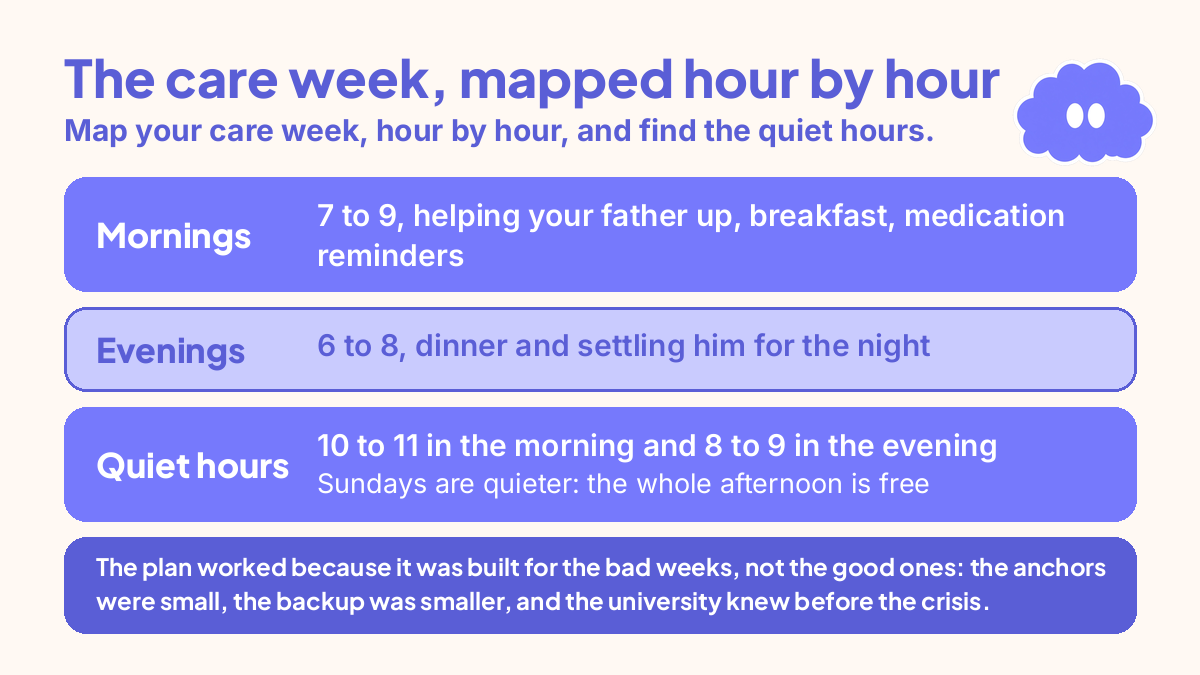
- Step 1, the map: You map the week. Mornings are care: 7 to 9, helping your father up, breakfast, medication reminders. Evenings are care too: 6 to 8, dinner and settling him for the night. The quiet hours are 10 to 11 in the morning and 8 to 9 in the evening. Sundays are quieter: the whole afternoon is free. The hospital appointment is Wednesday, 2 to 5, and that afternoon is lost.
- Step 2, the anchors: Two anchors a day, Monday to Friday: 10 to 10.25 in the morning, and 8 to 8.25 in the evening, with a third session on Sunday afternoon. That is 11 sessions a week, about five hours of focused study.
- Step 3, the university: You tell your tutor in week one, and ask the three questions. The answers: a deadline can move by a week with a form, the contact is your tutor’s email, and the evidence is a letter from your father’s GP, which you request now. You also check whether full-time study affects the carer support you receive.
- Step 4, the sessions: Statistics goes first, one session a day, learning then testing. Each session starts with a two-minute recall of the last one. By week three, the statistics pages show fewer misses.
- Step 5, the backup: In week four, your father is unwell for three days, and no anchor happens. You do the ten-minute recall each night, mark the days as care days, and email your tutor on the second day. The deadline for the essay moves by a week. On the fourth day, your sister covers the evening, and the missed statistics topic gets the first session.
- Step 6, the check: Every Sunday, you move the anchors to fit the next week. The Wednesday appointment moves Wednesday’s anchor to Thursday. The quiet Sunday adds a third session. By the exam week, the log shows 49 sessions done, and the statistics pages are the ones you re-test the night before.
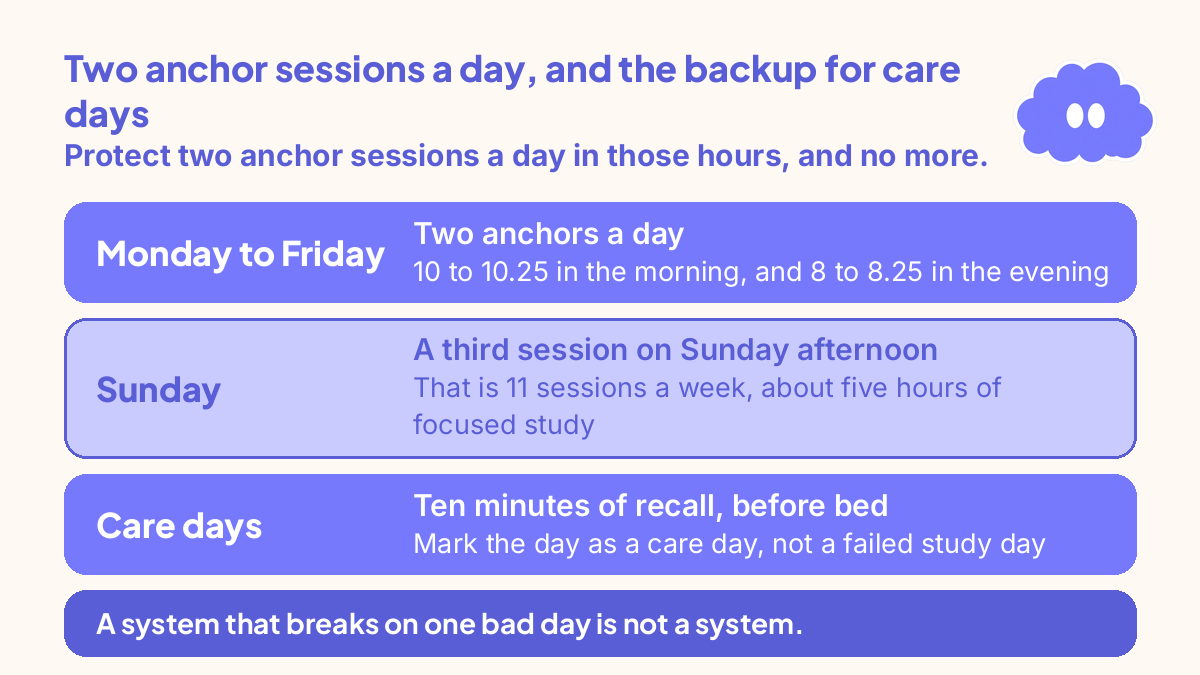
The plan worked because it was built for the bad weeks, not the good ones: the anchors were small, the backup was smaller, and the university knew before the crisis. The exam was passed, and the caring never stopped, which is the point.
When it goes wrong
There is no quiet hour in the day. Look again at the map, and look for ten minutes, not an hour: the ten minutes after breakfast, the ten minutes on the bus, the ten minutes before bed. One ten-minute recall a day keeps the course alive until a quiet hour appears, usually when another family member takes a shift, or when the care routine settles. If no quiet hour appears for two weeks, tell your tutor: the plan needs the university’s help, not more willpower.
You feel guilty for studying while someone needs you. The guilt is real, and it is also wrong: an hour of study does not take an hour of care away, and a student who finishes the course is a carer with a future, not a carer who has failed. The anchor sessions are protected time, agreed with the family.
A care crisis takes a whole week. Use the backup every night, tell your tutor on the second day, and move the deadline. Do not try to catch up by doubling the sessions when the crisis ends. The system is built to pause, not to break.
The family does not respect the anchor hours. Tell them again, with the times written down, and ask one person to hold the calls. If the interruptions keep coming, move the anchors to the hours nobody else is awake: the early morning, or the late evening. An anchor at 6 in the morning, protected, beats one at 8 in the evening, interrupted.
Weekly review checklist
- Which care tasks are different next week, and which anchors still fit?
- Did both anchors happen most days, or did care take the week?
- Which topics turned from red to amber, and which still need a session?
- Did I use the backup on the care days, and did I mark them as care days?
- Does the university know what is happening, or do I need to tell them now?
- What are next week’s anchors, and which topic is each one for?
Downloadable infographic spec: one vertical image, title “How to study when you care for a family member”, with the six steps from “The system in short” and the six review questions above, in Thynq cream, Cloud Purple, Dark Purple and pink, with the Cloud mascot. Text taken word-for-word from this article.
What this system is not
It is not a way to study as much as a student with no caring: your week has fewer hours, and no system adds hours to it. It is not medical advice, and it does not tell you how to care for someone: it tells you how to study around the caring you already do. It does not replace your tutor or your student support service, and it does not guarantee a pass; it guarantees a plan that fits the week you actually live, and a backup for the days that week falls apart.
Sources
- Dunlosky, J., et al. (2013). Improving students’ learning with effective learning techniques. Psychological Science in the Public Interest, 14(1), 4-58. Practice testing and distributed practice rated high, which is why every session tests from memory.
- Cepeda, N. J., et al. (2006). Distributed practice in verbal recall tasks. Psychological Bulletin, 132(3), 354-380. Spaced practice beat massed practice, which supports spreading the sessions across the week instead of cramming them.
For the wider system behind this one, start with How to study when you are tired after work.
Questions
How do I study while caring for a family member?
Map your care week first, then protect two short anchor sessions a day in the hours when care is lightest. Study in 25-minute sessions, keep a backup plan for the days care takes over, and tell your university early, so a deadline can move before it is missed.
How many hours a day can a student carer study?
Two anchor sessions of 25 minutes, plus one short review, is a realistic daily target for most student carers: about one hour of focused study. On a quiet day, add a third session. The number that matters is the one you can keep on a bad week.
Should I tell my university that I care for a family member?
Yes, and early. Tell your tutor or your student support service what your caring takes, and ask what help exists: deadline extensions, recorded lectures, or a changed seminar time. A university cannot help with a problem it does not know about.
What do I do when caring takes the whole day and I study nothing?
Do one thing only: ten minutes of recall, writing down what you remember from the last session, before bed. Then mark the day as a care day, not a failed study day, and give the missed topic the first session tomorrow.