
The direct answer
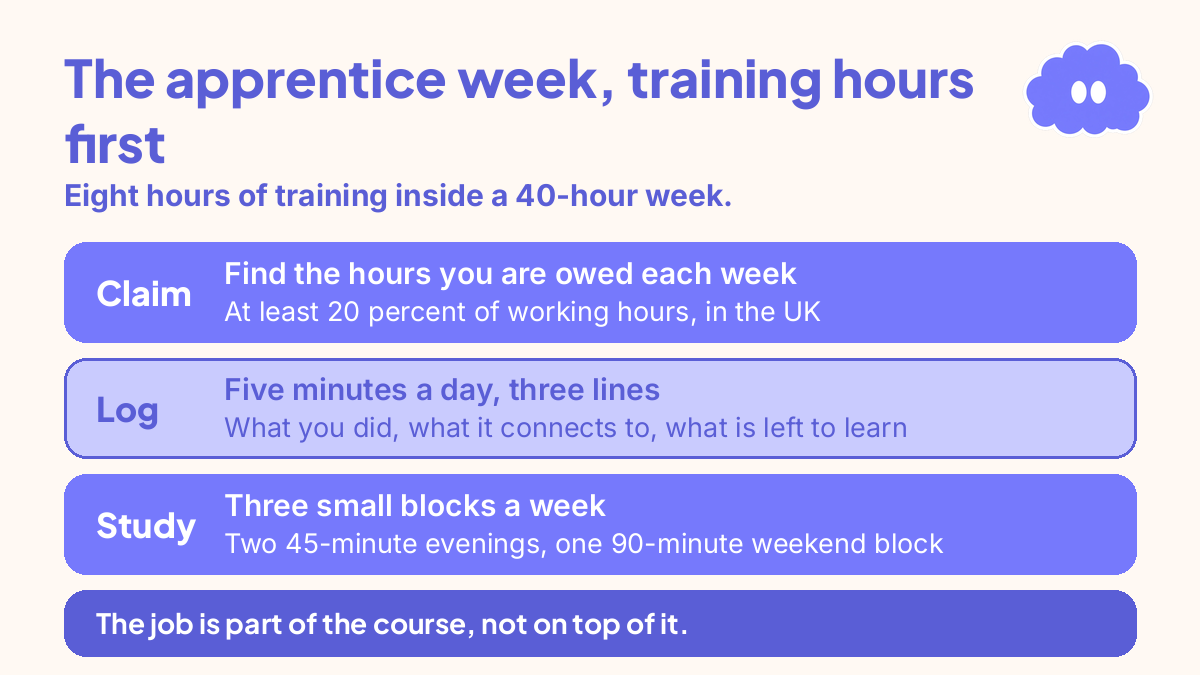
How to study when you are an apprentice: use the training time you are already owed, turn the working week into study material, and keep a daily log that proves what you have learned. An apprenticeship is not a job plus a course on top. The job is part of the course, and the system below treats it that way.
An apprentice has a problem other working students do not. The work is full-time, the study is real, and the two are supposed to fit together, but nobody hands you a plan for making them fit. The training hours get eaten by busy weeks, the coursework piles up at the end of the month, and the evidence log gets written in a panic the night before a review. The system below makes the working week do the studying, instead of fighting it.
The system in short
- Claim your training hours first: find the hours you are owed each week and put them in the calendar before anything else.
- Turn the working week into study material: every job you do is an example for your coursework, if you log it the same day.
- Keep a five-minute daily log: what you did, what it connects to, and what you still need to learn.
- Study in three small blocks a week: two 45-minute evening sessions and one 90-minute weekend block.
- Prepare for each review meeting in advance, with the log and the evidence ready, so the meeting moves you forward.
- Review for 15 minutes each Sunday: which training hours happened, which ones were lost, and what next week must protect.
Step 1: Claim your training hours first
An apprenticeship comes with training hours built in. In the UK, at least 20 percent of your normal working hours must be spent on training, so a 40-hour week gives you eight hours. That time might be a day at college, a morning of online modules, or a few hours spread across the week. Find out exactly what your arrangement is, from your training plan and your training provider, and write it down.
Then put those hours in your calendar before anything else. They are not spare time, and they are not a favour from your employer. They are part of the apprenticeship, and they are the first study time you have. If the hours are a college day, protect it. If they are spread across the week, block them in the rota and treat them as fixed.
If the hours keep getting eaten by busy work, say so early, in writing, with the training plan in front of you: “My training plan says I have eight hours of training a week, and this week I had two. Can we agree which hours next week are protected?” If that does not work, talk to your training provider. The system in How to ask your boss for study time has the words for this conversation, including what to say when the answer is no.
Step 2: Turn the working week into study material
The biggest waste in an apprenticeship is treating work and study as two separate things. The work is the study material. Every job you do is an example for your coursework, a piece of evidence for your log, and a chance to practise the theory you learned in training. The trick is to connect them deliberately, not to hope the connection happens by itself.
Before each working week, look at what you are studying and pick one thing to watch for at work: how your supervisor handles a difficult customer, how a risk assessment is actually done, or how testing is carried out. One thing a week is enough, and it turns an ordinary working day into a lesson.
After the job, write down what happened in two lines: what you did, and what it showed about the theory. That note is coursework material. A student who writes two lines a day has 10 examples by Friday, and those examples are what make coursework specific instead of generic. A student who writes nothing has to invent examples at the end of the month, and the coursework shows it.
Step 3: Keep a five-minute daily log
The log is the heart of the system. At the end of each working day, spend five minutes writing three things: what you did today, what it connects to in your coursework, and what you still need to learn. Keep it in one place, a notebook or a notes app on your phone, and keep it short. Five minutes, three lines, every day.
The log does three jobs. First, it is your evidence: most apprenticeships ask you to prove what you have learned, and the log is the proof, with dates and details. Second, it is your coursework: when an assignment is due, the log already holds the examples. Third, it is your early warning: if the log shows three weeks with nothing new, the training has stalled, and you can raise it before a review meeting.
Write the log the same day, not at the end of the week. A log written on Friday about Monday is mostly guessing. A log written on Monday about Monday is accurate, and accuracy is what makes it useful as evidence. If you miss a day, write it the next morning, while you still remember it, and then carry on.
Step 4: Study in three small blocks a week
On top of the training hours, you need three small blocks a week for coursework and revision. Two 45-minute evening sessions and one 90-minute weekend block is enough for most apprentices, and it is a plan that survives a full-time working week. Put the evening sessions on fixed days, for example Tuesday and Thursday at 7.00, and the weekend block on Saturday or Sunday morning.
Each block has one job, written down before it starts. The evening sessions take the small jobs: one section of an assignment, one online module, or one topic tested from memory. The weekend block takes the hard job: an essay draft, an assessment, or the topic you keep getting wrong. Finish each block by writing down the next block’s job.
The evening sessions are short on purpose. After a full day at work, a 45-minute block on a fresh enough mind does more than two tired hours. If the evening is too tired for even 45 minutes, do 20 minutes of retrieval, flashcards or practice questions from memory, and stop. For the evenings when tiredness wins completely, use the system in How to study when you are tired after work.
Step 5: Prepare for each review meeting in advance
Apprenticeships have regular review meetings, with your employer and your training provider, and most apprentices waste them by arriving unprepared. Prepare the day before, in 30 minutes, with the log open. Write down three things: what you have learned since the last review, what you are stuck on, and what you need next. Bring the log, and bring one example from it.
The meeting is where you get what you need: a new task that teaches you something, time for an assessment, or help with a topic you do not understand. But you only get those things if you ask for them specifically. “I need more practice on fault-finding, because my log shows I have only done it twice” is a request that gets an answer.
After the meeting, write down what was agreed in the log, with dates. That note is what you check at the next meeting, and it is what stops the same problem being raised three times without being fixed.
Step 6: Review for 15 minutes each Sunday
On Sunday, or on your first free evening after the week ends, spend 15 minutes on three questions. First, did the training hours happen this week, and if not, where did they go? Second, did the daily log happen every day, and what did it show? Third, did the three study blocks happen, and did they carry the right jobs?
Write the answers in two or three lines. If the training hours keep being lost, that is a conversation to have on Monday, not a problem to carry for a month. If the log keeps being skipped, move it to the journey home, or to the first five minutes after you sit down in the evening. If the study blocks keep failing, cut one evening session and protect the weekend block harder.
A worked example: a first-year electrical apprentice
Your situation: First-year electrical apprentice, 40 hours a week, Monday to Friday, 8.00 to 4.30. Training day at college every Wednesday. Coursework: one assignment a month, plus an online module each week. Review meeting every six weeks.
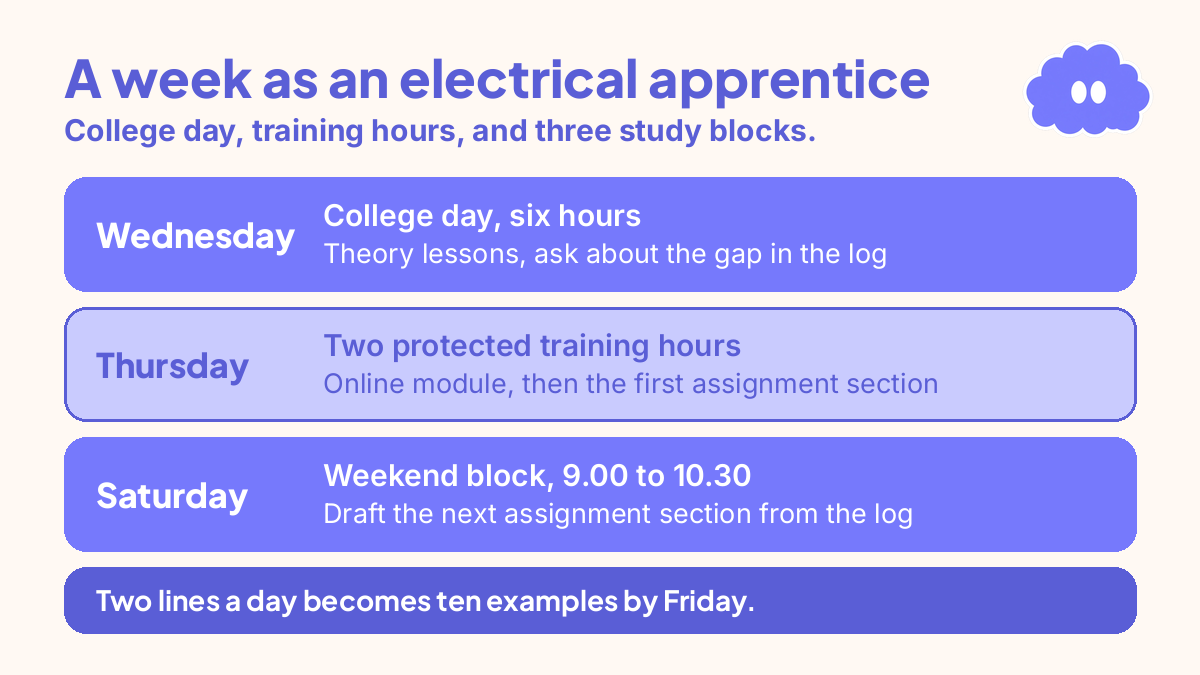
- Training hours claimed: Eight hours a week, as the training plan says. Wednesday is the college day, six hours. Thursday morning, 8.00 to 10.00, is the other two hours, spent on the online module at work, agreed with the supervisor in writing.
- Monday, on the job: Installing lighting circuits with a qualified electrician. Watch for one thing: how the testing is carried out. Log at the end of the day: “Tested three lighting circuits with the insulation tester. Connects to the testing module, Unit 4. Still unsure about the test sequence order.”
- Wednesday, college day: Theory lessons, six hours. Ask the tutor about the test sequence order, because the log shows it is the gap. Write the answer in the log.
- Thursday morning, 8.00 to 10.00: Protected training hours. Finish the online module, then write the first section of the monthly assignment, using Monday’s lighting circuits as the example.
- Saturday morning, 9.00 to 10.30: Weekend block. Draft the second section of the assignment, using the week’s log entries as examples. Write down next week’s job before stopping.
- Sunday review, 15 minutes: Training hours happened, all eight. Log happened every day. Three study blocks happened. The gap on the test sequence is closed. Next week: watch for how cable sizing is chosen, because that is the next module.
When it goes wrong
The training hours get eaten by busy work. This is the most common failure, and it happens slowly: one busy week, then two, then the training day is a rumour. The fix is early and in writing, with the training plan in front of you, and with your training provider copied in if the employer does not respond. Do not let it run for a month.
The coursework piles up at the end of the month. That means the three small blocks are not happening, or they are being spent on the wrong jobs. The fix is the weekend block: protect it for two weeks, spend it only on the assignment, and the pile shrinks. If the assignment is still too big, break it into sections and do one section per block.
You feel like a worker, not a student, and the course feels like an extra. That feeling is a signal, not a fact. Look at the log: if it shows new things learned every week, you are a student who works. If it shows the same tasks repeated for a month, the training has stalled, and the review meeting is where to raise it, with the log as evidence.
Weekly review checklist
- Did my training hours happen this week, all of them, and if not, where did they go?
- Did the daily log happen every day, and what did it show I still need to learn?
- Did the three study blocks happen, and did they carry the right jobs?
- What did the working week teach me that I can use in my coursework?
- Is there anything I need to ask for at the next review meeting, and is it written down?
- What must next week protect: a training hour, a study block, or a conversation with my supervisor?
Downloadable infographic spec: one vertical image, title “How to study when you are an apprentice”, with the six steps from “The system in short” and the six review questions above, in Thynq cream, Cloud Purple, Dark Purple and pink, with the Cloud mascot. Text taken word-for-word from this article.
What this system is not
It is not a promise that an apprenticeship stops being tiring. A full-time working week plus a course is a lot, and some weeks the study will be thinner than you want. It is not a way to do a course without using the training hours, and it will not work if you treat the log as paperwork for the end of the month. What it does is smaller: it makes the working week do the studying, so the course and the job stop fighting each other.
Sources
- Dunlosky, J., et al. (2013). Improving students’ learning with effective learning techniques. Psychological Science in the Public Interest, 14(1), 4-58. Practice testing and distributed practice rated high; rereading rated low, which is why the evening sessions use testing from memory.
- Roediger, H. L., & Karpicke, J. D. (2006). Test-enhanced learning. Psychological Science, 17(3), 249-255. Recallers remembered more a week later than restudiers, which supports testing yourself on the theory after seeing it at work.
- Cepeda, N. J., et al. (2006). Distributed practice in verbal recall tasks. Psychological Bulletin, 132(3), 354-380. Spaced practice beat massed practice, which supports the daily log and the short sessions spread across the week.
For the wider working-student system behind this one, start with How to build a study system that fits your life.
Questions
How do I study as an apprentice when I work full-time?
Use the training time you are already owed. In the UK, at least 20 percent of your working hours must be spent on training, so a 40-hour week gives you eight hours of study time inside the working week. Protect that time first, then add two short evening sessions and one weekend block for the rest.
What counts as off-the-job training for an apprentice?
Any learning that happens away from your normal productive work: theory lessons, online modules, practice exercises, writing up your evidence log, and revision for assessments. It does not include the day-to-day work itself, even when you are learning on the job. Ask your training provider for a written list if you are unsure.
How do I keep up with coursework during a busy week at work?
Keep a small daily log of what you did and what it connects to in your coursework, five minutes at the end of each day. When the busy week ends, that log is your coursework: you already have the examples, the dates, and the evidence. Without the log, a busy week leaves you with nothing to write about.
What if my employer will not give me study time?
Ask in writing, with your training plan in front of you, and name the hours you are owed. If that does not work, talk to your training provider, because it is their job to make sure the employer keeps the agreement. Do not give up the training hours quietly; they are part of your pay.