
The direct answer
How to structure a thesis made of published papers: decide early, plan one paper per question, and write the linking chapters that turn separate papers into one argument. A thesis by publication is not three papers stapled together. It is one argument, told in papers, with an introduction and a conclusion that only the thesis has.
Most guidance on this format comes from university rulebooks, which tell you what is allowed and say nothing about how to do it. Students end up with three papers that do not fit together, and a conclusion that repeats the papers instead of synthesising them. The system below plans the thesis as one argument from the start, so the papers fit together when they are written, not after.
The system in short
- Decide in the first three months, with your supervisor, and check your university’s rules on numbers, authorship, and permissions.
- Break the thesis question into three paper-sized questions, one per paper, in the order they will be answered.
- Write the papers in the order that makes sense for the research, not the order they will appear in the thesis.
- Keep a running synthesis note: what each paper found, and how it changes the answer to the big question.
- Write the linking chapters last: an introduction, short links before each paper, and a conclusion that synthesises across all three.
- Review for 15 minutes each week: which paper is moving, which one is stuck, and what the synthesis note is missing.
Step 1: Decide in the first three months, and check the rules
Decide early, ideally in the first three months of your degree, because the decision shapes everything after it. A thesis by publication is built paper by paper, and a paper takes months to write, submit, and revise. If you decide in your final year, there is no time to publish three papers properly, and you end up rushing them. Talk to your supervisor, and make the decision together, in writing, so there is no confusion later.
Then read your university’s rules, because they differ. Most ask for three papers for a doctorate and two for a research masters, with at least one published or accepted by the time you submit. Most require you to be the sole or lead author, and most require a statement of contribution from each co-author. Some require permission from the journal to include a published paper in your thesis. Get the rules in writing, and keep them with the thesis plan.
Check one more thing: whether the format suits your discipline and your career. It suits students who want an academic career, because the papers are already published when they finish, and published papers are what academic jobs ask for. It does not suit every project. If your research is one long experiment that cannot be split into three questions, a normal thesis is better. If your discipline does not publish in journals, the format may not be an option at all.
Step 2: Break the thesis question into three paper-sized questions
A thesis by publication is one big question, broken into three smaller questions, one per paper. The big question is the thesis question, the one the whole degree answers. The small questions are the paper questions, and each one must be answerable in one paper, with one method and one set of results.
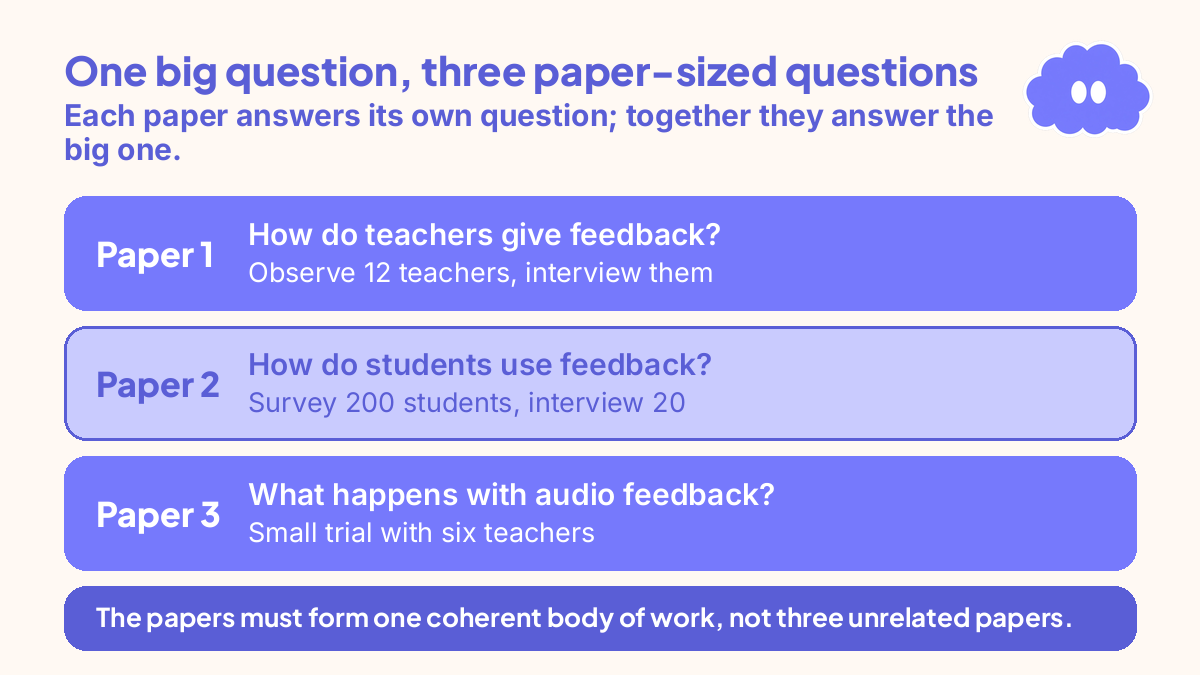
Write the big question down, then break it. A thesis on how teachers use feedback might break into three papers: how teachers give feedback, how students use it, and what happens when the feedback changes. A thesis on a new material might break into three papers: how it is made, how it behaves, and how it performs in use. Each paper answers its own question, and together they answer the big one.
Check the break before you write anything. Each small question must be narrow enough for one paper, and the three together must cover the big question without big gaps. If one paper is really two papers, split it. If two papers are really one question asked twice, merge them.
Step 3: Write the papers in the order that makes sense for the research
Write the papers in the order the research demands, not the order they will appear in the thesis. Often the methods paper comes first, because the method has to work before the results exist. Sometimes the first results paper comes first, because it is the easiest to write and it gets you publishing early. The order in the thesis can be different from the order you wrote them, and it usually is.
Plan the order with your supervisor, and put dates on it. A paper takes three to six months from first draft to submission, and longer if it needs major revisions. Three papers, written one after another, take a year or more. Draft the second paper while the first is under review, so the waiting time is not wasted.
Keep a simple tracker for each paper: draft, submitted, under review, revise and resubmit, accepted, published. When a paper comes back with revisions, do the revisions promptly, because a paper that sits for three months after review is a paper that will not be published in time. For the wider skill of turning a thesis chapter into a paper, the method in How to turn your thesis into a journal article covers the rewriting in detail.
Step 4: Keep a running synthesis note
The synthesis note is a document you keep from the first paper onwards, and it is what stops the thesis from becoming three separate papers. Every time a paper is finished, write two paragraphs in the note: what this paper found, and how it changes the answer to the big question. The note grows as the papers grow, and by the time the third paper is done, the note is the first draft of the conclusion.
The note also catches problems early. If the second paper contradicts the first, the note shows it, and you can deal with it while there is still time. If the three papers together leave a gap in the big question, the note shows that too. Without the note, the gap is discovered in the final month, when it is too late to fix.
Keep the note short and honest. It is not a draft, and it is not for anyone else. It is a thinking tool, and its job is to hold the whole thesis in your head while you are working on one paper at a time. Update it the week each paper is finished, while the findings are fresh.
Step 5: Write the linking chapters last
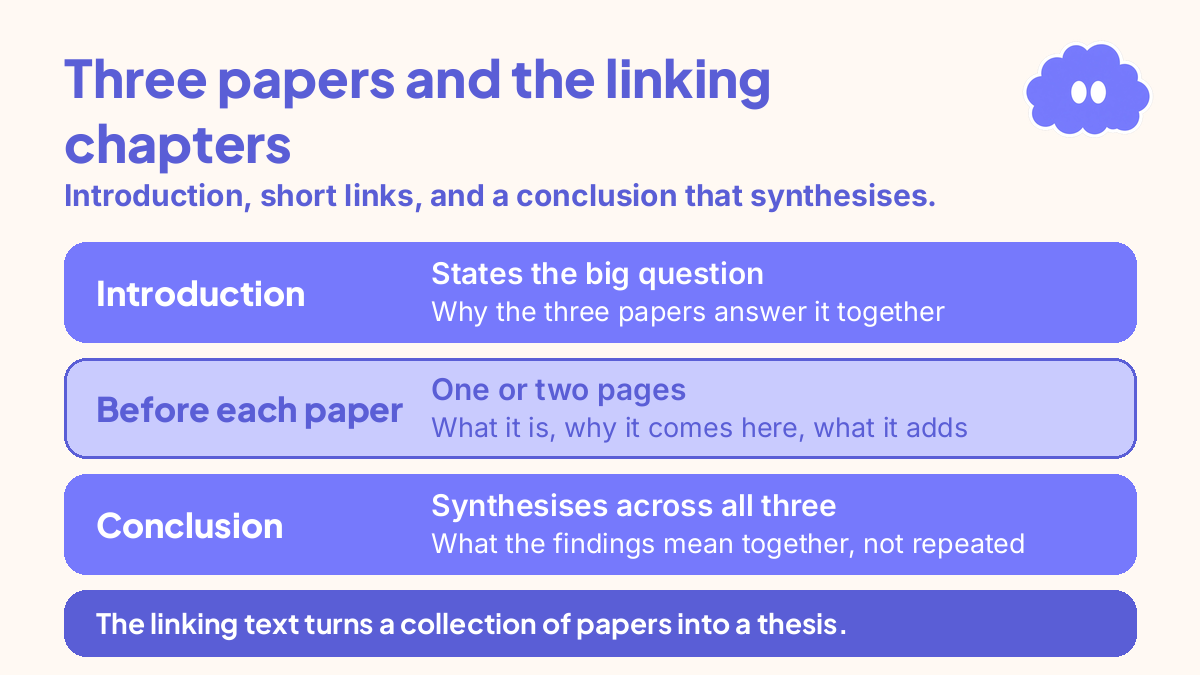
The linking chapters are what turn a collection of papers into a thesis, and they are written last, after the papers are done. They are the introduction, the short links before each paper, and the conclusion. The introduction states the big question, explains why the three papers answer it together, and says what each paper contributes. It is usually the longest linking chapter, and it is the one examiners read first.
Before each paper, write a short linking section, one or two pages, that says what the paper is, why it comes here, and what it adds to the argument. The linking section also explains any overlap: if two papers use the same method, say so, and say why the method is described once and referred to afterwards.
The conclusion synthesises across all three papers. It does not repeat them. It says what the three findings mean together, what they do not mean, and what is left to do. Use the synthesis note from Step 4 as the first draft, and build from there. The conclusion is also where you answer the big question directly, in one paragraph, so an examiner who reads only the introduction and the conclusion knows what the thesis found.
Step 6: Review for 15 minutes each week
At the end of each week, spend 15 minutes on three questions. First, which paper is moving, and which one is stuck? Second, what does the synthesis note need: a new paragraph for a finished paper, or a fix for a contradiction? Third, are the dates still realistic, or has a paper slipped, and what moves to make room?
Write the answers in two or three lines. If a paper is stuck, the problem is usually one thing: the question is too big, the method does not work, or the draft has no clear argument. Name the one thing, and fix that. If the dates have slipped, move the next paper’s start date, and tell your supervisor.
A worked example: a PhD on teacher feedback, in three papers
Your situation: PhD student, education, thesis question: how do teachers’ feedback practices affect students’ use of feedback? University rules: three papers, at least one published by submission, you must be lead author on all three. Three years to finish.
- First three months, decide and break the question: Big question broken into three paper questions. Paper one: how do teachers give feedback? Paper two: how do students use it? Paper three: what happens when feedback comes as a short audio note instead of written comments?
- Months four to ten, paper one: Observe 12 teachers, interview them, write the paper. Submit in month ten. While it is under review, start paper two.
- Months eighteen to twenty-six, paper three: Run a small trial of audio feedback with six teachers, write the paper. Submit in month twenty-six.
- Synthesis note, updated after each paper: Paper one found that teachers give mostly corrective feedback. Paper two found that students use corrective feedback least. Paper three found that audio feedback is used more, but only when it is short. Together, the answer is that the format matters as much as the content.
- Months thirty to thirty-six: Revisions, permissions from journals, formatting, submission. The thesis is three papers plus the linking chapters, and the examiners read it as one argument.
When it goes wrong
The three papers do not fit together. This is the most common failure, and it is usually discovered too late. The fix is the synthesis note: if the note cannot say how the papers answer one question, the break was wrong, and it is better to know that after paper one than after paper three. Rework the break, and if one paper does not fit, move it to an appendix and write a different paper.
The linking chapters feel like an afterthought. They will, if you leave them to the last month. Start the introduction early, as a sketch, and update it as each paper finishes. The conclusion is built from the synthesis note, so it is never started from a blank page. If the linking chapters are still an afterthought in the final month, give them two full weeks, not two days.
You run out of time, and only two papers are published. Check the rules: most universities accept papers that are submitted or under review, not only published ones, as long as at least one is published or accepted. If the rules are strict, talk to your supervisor and your graduate school early, and ask what the options are. Do not discover the rule in the final month.
Weekly review checklist
- Which paper is moving this week, and which one is stuck?
- What does the synthesis note need: a new paragraph, or a fix for a contradiction?
- Do the three paper questions still answer the one big question, or has the break drifted?
- Are the submission dates still realistic, or has a paper slipped?
- Have I checked the university’s rules on authorship, permissions, and numbers lately?
- What must next week protect: a writing day, a revision, or a conversation with my supervisor?
Downloadable infographic spec: one vertical image, title “How to structure a thesis made of published papers”, with the six steps from “The system in short” and the six review questions above, in Thynq cream, Cloud Purple, Dark Purple and pink, with the Cloud mascot. Text taken word-for-word from this article.
What this system is not
It is not a promise that a thesis by publication is easier than a normal thesis. It is not easier. It adds publishing to the work of the thesis, and publishing takes time, brings rejections, and follows its own timetable. It is not a way to avoid writing the linking chapters. What it does is smaller: it plans the thesis as one argument from the start, so the papers fit together when they are written.
Sources
- Queensland University of Technology. Thesis by Published Papers Guidelines. (2017). Papers must be closely related and form a cohesive research narrative, with additional chapters linking them, which is why the system plans the linking chapters from the start.
- University of New England. HDR Thesis by Publication guideline. Manuscripts should form a coherent body of work on a single thesis project, and at least one manuscript must be published or accepted, which supports the three-paper plan in Step 2.
- University College Dublin. Research Degree Thesis by Publication Guidelines. (2024). A doctoral thesis would normally comprise three or more publishable papers, accompanied by a critical overview, which supports the structure in this article.
- Dunlosky, J., et al. (2013). Improving students’ learning with effective learning techniques. Psychological Science in the Public Interest, 14(1), 4-58. Practice testing and distributed practice rated high; the same spacing principle supports writing papers in sequence with review between them.
For the wider thesis system behind this one, start with How to write a thesis introduction.
Questions
What is a thesis made of published papers?
It is a thesis where the main chapters are papers you have published, or submitted for publication, during your degree, held together by an introduction and a conclusion that you write for the thesis itself. Most universities ask for three papers for a PhD, with at least one published or accepted by the time you submit.
Should I choose a thesis by publication or a normal thesis?
Choose it early, ideally in your first three months, and only if publishing fits your career plans. It suits students who want an academic career, because the papers are already published when they finish. It does not suit every discipline or every project, so check your university’s rules and talk to your supervisor before you decide.
How many papers do I need for a thesis by publication?
Most universities ask for three papers for a doctorate and two for a research masters, with at least one published or accepted by submission. The papers must form one coherent body of work on a single question, not three unrelated papers. Check your own university’s rules, because the numbers differ.
How do I link published papers into one thesis?
Write an introduction that states the single question all the papers answer, a short linking section before each paper that says what it contributes, and a conclusion that synthesises the findings across all the papers. The linking text is what turns a collection of papers into a thesis.