The direct answer
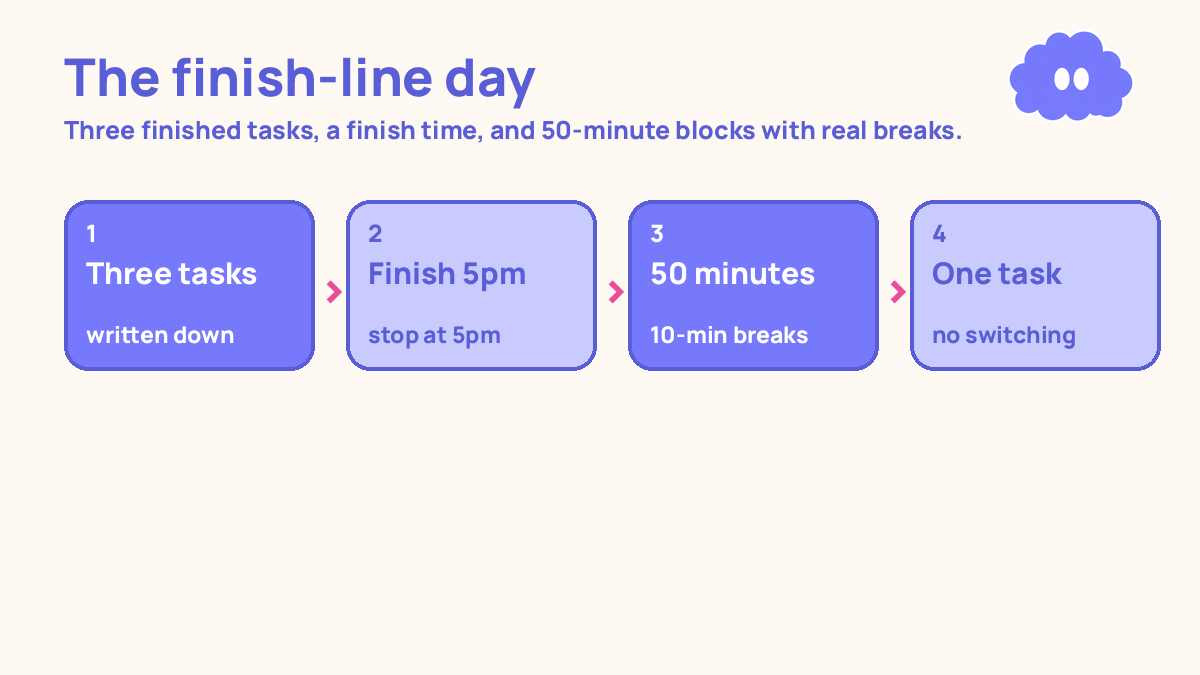
The way to learn how to stop studying all day and finish is to give the day a finish line before it starts: three finished tasks, a clock time when you stop, and 50-minute blocks with real breaks in between. That is the whole system. An all-day study session has no edge to push against, so it spreads to fill every hour and still feels unfinished at midnight.
Why your study day never ends
You sit down at 9am with a vague plan to “study all day”. By 11am you have read some notes and checked your phone six times. By 9pm you are still at the desk, tired, and you cannot name a single thing you finished. The day was long and the work was thin.
The problem is not that you need more discipline. The problem is that “study all day” is not a plan. It has no finish line, no finished tasks, and no point where you can say “done”. Without a finish line, your brain treats every hour as equal and none of them as urgent. So it drifts, and the drift fills the whole day.
The system in short
- The night before, or first thing in the morning, pick three finished tasks. Write each one so you can check it off.
- Pick a finish time. For most students, 5pm or 6pm works. Write it down.
- Work in 50-minute blocks with 10-minute breaks. Four blocks is a full study day.
- One task at a time. No switching between subjects inside a block.
- When the finish time arrives, stop. Close the books, write tomorrow’s three tasks, and leave the desk.
- Test yourself inside the blocks, not just re-read. In a 2013 review, Dunlosky and colleagues rated ten common study techniques, and only two received a high utility rating: practice testing and distributed practice. Re-reading was rated low.
Step 1: Pick three finished tasks
“Study biology” is not a finished task. “Revise chemistry” is not a finished task. “Read chapter 7” is not one either, unless you add the check: read it, close it, and write down the three main points from memory. The check is what turns reading into work.
Pick three, not six. Three is a number you can actually finish in four blocks. Six guarantees you end the day behind, and ending the day behind is what makes you sit down again at 9pm. If you finish all three by 3pm, add a fourth task, or stop early. Stopping early is allowed.
Write the three tasks on paper, in one line each, before you start. If you cannot write a task in one line, split it until it fits.
Step 2: Give the day a finish time
Pick the time you will stop, and write it next to your three tasks. For a student with classes, 5pm or 6pm is realistic. For a student on a full revision day, 7pm is realistic. Later than that, and the finish time stops being a finish time — it becomes “when I fall asleep at the desk”, which is where you started.
The finish time makes the day finite, so the hours before it matter, and it gives you an evening — time to rest, eat properly, and sleep.
Step 3: Work in 50-minute blocks with real breaks
Set a timer for 50 minutes, work on one task, and when it rings, take a 10-minute break. Stand up, get water, look out of a window. Do not open your phone — ten minutes of scrolling is not a break, it is a new distraction that follows you into the next block.
Four 50-minute blocks is a full study day: 200 minutes of focused work, which is more than most students actually do in eight distracted hours. If you need a longer day, add a fifth or sixth block, with a proper lunch break in the middle. Do not add blocks by cutting the breaks. The breaks are part of the system, not a reward for finishing.
The 50-minute length is a practical choice, not a number from cognitive science. The same is true of the 25-minute Pomodoro: Cirillo picked 25 minutes because it worked for him, not because research proved it. If 50 minutes feels too long, use 25-minute blocks instead. What matters is the structure: a block, a break, a block, a break, and a finish time.
Step 4: One task at a time, no switching
Inside a block, you do one thing. If another task pops into your head, write it on a scrap of paper and keep going. Do not switch. Switching is how a 50-minute block becomes 50 minutes of three half-started things.
Rubinstein, Meyer and Evans (2001) measured the cost of switching between tasks: between 614 and 1,096 milliseconds lost on every switch, more when the tasks were complex or unfamiliar. A switch is not just the lost second — it is the time it takes to reload the first task in your head and find where you stopped. Ten switches in a block can eat a quarter of it.
Batch the switches instead. If you need to check messages, do it in the break, all at once, and then put the phone away again. The block is for one task. The break is for everything else.
Step 5: Close the day with a 10-minute review
When the finish time arrives, stop. Then take ten minutes to close the day properly. Check off the tasks you finished. Write down the one thing you will start with tomorrow. Put the books away and clear the desk.
If-then plans help here. In a meta-analysis of 94 studies, Gollwitzer and Sheeran (2006) found that deciding the cue and the action in advance raised goal attainment by a medium-to-large amount (d = 0.65) over holding the goal alone. So write it as a plan, not a wish: “If I sit down at 9am, then I will start with the five mole problems.”
A worked example: how to stop studying all day and finish by 5pm
You have classes in the morning and the afternoon free. Your three tasks: answer the 10 cell-division questions from memory, work through the five mole-calculation problems, and write one essay paragraph.
1:00–1:50 — Block 1: Answer the 10 cell-division questions from memory, then check against your notes. Two wrong. Write the two correct answers out by hand. 1:50–2:00 — Break: Stand up, water, window. Phone stays in the other room. 2:00–2:50 — Block 2: Work through the five mole-calculation problems. Three right, two wrong. Redo the two wrong ones slowly, writing each step. 2:50–3:00 — Break: Walk to the kitchen and back. Stretch. 3:00–3:50 — Block 3: Write one essay paragraph. Read it aloud. Fix the sentence that does not make sense when you hear it. 3:50–4:00 — Break: Ten minutes, away from the desk. 4:00–4:50 — Block 4: Review yesterday’s topics from memory — ten minutes per topic, two topics. Write down what you could not recall. 4:50–5:00 — Close: Check off all three tasks. Write tomorrow’s first task: “Redo the two mole problems I got wrong.” Clear the desk. Stop.
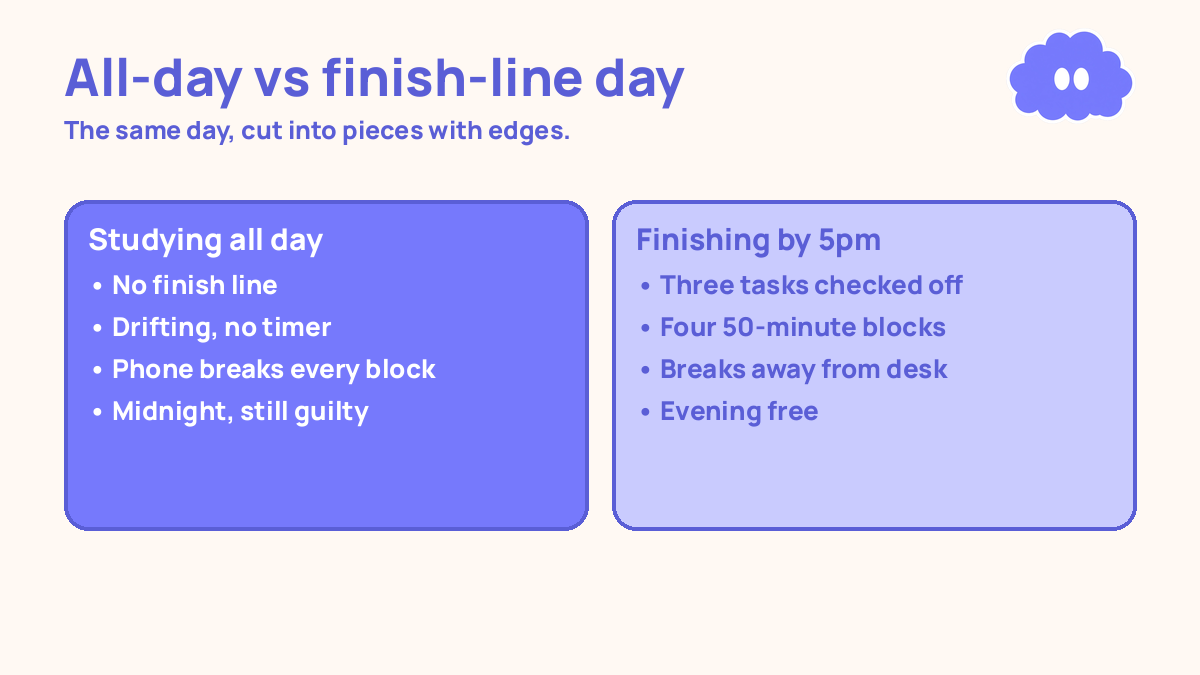
| Studying all day | Finishing by 5pm | |
|---|---|---|
| Start | “Study all day” | Three tasks written down |
| Blocks | No timer, drifting | Four 50-minute blocks |
| Breaks | Phone scrolling | 10 minutes, away from desk |
| End | Midnight, still guilty | 5pm, tasks checked off |
| Evening | More tired studying | Rest, food, people, sleep |
What changes when the day has an end
A day with a finish time is not a shorter day. It is a day with edges, and edges change how you use the hours inside them.
This is why the system works even though it does less. Four blocks is 200 minutes of real work. Eight hours of drifting is often less than 100 minutes of real work, spread so thin you cannot see it. The finish line does not cut your study time. It shows you how little of it you were actually using.
When it goes wrong
You pick three tasks and finish none of them. The tasks are too big. Split each one in half and pick the halves. “Answer 10 questions” becomes “answer 5 questions, then 5 more”. A task you can finish in one block is the right size. A task that needs three blocks is three tasks.
You keep moving the finish time. 5pm becomes 6pm, then 7pm, then midnight. This usually means the list was too big for the day, not that you lack discipline. Tomorrow, pick two tasks instead of three, and set the finish time one hour earlier. A finish time you actually keep beats one you keep breaking.
You work the blocks but spend them re-reading. The timer only controls time. What you do inside it still matters. Dunlosky and colleagues (2013) rated re-reading as low utility, and practice testing as high. Use the blocks to test yourself: answer questions from memory, work problems, write from recall.
The phone breaks every block. The phone is the problem, not your willpower. Put it in another room. If you need a timer, use a kitchen timer, a watch, or a laptop timer with the phone still in another room. One study found a phone on the desk cost focus even when it was off — but a later replication did not find the effect, so the evidence is mixed (Ward et al., 2017; Ruiz Pardo & Minda, 2022). Either way, a phone in another room is a practical fix, and the phone focus system for distracted students covers it in detail.
Weekly review checklist
Copy this list and use it each week:
- How many days this week did I stop at my finish time?
- How many of my three daily tasks did I actually finish?
- Which tasks kept running over — too big, too vague, or the wrong task for the block?
- What one change will I make next week: smaller tasks, an earlier finish time, or the phone in another room?
Downloadable infographic spec: one vertical image, title “The finish-line day”, with the four steps — three finished tasks, a finish time, 50-minute blocks with 10-minute breaks, one task at a time — and the rule “when the finish time arrives, stop”, in Thynq cream, Cloud Purple, Dark Purple and pink, with the cloud mascot. Text taken word-for-word from this article.
What this system is not
It is not a promise that you will study less and learn more, and it is not a claim that four blocks is the scientifically correct amount of study for every student. It is a practical finish-line system: three tasks, a stop time, and honest blocks. If your course needs more hours, add blocks — but add them as blocks with breaks, not as an open-ended day.
Sources
- Dunlosky, J., et al. (2013). Improving students’ learning with effective learning techniques. Psychological Science in the Public Interest, 14(1), 4-58. Only practice testing and distributed practice received a high utility rating; rereading was rated low.
- Rubinstein, J. S., Meyer, D. E. & Evans, J. E. (2001). Executive control of cognitive processes in task switching. Journal of Experimental Psychology: Human Perception and Performance, 27(4), 763-797. Mean switch costs were 614 to 1,096 milliseconds per switch.
- Gollwitzer, P. M. & Sheeran, P. (2006). Implementation intentions and goal achievement: a meta-analysis of effects and processes. Advances in Experimental Social Psychology, 38, 69-119. If-then plans raised goal attainment by a medium-to-large amount (d = 0.65) across 94 studies.
- Ward, A. F., et al. (2017). Brain drain: the mere presence of one’s own smartphone reduces available cognitive capacity. Journal of the Association for Consumer Research, 2(2). Evidence is mixed: a pre-registered replication (Ruiz Pardo & Minda, 2022) found no effect.
For the timer version of this system, read the Pomodoro technique for students, and for the week around it, the weekly study planner for students. To go deeper on the focus part, the deep work system for students builds on this one.
Questions
How many hours a day should I study?
There is no right number of hours. This system uses three finished tasks and a finish time instead. Three finished tasks in four focused hours beat eight distracted hours with nothing completed.
What if I have an exam tomorrow and need to study all day?
Use the same system with more blocks, not with no finish line. Plan six blocks, take a real lunch break, and stop at 9pm. A session with no breaks and no finish time is how you arrive at the exam exhausted.
What counts as a finished task?
Something you can check off: ten questions answered from memory, one problem set completed, one essay paragraph written. Reading a chapter is not finished until you can say what it said without looking.
I keep going past my finish time. What do I do?
Shrink tomorrow’s list to two tasks instead of three, and set the finish time one hour earlier. If you keep missing the finish line, the list is too big, not your willpower too small.