The direct answer
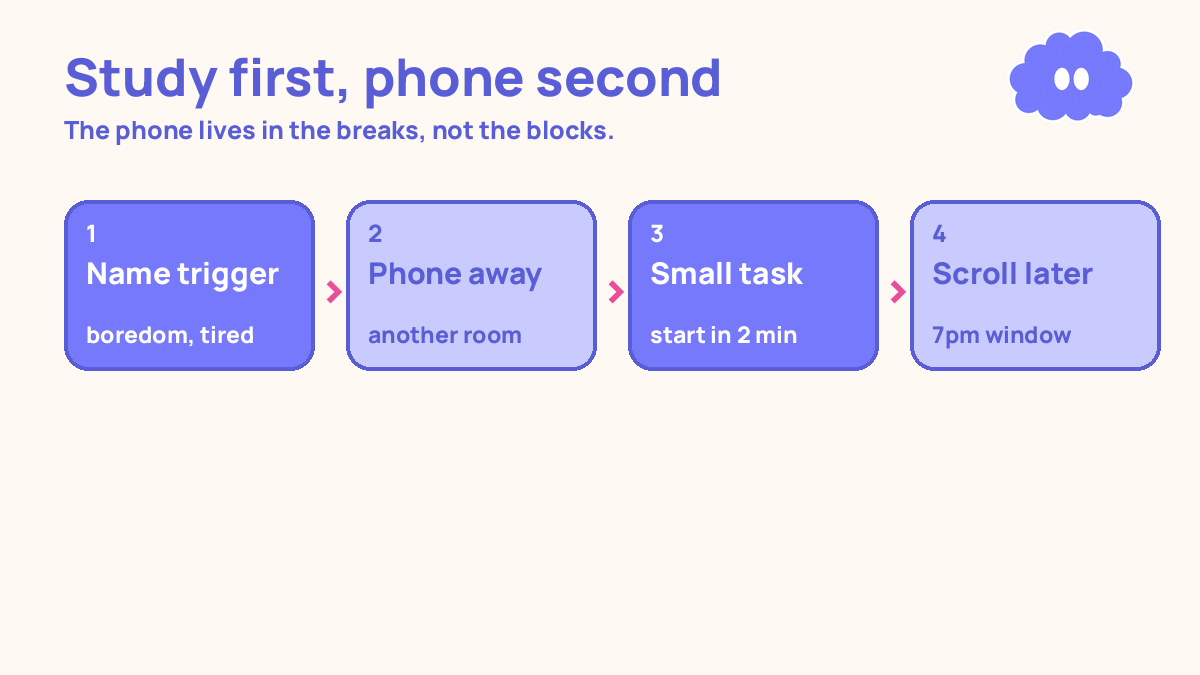
Here is how to stop doomscrolling before study: study first, phone second. Put the phone in another room, write down one small task, and start it for just 2 minutes. That is the whole system. Doomscrolling is not a character flaw. It is a loop — boredom, phone, one more video, guilt — and a loop is broken by changing the first step, not by trying harder.
The scroll that eats the morning
You sit down to study at 9am. You will just check one message first. Twenty minutes later you are watching a video about something you do not care about. You put the phone down, pick up the book, and three minutes later your hand is reaching for the phone again.
The problem is not that you are lazy. The problem is that the phone is closer than the book, easier than the book, and designed to keep you there. The book asks you to think. The phone asks you to watch. When you are tired, bored, or unsure where to start, the phone wins — unless you change the setup first.
There is also a cost to every switch. In four experiments, Rubinstein, Meyer and Evans (2001) found that people lost between 614 and 1,096 milliseconds on every switch between tasks. A morning of twenty switches is a morning with no real work in it.
The system in short
- Name your trigger: boredom, tiredness, not knowing where to start, or a notification.
- Put the phone in another room before you sit down. Not on silent, not face down — another room.
- Write one small first task on paper. One line. Start it for 2 minutes only.
- Work in a 50-minute block, then take a 10-minute break. Check the phone in the break if you want.
- Give scrolling a window later in the day — 30 minutes after dinner, not before study.
How to stop doomscrolling before study: name the trigger first
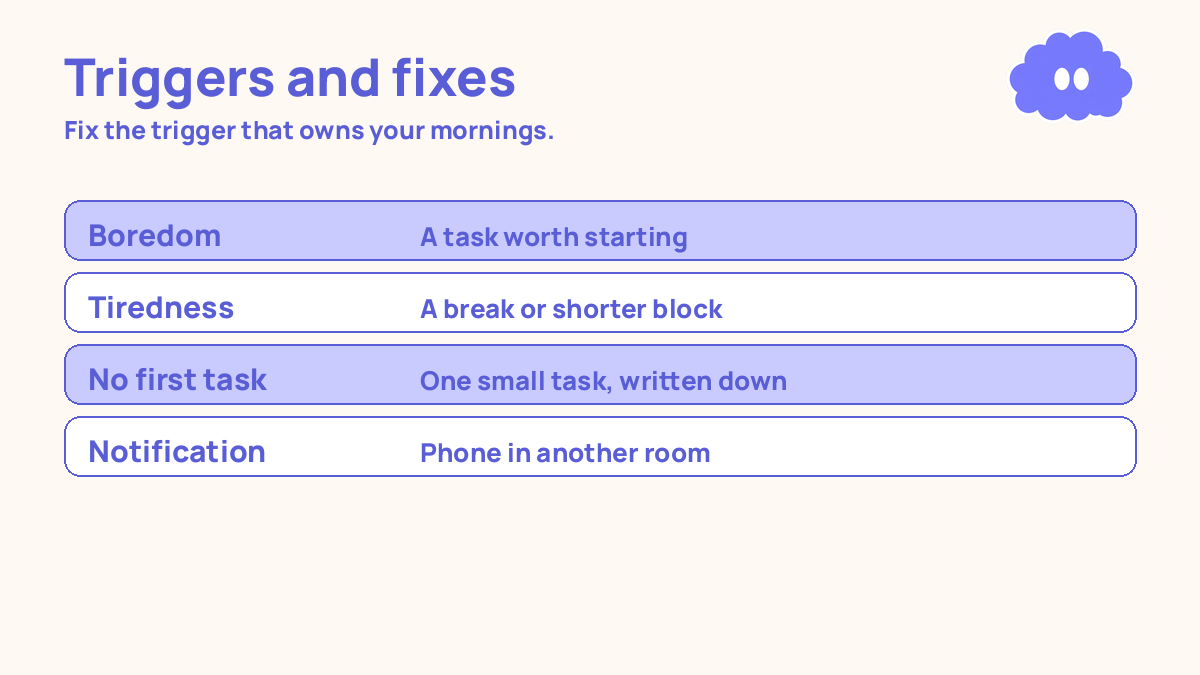
Doomscrolling has a trigger, and it is usually one of four things: you are bored, you are tired, you do not know where to start, or a notification pulled you in. For one day, write down the time and the trigger every time you pick up the phone instead of studying. One day of notes shows the pattern.
If the trigger is boredom, the fix is a task worth starting: a question to answer, a problem to solve. If the trigger is tiredness, the fix is a break or a shorter block. If the trigger is not knowing where to start, the fix is one small task, written down, before you sit down. If the trigger is a notification, the fix is the phone in another room, notifications off.
Step 1: Put the phone in another room
Before you sit down to study, put the phone in another room, on charge. Not in your pocket on silent. Not face down on the desk. Another room. If you need a timer, use a kitchen timer, a watch, or a laptop timer.
One study found a phone on the desk cost focus even when it was off — but a later replication did not find the effect, so the evidence is mixed (Ward et al., 2017; Ruiz Pardo & Minda, 2022). Either way, a phone in another room is a practical fix, because it removes the choice. Reaching for it means standing up and walking to another room. That is a decision, not a reflex.
If the phone must stay near you, put it in a bag, in a drawer, or on a shelf across the room, with notifications off. The rule is the same: the phone must be harder to reach than the book. For the full version — studying with the phone left in another room entirely — see how to study without your phone.
Step 2: Write one small first task
Never sit down with a vague plan. “Study biology” has no first step, so your hand reaches for the phone. Write the first task on paper, in one line, before you sit down: “Answer the 10 questions on cell division from memory.” “Work through the five mole problems on page 42.” “Write one essay paragraph.”
Then start it for 2 minutes only. Set a timer for 2 minutes and do the first small piece: write the first answer, read the first problem, write the first sentence. Two minutes is small enough that starting does not feel hard, and once you have started, stopping feels harder than continuing. The 2 minutes is a door, not a limit.
An if-then plan makes this automatic. In a meta-analysis of 94 studies, Gollwitzer and Sheeran (2006) found that deciding the cue and the action in advance raised goal attainment by a medium-to-large amount (d = 0.65) over holding the goal alone. Write it down the night before: “If I sit down at 9am, then I will answer the first cell-division question.”
Step 3: Work in blocks, scroll in breaks
Work in a 50-minute block with a 10-minute break. During the block, the phone stays in the other room. During the break, you can check it — all at once, for 10 minutes, then back to work.
This is not a ban. A break is a container: the scrolling has a place, and the place is not inside the study block. Answer the messages in the break, all at once, and then the phone goes back to the other room.
If 50 minutes feels too long, use 25-minute blocks. The 25-minute Pomodoro is a practical choice from Cirillo, not a number from cognitive science. The phone lives in the breaks, not the blocks.
Step 4: Give scrolling a window, not a ban
Pick a 30-minute scroll window later in the day — after dinner, for example — and make it the only time you open social media for fun. Outside the window, the apps stay closed. Inside the window, scroll as much as you want.
A window works better than a ban. A ban makes the phone more interesting, because forbidden things are interesting. A window gives you something to look forward to, so the urge during study has an answer: “not now, at 7pm.” That answer is easier than “never”.
If you break the window and scroll at 11am, do not throw the day away. Write down the trigger, close the app, and go back to the block. One bad morning does not reset anything: in a study of 96 people building one new daily behaviour, Lally and colleagues (2010) found the median time for it to feel automatic was 66 days, with a range of 18 to 254 days, and missing a single day did not measurably hurt.
A worked example: a Tuesday morning
You have a free morning. Your task is the 10 cell-division questions.
8:55am — Set up: Phone on charge in the kitchen. Notifications off. One line written on paper: “Answer the 10 cell-division questions from memory.” 9:00am — Start: Timer for 2 minutes. Write the first answer. Keep going. 9:00–9:50am — Block 1: Answer all 10 questions from memory, then check against your notes. Two wrong. Write the two correct answers out by hand. 9:50–10:00am — Break: Stand up, water, window. Check the phone for 5 minutes if you want, then put it back. 10:00–10:50am — Block 2: Work through the five mole problems. Three right, two wrong. Redo the two wrong ones slowly. 10:50–11:00am — Break: Walk to the kitchen and back. Phone stays in the kitchen. 11:00am — Done: Two blocks finished, and the phone was checked twice, in breaks, for a few minutes each time.
| Scroll-first morning | Study-first morning | |
|---|---|---|
| 9:00am | Check one message | First question answered |
| 9:30am | Still scrolling | Block 1 nearly done |
| 10:00am | Guilty, start late | Break, phone checked |
| 11:00am | Half a chapter read | 2 blocks finished |
| Feeling | Behind, tired | Done, phone waiting |
What a study-first morning feels like
The first week of study-first mornings feels strange. The phone is in the other room and your hand still reaches for it. That is the reflex, and it fades. By the second week, the 2-minute start feels normal.
If the phone is your main distraction in every session, the phone focus system for distracted students goes deeper: it is the same idea — phone in another room, timer on, one task at a time — built into a full session system.
When it goes wrong
You put the phone in another room and go and get it after five minutes. The room is too close, or the task is too vague. Move the phone further away, and write the first task on paper before you sit down. A vague task is an open door for the phone.
You start the 2 minutes and stop at 2 minutes. That is fine. Two minutes of work is more than zero, and tomorrow the start will be easier. Do not force the block. The habit is the return, not the length.
You check the phone in the break and the break becomes 40 minutes. Set a timer for the break too. When it rings, the phone goes back to the other room, even mid-video. If breaks keep running over, make them 5 minutes instead of 10, standing up, away from the desk.
You scroll for an hour and the day feels ruined. It is not ruined. Write down the trigger, close the app, and do one 25-minute block. One block after a bad morning proves the day can be rescued.
Weekly review checklist
Copy this list and use it each week:
- How many mornings this week did I study before checking my phone?
- What was my most common trigger — boredom, tiredness, no first task, or a notification?
- How many blocks did the phone break, and what was I doing when it did?
- What one change will I make next week: phone further away, a written first task, or a shorter block?
Downloadable infographic spec: one vertical image, title “Study first, phone second”, with the five steps — name the trigger, phone in another room, one small first task, work in blocks and scroll in breaks, a 30-minute scroll window after dinner — in Thynq cream, Cloud Purple, Dark Purple and pink, with the cloud mascot. Text taken word-for-word from this article.
What this system is not
It is not a ban on your phone, and it is not a claim that a phone on the desk always costs focus — the evidence on that is mixed (Ward et al., 2017; Ruiz Pardo & Minda, 2022). It is a practical system: study first, phone second, one small task to start, and a scroll window later in the day.
Sources
- Rubinstein, J. S., Meyer, D. E. & Evans, J. E. (2001). Executive control of cognitive processes in task switching. Journal of Experimental Psychology: Human Perception and Performance, 27(4), 763-797. Mean switch costs were 614 to 1,096 milliseconds per switch.
- Ward, A. F., et al. (2017). Brain drain: the mere presence of one’s own smartphone reduces available cognitive capacity. Journal of the Association for Consumer Research, 2(2). Evidence is mixed: a pre-registered replication (Ruiz Pardo & Minda, 2022) found no effect.
- Gollwitzer, P. M. & Sheeran, P. (2006). Implementation intentions and goal achievement: a meta-analysis of effects and processes. Advances in Experimental Social Psychology, 38, 69-119. If-then plans raised goal attainment by a medium-to-large amount (d = 0.65) across 94 studies.
- Lally, P., et al. (2010). How are habits formed: modelling habit formation in the real world. European Journal of Social Psychology, 40(6), 998-1009. Median time for a new daily behaviour to feel automatic was 66 days, range 18-254; one missed day did not measurably hurt.
- Cirillo, F. — Pomodoro Technique, late 1980s. The 25-minute length was Cirillo’s practical choice, not a number derived from cognitive science.
For the full phone setup, read the phone setup for focus, and for the session system, the phone focus system for distracted students.
Questions
How long should I wait before checking my phone in the morning?
Until your first study block is done. Study first, phone second. A 50-minute block, then a 10-minute break where you can check it. The order is the system.
Should I delete social media apps?
Only if you want to. Deleting helps some students and frustrates others. The system works without deleting: phone in another room, a written first task, and a scroll window later in the day.
What if I need my phone for study — a timer, a PDF, a group chat?
Use a kitchen timer or a laptop timer, keep PDFs on the laptop, and check the group chat in your breaks. If the phone must be near you, turn off notifications and put it face down, out of reach.
I scrolled for an hour again. Did the system fail?
No. One bad morning does not reset anything. Write down what the trigger was, move the phone further away tomorrow, and start with the 2-minute task. The system is a routine, not a streak.