The direct answer
To revise for your driving theory test, learn the Highway Code topic by topic, in 25-minute sessions, testing yourself from memory after each one. Practise hazard perception every day, take a mock test each week, and keep an error log of every question you miss. Five weeks at 60 minutes a day is enough for most learners.
The theory test has two parts, and both must be passed in the same sitting: 50 multiple-choice questions in 57 minutes, with a pass mark of 43 out of 50, and hazard perception, 14 video clips with 15 developing hazards, with a pass mark of 44 out of 75. Students who fail usually fail one part, not both: the multiple-choice part is a knowledge problem, and the hazard part is a timing problem.
The system in short
- Book the test, and count the study days and the sessions you have.
- Split the Highway Code into 14 topics, and learn one at a time.
- Practise hazard perception every day, with the click early and once.
- Take a mock test each week, and log every question you miss.
- Re-test the error log until the misses stop appearing.
- Check the week every Sunday, and move the sessions to fit the week.
Step 1: Book the test, and count the study days and the sessions you have
Book the test first, then plan around the date. In England, Scotland, and Wales you book through GOV.UK; in Northern Ireland the booking is separate, through the DVA. The date is fixed once booked, which is the point: a date on the calendar is a deadline, and a deadline is what turns reading into revision. Book five weeks ahead, and tell someone the date.
Count the study days from today to the day before the test, five days a week. Then turn those days into 25-minute sessions: study days times minutes a day, divided by 25, rounded down. Twenty-four study days at 60 minutes a day is 1,440 minutes, which is 57 sessions. Write that number down: 57 sessions is the budget.
Check the number against the work. Fourteen Highway Code topics, two sessions each, is 28 sessions. Hazard perception, eight sessions in the first three weeks and seven more in the last two, is 15. Mock tests and error-log review, five mocks and nine review sessions, is 14. That is 57 sessions, exactly the budget.
Step 2: Split the Highway Code into 14 topics, and learn one at a time
The Highway Code is long, and reading it from start to finish is the slowest way to learn it. Split it into 14 topics instead: rules for pedestrians, signs and signals, speed limits, junctions, roundabouts, motorways, parking, vehicle condition, documents and insurance, alcohol and drugs, tiredness and health, vulnerable road users, adverse weather, and first aid at the scene. One topic at a time, two sessions each: the first to learn it, the second to test it.
A learning session has a shape: read the topic once, close the book, and write down everything you remember, in your own words. Then open the book and check: what did you get right, what did you miss, what did you get wrong. A testing session has a different shape: answer 20 practice questions on that topic, from memory, mark them, and write the misses in the error log. A session is not reading: reading without testing fills the hours and leaves nothing behind.
Work the topics in order of difficulty, not in the order of the book. Signs and signals, speed limits, and junctions come first, because they appear in the most questions; first aid and documents come last, because they appear in the fewest. The multiple-choice exam system is the same shape: each topic ends with practice questions, not with another read.
Step 3: Practise hazard perception every day, with the click early and once
Hazard perception is a timing skill, not a knowledge skill, and it is trained by doing it, not by reading about it. Practise every study day, one session of clips, and click the moment you see a hazard developing: a pedestrian stepping towards the road, a car pulling out, a cyclist wobbling. Click early, and click once per hazard: clicking repeatedly, or clicking in a pattern, scores nothing.
The first click is the earliest sign: the brake lights ahead, the pedestrian looking at the road, the side road with a car waiting. The second click is the hazard developing: the pedestrian stepping out, the car moving, the cyclist swerving. The third click is too late: the hazard is already there, and the score is low. The scoring window opens early, so click at the first sign, not when you are sure.
Watch the clips on a proper screen, not a phone, and watch them once, at full speed, the way the test shows them. Replaying a clip teaches you that clip, not the skill; the test shows each clip once, and the skill is seeing the hazard the first time. After each clip, say out loud what the hazard was and when you clicked, before the answer appears.
Step 4: Take a mock test each week, and log every question you miss
Take a mock test at the end of week two, then two a week in the last two weeks, both parts, timed, in one sitting, with no book and no phone. The first mock is a baseline, not a verdict: most learners score around 31 out of 50 and around 28 out of 75, both below the pass mark. That is normal, and it is useful: the mock shows which topics are weak, and the error log shows which questions keep appearing.
Log every question you miss, with the topic, the right answer, and why you got it wrong. The log is one line per miss, and it is the most valuable page in your revision: the questions you miss twice are the questions the test will ask, and the topics with the most misses are the topics that need the next sessions. A student who logs the misses and re-tests them passes faster than one who takes ten mocks and logs nothing.
Take the mocks in order: multiple-choice first, then a break of up to three minutes, then hazard perception, exactly as the real test runs. Three of the multiple-choice questions use a short silent video, so the mock should include them, and the break is part of the test, not a pause in it: use it to breathe, not to look anything up.
Step 5: Re-test the error log until the misses stop appearing
The error log is the revision plan for the last two weeks. Every review session starts with the log, not with the book: re-test the ten most recent misses, then the ten oldest, then the topics with the most misses. A question answered right twice in a row leaves the log; a question answered wrong stays, and gets a session of its own.
Make flashcards for the misses that keep coming back: the sign you keep confusing, the speed limit you keep forgetting, the stopping distance you keep guessing. One card per miss, question on the front, answer on the back, and test yourself with spaced repetition: the card comes back tomorrow, then in three days, then in a week, and it leaves the pile when you answer it right three times.
Do not add new material in the last week. The last week is for the log, the mocks, and the hazard clips, not for a topic you have never read. A topic learned in the last week is a topic learned badly.
Step 6: Check the week every Sunday, and move the sessions to fit the week
Spend ten minutes every Sunday on three numbers: the sessions left, the topics left, and the mock scores. If the mock scores are climbing, the spare sessions go to the weakest topic, not to new material. If the scores are flat, the plan needs to change: more sessions on the weakest topic, fewer on the strongest.
End the check by writing next week’s sessions into the diary, with the topic each one is for, and the mock test too, at the end of the week, both parts, timed. Then tell someone the plan, so the sessions are protected.
A worked example: five weeks, 57 sessions, test on Friday 18 December 2026
Your situation: Mia, 19, learner driver, test booked for Friday 18 December 2026. You start on Monday 16 November 2026, study five days a week, 60 minutes a day, and have never read the Highway Code.
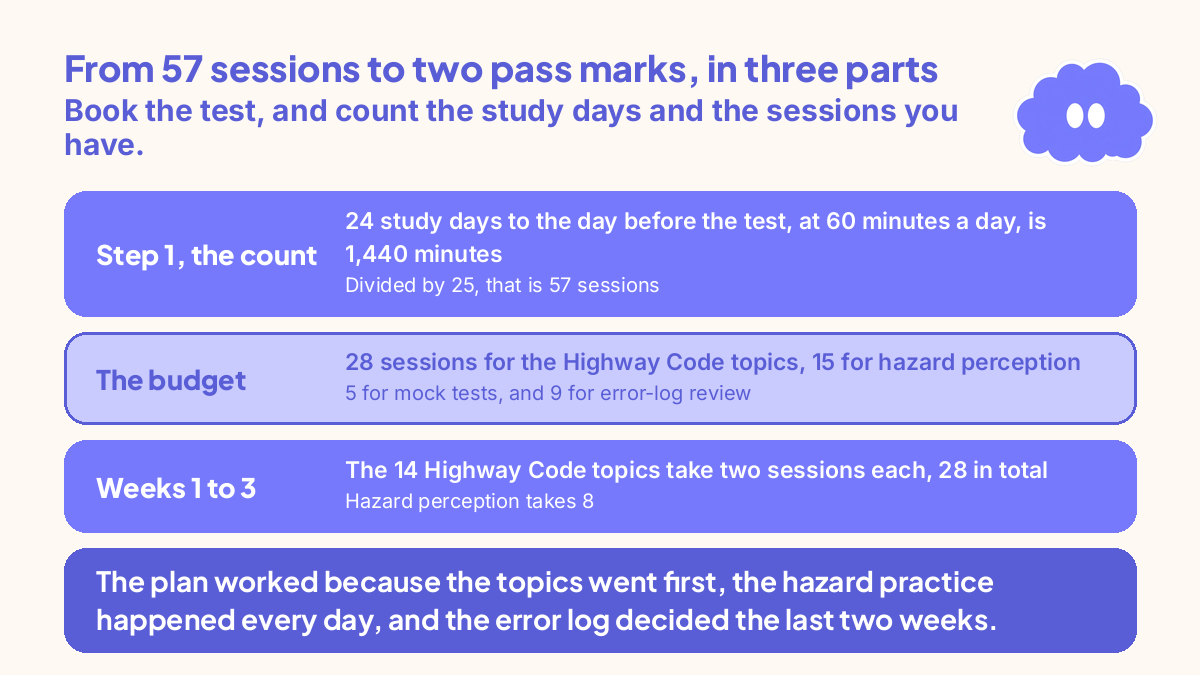
- Step 1, the count: 24 study days to the day before the test, at 60 minutes a day, is 1,440 minutes. Divided by 25, that is 57 sessions. The budget: 28 sessions for the Highway Code topics, 15 for hazard perception, 5 for mock tests, and 9 for error-log review, which is 57 in total.
- Weeks 1 to 3, the topics: 15 study days, 36 sessions. The 14 Highway Code topics take two sessions each, 28 in total, and hazard perception takes 8. Signs and signals, speed limits, and junctions go first. At the end of week 2, the first mock is 31 out of 50, and hazard perception is 28 out of 75.
- Week 4, the mocks: 5 study days, 12 sessions. Two mock tests, 2 sessions, with scores of 38 and 41 out of 50, and hazard perception at 44 out of 75. Error-log review takes 6 sessions, and hazard perception takes 4. The log shows the same misses twice: a speed limit question, a stopping distance question, and a sign question, and each one gets a flashcard.
- Week 5, the last week: 4 study days, 9 sessions. Two mock tests, 2 sessions, with scores of 44 and 45 out of 50, and hazard perception at 47 out of 75. Error-log review takes 4 sessions, and hazard perception takes 3.
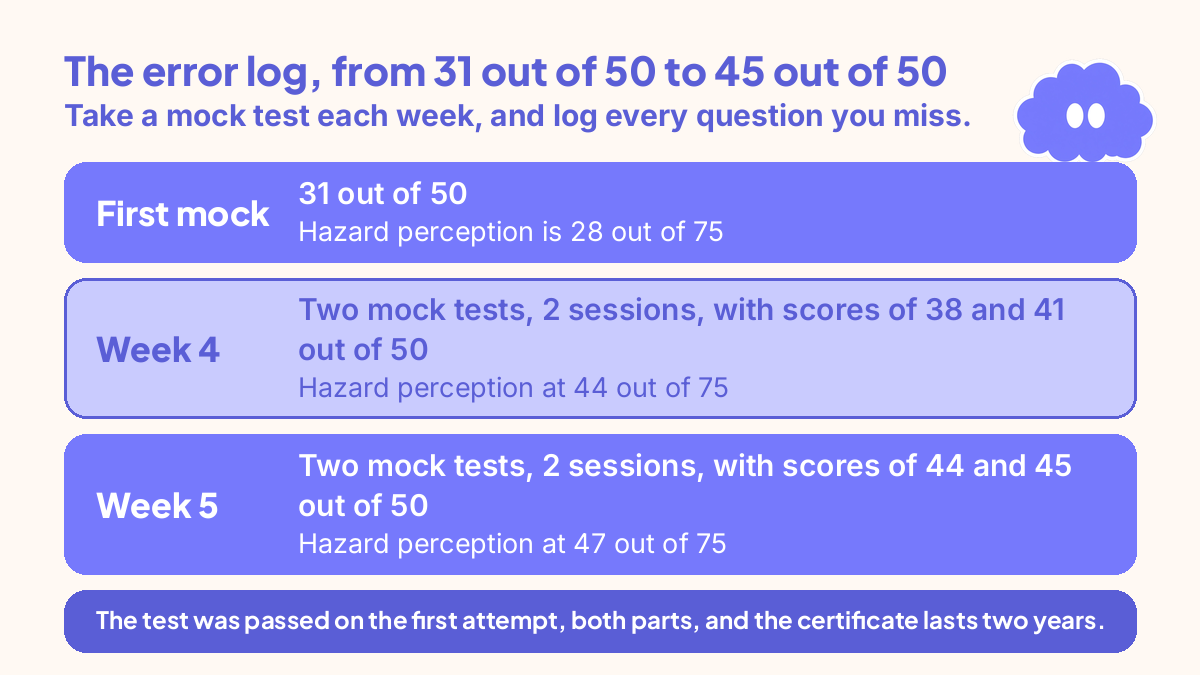
The plan worked because the topics went first, the hazard practice happened every day, and the error log decided the last two weeks. The test was passed on the first attempt, both parts, and the certificate lasts two years.
When it goes wrong
You keep failing the mock on multiple choice, but hazard perception is fine. The problem is knowledge, not timing, and the fix is in the topics, not in more mocks. Go back to the weakest topics, one at a time, and re-test the error log before taking another mock.
You keep failing hazard perception, but multiple choice is fine. The problem is timing, and the fix is clicking earlier. Watch the clips again and click at the first sign, not when you are sure: the scoring window opens early, and waiting for certainty is the habit that fails the test.
You run out of time in the multiple-choice part. Fifty questions in 57 minutes is just over a minute per question, and the fix is practice, not speed: take the mocks timed, mark any question you cannot answer in 30 seconds, move on, and come back at the end. A question that takes three minutes steals two questions from the end.
You fail one part and pass the other. Both parts must be passed in the same sitting, so the whole test must be taken again, and the fee paid again. Train the failed part harder and keep the passed part warm: one session a week on the passed part, so it does not slip, and the rest on the failed part, until the mocks pass on both.
The certificate expires before the practical test. The theory certificate lasts two years, and if the practical test is not passed in that time, the theory test must be taken again. Book the practical test as soon as the theory is passed, and keep the theory warm with a mock test every month.
Weekly review checklist
- How many sessions are left, and how many topics are left?
- Did the mock scores climb this week, or are they flat?
- Which questions are in the error log twice, and which topics have the most misses?
- Did hazard perception get a session every study day?
- Are the flashcards for the repeat misses being tested, or just written?
- What are next week’s sessions, and which topic is each one for?
Downloadable infographic spec: one vertical image, title “How to revise for your driving theory test”, with the six steps from “The system in short” and the six review questions above, in Thynq cream, Cloud Purple, Dark Purple and pink, with the Cloud mascot. Text taken word-for-word from this article.
What this system is not
It is not a driving lesson: it teaches the theory test, not how to drive, and it does not replace lessons with an instructor or practice in a car. It is not a guarantee of a pass; it guarantees that you know, every week, how many sessions you have left, what each one must do, and which questions you keep missing. It does not replace the Highway Code or the official practice material.
Sources
- GOV.UK theory test guidance. The official guidance on the driving theory test, as reported by the driving-school guides read 20 November 2026. Supports the test format in this article: 50 questions in 57 minutes, pass 43 out of 50, 14 clips with 15 developing hazards, pass 44 out of 75, the 3-minute break, and the 2-year certificate.
- The Highway Code. The official rules of the road, as published by GOV.UK. Supports the topic list in this article, including signs and signals, speed limits, junctions, roundabouts, motorways, parking, and vulnerable road users.
- Dunlosky, J., et al. (2013). Improving students’ learning with effective learning techniques. Psychological Science in the Public Interest, 14(1), 4-58. Practice testing and distributed practice rated high, which is why every session tests from memory.
For the wider revision system behind this one, start with the past-paper system for exams.
Questions
How do I revise for my driving theory test?
Learn the Highway Code topic by topic, in 25-minute sessions, testing yourself from memory after each one. Practise hazard perception every day, take a mock test each week, and keep an error log of every question you miss.
What is the pass mark for the driving theory test?
The multiple-choice part is 50 questions in 57 minutes, and the pass mark is 43 out of 50. The hazard perception part is 14 video clips with 15 developing hazards, and the pass mark is 44 out of 75. You must pass both parts in the same sitting.
How long does a driving theory test certificate last?
Two years. If you do not pass your practical test within two years of passing the theory test, the certificate expires, and you must take and pass the theory test again.
How many weeks does it take to revise for the driving theory test?
Five weeks at 60 minutes a day, five days a week, is enough for most learners: about 57 focus sessions, covering the Highway Code topics twice, daily hazard perception, and weekly mock tests. A learner who already drives regularly may need less.