The direct answer
When you work full time and have an exam coming, count back four weeks and build the plan from the exam date, not from today. Book two leave days: the day before the exam and the exam day itself. Revise in the evenings in two 50-minute blocks, five evenings a week in the final weeks. Drop the lowest-weight topics first, and sit one full mock under exam conditions on a weekend. That is the whole system: four weeks, two leave days, evening blocks, triage, and one mock.
You need a plan that fits around full-time hours, a clear order for what to revise, and leave days that protect the final stretch.
Why full-time revision plans fail
Most revision plans assume you have the day free. You do not. You work eight hours, you commute, you eat, and by the time you sit down it is 7pm and you have two hours before you are too tired to think. A plan that needs four hours a night fails on the first night.
The other failure is order. Without a plan, you revise the topic you like first, or the one at the front of the book, or the one you already know. The exam does not care about the order you like. It cares about weight — which topics carry the most marks — and about what you do not know yet.
The system in short
- Count back four weeks from the exam and list every topic, in order of exam weight.
- Book two leave days now: the day before the exam and the exam day itself.
- Revise in the evenings: two 50-minute blocks, with a ten-minute break, five evenings a week in the final weeks.
- Drop the lowest-weight topics first. If time runs out, the dropped topics are the ones that cost the fewest marks.
- Sit one full mock on a weekend, under exam conditions, two weeks before the exam.
This exam plan sits inside the Study system for students with a full-time job — read that first if your week has no spare hours.
Step 1: Count back four weeks and triage the topics
Four weeks before the exam, sit down with the syllabus and list every topic. Next to each one, write two things: how much of the exam it is worth, and how well you know it. Then sort the list by weight, heaviest first.
The top of the list is where your hours go. The bottom is what gets dropped if time runs out. Dropping is not giving up — it is a decision, made now, while you are calm, instead of a panic in the final week.
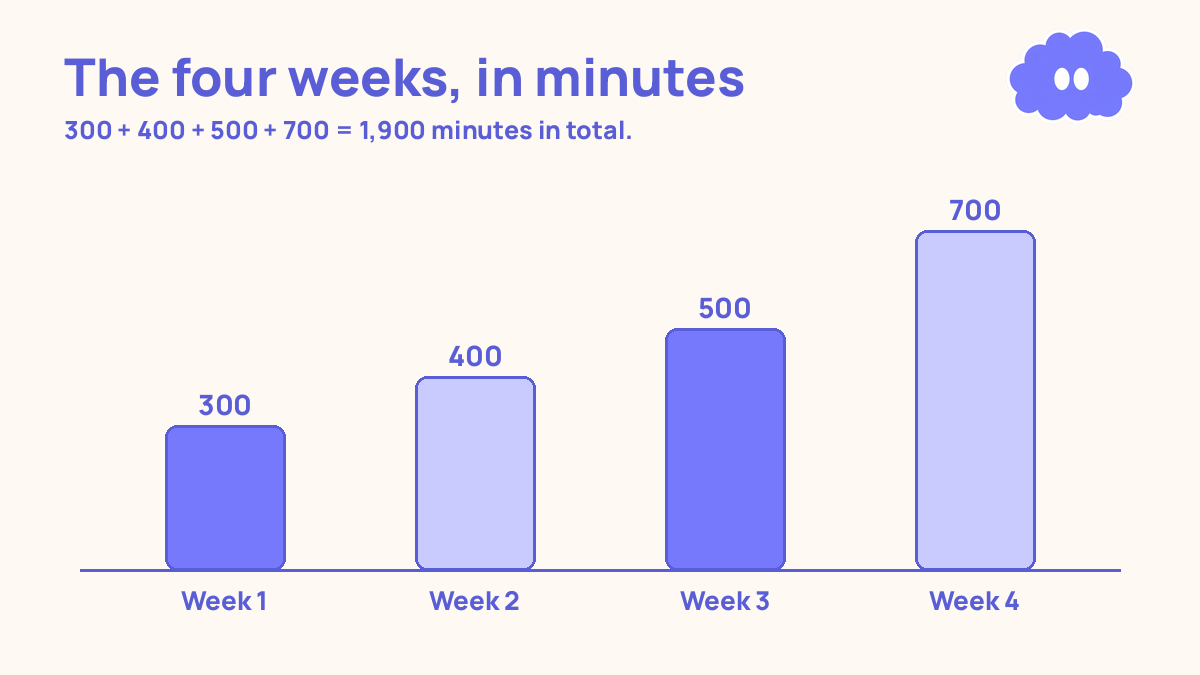
Work out the hours you actually have. Four weeks, evenings only: week one, three evenings of 100 minutes — 300 minutes. Week two, four evenings — 400 minutes. Week three, five evenings — 500 minutes. Week four, the exam week, with two leave days — 700 minutes. That is 1,900 minutes in total, just over 31 hours. Write that number down. It is the budget, and every topic has to fit inside it.
If the list does not fit the budget, cut from the bottom now. A topic worth a few marks that you have never studied is not worth the hours.
Step 2: Book the leave days now
Book two days off: the day before the exam and the exam day itself. Book them at least a month ahead, so the rota is set before anyone else asks. The day before the exam is not for learning new material. It is for testing yourself on everything, from memory, and for resting early. If you cannot take any leave, the plan still works — the evenings carry the whole four weeks, and the triage matters more.
Step 3: Evening sessions — two 50-minute blocks
The evening session is two 50-minute blocks with a ten-minute break between them. That is 100 minutes, and it fits after work: home at 6pm, eat, rest for 20 minutes, study 7:00–7:50pm, break, study 8:00–8:50pm, done by 9pm. The 50-minute block is a practical timer, not a prescription. Sit down for both blocks, at a table, with the phone in another room — the evidence on phones is mixed (one study found a cost, a later replication did not), so treat it as a practical system, not a proven fact (Ward et al., 2017).
Spend the blocks testing yourself, not re-reading. In a 2013 review, Dunlosky and colleagues rated ten common study techniques, and only two received a high utility rating: practice testing and distributed practice. Testing yourself is one of the two best-supported things you can do — and it fits in a 50-minute block. Spacing helps too: spaced practice beat massed practice in a major synthesis, and the right gap grows with how long you need to remember the material (Cepeda et al., 2006).
Step 4: The weekend mock
Two weeks before the exam, sit one full mock on a weekend, under exam conditions. Same length as the real exam, same rules: no notes, no phone, a timer, and a fixed finish time. Then mark it, with feedback, the same day. A meta-analysis found testing beat restudying (g = 0.50), and the advantage was larger with feedback (g = 0.73 with feedback, against 0.39 without) (Rowland, 2014) — so the marking matters as much as the sitting. Mark it, list the topics you got wrong, and those topics go to the top of the final week’s plan.
The mock also tells you the truth about timing. If you ran out of time on the last question, you know now, two weeks early.
Step 5: The final week
The final week is different from the other three. No new topics. No starting anything you have not seen before. The final week is for testing, checking, and resting. On the leave day before the exam, test yourself on everything from memory in the morning, then check your answers and stop early. Go to bed at a normal time: sleep is when the day’s learning is consolidated, and a short night means the work was done but the consolidation was cut short (Diekelmann & Born, 2010).
A worked example: four weeks to a Friday exam
Your exam is on a Friday, four weeks from now. You work full time, Monday to Friday, and you have booked Thursday and Friday off. Your revision budget is 1,900 minutes.
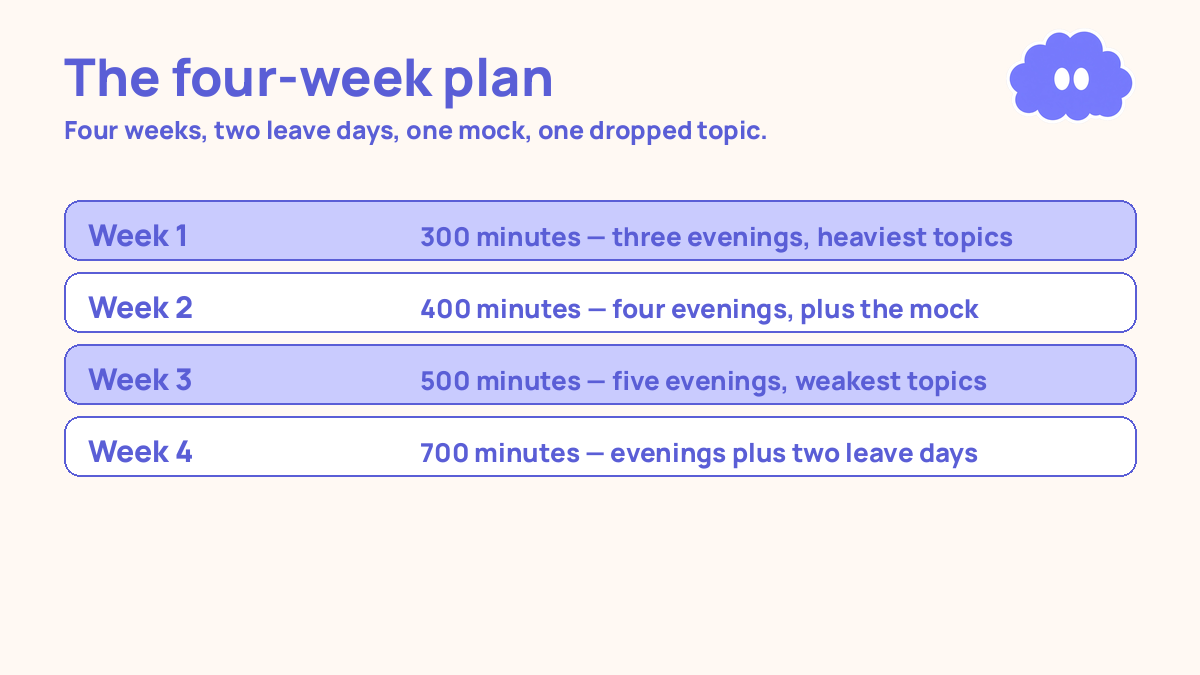
Week 1 — 300 minutes: Three evenings, Monday, Wednesday and Friday, 100 minutes each, covering the two heaviest topics, testing yourself as you go.
Week 2 — 400 minutes: Four evenings, Monday to Thursday, 100 minutes each. You cover the next two topics, and review week one’s topics for 20 minutes at the start of each session. Saturday morning, the mock: a full paper under exam conditions, marked the same afternoon. Three topics come back wrong. They go to the top of week three.
Week 3 — 500 minutes: Five evenings, Monday to Friday, 100 minutes each. The three weak topics from the mock first, then the remaining topics in weight order. The lowest-weight topic — worth a few marks, never studied — is dropped.
Week 4 — 700 minutes, the exam week: Monday to Wednesday evenings, 100 minutes each, testing yourself on everything. Thursday, the leave day: 300 minutes in the morning testing everything from memory, then checking, then stopping by the early evening. Friday, the exam day: 30 minutes in the morning on the cards you keep getting wrong, then the exam.
When it goes wrong
Work gets busy in week three and the evenings disappear. Do not try to do five evenings in week four to catch up — week four is for testing, not for learning. Cut from the bottom of the topic list instead: drop the next lowest-weight topic, and protect the evenings you have left.
The mock goes badly and you panic. A bad mock two weeks before the exam is good news, not bad — it found the gaps while there is still time to fix them. Do not re-read the whole syllabus. Take the three worst topics from the mock and put them at the top of week three.
You cannot get the leave days. The rota is full, or the boss says no. Then the evenings carry the whole plan, and the triage matters more. Cut the list harder — drop two topics instead of one — and use the weekend before the exam for a long testing session instead of a leave day.
You start new topics in the final week. The panic move. A new topic in the final week takes hours you do not have, and it pushes out the review of topics you nearly know. The rule is simple: no new topics after week three. If a topic is not started by the end of week three, it goes on the dropped list.
Weekly review checklist
Copy this list and use it each Sunday of the four weeks:
- How many evening sessions did I complete this week — and how many minutes?
- Which topics did I test myself on, and which ones did I only re-read?
- Did the mock happen, and what were the three worst topics?
- Is the topic list still fitting the hours left, or does something need dropping?
- Are the leave days still booked, and is the exam day clear?
Downloadable infographic spec: one vertical image, title “Revise while working full time”, with the four weeks — 300, 400, 500 and 700 minutes — and the three rules: two leave days booked a month ahead, two 50-minute blocks each evening, no new topics in the final week, in Thynq cream, Cloud Purple, Dark Purple and pink, with the cloud mascot. Text taken word-for-word from this article.
What this system is not
It is not a way to revise a full course in four evenings a week. Thirty-one hours is the honest total for a working student, and this system does not pretend it is more. It is also not a promise of a result — no plan can promise that, and this one does not. It is a way to use the hours you actually have, on the topics that carry the most marks, with a mock that tells you the truth two weeks early.
Sources
- Dunlosky, J., et al. (2013). Improving students’ learning with effective learning techniques. Psychological Science in the Public Interest, 14(1), 4-58. Only practice testing and distributed practice received a high utility rating.
- Cepeda, N. J., et al. (2006). Distributed practice in verbal recall tasks: a review and quantitative synthesis. Psychological Bulletin, 132(3), 354-380. Spaced practice beat massed practice; the optimal gap grows with how long you need to remember the material.
- Rowland, C. A. (2014). The effect of testing versus restudy on retention: a meta-analytic review of the testing effect. Psychological Bulletin, 140(6), 1432–1463. Testing beat restudying (g = 0.50); with feedback the effect was larger (g = 0.73) than without it (g = 0.39).
- Diekelmann, S. & Born, J. (2010). The memory function of sleep. Nature Reviews Neuroscience, 11(2), 114–126. Sleep improves the consolidation of what was learned; a short night after a long study day means the work was done but the consolidation was cut short.
- Ward, A. F., et al. (2017). Brain drain: the mere presence of one’s own smartphone reduces available cognitive capacity. Journal of the Association for Consumer Research, 2(2). One study found a phone on the desk cost focus even when off — but a later replication did not find the effect, so the evidence is mixed.
For the full system this fits inside, start with the two-hour study system for working students, and if your exam is a week away and you have not started, read the exam week plan for students instead — it is built for seven days, not four weeks.
Questions
How many weeks before the exam should I start revising?
Four weeks. That is enough time to cover the topics once and review them again, without needing hours you do not have. Less than four weeks means triage only — the biggest topics first, and the rest dropped.
How much leave should I take for exams?
Two days: the day before the exam and the exam day itself. If you can take more, take the two days before the exam as well. Book them at least a month ahead, so the rota is set before anyone else asks.
What if I cannot take any leave?
Then the evenings carry the whole plan. Five evenings a week, two 50-minute blocks each, and a weekend mock. It is harder, but it works — the plan in this article still fits, just without the leave days in the final week.
What should I drop when there is too much to revise?
Drop the topics with the lowest weight in the exam and the ones you know least about. A topic worth a few marks that you have never studied is not worth the hours — spend those hours on the topics that carry the exam.