
The direct answer
How to remember formulas for exams: test yourself from a prompt, mix them up, and use them in problems. Make one list of every formula the exam needs, learn what each symbol means, then drill ten minutes a day: cover the answer, write the formula from memory, and check it.
You know the feeling. You open the exam paper, read the question, and you know there is a formula for this — you have seen it a dozen times — but you cannot remember whether it is divided by two or multiplied by two, whether the square goes on the top or the bottom.
The problem is usually not that you never learned it. The problem is how you learned it: by reading it. Reading a formula feels like knowing it, because recognition is easy. Writing it from memory, with nothing to look at, is hard — and that hardness is the learning. In a 2013 review, Dunlosky and colleagues rated practice testing and distributed practice as the only two high-utility techniques; re-reading was rated low.
This system is the formula list, the drill, and the mix-up. It sits inside how to revise for exams without cramming, and it pairs with the memorisation system for heavy syllabuses and the flashcard system that works.
The system in short
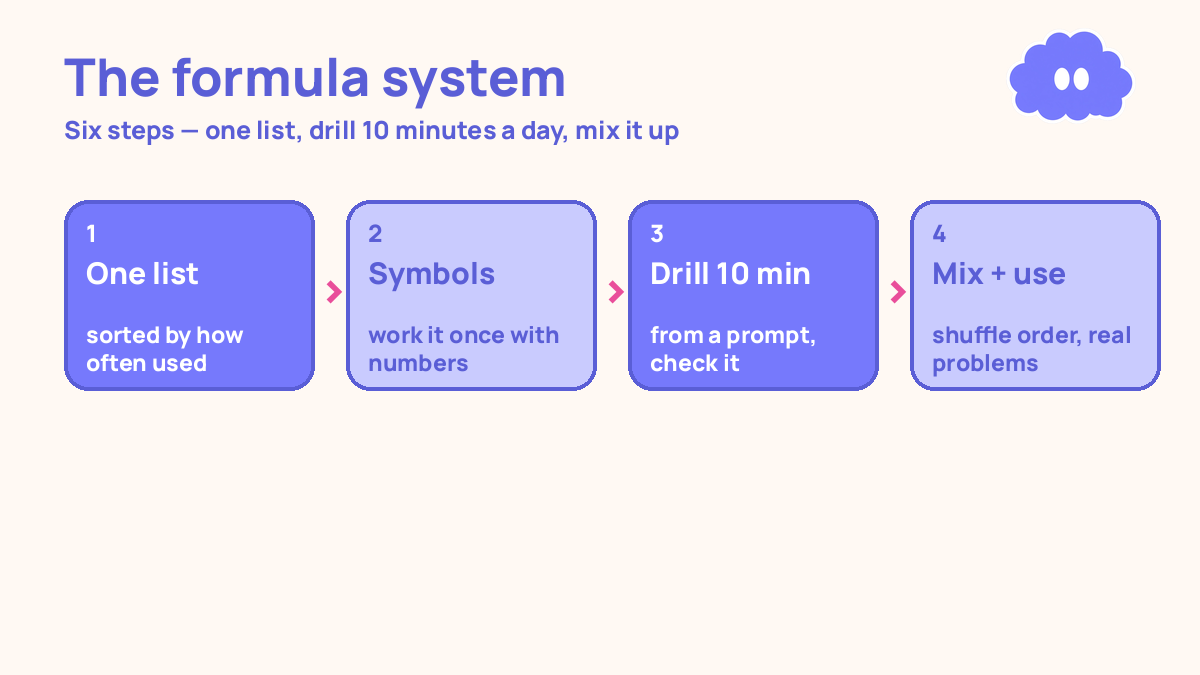
- Make one list of every formula the exam needs, sorted by how often it is used.
- Learn what each symbol means, and work through the formula once with numbers.
- Drill ten minutes a day: cover the answer, write the formula from memory, check it.
- Mix the order every time, and practise similar formulas side by side.
- Use every formula in a real problem at least once a week.
- Re-test the whole list once a week, and move the ones you always get right to a monthly check.
Step 1: Make one list, sorted by use
Go through the syllabus and write down every formula the exam needs — not the ones you like, not the ones you remember, every one. One list, on one page, or on cards. Each entry has three parts: name, formula, and what it is for.
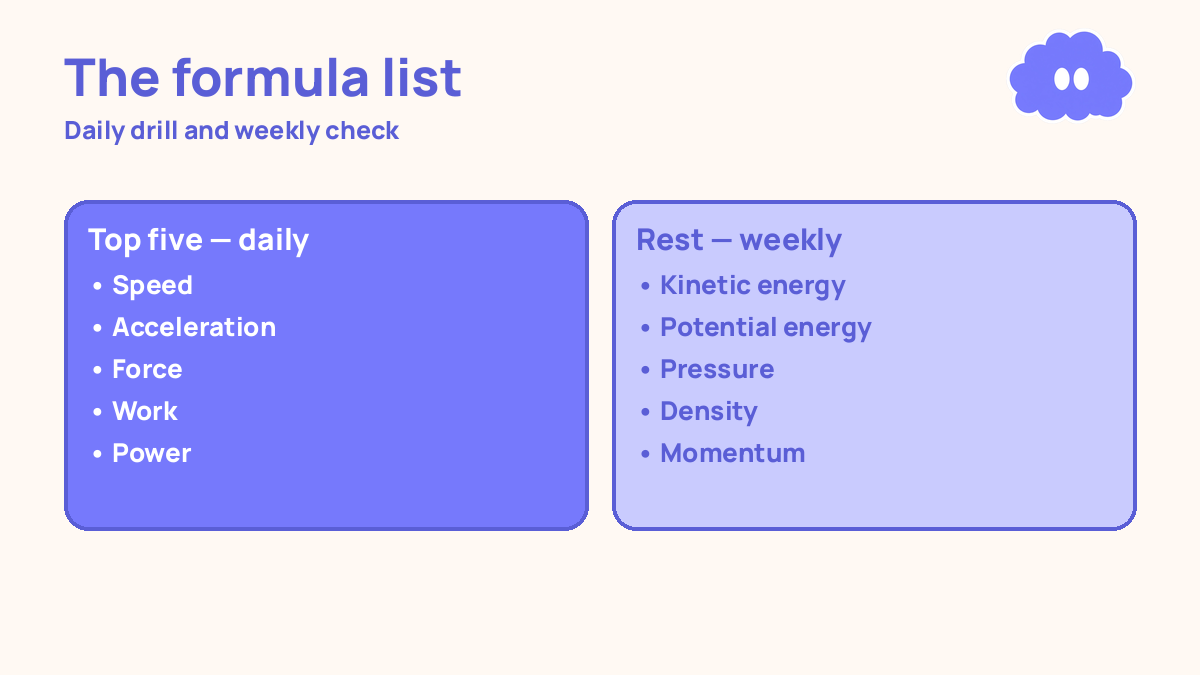
Then sort the list by how often each formula is used. The five you use every week go at the top. The ones that appear once a year go at the bottom. The top five get drilled every day. The bottom ones get drilled once a week.
If the exam gives you a formula sheet, check it before you make the list. There is no point memorising a formula the exam hands you. Cross it off the list and spend the time on the ones you have to know. If the exam does not give you a sheet, every formula on the syllabus is on the list.
Step 2: Learn what each symbol means, and work it once
Before you drill a formula, learn what it means. For each symbol, write down what it stands for and what unit it is measured in. In F = ma, F is force in newtons, m is mass in kilograms, a is acceleration in metres per second squared. A formula you understand is easier to remember than one you have only seen.
Then work through the formula once with real numbers: a mass of 2 kg, an acceleration of 3 m/s², so the force is 6 N. Work it out on paper and say out loud why each step works. Self-explanation is a moderate-utility technique (Dunlosky, 2013), and a 2018 meta-analysis found a moderate average benefit for prompting it (Bisra et al., 2018).
This step is done once per formula, when you first meet it. A formula you have never worked through is a formula you will write wrong under pressure, even if you have drilled it
Step 3: Drill ten minutes a day, from a prompt
The drill is ten minutes a day, and it has a fixed shape. Take the top five formulas. For each one, look at the prompt — the name and what it is for — cover the formula, and write it from memory on paper. Then uncover it and check. If you got it wrong, write the correct version three times, then move on.
The prompt matters. “Write the formula for speed” is a recall test: you have to produce the formula from nothing. “Which of these is the formula for speed?” is a recognition test. Recall is the harder test, and it is the one that matches the exam. Across 61 studies, testing yourself beat restudying (g = 0.50), and recall formats beat recognition formats as practice (Rowland, 2014).
Ten minutes a day beats one 45-minute session a week, because the gap between sessions is where the forgetting happens.
Step 4: Mix the order, and practise similar formulas side by side
Mix the order every time you drill. Do not drill the formulas in the same order every day, because you will learn the order instead of the formulas. Shuffle the cards, or pick five at random from the list.
Practise similar formulas side by side, on purpose. Speed and velocity, area and circumference — these are the pairs that get mixed up in exams, and the only way to learn to tell them apart is to practise telling them apart. Write both formulas, say what is different about each one, and test yourself on both in the same drill.
This is interleaving, and it feels worse than blocked practice. In a 2007 study, college students who practised four kinds of maths problems interleaved scored 63% on a test a week later, against 20% for students who practised them blocked by type — even though the blocked group did far better during practice itself, 89% against 60% (Rohrer & Taylor, 2007). Mixing feels worse during practice and works better on the test.
Step 5: Use every formula in a real problem, once a week
A formula you can write from memory is not the same as a formula you can use. Once a week, use each formula in a real problem — a past-paper question, a textbook exercise, a problem you make up. Work it out on paper and check the answer.
This step catches the formulas you can recite but cannot apply. The most common version is the unit mistake: you remember the formula, but you put the time in minutes instead of seconds, or the distance in centimetres instead of metres, and the answer is wrong by a factor of sixty.
Step 6: Re-test the whole list once a week
Weekly, re-test the whole list from prompts. The ones you got right three weeks in a row move to a monthly check. The ones you got wrong stay on the daily drill.
If the same formula is wrong three weeks in a row, the problem is not memory — it is understanding. Go back to step 2: work through it with numbers and check that you know what every symbol means.
A worked example: how to remember formulas for exams — physics, one week of drills
You have a physics exam in four weeks. The syllabus needs 20 formulas; the five you use every week are speed, acceleration, force, work, and power.
Monday, 10 minutes: Drill the top five from prompts, in a shuffled order. You get speed, force, and work right. Acceleration is wrong — you write a = v ÷ t² instead of a = (v − u) ÷ t. Power is wrong — you forget it is work ÷ time. You write both correct versions three times each.
Wednesday, 10 minutes: Drill the five again, plus kinetic energy and potential energy from the bottom of the list, side by side. You get six right. Potential energy is wrong — you write mgh² instead of mgh.
Friday, 10 minutes: Drill the seven again. You get all seven right. You add three more — pressure, density, and momentum — and drill those from prompts.
Saturday, 30 minutes: Use the formulas in problems. Five past-paper questions, one per formula. You get four right. The momentum question is wrong — you used grams instead of kilograms. You write the unit rule on the list: always convert to kilograms first.
Sunday, 20 minutes: Re-test the whole list of 20 from prompts. You get 16 right. The four you got wrong — acceleration, power, kinetic energy, potential energy — stay on the daily drill. The 16 you got right move to the weekly check.
| Day | Time | What you do | Result |
|---|---|---|---|
| Monday | 10 min | Drill top 5, shuffled | 3 right, 2 wrong |
| Wednesday | 10 min | Drill 5 + 2 similar ones | 6 right, 1 wrong |
| Friday | 10 min | Drill 7 + 3 new ones | 7 right |
| Saturday | 30 min | Use formulas in 5 problems | 4 right, 1 unit mistake |
| Sunday | 20 min | Re-test all 20 | 16 right, 4 stay on daily drill |
When it goes wrong
You read the formula sheet every day and call it revision. Reading the sheet is re-reading, and it feels like learning without being learning. Test yourself from the prompts instead, with the answers covered. If you can write the formula without looking, you know it. If you can only recognise it when you see it, you do not.
You drill the formulas in the same order every day. You have learned the order, not the formulas. Shuffle the cards every time. If you always drill speed, then acceleration, then force, the exam will ask them in a different order and you will blank.
You can write the formula but cannot use it in a problem. This is the most common failure, and it means the formula is memorised but not understood. Go back to step 2: work it through with numbers, explain each step out loud, and check the units.
The same formula is wrong three weeks in a row. The problem is not memory. It is understanding. Work through it with numbers, say out loud what each symbol means, and check whether you are confusing it with a similar formula. If you are, drill the two side by side until you can say what is different about each one.
Weekly review checklist
Copy this list and use it each week:
- How many formulas are on the list, and how many did I test from prompts?
- Which formulas did I get wrong twice, and did I work them through with numbers?
- Did I use every formula in a real problem this week?
- What one change will I make next week: more similar pairs, a longer drill, or a new top five?
Downloadable infographic spec: one vertical image, title “How to remember formulas”, with the six steps — one list sorted by use, learn what each symbol means, drill 10 minutes a day, mix the order, use them in problems, re-test weekly — and the rule “test from a prompt, never read the sheet” in Thynq cream, Cloud Purple, Dark Purple and pink, with the cloud mascot. Text taken word-for-word from this article.
What this system is not
It is not a promise of a grade, and it is not a claim that drilling alone is enough. A formula you can write from memory but cannot use in a problem is a formula you do not know yet.
Sources
- Dunlosky, J., et al. (2013). Psychological Science in the Public Interest, 14(1), 4-58. Practice testing and distributed practice rated high utility; rereading rated low.
- Rowland, C. A. (2014). Psychological Bulletin, 140(6), 1432-1463. Testing beat restudy (g = 0.50); recall formats beat recognition.
- Cepeda, N. J., et al. (2006). Psychological Bulletin, 132(3), 354-380. Spaced practice beat massed practice; the optimal gap grows with the retention interval.
- Chi, M. T. H., et al. (1989). Cognitive Science, 13(2), 145-182. Eight physics students; best solvers gave 15.3 explanations per example versus 2.8.
- Bisra, K., et al. (2018). Educational Psychology Review, 30(3), 703-725. Prompting self-explanation gave a moderate average benefit (g = 0.55) across 64 reports.
- Rohrer, D. & Taylor, K. (2007). Instructional Science, 35(6), 481-498. Interleaved maths 63% versus blocked 20% a week later.
Questions
How many formulas should I memorise?
As many as the exam needs, and no more. List every formula the syllabus requires, then sort them by how often they are used. The five you use every week go on the daily drill.
What if I keep mixing up two similar formulas?
Practise them side by side, on purpose. Write both formulas, say what is different about each one, and test yourself on both in the same drill.
Should I write formulas on a sheet and read it every day?
Write the sheet, but do not read it every day. Reading the sheet is re-reading. Test yourself from the sheet’s prompts instead, with the answers covered.
What if I forget a formula in the exam?
Work out what you can from what you do remember. Write down the quantities you know, the units, and the relationship between them — the formula often comes back once you start. If it does not, move on.