
The direct answer
To cite a journal article in Harvard style, write (Author, Year) in your text and add one full entry to your reference list: Author, A. (Year) ‘Title of article’, Title of Journal, Volume(Issue), pp. xx-xx. The article title goes in single quotes, the journal title in italics. Every detail you need sits on the article’s first page.
A journal article is the source students cite most and get wrong most often: the article title is confused with the journal title, the volume and issue are swapped, the page range is left out, or the DOI is missing.
The system in short
- Check which Harvard your university wants before you write anything.
- Collect the seven details the reference needs, from the article’s first page.
- Write the in-text citation as you draft, beside every fact the article gave you.
- Build the reference list entry from one template, with the journal title in italics.
- Handle the awkward cases: no DOI, no page numbers, and many authors.
- Run the five-minute check, then let the tool build the list.
Step 1: Check which Harvard your university wants
Harvard is a family of styles, not one rulebook. Most UK and Australian universities follow Cite Them Right, but your university’s own guide always wins. Open it and find its journal article page. Note three things: whether the article title goes in single quotes, whether it wants the DOI, and how many authors it names before et al.
The article title varies most. Cite Them Right puts it in single quotes: ‘Title of article’. Some guides use no quotes at all, and a few use double quotes. All three are Harvard somewhere, but mixing them in one list is wrong. Pick your guide’s form and use it for every article. The journal title is always in italics.
The DOI is the second thing to check. Cite Them Right adds it at the end, as: Available at: DOI. Some guides leave it out for print articles, and some want it for every article. If your guide wants it, give it for every article that has one. If your handbook names APA or MLA instead of Harvard, stop: the rules here do not apply.
Step 2: Collect the seven details the reference needs, from the article’s first page
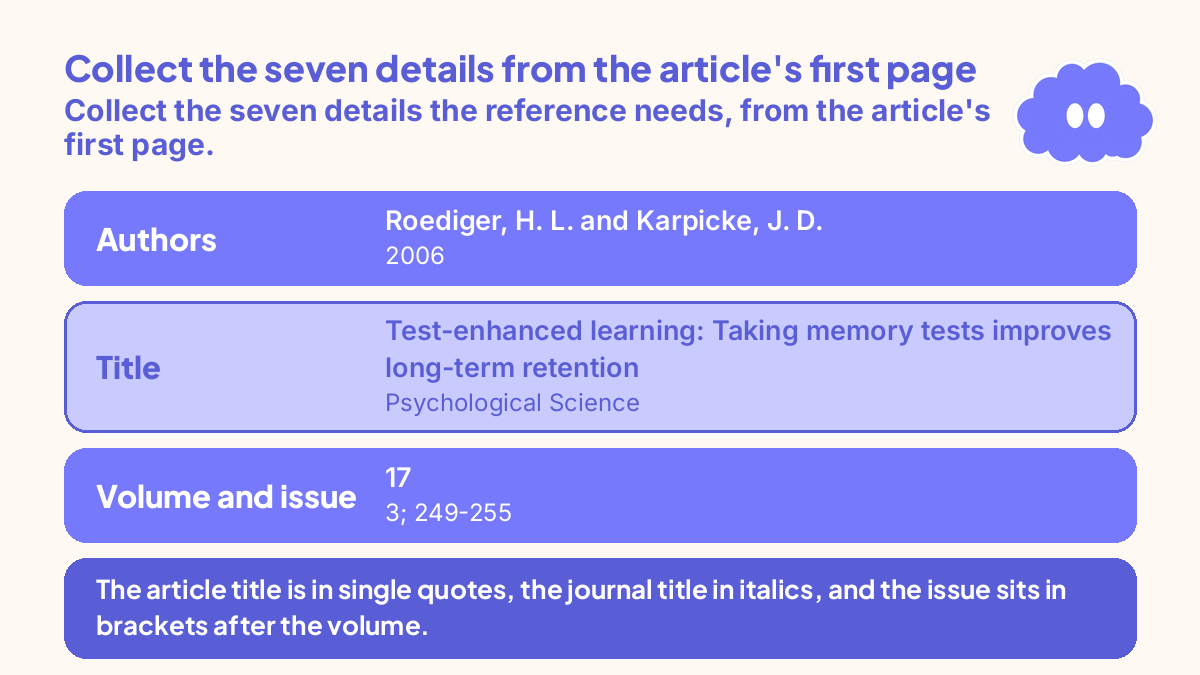
A journal article reference needs seven details, and a missing one is the most common reason a reference loses marks. First, the author, from the first page, in the order the article prints them. Second, the year: use the year the article was published, not the year you read it. Third, the article title, exactly as printed, including any subtitle. Fourth, the journal title, exactly as printed, keeping the journal’s own capitals. Fifth, the volume number. Sixth, the issue number, in brackets after the volume. Seventh, the page range, such as pp. 249-255.
Write the seven details on one line, in the order the template uses them, and keep that line next to your notes. The line is the reference, half built, and it stops the most common error in student essays: writing first and hunting for the details after, when the article is closed and the tab is lost. If you read a PDF, the same details sit on the first page: use the volume and issue printed there, not the ones in the search result.
Step 3: Write the in-text citation as you draft, beside every fact the article gave you
The in-text citation is the same for every article: the author’s surname and the year, in brackets, beside the fact the article gave you. “Roediger and Karpicke (2006) found that students who took a test remembered more a week later than students who restudied.” Write it as you draft, beside every fact, not at the end: a citation added later is usually wrong about the page.
Add a page number when you quote directly, or when the fact sits on one page of a long article: (Roediger and Karpicke, 2006, p. 251). A page number is not required for a general finding, but it is required for a quotation. Copy the words exactly, use quotation marks, and give the page.
With three authors, name all three in the text the first time, then use et al. after that. With four or more, use the first author’s surname and et al. from the start: (Roediger et al., 2006). The reference list follows the same rule. The tool follows it automatically.
Step 4: Build the reference list entry from one template, with the journal title in italics
The reference list entry follows one template: Author, A. (Year) ‘Title of article’, Title of Journal, Volume(Issue), pp. xx-xx. The article title goes in single quotes, the journal title in italics, and the issue sits in brackets after the volume. The entry sits in alphabetical order by the author’s surname.
For the worked example, an article by Henry Roediger and Jeffrey Karpicke, published in 2006, the entry reads: Roediger, H. L. and Karpicke, J. D. (2006) ‘Test-enhanced learning: Taking memory tests improves long-term retention’, Psychological Science, 17(3), 249-255. Note the initials, the year in brackets, the article title in single quotes, the journal title in italics, the volume 17 with the issue 3 in brackets, and the page range at the end. If your guide wants the DOI, the entry ends with: Available at: DOI.
For an article with a DOI and no print pages, the template ends differently: Author, A. (Year) ‘Title of article’, Title of Journal, Volume(Issue), Article 106346. doi: 10.1016/j.econmod.2023.106346. Note the article number in place of the page range. The book citation guide follows a different template, because a book has a publisher, not a journal.
Step 5: Handle the awkward cases
Four cases cause most of the lost marks. First, no DOI: give the URL where the article can be read, with the date you accessed it, as: Available at: URL (Accessed: Day Month Year). A DOI never changes, so it is the most reliable link; a URL can break, which is why the access date matters. Never give the URL of the database you found the article in.
Second, no page numbers: use the article number instead, if the journal gives one, as in Step 4. Some online-only journals number articles instead of paging them. If there is neither a page range nor an article number, give the volume and issue only.
Third, an article published online before it has a volume and issue: write “In press” where the volume would go, and give the DOI. Update the entry when the volume and issue appear. Fourth, more than three authors: name up to three in the reference list, then et al., and use the first author and et al. in the text. The chapter citation guide covers a chapter in an edited book, which cites the book’s editor too.
Step 6: Run the five-minute check, then let the tool build the list
Before you submit, spend five minutes checking every article reference. First, does each entry have all seven details? Second, is the article title in single quotes and the journal title in italics? Third, are the volume and issue the right way round, with the issue in brackets? Fourth, does every in-text citation have a matching entry, and does every entry have at least one in-text citation? Fifth, is the list in alphabetical order, with et al. used the same way in the text and in the list?
Then let the citation generator build the list. Choose Harvard, choose Journal article, and type the seven details into the fields that appear. The tool shows only the fields Harvard needs for an article, builds the entry in the template above, and keeps the list in your browser, with copy, print, and export. Check the output against your guide once, especially the quotes and the DOI, and then trust it: the tool’s job is the punctuation, and yours is the details.
A worked example: citing a journal article in an essay on memory
Your situation: Second-year student, essay on why testing yourself beats rereading. You used one journal article throughout: Roediger and Karpicke (2006), ‘Test-enhanced learning’, in Psychological Science, volume 17, issue 3, pages 249-255. The essay is due on Friday.
- Monday, 20 minutes: You open your university’s referencing guide and find its journal article page: Cite Them Right, article title in single quotes, DOI at the end. You write the template on a sticky note.
- Monday, 10 minutes: You open the article’s first page and copy the seven details: Roediger, H. L. and Karpicke, J. D.; 2006; Test-enhanced learning: Taking memory tests improves long-term retention; Psychological Science; 17; 3; 249-255. You write them on one line, next to your notes.
- Tuesday, while drafting: Every fact from the article gets its citation as you write it. “Roediger and Karpicke (2006) found that students who took a test remembered more a week later than students who restudied.” One direct quotation gets a page number: (Roediger and Karpicke, 2006, p. 251).
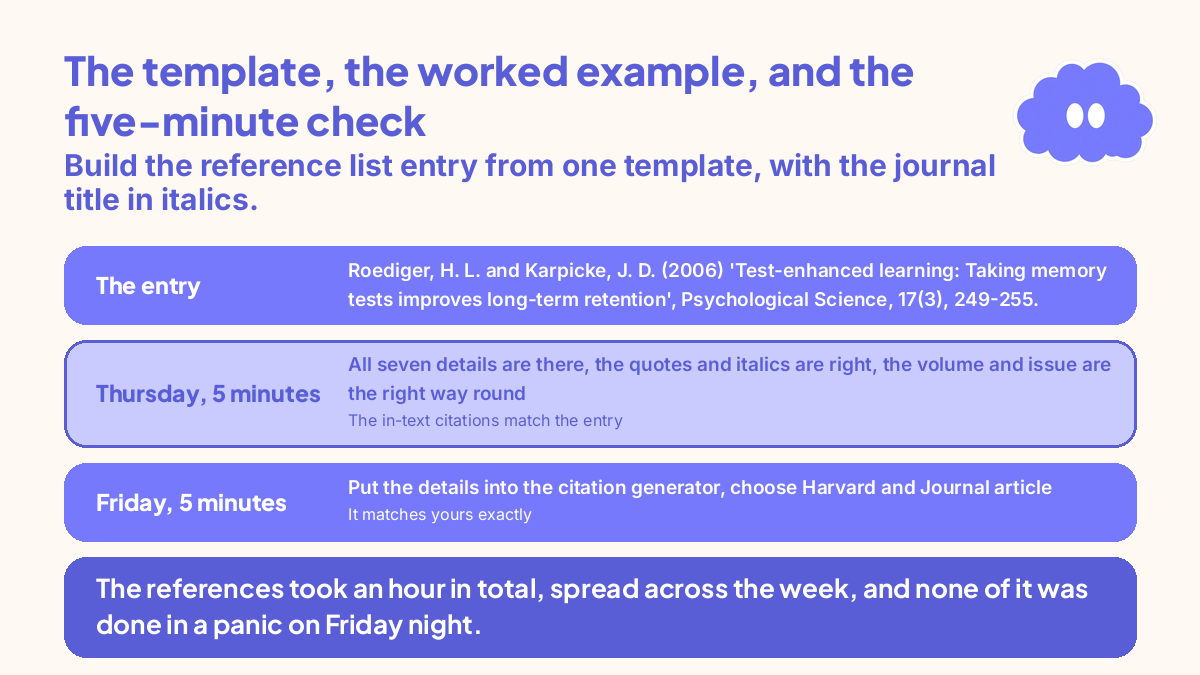
- Wednesday, 15 minutes: You build the reference list entry from the template: Roediger, H. L. and Karpicke, J. D. (2006) ‘Test-enhanced learning: Taking memory tests improves long-term retention’, Psychological Science, 17(3), 249-255. The article title is in single quotes, the journal title in italics, and the issue sits in brackets after the volume.
- Thursday, 5 minutes: You run the check: all seven details are there, the quotes and italics are right, the volume and issue are the right way round, and the in-text citations match the entry. You also check the book reference against the book template, so the two entries do not get mixed up.
- Friday, 5 minutes: You put the details into the citation generator, choose Harvard and Journal article, and let it build the entry. It matches yours exactly. You copy it into the reference list and submit.
The references took an hour in total, spread across the week, and none of it was done in a panic on Friday night.
When it goes wrong
You confuse the article title with the journal title. The article title is the title of the piece you read, in single quotes. The journal title is the name of the journal, in italics. If your entry has two italic titles, or two quoted titles, one of them is wrong.
You swap the volume and the issue. The volume is the big number, the issue is the small one in brackets: 17(3), not 3(17). Check the first page of the article, not the search result.
You leave out the page range. A reference without pages cannot be found in a print journal, and a marker who cannot find it will not trust it. The page range sits on the first page of the article, and it is the seventh detail for a reason.
You give the database URL instead of the article URL. Give the DOI if there is one, or the URL of the article itself. The URL of the database you found it in does not help a reader without access to that database.
Your reference list has an entry with no in-text citation. Every entry must be cited in the text, and every in-text citation must have an entry. An article you read but never cited does not belong in the reference list.
Weekly review checklist
- Have I checked which Harvard my university wants, including the quotes and the DOI?
- Have I collected all seven details for each article, from the first page?
- Did I write the in-text citation as I drafted, beside every fact the article gave me?
- Is the article title in single quotes and the journal title in italics?
- Are the volume and issue the right way round, with the page range at the end?
- Did I run the five-minute check, and does the tool’s output match my guide?
Downloadable infographic spec: one vertical image, title “How to cite a journal article in Harvard style”, with the six steps from “The system in short” and the six review questions above, in Thynq cream, Cloud Purple, Dark Purple and pink, with the Cloud mascot. Text taken word-for-word from this article.
What this system is not
It is not a substitute for your university’s referencing guide, which always wins where it differs from this article. It is not a way to cite an article you have not read: the seven details come from the first page of the article in your hand, not from a search result. It does not cover APA or MLA, which use different templates; the tool builds those, but this article is Harvard only. And it does not make referencing interesting; it makes it routine.
Sources
- Thynq citation generator. The tool page on thynq.org, read 20 November 2026. Supports the tool description in this article: four source types, three styles, the journal article fields, and the Harvard article template, including the DOI and article number handling.
- University of Newcastle, Cite Them Right Harvard style sheet. Read November 2026. Supports the Cite Them Right Harvard journal article form and the worked example: Borden, S. L. and Tew, C. (2007) ‘The role of journalist and the performance of journalism’, Journal of Mass Media Ethics, 22(4), pp. 300-314.
- University College London, Harvard referencing guide. Read November 2026. Supports the journal article example form and the DOI ending: Skelton, A. (2011) ‘Value conflicts in higher education teaching’, Teaching in Higher Education, 17(3), pp. 257-268. doi: 10.1080/13562517.2011.611875.
For the full system behind this method, start with How to build a study system that fits your life.
Questions
How do I cite a journal article in Harvard style?
Write (Author, Year) in your text, then add one full entry to your reference list: Author, A. (Year) ‘Title of article’, Title of Journal, Volume(Issue), pp. xx-xx. The article title goes in single quotes and the journal title in italics. Collect the author, year, article title, journal title, volume, issue, and page range before you write.
Do I need a DOI for a journal article in Harvard style?
Yes, if the article has one. Cite Them Right adds the DOI at the end of the entry, as: Available at: DOI. If there is no DOI, give the URL where the article can be read, with the date you accessed it. A DOI never changes, so it is the most reliable link to the article.
What do I do if a journal article has no page numbers?
Use the article number instead, if the journal gives one. Write it as: Article 106346, after the volume and issue, with the DOI. Some online-only journals number articles instead of paging them, and the article number is how a reader finds the right one.
How do I cite a journal article with more than three authors in Harvard style?
In the reference list, name up to three authors, then write et al. from the fourth author onwards. In the text, use the first author’s surname and et al., for example (Roediger et al., 2006), for four or more authors. With three authors, name all three in the text the first time, then use et al. after that.