The direct answer
A 10-minute presentation is about 1,300 words at an average speaking pace of 130 words a minute. A slow speaker needs about 1,100 words, and a fast one about 1,600, so the honest answer is a range, not a single number.
The number matters because a presentation is timed by the clock, not by the page. A script that is 300 words too long is two minutes over, and two minutes over is the difference between a talk that lands and a talk that gets cut off. The system below shows how to measure your own pace, split the words across the parts of your talk, and rehearse in a way that catches the overrun before the real thing. It uses the same three paces as the presentation words to minutes calculator: 110 words a minute for slow, 130 for average, and 160 for fast.
The system in short
- Measure your own speaking pace by timing yourself reading one minute of your script aloud.
- Work out your word target from your pace: minutes times words per minute, minus time for questions and pauses.
- Split the words across the talk: about 150 for the introduction, 1,000 for the body, and 150 for the conclusion.
- Write to the target, then cut 10 per cent, because nerves make most people faster, not slower.
- Rehearse the whole talk aloud, with slides and pauses, and time it with a clock, not a feeling.
- Review after the talk for 10 minutes: how long it really took, where it ran over, and what to change next time.
Step 1: Measure your own speaking pace
Do not plan from the average. Measure your pace, because your pace is the number that decides your word target. Take one minute of your script, about 130 words, read it aloud at the speed you would present it, and time it. If it takes you 60 seconds, your pace is about 130 words a minute. If it takes 70 seconds, your pace is about 110. If it takes 50 seconds, your pace is about 155.
Most people present at 120 to 150 words a minute with normal pauses, and nerves usually make you faster, not slower. That is why the planning pace should be the slow, careful number, not the average. If you have never measured your pace, use 130 as a starting point, then replace it with your measured number as soon as you have one.
Step 2: Work out your word target from your pace
The maths is simple: words equal minutes times words per minute. At 130 words a minute, 10 minutes is 1,300 words. At 110, it is 1,100. At 160, it is 1,600. But the number you plan from is not the full 10 minutes. It is the talking time, which is the 10 minutes minus everything else: questions, pauses, slide changes, and the demonstration, if you have one.
If questions sit inside the 10 minutes, take their time off first. Two minutes of questions leaves eight minutes of talking, which is about 1,040 words at 130 words a minute. If you have a 30-second demonstration, take that off too. If you pause for effect, which you should, that time also comes out of the talking time. Most students forget this step, and that is why their scripts are too long even when the maths looks right.
The same maths works for any length. Divide your word count by your pace to get the minutes. At 130 words a minute, 650 words takes about 5 minutes, and 1,950 words about 15. If your talk is not 10 minutes, use the same rule with your own number of minutes. For the class presentation this system supports, how to prepare a class presentation covers choosing the structure and the slides, while this article covers the word count that makes the timing work.
Step 3: Split the words across the talk
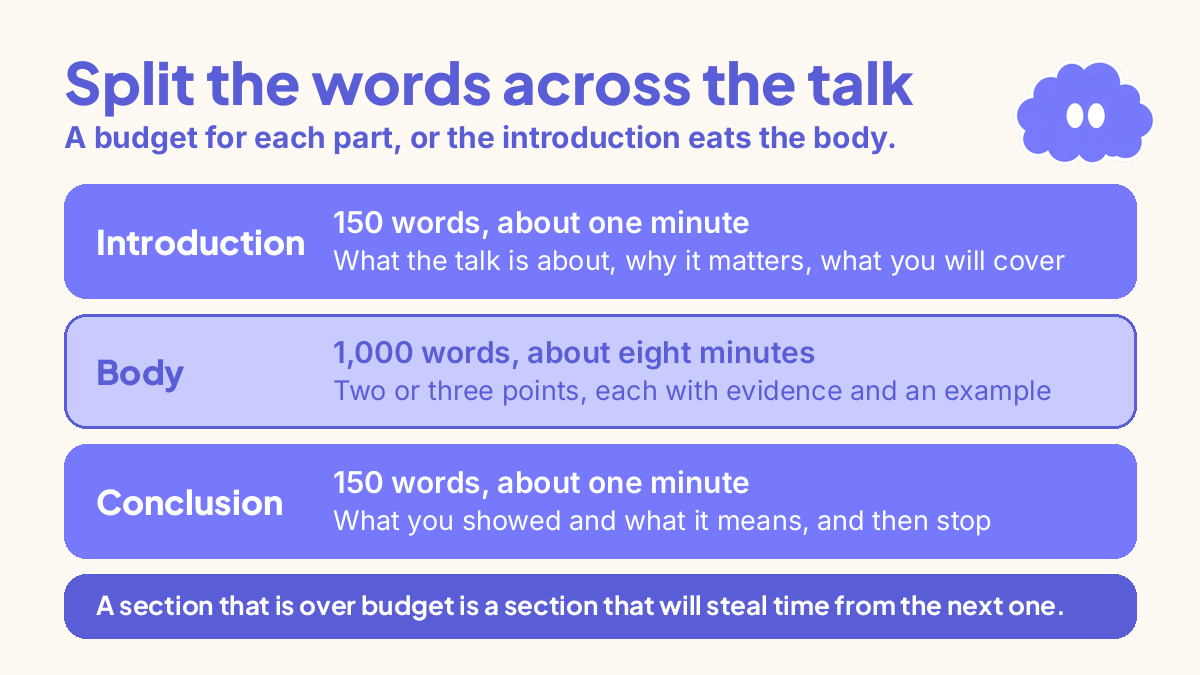
A word target for the whole talk is not enough. You need a budget for each part, or the introduction will eat the body. For a 1,300-word talk, a workable split is: introduction 150 words, body 1,000 words, conclusion 150 words. That gives the body most of the time, keeps the opening short, and leaves room for a clear ending.
The introduction, about one minute, does three things: what the talk is about, why it matters, and what you will cover. The body, about eight minutes, is where the argument lives: two or three points, each with evidence and an example. The conclusion, about one minute, says what you showed and what it means, and then stops.
Adjust the split if your talk has a long example or a demonstration. A talk with a two-minute demonstration has eight minutes of talking, so the split becomes about 120 words for the introduction, 800 for the body, and 120 for the conclusion, with the demonstration time kept separate. Write the budget at the top of your script, and check each part against it as you write. A section that is over budget is a section that will steal time from the next one.
Step 4: Write to the target, then cut 10 per cent
Write the script to the target, then cut 10 per cent of the words. For a 1,300-word target, that means cutting about 130 words, leaving roughly 1,170. The cut is not because the maths is wrong. It is because real talks have pauses, slide changes, and moments when you lose your place, and those moments take time that the script does not show.
Cut the words that do the least work. Long introductions to points you then make anyway. Sentences that say the same thing twice. Qualifiers that soften every claim. Examples that prove a point you have already made. Keep the words that carry the argument: the claim, the evidence, and the link to the next point. Read the script aloud as you cut, because a sentence that reads well on the page can still be too long to say in one breath.
Step 5: Rehearse the whole talk aloud, with slides and pauses
Rehearse the whole talk, aloud, standing up, with the slides, and time it with a clock. Not in your head, and not sitting down reading it silently, because silent reading is faster than speaking, and a silent rehearsal will tell you the talk fits when it does not. Speak it, change the slides when you would change them, pause where you would pause, and write down the time at the end.
If the rehearsal runs over, cut words, not pauses. The pauses are part of the talk: they let the audience catch up, and they make you sound confident. Cut a sentence, shorten an example, or drop a point that matters least. If the rehearsal runs under by more than a minute, add one example or one piece of evidence to the weakest point, but do not add a whole new point in the last rehearsal.
Rehearse at least twice, and if you can, rehearse once in the room, or in a room like it. Standing in front of people, even imaginary ones, changes your pace. The first rehearsal finds the overrun. The second one confirms the fix. A talk that has been rehearsed twice, timed, and cut to fit is a talk you can trust. A talk that has only been read silently is a guess.
Step 6: Review after the talk for 10 minutes
After the talk, spend 10 minutes on three questions. First, how long did it really take, and where did it run over or under? Second, which part felt rushed, and which part had time to spare? Third, what was your real pace, and what should your planning pace be next time?
Write the answers down, in a few lines, with the numbers: the word count, the planned time, the real time, and the pace you measured. That note is the planning number for your next presentation, and it is worth more than any average, because it is yours. If you ran over by two minutes, the fix is a shorter script next time, not a faster delivery.
A worked example: a 10-minute talk on spaced practice
Your situation: Second-year student, 10-minute class presentation on spaced practice, with slides and two minutes for questions at the end. You have never measured your pace.
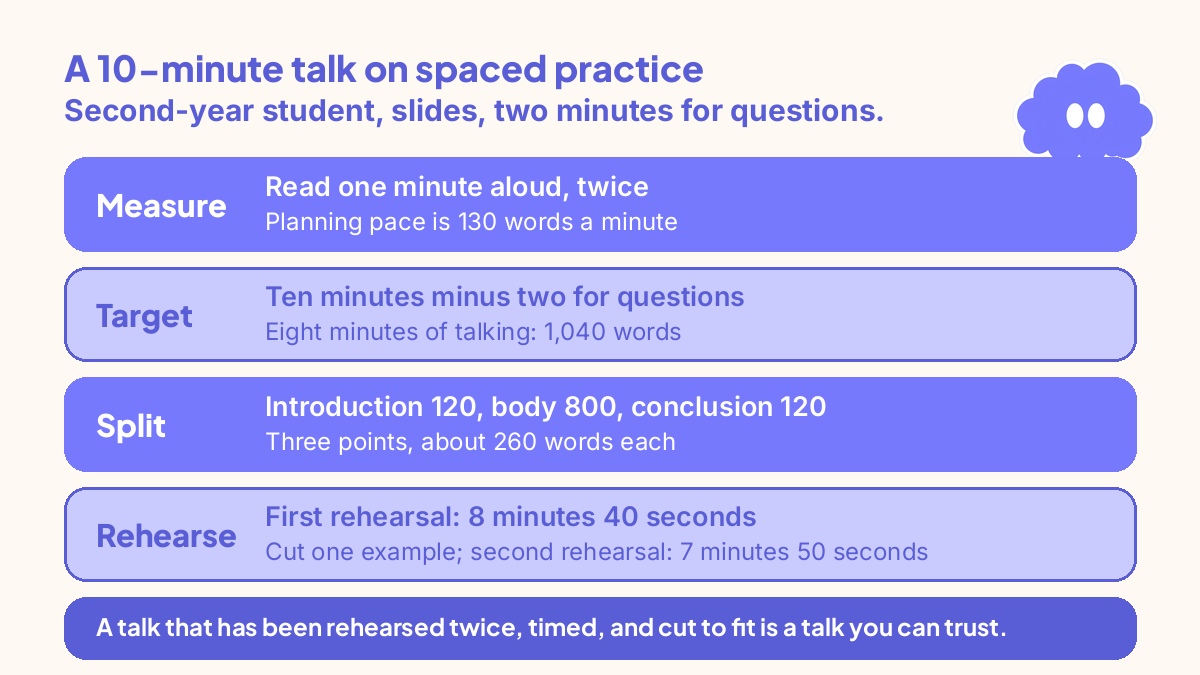
- Step 1, measure: Read one minute of your draft aloud, twice. First reading takes 62 seconds, second takes 66. Your planning pace is 130 words a minute, and you will use the slower reading as the guide.
- Step 2, target: Ten minutes minus two minutes of questions leaves eight minutes of talking. Eight times 130 is 1,040 words. That is the target.
- Step 3, split: Introduction 120 words, body 800 words, conclusion 120 words. The body has three points: what spaced practice is, the evidence for it, and how to use it. Each point gets about 260 words plus one example.
- Step 4, write and cut: First draft is 1,120 words. Cut 10 per cent, about 110 words, mostly from the introduction and a repeated example. Final script is 1,010 words.
- Step 5, rehearse: First rehearsal, aloud with slides, takes 8 minutes 40 seconds of talking. Too long. Cut one example from the second point, 90 words. Second rehearsal takes 7 minutes 50 seconds, inside the eight minutes, with room for a pause.
- Step 6, review: The real talk takes 8 minutes 5 seconds. The introduction felt rushed, the body felt right. Note for next time: give the introduction 150 words, not 120, and keep the body at 800.
When it goes wrong
Your script is 2,000 words and the talk is 10 minutes. It will not fit, and no amount of fast talking will fix it. Cut it to the target in Step 2, using the split in Step 3. If the material genuinely needs more time, drop a point, not a minute. A talk with two points made well beats a talk with four points rushed.
You speak much faster when nervous. That is normal, and it is why the system plans from the slow pace and cuts 10 per cent. If you still rush, put a pause mark in the script after each point, and practise the pauses in rehearsal. A pause feels long to you and short to the audience. Use it.
Your talk has a demonstration that eats the time. Time the demonstration separately, take it off the talking time first, and write the script for what is left. A two-minute demonstration in a 10-minute talk leaves eight minutes of talking, which is 1,040 words. Do not write a 1,300-word script and hope the demonstration fits around it.
The questions run long and you run out of time. Say so at the start: “I will take questions at the end, and I have two minutes for them.” If a question needs a long answer, offer to answer it after the talk. Protecting the conclusion matters, because the conclusion is what the audience remembers.
Weekly review checklist
- Did you measure your own pace, or did you plan from the average?
- Did you take the questions, pauses, and demonstration off the talking time first?
- Does each part of the talk fit its word budget, especially the introduction?
- Did you cut 10 per cent after writing, and what did you cut?
- Did the rehearsal run aloud, with slides, and timed with a clock?
- How long did the real talk take, and what is your planning pace for next time?
Downloadable infographic spec: one vertical image, title “How many words for a 10-minute presentation”, with the six steps from “The system in short” and the six review questions above, in Thynq cream, Cloud Purple, Dark Purple and pink, with the Cloud mascot. Text taken word-for-word from this article.
What this system is not
It is not a rule that every 10-minute talk is 1,300 words. Your pace, your pauses, and your questions change the number, and the system exists to find your number, not to impose an average. It does not cover speeches that are read word for word from a script in a formal setting, where the pace is deliberately slower, or talks where the audience interrupts throughout. It does not replace knowing your material: a script that fits the time but is read without understanding will still fail. What it does is give you a target you can trust, a budget for each part, and a rehearsal that catches the overrun before the audience does.
Sources
- Thynq. Presentation words to minutes calculator. Read November 2026. Slow, average, and fast paces of 110, 130, and 160 words a minute; a 10-minute presentation is about 1,300 words at the average pace, 1,100 slow, 1,600 fast; 8 minutes of talking is about 1,040 words.
- Jusnod. How many words is a 10-minute speech? Read November 2026. A 10-minute speech is about 1,500 words at 150 words a minute, 1,300 at 130, and 1,600 at 160; write toward the slow number when you will pause for slides or questions.
- Dunlosky, J., et al. (2013). Improving students’ learning with effective learning techniques. Psychological Science in the Public Interest, 14(1), 4-58. Practice testing and distributed practice rated high; the spaced practice example in this article draws on the same evidence.
For the presentation this article supports, read How to prepare a class presentation. For the essay behind a presentation script, read How to write a coursework essay.
Questions
How many words is a 10-minute presentation?
About 1,300 words at an average speaking pace of 130 words a minute. A slow, careful speaker needs about 1,100 words, and a fast one about 1,600. If questions sit inside the 10 minutes, take their time off first: 8 minutes of talking is about 1,040 words.
How do I work out the words for a presentation of any length?
Divide your word count by your speaking pace in words a minute. At an average 130 words a minute, 650 words takes about 5 minutes and 1,950 words about 15. Measure your own pace by timing yourself reading one minute of your script aloud, then use that number instead of the average.
How should I split 1,300 words across a 10-minute presentation?
Use about 150 words for the introduction, 1,000 words for the main body, and 150 words for the conclusion. That split gives the body most of the time, keeps the opening short, and leaves room for a clear ending. Adjust the split if your talk has a long example or a demonstration.
Why do I always run over time in presentations?
Usually because the script was written to the average pace and you speak faster when nervous, or because pauses, slide changes, and questions were never counted. Time a full rehearsal aloud, cut 10 per cent of the words, and leave one minute of slack in the plan.