The direct answer
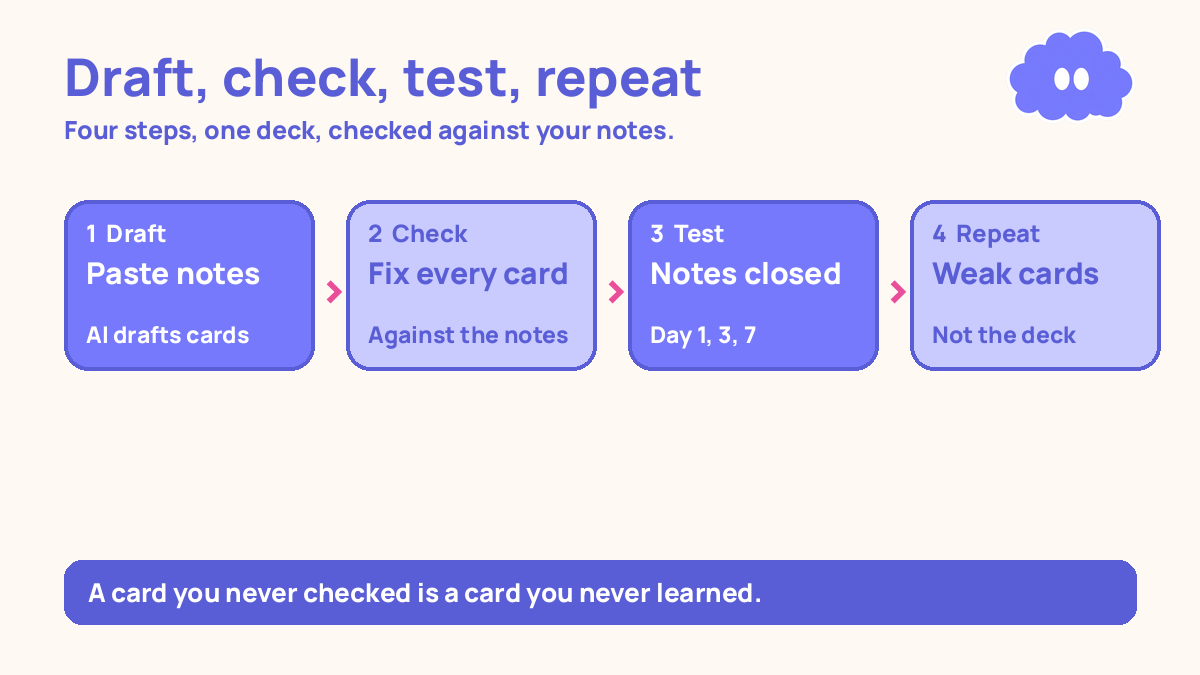
Turn your notes into flashcards with AI: paste one chapter of your notes into an AI chat app, ask it to draft cards from the notes only, then check every card against your notes before you use it. A checked card is a real card; an unchecked card is a guess.
You have pages of notes and no flashcards. Hand-writing a full deck takes an evening you do not have, so the notes stay as notes — and notes are for reading, not remembering. Re-reading is one of the techniques learning researchers rated low utility in a 2013 review by Dunlosky and colleagues; practice testing and distributed practice were the only two rated high.
This system uses AI as a drafting assistant, not a teacher. You supply the knowledge — your notes. AI supplies the labour of turning them into questions. You check them. That is different from the manual flashcard system that works, where you write every card by hand: slower, but you catch errors while you write; AI drafting is faster and you catch them after.
The system in short
- Pick one chapter and tidy your notes for it — one source, not three.
- Ask AI to draft 25 to 30 cards from those notes only, one fact per card.
- Check every card against your notes. Fix the wrong ones, delete the ones the notes do not support.
- Shuffle the deck. Test yourself on day 1, notes closed, and mark every card right, wrong, or not sure.
- Re-test the wrong and not-sure cards on day 3 and day 7. Retire the cards you answer right every time.
- Add one new topic a week and keep the old decks alive with a short weekly review.
Step 1: Pick one chapter and tidy the notes
Work from one chapter at a time, not a whole module. A deck that covers everything covers nothing — it becomes a pile you never finish.
Before you open the AI app, read your notes once and tidy them in plain text: cut the copied paragraphs you never understood and merge the two versions of the same idea. AI cannot tell which of your notes are right; it will draft cards from the mistakes as happily as from the correct parts. Aim for about 1,000 to 1,500 words of notes per chapter — a much longer chapter produces a deck so big you will not check it, so split long chapters in two.
Step 2: Ask AI to draft the cards — from your notes only
Open any AI chat app already on your phone — no paid app or special flashcard app needed. Paste your notes in one message with a prompt like this:
“Make flashcards from these notes only. Do not add facts that are not in the notes. One question per card, one fact per answer. Keep each question under 15 words and each answer under 25 words. Give me 25 to 30 cards. Number them. If part of the notes is unclear, say so instead of guessing.”
The “from these notes only” line is the most important part. Without it, AI fills gaps with facts it remembers from its training — facts that may be from a different syllabus or nowhere at all. With it, the cards stay tied to what you are actually supposed to learn. Fewer than 20 cards and the deck misses the parts that will be tested; more than 35 and the checking takes so long you will skip it.
Step 3: Check every card against your notes — this is the real work
This is the step that makes the system work, and the one most students skip. AI drafts fast and wrong in three predictable ways. First, invented facts: a detail that sounds right and is not in your notes — a date, a name, a number. If the notes do not support the card, the card goes. Second, questions that give away their own answer: “What colour is the red blood cell?” is a reading exercise, not a test. Rewrite it so the answer is not in the question. Third, cards with two facts hiding inside: “What is photosynthesis and where does it happen?” is two cards. Split it.
Go through the deck card by card, notes open: fix the wording where the meaning is right, rewrite it where it is wrong, and delete it where the notes do not support it. Expect to fix or delete about one card in five — that is the system working, not failing. A deck you never check teaches you the wrong answers on a schedule.
Feedback is what makes testing work: across 61 studies, testing beat restudying, and the advantage was larger with feedback than without it (Rowland, 2014). A wrong card is wrong feedback.
Step 4: Shuffle, then test yourself on day 1
Shuffle the deck before you test it — AI drafts cards in the order of your notes, and testing in that order means you are remembering the sequence, not the facts.
Test yourself on day 1, notes closed, in one sitting of about 25 minutes — a 25/5 timer is a practical starting point, not a research rule. Say the answer out loud or write it down before you flip the card. Reading the question, thinking “I know that”, and flipping is not testing; it is re-reading with extra steps.
Sort every card into three piles: right, wrong, and not sure. “Not sure” is its own pile — a card you got right after thinking for a minute is not one you knew at once. Do not merge the not-sure pile into the right pile to make the numbers look better.
Step 5: Re-test the weak cards on day 3 and day 7
Do not re-test the whole deck — only the wrong and not-sure piles, on day 3 and again on day 7. The cards you got right wait for the weekly review.
The 1-3-7 pattern is a practical starting schedule, not a research rule. The research says the gap should grow with how long you need to remember the material (Cepeda et al., 2006) — a day or two for a test next week, longer for a test in a month. Treat 1-3-7 as the starting point for a test a week or two away; stretch the gaps if the exam is further off. The spaced-repetition system for students explains the same idea in full.
When you re-test, a card only moves to the “right” pile when you answer it at once. If you hesitated, it stays in the not-sure pile. Short-answer recall — saying the answer from memory — beats recognition formats like multiple choice as practice, and the advantage grows with the delay (Rowland, 2014).
Step 6: Add one topic a week and keep old decks alive
Once built and checked, a deck needs very little time. Add one new topic a week — draft, check, test on day 1, re-test on day 3 and 7 — and keep old decks alive with a short weekly review.
The weekly review is ten minutes: shuffle each old deck, run through it once, pull out any card you miss. A card you miss in week three was never learned, only recognised — keep it active until it survives two weekly reviews. Retire a card only when you answer it right, at once, three times running — on day 7 and twice in weekly reviews. A retired card is not deleted; keep it aside and run through it once before the exam.
A worked example: biology, one chapter, 28 cards
A worked example, with the article’s own numbers — not a real student, and not a promise of a grade.
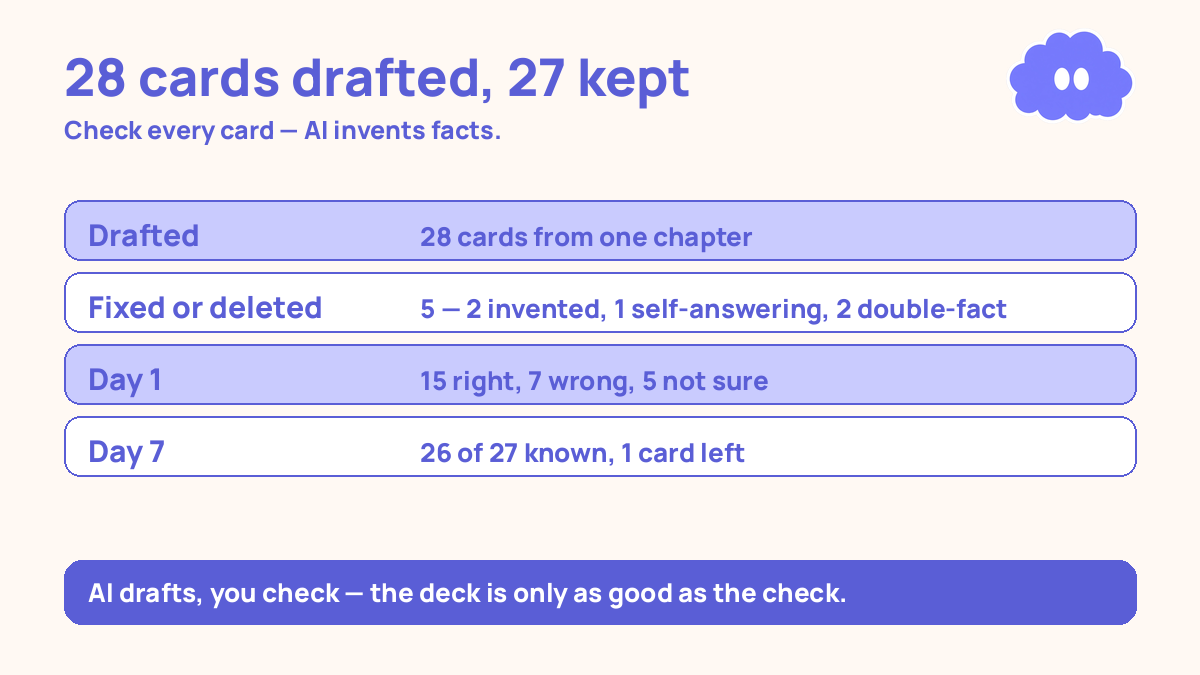
A biology chapter on the heart and circulation, about 1,200 words of notes. You tidy the notes, paste them into an AI chat app, and ask for 25 to 30 cards. AI returns 28.
Checking takes about 20 minutes. Five cards need fixing: two invent a detail not in your notes, one gives away its own answer, and two hide two facts inside one card. You fix four and delete one, so the deck is 27 cards — about one in five, which is normal.
Day 1, you shuffle and test yourself, notes closed, in 25 minutes: 15 right at once, 7 wrong, 5 not sure. Day 3, you re-test the 12 weak cards: 7 right, 3 wrong, 2 not sure. Day 7, you re-test the 5 still weak: 4 right, 1 not sure. That last card — why the left ventricle wall is thicker — goes into the weekly review pile.
| Round | Cards tested | Right at once | Wrong | Not sure |
|---|---|---|---|---|
| Draft from AI | 28 | — | — | — |
| After checking | 27 | — | — | — |
| Day 1 | 27 | 15 | 7 | 5 |
| Day 3 | 12 | 7 | 3 | 2 |
| Day 7 | 5 | 4 | 0 | 1 |
| Deck after day 7 | 27 | 26 known | 0 | 1 still weak |
When it goes wrong
You use the AI draft without checking it. A wrong card teaches you the wrong answer every time you practise it, and because the card feels familiar by day 7, you will trust it more, not less. The check takes 20 minutes. Do it every time.
You ask AI for cards from a whole module at once. The deck comes back at 80 cards, you check the first 20, and the rest sit unchecked forever. One chapter, one deck, 25 to 30 cards.
You let AI write the cards from nothing. If you have no notes and ask AI to “make flashcards about the heart”, you have asked it to choose your syllabus for you. AI drafts from your notes. No notes, no deck — write the notes first.
You test in order and mark yourself generously. Testing in the order of your notes tests the sequence, not the facts. Marking “not sure” as “right” hides the cards you need most. Shuffle the deck and only count a card right when the answer comes at once.
You build the deck and never test it. A deck is not a study system; testing the deck on a schedule is. Practice testing and distributed practice were the two techniques rated high utility (Dunlosky et al., 2013) — the deck only works when both happen.
You paste coursework or assessed work into an AI app. This system is for your own notes and practice decks. Do not paste work that counts. Your school’s rules come first.
Weekly review checklist
Copy this list each week:
- Did I build one new deck this week, 25 to 30 cards, and check every card against my notes?
- How many cards did I fix or delete in the check?
- Did I test the new deck on day 1, and re-test the weak cards on day 3 and day 7?
- Which cards are still weak after day 7, and are they in the review pile?
Downloadable infographic spec: one vertical image, title “Turn your notes into flashcards with AI”, with the six steps and the rule “AI drafts, you check, the deck tests you” in Thynq cream, Cloud Purple, Dark Purple and pink, with the cloud mascot.
What this system is not
It is not a promise of a better grade, nor a shortcut around understanding your notes. AI drafts questions from what you already wrote — it does not learn the material for you. A deck built from muddled notes is a muddled deck, checked or not. This system is for the weeks when you have notes and no time to hand-write a deck: honest practice testing from the tools already on your phone, every card checked against its notes.
Sources
- Dunlosky, J., et al. (2013). Psychological Science in the Public Interest, 14(1), 4-58. Only practice testing and distributed practice rated high utility; rereading rated low.
- Cepeda, N. J., et al. (2006). Psychological Bulletin, 132(3), 354-380. The optimal gap is not fixed: it grows with how long you need to remember the material.
- Rowland, C. A. (2014). Psychological Bulletin, 140(6), 1432-1463. Across 61 studies, testing beat restudying, with a larger advantage with feedback; short-answer recall beat recognition.
For the manual version, read the flashcard system that works, and for the spacing schedule, the spaced-repetition system for students.
Questions
Can AI make good flashcards from my notes?
Yes, as a first draft. AI turns notes into clear cards fast, but it invents facts and sometimes writes the answer into the question. Check every card against your notes before you use it.
How many cards should I make per topic?
About 25 to 30 cards for one chapter. More than that and the deck becomes a pile you never finish; fewer and it misses the parts that will actually be tested.
What if AI gets a card wrong?
Fix it or delete it. A wrong card is worse than no card — it teaches you the wrong answer every time you practise it. If the notes do not support the card, the card goes.
How often should I review the deck?
Test the deck on day 1, day 3, and day 7 after you make it. That 1-3-7 pattern is a practical starting schedule, not a research rule. Retire cards you answer right every time.