The direct answer
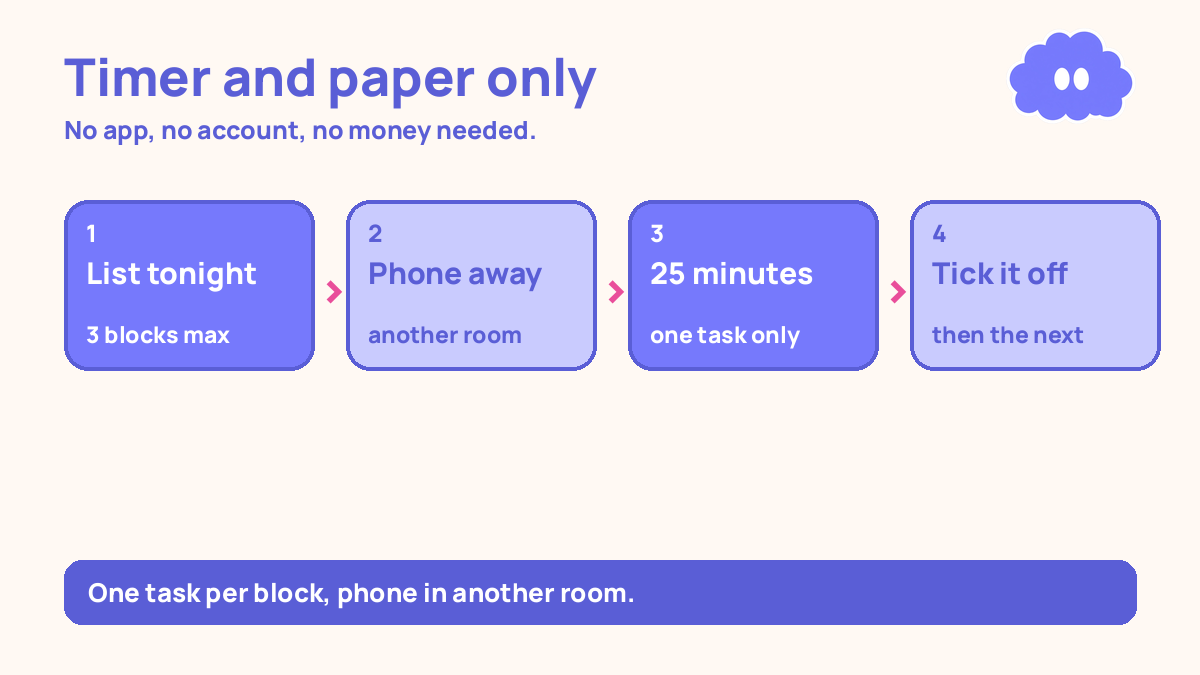
You do not need an app, an account, or any money to study properly. You need a free timer, a sheet of paper, and a pen. Write tomorrow’s tasks on the paper the night before, one task per block, three blocks maximum. When a block starts, put your phone in another room, set the timer for 25 minutes, work on one task until it rings, take a 5-minute break, and tick the block off. That is the whole system.
This article is for the student who has nothing fancy. No study app subscription, no tablet, no second screen, no quiet desk of their own. Just a phone, a pen, and a sheet of paper — and the feeling that everyone else has a better system than you do. They do not. Most study apps sell you a timer, a to-do list, and a streak counter. A phone timer and a piece of paper already do all three, and they do it without notifications, without an account, and without asking for money.
The hard part of studying is not the tool. It is starting, staying on one task, and stopping at a sensible point instead of drifting. A timer handles the starting and the stopping. A paper list handles the staying on one task. The phone in another room handles the drifting. Nothing in this system needs to be bought, downloaded, or signed up for, and nothing here depends on your internet working.
The system in short
- The night before, write tomorrow’s tasks on paper — one task per block, three blocks maximum to start.
- Write one if-then plan for starting the first block.
- When a block starts, put your phone in another room and set the timer for 25 minutes.
- Work on one task only until the timer rings, then take a 5-minute break.
- Tick the block off on the paper. Repeat for the next block.
- At the end of the day, move unfinished tasks to tomorrow’s list and write tomorrow’s list before bed.
Step 1: Write tomorrow’s list tonight, on paper
The list is written the night before, not in the morning. That is the whole point. If you wake up and have to decide what to study, you will spend the first twenty minutes deciding, checking your phone, and deciding again. A list written the night before means the decision is already made. You sit down, look at the paper, and start.
Take a sheet of paper and write the date at the top. Then write the tasks, one per line, as single jobs you can actually finish in one block. “Revise biology” is not a task. “Write out the photosynthesis diagram from memory, then check it” is a task. “Do chemistry” is not a task. “Answer ten questions on moles from the textbook, notes closed” is a task. If a task does not fit in one block, it is two tasks — split it now, on the paper, not halfway through the block.
Three blocks is the starting limit. That is about an hour and a half of real work, with breaks. It sounds small, and that is deliberate. A list of three tasks you finish is a good day. A list of eight tasks you abandon by the second one is a bad day that also makes you feel like a failure. You can add a fourth block later, once three blocks a week feels easy. Do not add it in week one.
Leave one empty line at the bottom of the list for the if-then plan. That is the next step.
Step 2: Write one if-then plan for starting
Starting is the hardest part of the day, and it is the part most systems ignore. You can have a perfect list and still sit on your bed for an hour, because starting needs a decision, and decisions are easy to put off.
So write one if-then plan on the paper, under the list. It names the cue and the action in advance: “If I finish breakfast, then I sit at the table, put my phone in the kitchen, and start block one.” Or: “If the 4 o’clock prayer is done, then I open the textbook to page 42 and start the timer.” The cue can be anything that already happens every day — a meal, a prayer, coming home, a younger sibling going to bed. The point is that the cue is already in your day, so you do not have to invent a new habit to trigger it.
This is not just a trick. Across 94 studies, if-then plans raised goal attainment by a medium-to-large amount over holding the goal alone (Gollwitzer & Sheeran, 2006). The plan works because the decision is made in advance, when you are calm and planning, instead of in the moment, when you are tired and the phone is right there.
Write only one if-then plan, for the first block. The first block is the only one that needs a push. Once the first block is done and ticked off, the second block starts itself — you are already sitting there, the paper is already in front of you, and the next task is already written down.
One warning about the plan: do not write it as a wish. “If I feel motivated, then I will study” is not a plan, because feeling motivated is not a cue you can count on. A daily study habit takes weeks to feel automatic — in one study of 96 people, the median time for a new daily behaviour to feel automatic was 66 days, with a range of 18 to 254 days, and missing a single day did not measurably hurt (Lally et al., 2010). Sixty-six days is the middle of a wide distribution, not a rule or a deadline, and “21 days” is not from this study or any study. Your system has to work before it feels automatic. The if-then plan is what carries it until then.
Step 3: Phone in another room, timer on
When the first block starts, take your phone to another room and leave it there. Not face down on the desk. Not on silent in your pocket. Another room.
The honest position is that the evidence here is mixed. One study found that a phone on the desk cost people focus even when it was switched off (Ward et al., 2017), but a pre-registered replication found no effect (Ruiz Pardo & Minda, 2022). So “phone in another room” is presented here as a practical system, not a proven fact. The practical case is simple enough on its own: a phone in another room cannot buzz, light up, or tempt you to check “just one message”, and walking to another room to check it is enough effort that you will usually decide not to bother. A phone face down on the desk costs you nothing to check. A phone in the kitchen costs you a walk.
If you live in one room and there is no “another room”, put the phone in a bag, in a drawer, or behind something — anywhere you cannot see it and cannot reach it without standing up. The rule is distance and effort, not the specific room.
Now set the timer. Twenty-five minutes of work, five minutes of break. That is the classic Pomodoro cycle, from the Pomodoro Technique — Francesco Cirillo, a university student in the late 1980s, who used a tomato-shaped kitchen timer. The 25-minute length was Cirillo’s practical choice, not a number derived from cognitive science, and this article says so plainly. Twenty-five minutes is a good starting length because it is short enough to start and long enough to do real work. It is not a law of the brain. The full pomodoro technique for students system explains the cycle in detail, including the longer break after four blocks.
Use whatever timer you already have. The timer on your phone works, but if the phone is in another room, you need a different timer — a kitchen timer, a cheap digital timer, a watch with an alarm, or the timer on a family member’s phone. If you have none of those, use a clock: start at a time you can remember, like 4:00, and stop at 4:25. The timer is not the system. The timer is a bell that tells you when to stop.
Step 4: One task, one block, until the timer rings
When the timer starts, work on the one task written on the paper for that block. Not two tasks. Not the task plus a quick check of something else. One task.
This matters because switching between tasks costs time on every switch. In four experiments, people lost time on every switch between tasks, and lost more as the tasks got more complex or less familiar — mean switch costs were 614 to 1,096 milliseconds per switch (Rubinstein, Meyer & Evans, 2001). A second here and a second there sounds small, but the real cost is not the second. It is the thread you lose each time you switch: where you were in the problem, what you were about to write, which step comes next. Every switch means re-finding your place, and that is where the minutes go. One task per block is how you pay that cost once, at the start, instead of paying it all afternoon.
If a thought about something else comes up during the block — an errand, a message you need to send, a topic you forgot to add to the list — write it on the paper, in the margin, and keep going. The paper is allowed to hold the thought so your head does not have to. Do not act on it until the break.
When the timer rings, stop. Even in the middle of a task. Especially in the middle of a task. Stopping mid-task feels wrong, and it is the most useful habit in this system, because a half-finished task is the easiest thing in the world to restart. Before you stand up, write one short note on the paper: the next step, or the sentence you were about to write. “Next: check the answer to question 7.” “Next sentence: the light reactions happen in the thylakoid.” That note is your starting point for the next block, and it means the next block starts with work, not with five minutes of figuring out where you left off.
Then take the break. Five minutes. Stand up, stretch, get water, look out of the window. Do not pick up your phone during the break — the phone is in another room, and the break is five minutes, not a scrolling session. If you check your phone in the break, the break becomes twenty minutes and the next block never starts. The break is for resting your eyes and your head, not for catching up on messages. The messages will still be there after three blocks.
Step 5: Tick it off, then the next block
When the timer rings and the break is over, tick the block off on the paper. A pen tick on a paper list is the whole reward system. There is no streak counter, no badge, no app telling you that you did well. The tick is enough, because the tick is visible: by the end of the day, the paper shows what you did, and a paper with three ticks on it is a day that worked.
Then start the next block the same way. Phone stays in the other room. Timer on, 25 minutes. One task. Tick it off. If you finish a task before the timer rings, do not start the next task early — use the remaining minutes to test yourself on what you just did, notes closed, or to re-read the one part you got wrong. Starting the next task early breaks the rhythm and turns the list into a race. The block is the unit, not the task.
After four blocks, take a longer break — fifteen to thirty minutes. That is the classic cycle: 25 minutes of work, 5 minutes of break, and a longer break after four blocks. If you are only doing three blocks a day, you will not reach the longer break most days, and that is fine. Three blocks with two short breaks is a complete day under this system.
Step 6: Fifty-minute blocks, for longer tasks
Once 25-minute blocks feel easy — usually after a week or two of three blocks a day — some tasks will start to feel cramped. Writing an essay plan, working through a long set of maths problems, or reading a dense chapter does not fit neatly into 25 minutes, and stopping every 25 minutes to write a restart note starts to feel like more stopping than working.
That is when you try 50-minute blocks, with a 10-minute break. Fifty minutes is simply two 25-minute blocks joined together, and it suits longer tasks that need a run-up before they get going. The rule is the same: one task per block, phone in another room, stop when the timer rings, tick it off. The only thing that changes is the length. The full system for longer blocks is in how to study in 50-minute blocks.
Do not start with 50-minute blocks. Start with 25, because 25 is easier to start, and starting is the hard part. Move to 50 when 25 feels too short, not when 25 feels too hard. If 50 minutes feels too long and you keep drifting in the second half, go back to 25. There is no prize for longer blocks. There is only the work you actually did, and the block length that gets you to do it.
A useful rule for choosing: if the task is mostly reading or mostly writing, try 50. If the task is mostly testing yourself — questions, flashcards, problems — 25 is usually enough, because testing in short bursts with a gap between them is where the learning happens. And if you are not sure, use 25. You can always do another block.
A worked example: Ayesha, three blocks, one evening
This is a worked example, with the article’s own numbers — not a real student, and not a promise of a grade.
Ayesha is in her second year, studying at home in a shared room. She has no money for a study app, no tablet, and one phone that she shares with her family in the evenings. She has a pen, a notebook, and the timer on the kitchen clock. Tomorrow she has a chemistry test on moles and a biology chapter on photosynthesis to finish, and she keeps putting both off.
The night before, she writes tomorrow’s list in the notebook:
- Answer ten questions on moles, textbook page 88, notes closed, then check.
- Write out the photosynthesis diagram from memory, then check it against the book.
- Re-do the five mole questions I got wrong yesterday.
Three blocks. Three tasks. Under the list she writes her if-then plan: “If I finish dinner, then I sit at the table, put my phone in the kitchen, and start block one.”
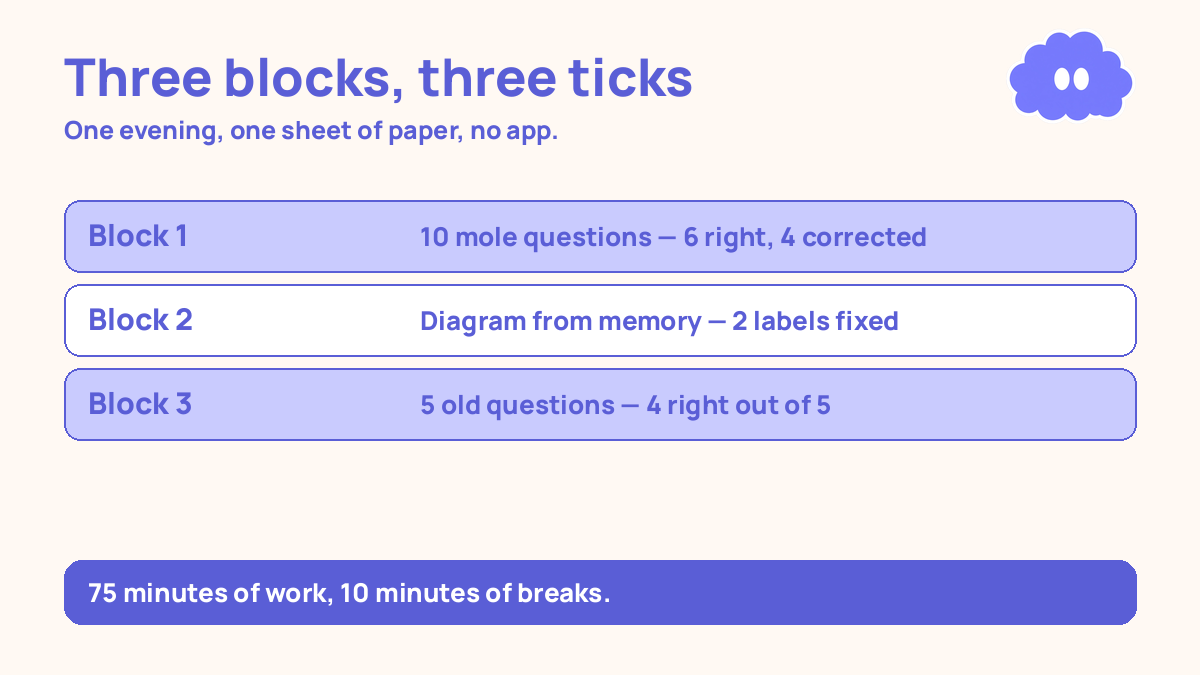
The next evening, after dinner, she sits at the table and puts her phone in the kitchen. She sets the kitchen timer for 25 minutes and starts block one: ten mole questions, notes closed. She gets six right. She checks the four she got wrong, writes the correct working next to each one, and the timer rings. She writes one note — “Next: question 7, the one about molar mass” — and takes a five-minute break. She ticks block one off.
Block two: the photosynthesis diagram, from memory. She draws it, labels it, then checks it against the book. Two labels are wrong. She corrects them, the timer rings, she writes “Next: light reactions happen in the thylakoid”, takes her break, and ticks block two off.
Block three: the five mole questions from yesterday. This time she gets four right out of five. The timer rings. She ticks block three off. Three blocks, one hour and fifteen minutes of work, two five-minute breaks, and the paper shows three ticks.
| Block | Task | Timer | Result |
|---|---|---|---|
| Block 1 | Ten mole questions, notes closed | 25 min work, 5 min break | 6 right out of 10; 4 corrected |
| Block 2 | Photosynthesis diagram from memory | 25 min work, 5 min break | 2 labels wrong, corrected |
| Block 3 | Re-do yesterday’s five wrong mole questions | 25 min work, 5 min break | 4 right out of 5 |
| Total | Three tasks, one evening | 75 min work, 10 min break | 3 ticks on the paper |
Nothing in that evening needed an app, an account, or any money. The timer was the kitchen clock. The list was a notebook page. The phone was in the kitchen. The learning happened because the work was one task at a time, tested from memory, with the wrong answers corrected on the spot — not because of any tool.
When it goes wrong
The list is too long. You wrote eight tasks, finished one, and now the paper feels like proof you failed. Cut the list. Three blocks is the starting limit, and it is a limit, not a minimum. Cross out the extra tasks, move them to tomorrow, and finish the three that are left. A short list you finish beats a long list you abandon, every time.
A block gets interrupted. Someone needs you, the power goes out, a family member calls you away. Stop the timer, write your restart note — the next step, the sentence you were about to write — and deal with the interruption. When you come back, restart the timer from the beginning of a fresh 25 minutes if you were interrupted early, or finish the remaining minutes if you were nearly done. Do not try to “make up” the lost time by skipping the break. The break is part of the system.
The timer rings mid-task and you want to keep going. You are in the middle of a good run and stopping feels wasteful. Stop anyway, write the restart note, and take the break. The note means the next block starts exactly where this one stopped, and the break means you come back fresh instead of grinding through tired. If the task truly needs a longer run, that is what 50-minute blocks are for — switch to them tomorrow, not mid-block today.
You keep checking your phone. The phone is in another room and you still walk over to check it. That is normal in the first week. Make the walk longer: put the phone in a bag, in a drawer, or with a family member. And shrink the block: if 25 minutes without the phone feels impossible, do 15-minute blocks for a few days, then build back up. The block length is a practical choice, not a law. The habit that matters is the phone staying away for the whole block.
You miss a day. You miss one day, then two, and the paper stays blank. Missing a single day does not measurably hurt a new habit — that is what the Lally study found — so the damage is not the missed day, it is the story you tell yourself about it. Do not do a double day to catch up. Write tomorrow’s list tonight, three blocks, one if-then plan, and start again. The system is still there. The paper is still there.
You finish all three blocks and feel like you did nothing. Three blocks is about an hour and a half of real work. It will feel small compared with a classmate who claims to study six hours a day. Most of those six hours are switching, scrolling, and re-reading. Your hour and a half was one task at a time, tested from memory, with wrong answers corrected. That is more real study than most six-hour days contain. Count the ticks, not the hours.
Weekly review checklist
Copy this list and use it once a week:
- How many days this week did I finish all three blocks, and what got in the way on the days I did not?
- Which block length did I actually use — 25 minutes, or did I try 50 — and which one got more ticks?
- Did my if-then plan work, or do I need a different cue that already happens every day?
- What is the one change I will make next week: a shorter list, a different starting cue, longer blocks, or the phone further away?
Downloadable infographic spec: one vertical image, title “Study with a free timer and paper only”, with the six steps — write tomorrow’s list tonight, one if-then plan, phone in another room, one task per 25-minute block, tick it off, try 50-minute blocks for longer tasks — and the rule “one task, one block, phone in another room” in Thynq cream, Cloud Purple, Dark Purple and pink, with the cloud mascot. Text taken word-for-word from this article.
What this system is not
It is not a promise of better grades, and it is not a claim that a timer and a piece of paper will fix a subject you have not studied. A timer does not teach you chemistry. It gives you a way to sit down, stay on one task, and stop at a sensible point — and to do that again tomorrow. The learning still comes from the work inside the blocks: testing yourself, getting things wrong, and correcting them.
It is also not a claim that phones ruin focus, or that 25 minutes is the scientifically correct block length, or that a habit forms in 21 days. The evidence on phones is mixed, 25 minutes was a practical choice by one student with a kitchen timer, and habits take a median of 66 days with a very wide range. This system is honest about what it is: a free, practical way to study with what you already have in your hand, measured by ticks on a piece of paper.
Sources
- Cirillo, F. (n.d.). The Pomodoro Technique. Francesco Cirillo, a university student in the late 1980s, used a tomato-shaped kitchen timer. The classic cycle is 25 minutes of work, 5 minutes of break, and a longer break after four blocks. The 25-minute length was Cirillo’s practical choice, not a number derived from cognitive science.
- Rubinstein, J. S., Meyer, D. E., & Evans, J. E. (2001). Journal of Experimental Psychology: Human Perception and Performance, 27(4), 763-797. In four experiments, people lost time on every switch between tasks, and lost more as tasks got more complex or less familiar. Mean switch costs were 614 to 1,096 milliseconds per switch.
- Lally, P., et al. (2010). European Journal of Social Psychology, 40(6), 998-1009. Ninety-six people tracked one new daily behaviour for 12 weeks; the median time for it to feel automatic was 66 days, range 18 to 254 days. Missing a single day did not measurably hurt.
- Gollwitzer, P. M. & Sheeran, P. (2006). Advances in Experimental Social Psychology, 38, 69-119. Across 94 studies, if-then plans raised goal attainment by a medium-to-large amount (d = 0.65) over holding the goal alone.
- Ward, A. F., et al. (2017). Psychological Science, 28(4), 480-491. Found a phone on the desk cost focus even when switched off.
- Ruiz Pardo, A. & Minda, J. P. (2022). Pre-registered replication of Ward et al. (2017) that found no effect. The evidence on phones and focus is mixed, so “phone in another room” is presented in this article as a practical system, not a proven fact.
For the full timer system this fits inside, read pomodoro technique for students, and for longer tasks, read how to study in 50-minute blocks.
Questions
What do I need to start this system?
A phone timer or a kitchen timer, a sheet of paper, and a pen. Nothing else. No app, no account, no money. Write tomorrow’s tasks on the paper the night before, put the phone in another room while you work, and tick each block off when the timer rings.
How long should each study block be?
Start with 25 minutes of work and a 5-minute break. That is the classic Pomodoro cycle, and the 25-minute length was Francesco Cirillo’s practical choice, not a number from cognitive science. If 25 minutes feels too short once you are used to it, try 50-minute blocks with a 10-minute break instead.
What do I do when the timer rings in the middle of a task?
Stop when the timer rings, even mid-task. Write one short note on your paper — the next step, or the sentence you were about to write — then take the break. When you sit back down, that note tells you exactly where to start, so no time is lost finding your place.
What if my list has more tasks than I can finish in a day?
That is normal, and it is not a failure. Three blocks is the starting limit for a reason. Move the unfinished tasks to tomorrow’s list, pick the one that matters most, and make that the first block of the next day. A short list you finish beats a long list you abandon.