The direct answer
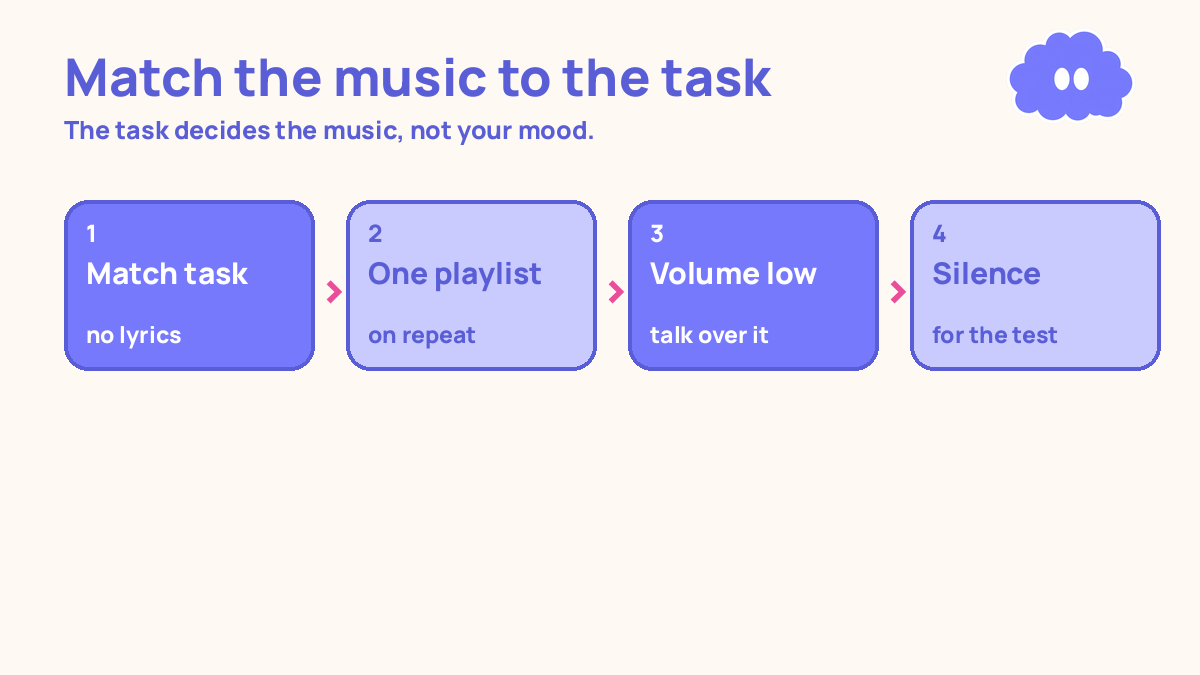
Focus music and study what to play comes down to one rule: match the music to the task. No lyrics for reading and writing, familiar music for routine work, and silence when you test yourself. That is the whole system. Music is not good or bad for studying. It is a tool that fits some tasks and fights others, and the test is always the same: what do you remember the next morning?
You need a simple rule for what plays, when it plays, and when it stops — and a one-week test to find out what actually works for you.
The playlist that eats the study session
You put on a playlist to focus. Ten minutes later you are choosing the next song. Then you are listening to the lyrics. An hour passes, the playlist was great, and the chapter is still on page one.
The problem is not the music. The problem is that new music, loud music, and music with words all demand attention, and attention is the thing you were trying to spend on studying. Every time the song changes, your brain checks the new song. That is switching, and switching costs you.
In four experiments, Rubinstein, Meyer and Evans (2001) found that people lost between 614 and 1,096 milliseconds on every switch between tasks. A playlist that changes songs every three minutes is a switch every three minutes. A familiar playlist on repeat is not — your brain already knows what is coming.
One honest limit: the research base for this series does not include a study on music and studying, so nothing here is presented as a research finding. The system below is practical: rules to try, and a one-week test to find out what works for you.
The system in short
- Match the music to the task: no lyrics for reading and writing, familiar music for routine work, silence for testing yourself.
- Use one familiar playlist on repeat. No new music while studying, no choosing songs mid-block.
- Keep the volume low. If you can hear every word, it is too loud.
- Music on for learning, music off for testing. The test is the honest check.
- If you notice the music, turn it off. Noticed music is not background music.
Focus music and study what to play for each task
The task decides the music, not your mood and not your “type”. Pashler and colleagues (2008) reviewed the evidence for learning styles and found no adequate evidence that matching teaching to a student’s type improves learning. People have preferences — those are real — but the matching claim is not supported. What decides the music is the task.
Reading a new chapter: no lyrics. Words compete with words, and a new chapter is already full of words you have not met. Play instrumental music, lo-fi, or white noise — or nothing at all. If you find yourself following the melody, turn it off.
Writing an essay or a draft: no lyrics, and probably no music. Writing is putting words in order, and lyrics are words in someone else’s order. Most students write better in silence or with steady instrumental sound. Try both for a week and compare what you wrote.
Routine problems you already know how to do: familiar music is fine, lyrics included, as long as it is music you have heard a hundred times. The work is procedural — you know the steps — so the music is decoration, not competition. Keep the volume low.
Testing yourself: silence. Always silence. The test is the honest check of what you remember, and music during the test muddies the check. If you test with music on, you will not know whether you remembered the material or leaned on the mood.
Reviewing notes or organising: anything you like, because the work is light. When the noise is not music but the house itself, the focus system for noisy environments covers earplugs, timing, and choosing what to study there.
Step 1: Build one familiar playlist
Pick one playlist and use it for every study session for a week. Not a new playlist each day — the same one, on repeat. It should be music you already know well: lo-fi, classical, ambient, or songs you have heard a hundred times. No new releases.
Familiar music fades into the background because your brain already knows what is coming. New music does the opposite.
Keep the playlist long — at least 90 minutes — so it does not loop awkwardly mid-block.
Step 2: Set the volume low and the rules clear
Set the volume low enough that you could hold a conversation over it. If you can hear every word of the lyrics, it is too loud. Low volume is the difference between background and foreground.
Then set the rules before you start the block, not during it. Write them on the plan: “Music on for Block 1, off for the test.” “No choosing songs during a block.” “If I notice the music, it goes off.” Rules decided in advance are rules you follow.
If you study in a noisy room — a shared house, a busy library, a family home — headphones do two jobs at once: they play the music and they block the room. In that case the music is also ear protection, and it earns its place even for harder tasks. The deep work system for students covers the noisy-room problem in full, including when to leave the room entirely.
Step 3: Music on for learning, off for testing
Here is the rhythm: music on while you learn, music off while you test. Read the chapter with lo-fi on. Then turn it off, close the book, and write down what you remember. Then check.
The test matters because it is the only honest check. Dunlosky and colleagues (2013) rated practice testing as one of only two high-utility techniques in their review of ten common study techniques — the other was distributed practice. Testing yourself with music on is a weaker test, because the music was part of the learning and it will not be there in the exam. Test in silence, and the result tells you what you actually know.
Step 4: When to stop — the notice test
The rule for when to stop is simple: if you notice the music, turn it off. Noticed music is not background music. If you are following the lyrics, choosing the next song, or thinking about the playlist, the music has stopped being background and started being the task. Turn it off and work in silence for the rest of the block.
Other stop signs: you have changed the song three times in one block; you are listening to a new album; the volume keeps creeping up; you finished the block and cannot say what you studied. Any one of these means the music is running the session. Turn it off.
Stopping is not failure. It is the system working. Some days the music helps. Some days it does not. The notice test tells you which day it is.
A worked example: a Wednesday afternoon with music
You have three hours in the afternoon. Your tasks: read a new chapter, work through five problems, and test yourself on yesterday’s topic.
2:00–2:50pm — Block 1, music on: Read the new chapter with your familiar lo-fi playlist on, low volume. No lyrics. When the chapter ends, close the book. 2:50–3:00pm — Break: Stand up, water, window. Playlist stays on. 3:00–3:50pm — Block 2, music on: Work through the five problems with the same playlist. Three right, two wrong. Redo the two wrong ones slowly. 3:50–4:00pm — Break: Stretch, water. Turn the music off. 4:00–4:50pm — Block 3, silence: Test yourself on yesterday’s topic. Close the notes, write from memory, then check. 4:50–5:00pm — Close: Write down what you remembered and what you missed. The missed one goes on tomorrow’s list. Music stays off.
| Task | Music | Why |
|---|---|---|
| Read new chapter | Lo-fi, no lyrics, low | Words compete with words |
| Routine problems | Same playlist, low | Familiar, procedural work |
| Test yourself | Silence | Honest check, no mood to lean on |
| Organise notes | Anything you like | Light work, no harm |
The one-week test
Do not take this article’s word for what works. Test it. One week with music, one week without, and compare the same measure: the 10-minute morning recall check. Each morning, close your notes and write down what you remember from yesterday.
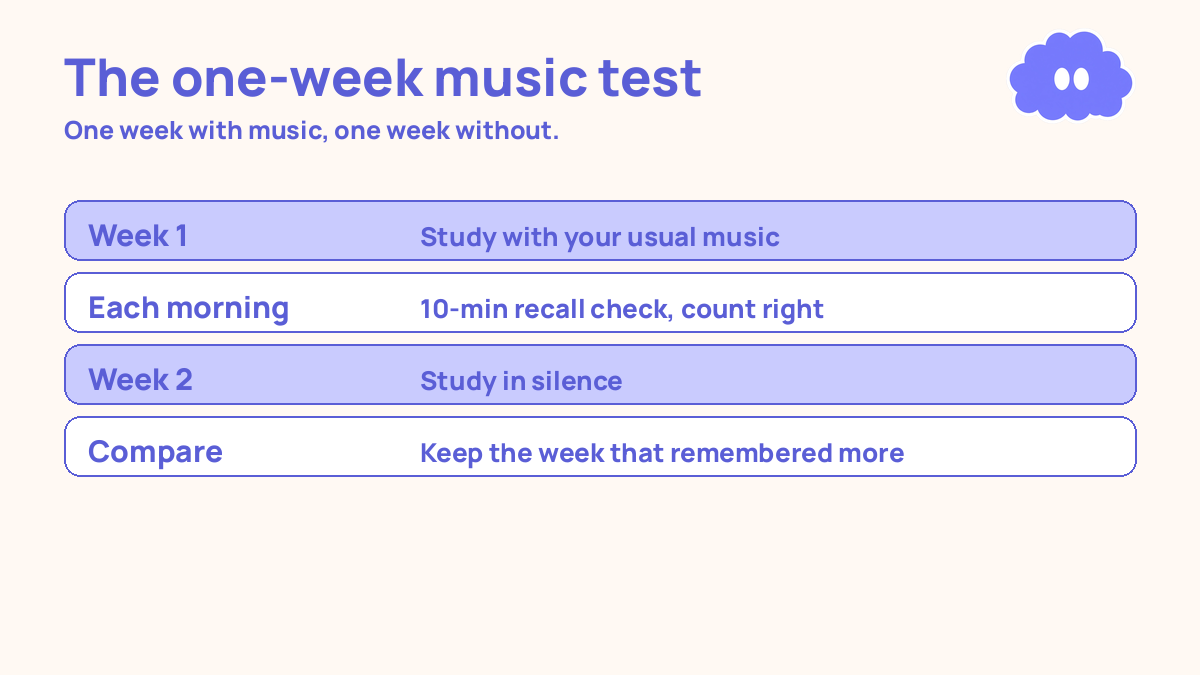
Week one: study with your usual music. Week two: study in silence. Same topics, same blocks, same morning check. At the end of week two, compare the two counts. If the music week remembered more, keep the music. If the silence week remembered more, drop the music. If they are the same, keep whichever you enjoy more — enjoyment is a real reason to keep a habit, as long as the recall is the same.
This test is honest in a way that feelings are not. Music feels like it helps, because studying with music feels better than studying in silence. Feeling better is not the same as remembering more. The morning check is the only number that matters.
When it goes wrong
You keep choosing songs instead of studying. The playlist is too new or too short. Build one familiar playlist of at least 90 minutes and use it for a week. No choosing songs during a block.
Lyrics keep pulling you in. Switch to instrumental music, lo-fi, or white noise for reading and writing. Keep the lyrics for routine work only.
You test yourself with music on and feel confident. Confidence during a music-assisted test is not the same as remembering. Test in silence.
Silence feels unbearable. That is usually a noisy room, not a music problem. Headphones with white noise, or a quieter room, fix it better than a playlist.
Weekly review checklist
Copy this list and use it each week:
- What did I play this week — and for which tasks?
- How many blocks did I notice the music in, and what did I do?
- What did the morning recall check say: music week or silence week?
- What one change will I make next week: a familiar playlist, lower volume, or silence for tests?
Downloadable infographic spec: one vertical image, title “Match the music to the task”, with the five rules — no lyrics for reading, familiar music for routine work, silence for testing, one playlist on repeat, if you notice it turn it off — and the one-week test, in Thynq cream, Cloud Purple, Dark Purple and pink, with the cloud mascot. Text taken word-for-word from this article.
What this system is not
It is not a research claim that music helps or hurts studying — the research base for this series does not include a music study. It is a practical system: match the music to the task, use one familiar playlist, keep the volume low, test in silence, and run the one-week test. If the test says silence wins, the music goes.
Sources
- Rubinstein, J. S., Meyer, D. E. & Evans, J. E. (2001). Executive control of cognitive processes in task switching. Journal of Experimental Psychology: Human Perception and Performance, 27(4), 763-797. Mean switch costs were 614 to 1,096 milliseconds per switch.
- Pashler, H., McDaniel, M., Rohrer, D. & Bjork, R. (2008). Learning styles: concepts and evidence. Psychological Science in the Public Interest, 9(3), 105-119. No adequate evidence for the meshing hypothesis; preferences are real, the matching claim is not supported.
- Dunlosky, J., et al. (2013). Improving students’ learning with effective learning techniques. Psychological Science in the Public Interest, 14(1), 4-58. Only practice testing and distributed practice received a high utility rating; rereading was rated low.
For the noisy-room problem, read the deep work system for students, and for the phone part, the phone focus system for distracted students.
Questions
Is it better to study in silence or with music?
It depends on the task. Silence is best for testing yourself and for new, hard material. Familiar music with no lyrics can work for routine work. The honest answer is to test it: one week with music, one week without, and compare your morning recall.
Does music with lyrics hurt studying?
For reading and writing, lyrics usually get in the way, because words compete with words. For routine problems you already know how to do, lyrics matter less. Try both and check what you actually remember the next morning.
What about lo-fi or white noise?
Both are practical choices, not research prescriptions. Lo-fi and white noise work for many students because they are steady and familiar, so they fade into the background. If you notice the sound, it is not in the background.
Should I wear headphones or play music out loud?
Headphones help in a noisy room, because they block the room. Out loud is fine in a quiet room. The rule is the same either way: low volume, no new music, and off when you test yourself.