The direct answer
Use YouTube as a tutor, not a distraction: name the one stuck topic as a single question, pick one short video that answers it, watch it once with the question written down, close YouTube, and test yourself from memory. If you cannot answer the question with the notes closed, the video did not teach you yet.
You are stuck on one thing — osmosis, or balancing equations, or one step in a maths problem — and you open YouTube to understand it. The video is good. Then the next video starts by itself, and it looks useful too. An hour later you have watched a lot, learned very little, and the one thing you were stuck on is still stuck.
The problem is not YouTube. YouTube has some of the best free explanations a student can find. The problem is that YouTube is built to keep you watching, and your plan was only “understand this topic”. A plan that vague has no finish line. This system gives you one before you press play: one question, one video, one test.
This is different from how to study from YouTube properly, which is for watching whole lectures and turning them into notes. This one is smaller: one stuck topic, one video, then a test from memory.
The system in short
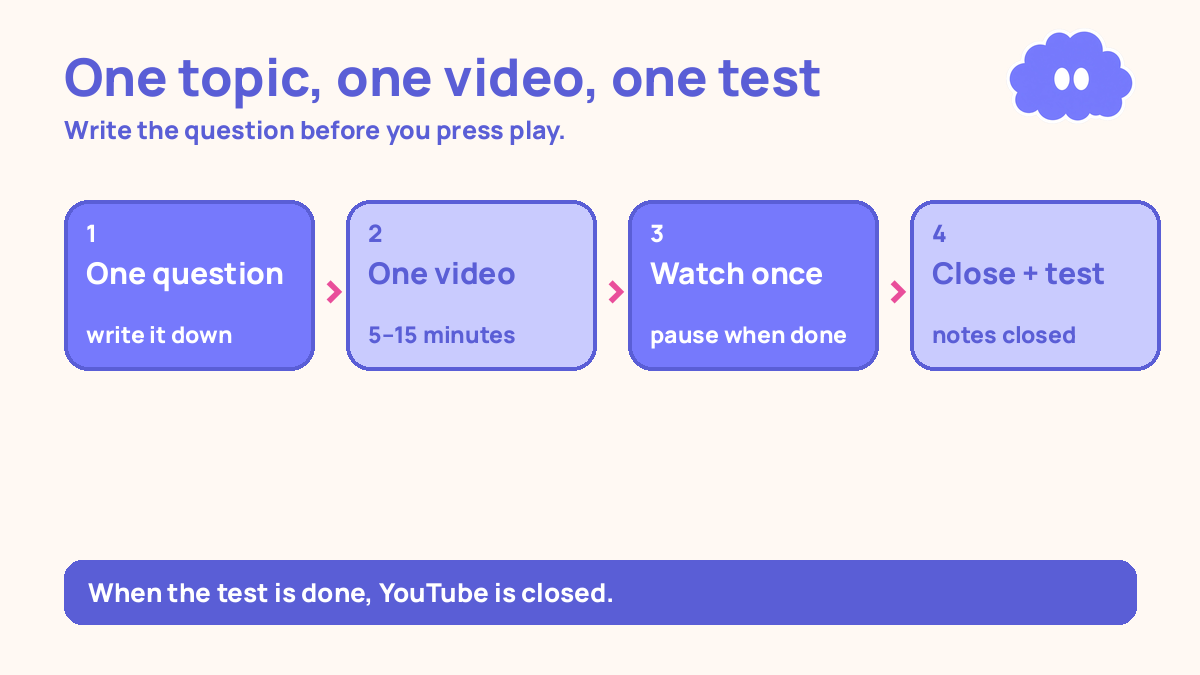
- Name the stuck topic as one question, written down.
- Pick one video that answers that question, before you press play.
- Watch it once, with the question in front of you, and pause when you have the answer.
- Close YouTube and test yourself from memory, notes closed.
- Re-test on day 1, day 3, and day 7; re-watch only if the test fails.
Step 1: Name the stuck topic as one question
Do not open YouTube until you can write the stuck topic as one question on one line. “Osmosis” is not a question — “Why does water move into a root hair cell?” is, and it tells you exactly what the video has to explain. “Balancing equations” is not a question — “How do I balance the equation for burning methane?” is.
If you cannot write the question, you are not ready to search yet. Spend two minutes with your notes first: read the part you do understand, and find the exact line where it stops making sense. That line is the question.
Write the question on paper and keep it where you can see it while you watch — it is also the test later. If the topic is bigger than one question, split it: “Photosynthesis” becomes “what happens in the light-dependent stage?” and “where does the oxygen come from?”
Step 2: Pick one video, before you press play
Search for your question, not for the topic. Then pick one video and commit to it before you press play. A good pick is short — usually 5 to 15 minutes for one question — and it is about your question, not about the whole chapter. A video called “osmosis in 10 minutes” beats a 50-minute “cell biology full course”.
Do not open three tabs to compare — comparing videos is watching in disguise. Pick the one that looks clearest and let the test decide whether it worked. If the test fails, pick a different video next time, with a better question.
Turn autoplay off before you start. Autoplay is the part of YouTube that turns one video into an hour. Switching costs time: in four experiments, people lost time on every switch between tasks, and lost more as the tasks got more complex (Rubinstein, Meyer & Evans, 2001). A new video is a new task, so turn autoplay off — when the video ends, the screen stops instead of choosing for you.
Step 3: Watch once, with the question in front of you
Watch once, with your written question in front of you. Your job is narrow: find the answer to that question, and nothing else. When the video gives you the answer, pause it. The video’s job is done when your question is answered.
If the video moves past your question, pause. The extra minutes are the drift starting — the video is a tutor you hired for one question, not a lecture you owe your full attention to.
Do not take notes while the video plays. Notes copied while watching are usually the video’s words. They feel like learning, and they are mostly copying. The real note comes after the video, from memory.
If the video does not answer your question, close it. Do not watch another twenty minutes hoping it will get there. Pick one more video, with a narrower question, and try again.
Step 4: Close YouTube and test yourself from memory
Close YouTube. Now answer your question with the notes closed, in your own words, out loud or on paper. No peeking, no replaying. If you cannot answer it, the video did not teach you — and that is useful: now you know the gap is real instead of finding out in the exam.
Testing yourself is not a way of checking what you learned. It is the learning. In a 2013 review, Dunlosky and colleagues rated ten common study techniques, and only two received a high utility rating: practice testing and distributed practice. Re-reading was rated low. Watching a video is closer to re-reading than to testing — it feels fluent, and fluency feels like learning. In one study, students who recalled a passage remembered more a week later than students who restudied it, though the restudiers felt more confident right after studying (Roediger & Karpicke, 2006).
So the test is the study. Write your answer, then check it against your notes or the video. Across 61 studies, testing yourself beat restudying by a medium amount, and the advantage was larger with feedback than without it (Rowland, 2014). A test without checking is only half a test. Check the answer, mark what you missed, and write the corrected answer once, in your own words. That corrected answer is your note.
If you got it right, you are done with this topic for today — do not watch a second video “to be sure”. Being sure is what the test was for. If you got it wrong, re-watch only the part that answers the question, then test yourself again.
The same rule keeps AI honest. An AI chat app can explain a topic in simple words, but it can also get things wrong and sound confident either way. Ask it one question, explain the answer back in your own words, and check it against your textbook. AI is for testing and explaining — it must not write the work for you, and it must not be trusted without checking.
Step 5: Re-test on day 1, day 3, and day 7
One right answer today does not mean you will remember it next week. Forgetting is steepest soon after learning, then flattens — measured by Ebbinghaus on himself, with meaningless syllables, so quote the shape, never a percentage as a law.
Test it tomorrow, then in three days, then in seven days. That 1-3-7 pattern is a practical starting schedule, not a research rule — the research says spacing beats massing, and the right gap grows with how long you need to remember the material (Cepeda et al., 2006). Each re-test takes two minutes. Get it right three times in a row and the topic is learned.
If a re-test fails, re-watch only the part that answers the question, test yourself again the next day, and keep the 1-3-7 pattern going. A failed re-test is the system working — it found the gap before the exam did. Keep a list of the questions you are testing, with the next test date next to each one.
A worked example: osmosis, one evening
This is a worked example, with the article’s own numbers — not a real student, and not a promise of a grade.
It is Tuesday evening, and you are stuck on osmosis. You write the question on paper — “Why does water move into a root hair cell?” — search for it, and pick a 9-minute video. Autoplay off, phone face down.
You watch once. At minute 6, the video explains that the root hair cell has a high concentration of salts, so water moves in by osmosis. You pause and close YouTube — you do not watch the last three minutes.
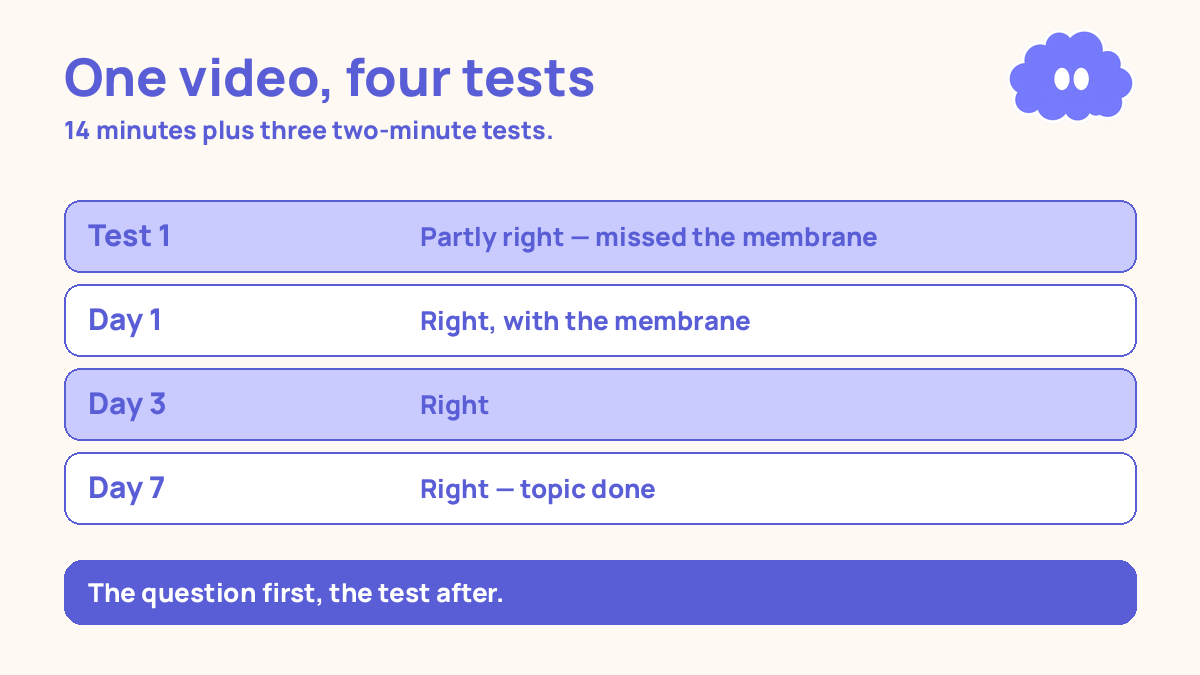
Now the test. Notes closed, you write: “Water moves into the root hair cell because the cell has more dissolved salts than the soil.” You check it against your notes and find you missed one part: the cell membrane lets water through. You write the corrected answer once. Total time so far: 14 minutes, including the video.
You test yourself again the next day and get it right. On Friday, day 3, right again. The following Tuesday, day 7, right again. Four tests, three of them right, and the topic is done.
| Test | When | Result |
|---|---|---|
| Test 1 | Tuesday, after the video | Partly right — missed the membrane |
| Test 2 | Wednesday, day 1 | Right, with the membrane |
| Test 3 | Friday, day 3 | Right |
| Test 4 | Next Tuesday, day 7 | Right |
Compare that with the old pattern: one hour of YouTube, three videos, no test, and the same question still unanswered on Wednesday. The new pattern took 14 minutes plus three two-minute tests. The difference is the question written down first, and the test after.
When it goes wrong
You open YouTube without a written question. The search becomes “osmosis” instead of one question, and every video looks relevant. Stop, close the app, write the question, and start again.
You watch the video twice “to be sure”. Being sure is what the test is for. Watching twice is mostly re-reading — test yourself instead.
You take notes during the video and never test yourself. Close the notes, answer the question from memory, and let the test decide whether you learned it.
Autoplay is still on. One video becomes three. Turn autoplay off before every session — it turns itself back on, and a new device or browser forgets your setting.
You use the system for a whole subject. A whole subject is a list of stuck topics, and you work through it one at a time. Sit down with no list and you will watch whatever looks interesting, and the stuck topics will still be stuck.
Weekly review checklist
Copy this list and use it each week:
- How many stuck topics did I clear this week?
- Did I write the question down before opening YouTube every time?
- Did I test myself after every video, notes closed?
- What one change will I make next week: narrower questions, autoplay off, or a shorter video?
Downloadable infographic spec: one vertical image, title “Use YouTube as a tutor, not a distraction”, with the five steps — one question, one video, watch once, close it and test yourself, re-test on day 1, 3, 7 — and the rule “one topic, one video, one test” in Thynq cream, Cloud Purple, Dark Purple and pink, with the cloud mascot. Text taken word-for-word from this article.
What this system is not
It is not a promise of a better grade, and it is not a claim that one video can teach a whole subject. It is not a ban on YouTube either — YouTube has some of the best free explanations a student can find. This system is a way to use that tutor for one question at a time, and to check with a test whether the answer stayed, instead of hoping it did.
Sources
- Dunlosky, J., et al. (2013). Psychological Science in the Public Interest, 14(1), 4-58. Only practice testing and distributed practice rated high utility; rereading rated low.
- Roediger, H. L., & Karpicke, J. D. (2006). Psychological Science, 17(3), 249-255. Retrieval practice beat restudying after a delay, despite restudiers feeling more confident immediately.
- Rowland, C. A. (2014). Psychological Bulletin, 140(6), 1432-1463. Across 61 studies, testing beat restudying, and the advantage was larger with feedback than without it.
- Cepeda, N. J., et al. (2006). Psychological Bulletin, 132(3), 354-380. Spaced practice beat massed practice, and the right gap grows with how long you need to remember the material.
- Rubinstein, J. S., Meyer, D. E. & Evans, J. E. (2001). Journal of Experimental Psychology: Human Perception and Performance, 27(4), 763-797. Every switch between tasks cost time, and the cost grew with complexity.
- Ebbinghaus, H. (1885). Über das Gedächtnis (On Memory). Forgetting was steepest soon after learning, then flattened — measured on himself, with meaningless syllables.
For watching whole lectures properly, read how to study from YouTube properly, and for the drifting itself, read how to stop procrastinating study.
Questions
How long should the video be?
Usually 5 to 15 minutes for one stuck topic. If the only good video is 40 minutes long, watch only the part that answers your question, then close YouTube.
What if the video does not answer my question?
Close it and pick one more video, with a narrower question. If two videos do not answer it, split the question in half and search for the first half.
Should I take notes while the video plays?
Write the answer in your own words after the video, not during it. The real note is the one you write from memory after you close YouTube.
Can I use this system for a whole subject?
No. One stuck topic at a time. A whole subject is a list of stuck topics — work through it one video at a time, testing each one.